

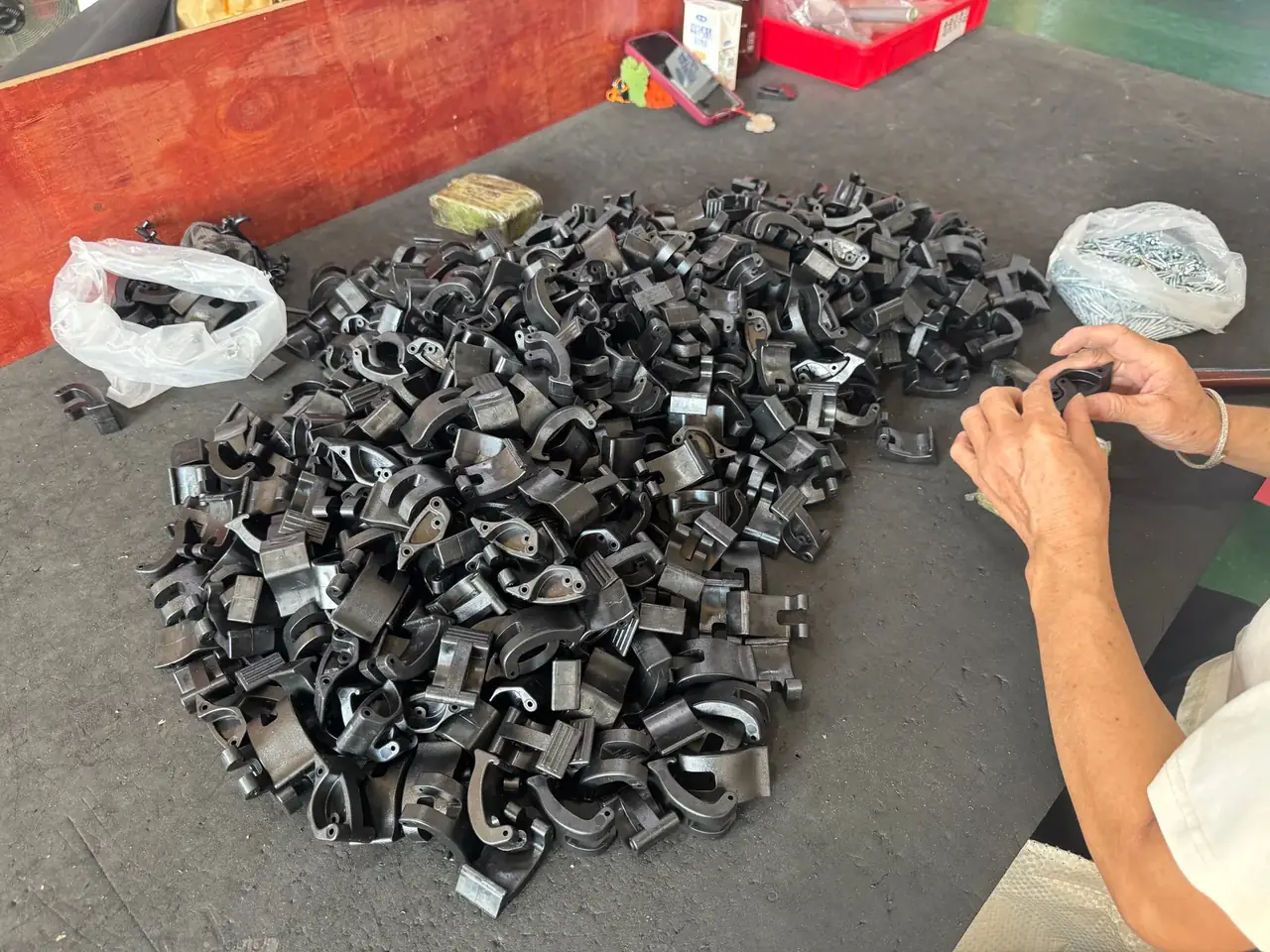
Quick answer: Medical ENT examination tool latch box sets one catch at 180 N and an 18 to 28 N release, in a 300 by 220 by 90 mm body with a 2.5 mm wall.
Table of contents
- Holding Force of One Moulded Catch
- Interference Against Release Force
- What Wear Looks Like After 5000 Cycles
- Compartment Layout in a 300 by 220 by 90 mm Body
- Tolerance Band and Rattle Suppression
- FAQ
1. Holding Force of One Moulded Catch
Close the lid and two sounds arrive: a light scrape as the hook rides the keeper lip, then a duller thud as the rim lands. The pause between them belongs to the 22 mm cantilever and the 4 by 2.5 mm root section.
The Medical ENT examination tool latch box puts 180 N in each catch, eight times the 22.5 N of a 2.3 kg loaded case. Two catches give 360 N, enough that a lid swung at 1.2 m does not let go. A third would push release from 18 to 28 N past 35 N, and a gloved nurse would need both hands.
| Catch feature | Load direction | Limit |
|---|---|---|
| Hook head | pull along the rim normal | 180 N without release |
| Hook root | bending at the stress riser | no crack in 5000 cycles |
| Keeper lip | rubbing against the hook | wear ≤0.08 mm |
The hook face is cut at 12 degrees, so pull turns part of the normal load sideways and the catch is pushed open before it lets go. A square face sends it all into the root.
2. Interference Against Release Force
Interference is the overlap between a free catch and the keeper lip. Spread 0.3 mm over a 22 mm cantilever and the root sees about 1.4 percent strain, still inside the linear POM curve, so the catch springs back. Past that the root yields, and a few dozen cycles leave a white mark.
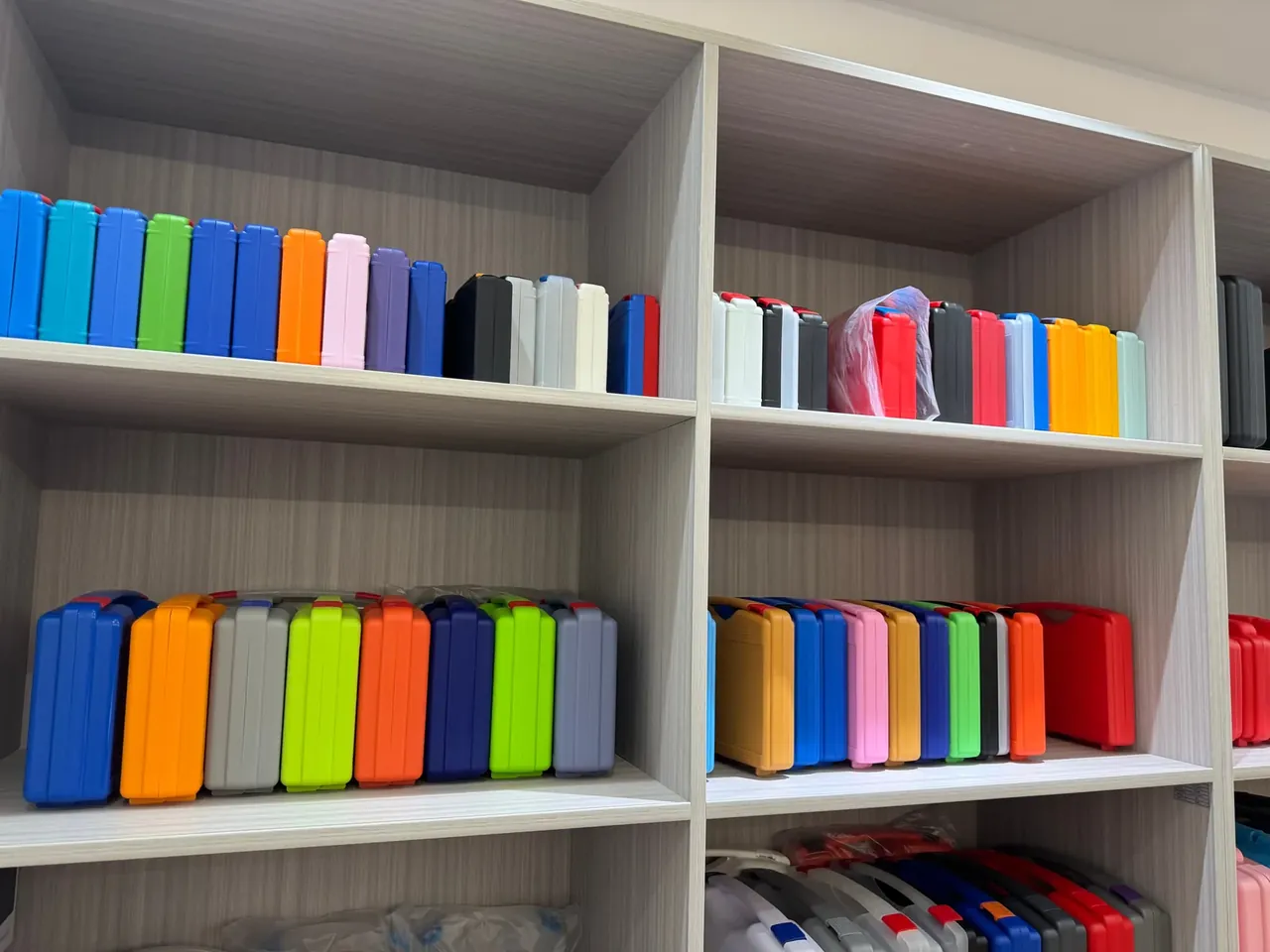
Release tracks interference almost in proportion. At 0.2 mm it falls to 12 to 18 N and a shaker table pops the lid open on its own; at 0.4 mm it climbs to 26 to 36 N and the thumb starts to work. The 18 to 28 N window carries about 10 percent either way, which is the spread between POM batches.
Once 0.3 mm is chosen, the Medical ENT examination tool latch box keeps that figure in the cavity dimensions, held by the tool and not by a fitter with a file. A filed catch keeps scratch marks, and a scratch at the root starts the first crack.
3. What Wear Looks Like After 5000 Cycles
The Medical ENT examination tool latch box runs 5000 cycles as 2 openings a day over 250 working days for ten years. The count runs at 25 ℃ and again at 55 ℃, because POM softens in the hot set and wear runs faster.
The Medical ENT examination tool latch box is judged on three lines: rubbing may not pass 0.08 mm, holding force may not fall below 126 N, and release may not drop under 15 N.
| Wear site | How it is read | Fail line |
|---|---|---|
| Hook nose | 20 times projector, nose radius | loss above 0.08 mm |
| Hook root | visual check for white marks | any visible crack |
| Keeper lip | feeler gauge across the joint | gap above 0.12 mm |
Wear is not even. The hook nose does most of the sliding and goes first; the lip carries load over the last 2 mm of travel and usually shows a third of the loss. The nose sets the fail line; 0.12 mm on the lip backstops it.
4. Compartment Layout in a 300 by 220 by 90 mm Body
Outside is 300 by 220 by 90 mm, inside is 270 by 190 by 70 mm, and the wall is 2.5 mm. The 15 mm per side holds the seal groove, the catch seats and two vertical ribs; the 20 mm of height splits between lid liner and base ribs. Empty 1.1 kg, load 1.2 kg, loaded 2.3 kg.
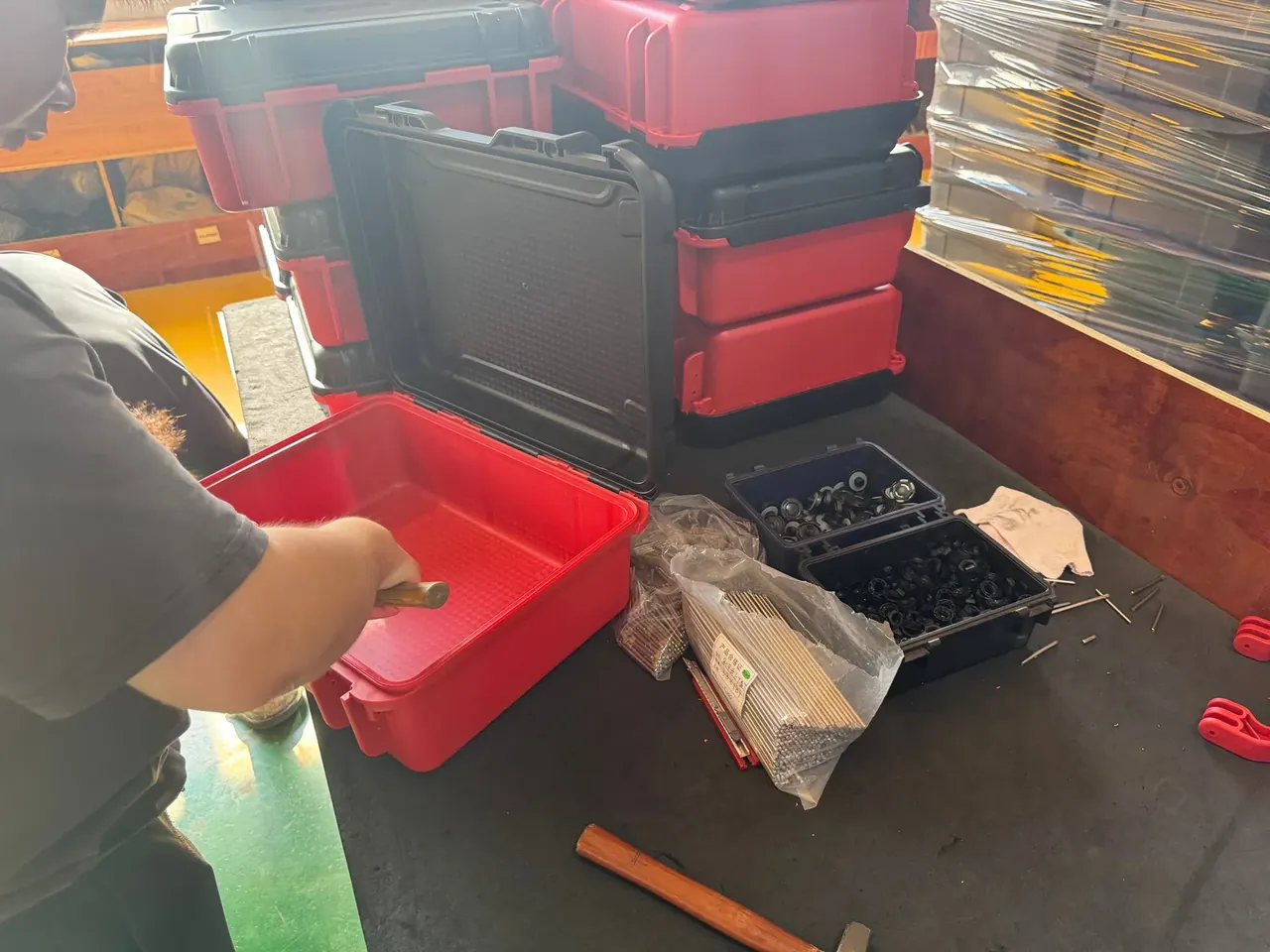
The Medical ENT examination tool latch box splits its cavity 3 by 2 into six cells, each 80 by 55 mm clear and 45 mm deep, with 3 mm ribs between. The two beside the handle go to 52 mm so a long-handled item has somewhere to sit; the four on the hinge side stay shallow so fingers need not reach the bottom.
A 2.5 mm wall is thin across a 270 mm span, so the Medical ENT examination tool latch box leans on two ribs to hold mid-span deflection under 0.6 mm. ABS shrinks 0.4 to 0.7 percent, up to 0.9 mm across 300 mm, so the tool is cut at the 0.55 percent midpoint.
5. Tolerance Band and Rattle Suppression
Rattle comes from clearance. Leave 0.1 mm between catch and keeper and the box hums in the 20 to 200 Hz band with a main tone near 30 Hz. Thickening the catch does not fix it; tightening the spread at the joint does.
The Medical ENT examination tool latch box holds ±0.15 mm between catch seat and keeper once the halves close on each other. Each half carries ±0.05 mm and the locating pins add 0.05 mm, which lands on 0.15 mm. Per-side clearance stays under 0.05 mm, the 0.3 mm interference always holds.
| Tolerance item | Nominal | Allowed shift |
|---|---|---|
| Catch seat centres | 96 mm | ±0.15 mm |
| Keeper lip height | 3.2 mm | ±0.15 mm |
| Rim flatness | 0 mm | within 0.2 mm |
A 0.2 mm bead on the contact face turns one broad contact into three short ones, and the pressure polishes the plastic quiet. A 2 h vibration check at 55 ℃ left a 0.6 mm wide mark with no drift. Working range is −10 ℃ to 55 ℃, and below that the POM turns brittle enough to push release past 30 N.
Conclusion
The Medical ENT examination tool latch box lives or dies on one part: a 180 N catch with 0.3 mm interference and an 18 to 28 N release, three figures that move together. Holding 126 N and keeping hook wear under 0.08 mm after 5000 cycles is the line a batch has to cross. A 300 by 220 by 90 mm body and 2.3 kg loaded mass frame the rest, and the ±0.15 mm band decides whether the click sounds clean. JUNZHIJIA issues drawings against that case-side scope.
This article covers case-side specification and design intent only. It does not address any handling, loading or use of the items carried inside.
Related Reading
- Where the cost of a plastic case and a wooden crate diverges
- Dividing a case for stethoscope and otoscope storage
- Case surfaces under frequent disinfection
- Storage requirements after instrument sterilisation
Related Products
- 8 Series — Gun Cases; Military Equipment Cases; Camera Equipment Cases; Drone Cases; Watch Cases; Knife Cases; First Aid Cases; Electronics Equipment Cases
- WL8-2812 PP Gun Case — model WL8-2812
- All protective cases and toolboxes: 7 series, 158 models