

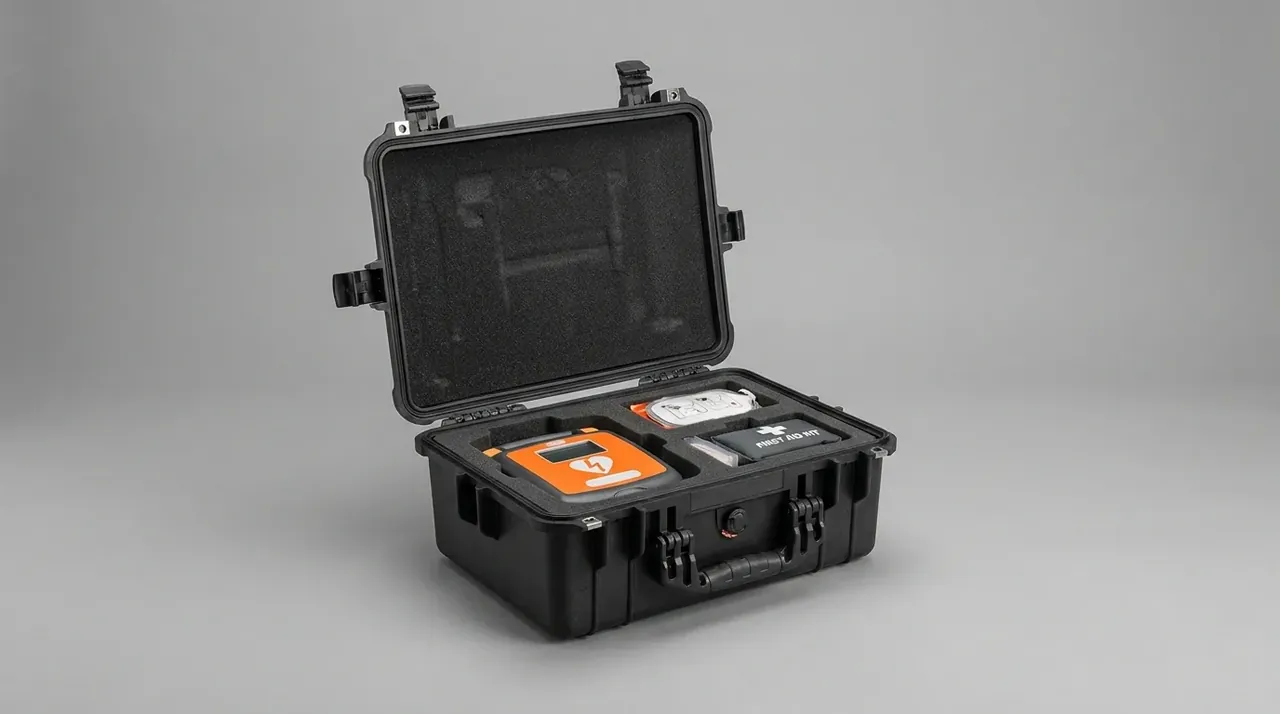
Quick answer: Medical high density easy-disinfect plastic box holds Ra 1.6 um roughness, an R8 mm base corner and 2 degree drainage slope to limit wipe residue.
Table of contents
- Surface roughness on the HDPE shell of the Medical high density easy-disinfect plastic box
- Base corner radius and the drainage slope
- Latch-seat inserts under repeated wipe cycles
- Measuring latch release force after a drop
- Residue rejection limits after batch wiping
- FAQ
1. Surface roughness on the HDPE shell of the Medical high density easy-disinfect plastic box
Outer size 520 x 380 x 220 mm and cavity 460 x 320 x 165 mm bound the material budget of the Medical high density easy-disinfect plastic box. Wall is 3.8 mm, empty shell 4.2 kg, rated load 9 kg, three figures that check one another on the drawing. JUNZHIJIA moulds the HDPE shell in one shot, lid and base in the same resin, so no joint leaves a colour shift after wiping. The seam carries no metal strip, keeping the wipeable face continuous and free of fibre catching ledges. Roughness is the first geometric variable because a deeper valley holds lint as cloth passes. Six measurement points are set out below, and fixed dimensions give every reading a baseline.
Roughness closes at Ra <=1.6 um over six points: lid crown, base floor, and four side wall mid heights, each traced three times with a stylus profiler at 25 C. Below 1.6 um the face does not fuzz after wiping and no streak stays in the texture.
| Wipe batch | Ra | Lint |
|---|---|---|
| Batch 1 (0) | 1.2 um | None |
| Batch 2 (100) | 1.3 um | None |
| Batch 3 (250) | 1.4 um | None |
| Batch 4 (400) | 1.5 um | None |
| Reject | >1.6 um | Lint: reject |
2. Base corner radius and the drainage slope
Base corners take an R8 mm radius and the floor a 2 degree drainage slope along the long edge, two features separating the Medical high density easy-disinfect plastic box from a flat bottom box. A square pocket holds liquid after wiping; the radius erases it and the slope moves residue to the low side. Radius and slope are a pair: R8 mm without the 2 degree slope still pools, and slope without the radius keeps four dead corners.
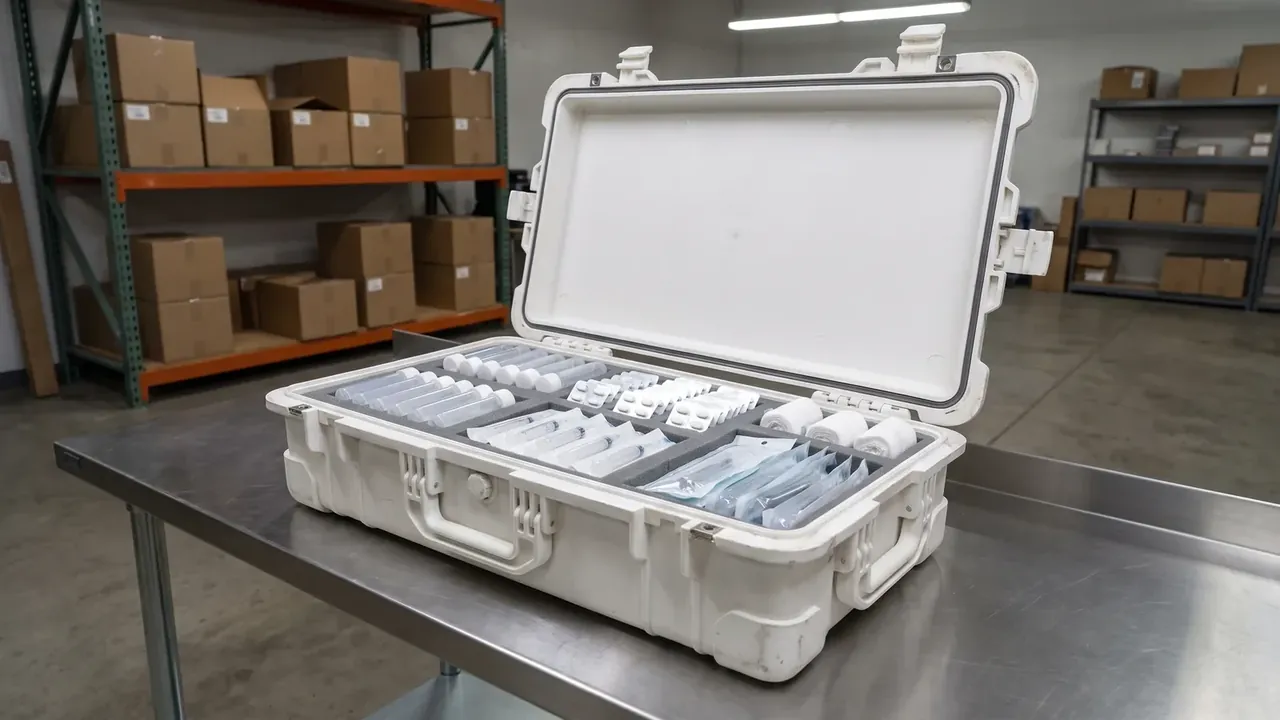
Drainage is judged by residue height at the low side after 30 min, not by how bright the floor looks. JUNZHIJIA levels the shell, pours a fixed water volume along the 2 degree slope, then presses absorbent paper to the low edge; no continuous wet mark means no pooling.
| Corner zone | Radius | Pooling |
|---|---|---|
| Front left | R8 mm | None |
| Front right | R8 mm | None |
| Rear left | R8 mm | None |
| Rear right | R8 mm | None |
| Long low edge | 2 degree | Dry |
3. Latch-seat inserts under repeated wipe cycles
An insert is moulded in first and the latch pivot sits inside it rather than being screwed into the shell wall. The Medical high density easy-disinfect plastic box uses 2 latches at 360 N each, force spread through the insert so repeated opening does not loosen the hole. Liner bonding is benchmarked at peel strength >=10 N/25 mm, cycle life at 3000 openings, and the mouth seal to IP65.
Wipe cycles pass a cloth with a set alcohol concentration back and forth 400 times over the outer shell, each stroke running from lid crown to base side wall. JUNZHIJIA treats 70% ethanol wipe 400 times as a test condition, logging only fuzzing, roughness drift, and insert blanching, with no entry about anything inside.
4. Measuring latch release force after a drop
The drop is 1.0 m with the base falling free onto a flat steel plate, and the Medical high density easy-disinfect plastic box rides the rig with its rated load. A force gauge hooks the latch handle and pulls along the opening direction; the peak as the tongue clears must be >=280 N. A lower value says the insert or tongue shifted and the lid may pop open in handling.
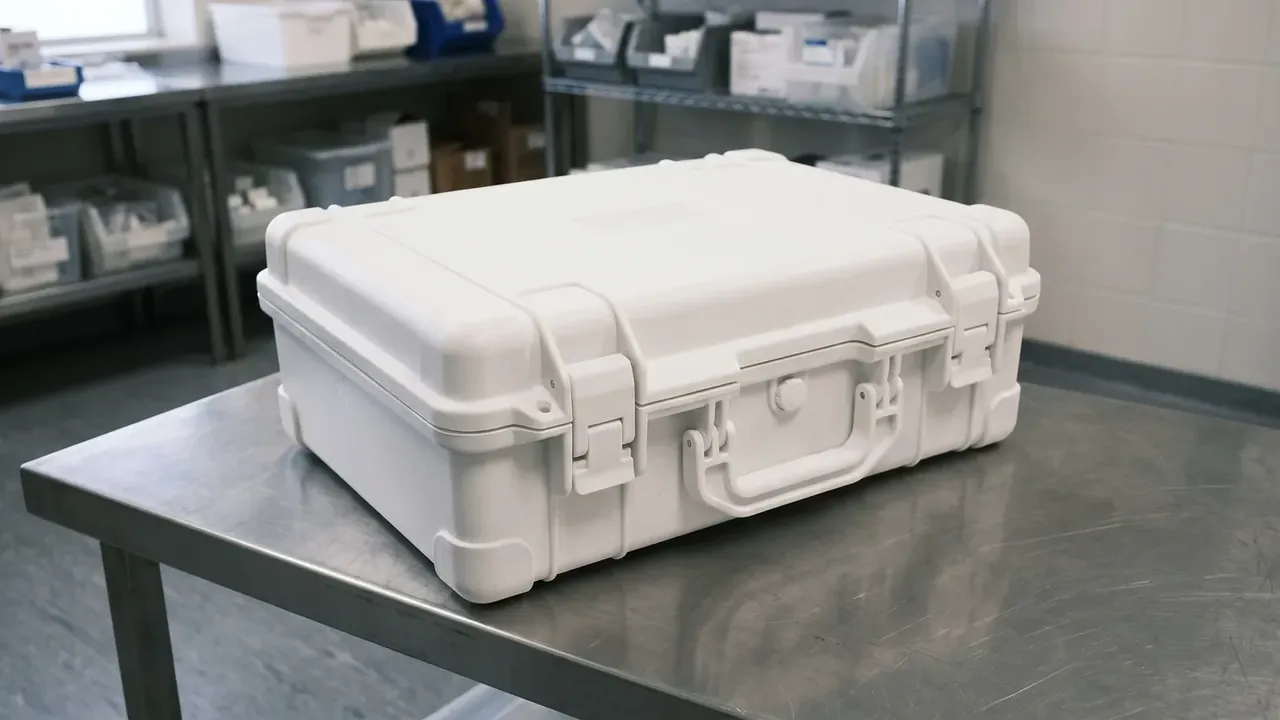
Release and fracture are separated: a tongue sliding out above 280 N passes, while a cracked plastic part is rejected even at a higher peak.
| Force reading | Release | Verdict |
|---|---|---|
| Pre drop left | 340 N | Pass |
| Pre drop right | 335 N | Pass |
| Post drop left | 305 N | Pass |
| Post drop right | 290 N | Pass |
| Reject | <280 N | Reject |
5. Residue rejection limits after batch wiping
Before shipping, 3 shells per lot are pulled for a wipe recheck, with two reject lines: Ra >1.6 um, or any fuzzing, blanching, or fibre snag on the face. Sampling of the Medical high density easy-disinfect plastic box allows no concession; either line trips and the lot is re-polished and 3 more shells drawn.
Shell roughness, base radius with drainage slope, latch inserts, and post drop release force are four points on one chain: Ra governs lint, R8 mm with 2 degree governs pooling, the insert governs loosening, and >=280 N governs pop open. Each figure is measured alone yet read together; one line crossed and the Medical high density easy-disinfect plastic box fails that lot.
The four criteria do not substitute for one another; a missing reading blocks sign off.
A retest of the same lot reuses the same card and the same points.
Conclusion
The Medical high density easy-disinfect plastic box puts wipeability on four measurable readings: shell roughness, base radius drainage, latch inserts, and post drop release force, not on a broad claim. Ra <=1.6 um, R8 mm with 2 degree, 400 wipe cycles, and >=280 N are independent yet restrain one another, forming the judgement window for this lot. JUNZHIJIA keeps one shared card so every reading traces back. Buyers asking for these four readings do better than judging the finish.
Related Reading
- General cleaning and wiping methods for protective cases
- Shell surface requirements for cases in medical use
- Sterilisation fit between medical and standard cases
- Material selection points for HDPE protective cases
Related Products
- 8 Series — Gun Cases; Military Equipment Cases; Camera Equipment Cases; Drone Cases; Watch Cases; Knife Cases; First Aid Cases; Electronics Equipment Cases
- WL8-2812 PP Gun Case — model WL8-2812
- All protective cases and toolboxes: 7 series, 158 models