

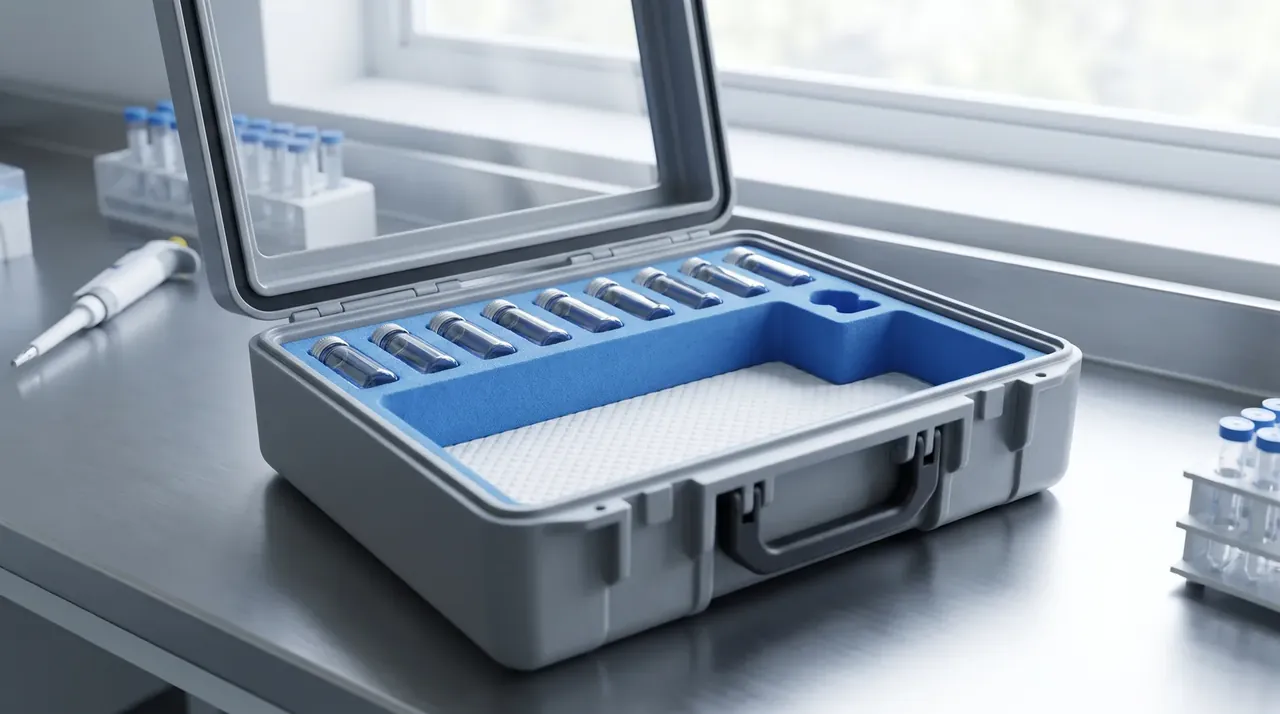
Quick answer: A medical vs standard case sterilisation gap sits in four parts rather than wall thickness, and 20 cycles at 134 ℃ push gasket set to 25%.
Table of contents
- Where the four differences sit
- 121 ℃/15 min is not 134 ℃/4 min
- Compression set of 25% after 20 cycles
- Is a 100 ℃ HDT enough headroom
- 316 hinges and zinc-plated pins
- FAQ
1. Where the four differences sit
Three cycles at 134 ℃ and the lid needs two hands to close, because the gasket has flattened. A 12 mm silicone strip comes back at 11.7 mm, 7.5% set, while the shell shows no visible distortion.
Four parts separate a medical vs standard case inside an autoclave. The gasket seals by compression on a solid silicone cord at 60 Shore A, or by its own rebound on an EPDM sponge strip of 8 mm × 4 mm, and that sponge collapses at 121 ℃ within 15 min.
The hinge pin comes next, 316 stainless at 5 mm against zinc-plated steel with an 8 μm coating. The lid rim is a 3.5 mm edge with two latches at 2 mm preload, against a 2.8 mm wall at 1 mm. Pressure relief is a valve opening at 0.3 kPa instead of a seal that seeps.
Only the valve is added; the rest are substitutions, and unit cost rises 18% to 25%.
| Part | Standard | Medical | First failure |
|---|---|---|---|
| Gasket | EPDM sponge 8×4 mm | Solid silicone 8 mm, 60A | Cells collapse, cycle 5 |
| Pin | Plated steel 5 mm, 8 μm | 316 stainless 5 mm | White rust, cycle 8 |
| Rim | 2.8 mm wall, 1 mm preload | 3.5 mm edge, 2 mm preload | Flatness 0.2 to 0.6 mm |
| Relief | Seepage only | 0.3 kPa valve | Gasket sucked inward |
2. 121 ℃/15 min is not 134 ℃/4 min
Saturated steam at 121 ℃ is 205 kPa absolute, at 134 ℃ it is 304 kPa. Pressure does not damage a case, it only sets penetration speed, while the gasket sees temperature times time: 1815 ℃·min against 536 ℃·min.
The larger total does less harm. Silicone degrades exponentially above 120 ℃, about 1.8 times faster per 10 ℃, so the 4 min cycle puts the gasket surface at 132 ℃ within 90 s while the 15 min cycle tops out at 119 ℃.
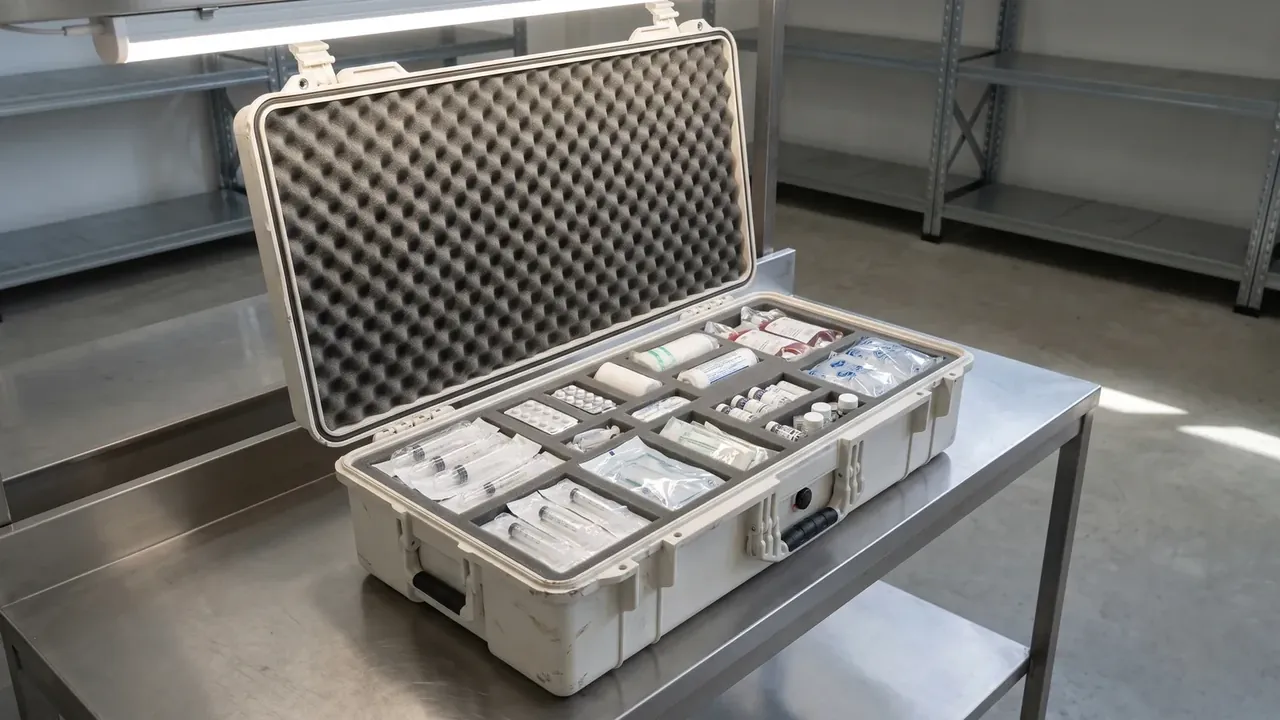
Split one gasket batch into two runs and the ranking flips: 25% set after 20 cycles at 134 ℃, 17% after 20 cycles at 121 ℃, an 8-point gap from that 13 ℃ peak.
| Cycle | Chamber | Hold | Gasket peak | Set, 20 cycles |
|---|---|---|---|---|
| Gravity | 121 ℃ | 15 min | 119 ℃ | 17% |
| Pre-vacuum | 134 ℃ | 4 min | 132 ℃ | 25% |
Which cycle you run depends on the packaging, not on the case. On the container side one rule holds: size the material list for 134 ℃, because a margin set at 121 ℃ loses 8% up there.
3. Compression set of 25% after 20 cycles
The test is fixed: compress 12 mm to 8 mm, a 33% squeeze, hold 24 h at 70 ℃, cool 30 min. A new strip returns to 11.8 mm, 5% set, while the same batch after 20 cycles at 134 ℃ returns to 11.0 mm, 25%.
Seal width shows what 25% means. Contact width falls from 4.2 mm to 3.0 mm and clamp force from 6.8 N/mm to 3.9 N/mm, 43% lower, so the same two latches need a second push.
| Cycles | Rebound | Set | Seal | Decay | Force |
|---|---|---|---|---|---|
| 0 | 11.8 mm | 5% | 4.2 mm | 0.02 kPa | 85 N |
| 5 | 11.6 mm | 10% | 3.9 mm | 0.03 kPa | 98 N |
| 10 | 11.3 mm | 18% | 3.5 mm | 0.05 kPa | 112 N |
| 20 | 11.0 mm | 25% | 3.0 mm | 0.11 kPa | 140 N |
Run the 0.3 kPa test within 2 h of unloading. A case straight from the chamber still holds above 60 ℃ and the decay reads low, at 25 ℃ it reads true. The limit is 0.05 kPa over 60 s, and a failed strip is replaced rather than preloaded harder.
Failure order is stable: gasket rebound at cycle 5, white rust on latch pins at cycle 8, rim flatness from 0.2 mm to 0.4 mm at cycle 12, hinge holes oval by 0.3 mm at cycle 20. The first two are spare parts, the last two mean a new case.
4. Is a 100 ℃ HDT enough headroom
PP at 0.45 MPa has a heat deflection temperature of 100 ℃, so 121 ℃ is 21 ℃ past it and 134 ℃ is 34 ℃ past. HDT is a loaded softening point, though: inside a chamber the case carries no external load, sees 205 kPa of differential pressure, and only for 15 min.
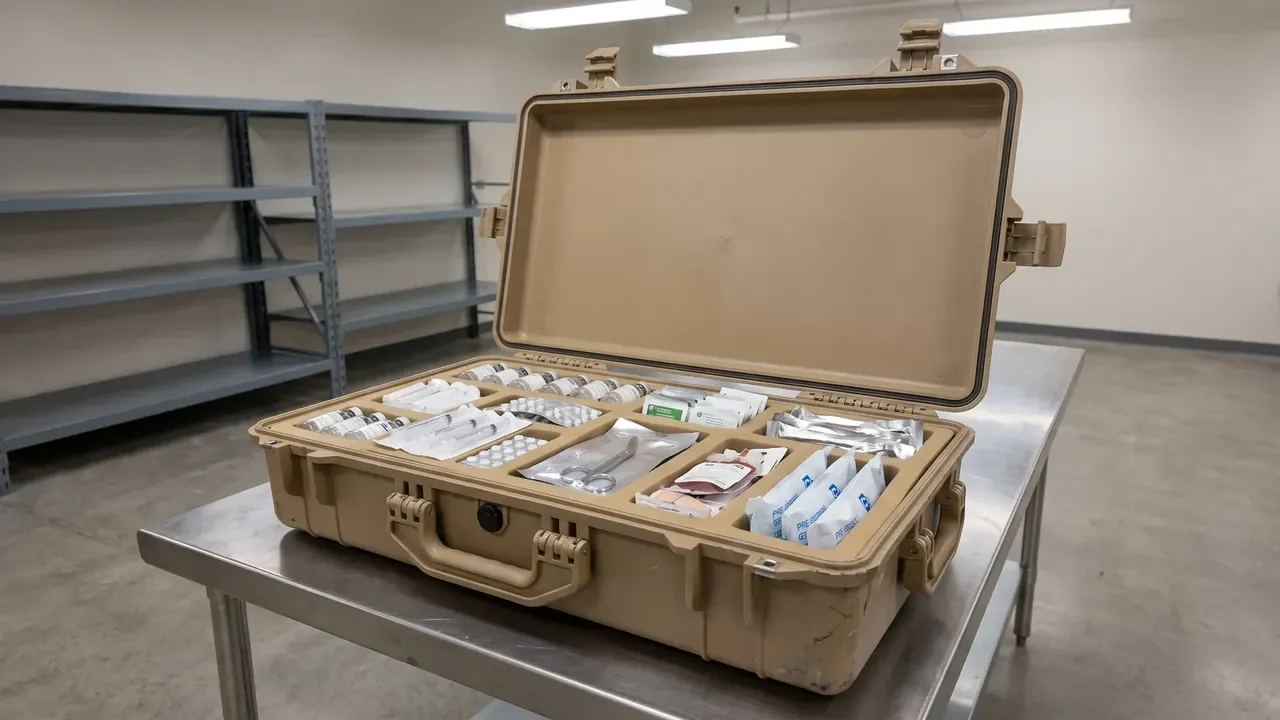
A 3.5 mm PP case run 20 cycles gives the practical answer. Rim flatness moved from 0.2 mm to 0.6 mm and the wall bulged 0.4 mm, with no collapse. Stress near the gate and the rim corners releases on the first cycle at 0.1 mm, reaches 0.35 mm by cycle 10 and 0.6 mm by cycle 20. Past 0.5 mm the gasket is compressed unevenly and the 0.3 kPa decay follows.
Substitution is the direct fix. PP with 30% glass fibre reaches 155 ℃ but drops notched impact from 45 kJ/m² to 22 kJ/m²; PC/ABS covers 110 to 125 ℃, short of 134 ℃; PPSU reaches 207 ℃ at six times the resin price.
Three materials, three cycles. Do not run a 121 ℃ design at 134 ℃.
5. 316 hinges and zinc-plated pins
Zinc-plated steel corrodes faster in a chamber than in a warehouse. Each cycle leaves the pin wet for 8 to 12 min, and an 8 μm coating goes within 20 cycles, so clearance grows from 0.15 mm to 0.4 mm and opening force from 12 N to 45 N.
In 316, molybdenum at 2–3% with chromium at 16–18% and nickel at 10–14% lifts the pitting potential more than 200 mV above 304 in chloride condensate, so opening force only reaches 18 N. On hardware the dividing line is the grade, not the word stainless.
Grade matching matters as much: a 316 pin in a 316 seat forms almost no galvanic couple, while a 316 pin in a zinc-plated seat sacrifices the coating three times faster and the seat fails first.
Clearance follows expansion, 16 against 100×10⁻⁶/K for PP, so the bore keeps 0.15 mm at 134 ℃.
Conclusion
The medical vs standard case boundary fits on two lines. On the 121 ℃/15 min line the silicone gasket sets 17% after 20 cycles, the rim stays at 0.4 mm and the 0.3 kPa test still passes; on the 134 ℃/4 min line set reaches 25%, flatness 0.6 mm and decay 0.11 kPa, 2.2 times the limit. Crossing to 134 ℃ leaves a substitution list of four items: sponge to solid silicone, plated pin to 316, 2.8 mm rim to 3.5 mm, and a 0.3 kPa relief valve. All four add 18% to 25% of cost and hold 0.05 kPa past 20 cycles; with two of the four, the rim fails at cycle 12. Put cycle count, chamber type and test method on the drawing rather than the words heat resistant.
This article discusses container-side specifications and design implications only, and does not cover any handling, loading or use of the contents.
Related Reading
- Case structure and sealing for autoclaves
- Inspection items and limits for medical cases
- The 0.3 kPa airtightness criterion
- Silicone versus EPDM gasket materials
Related Products
- 8 Series — Gun Cases; Military Equipment Cases; Camera Equipment Cases; Drone Cases; Watch Cases; Knife Cases; First Aid Cases; Electronics Equipment Cases
- WL8-2812 PP Gun Case — model WL8-2812
- All protective cases and toolboxes: 7 series, 158 models