

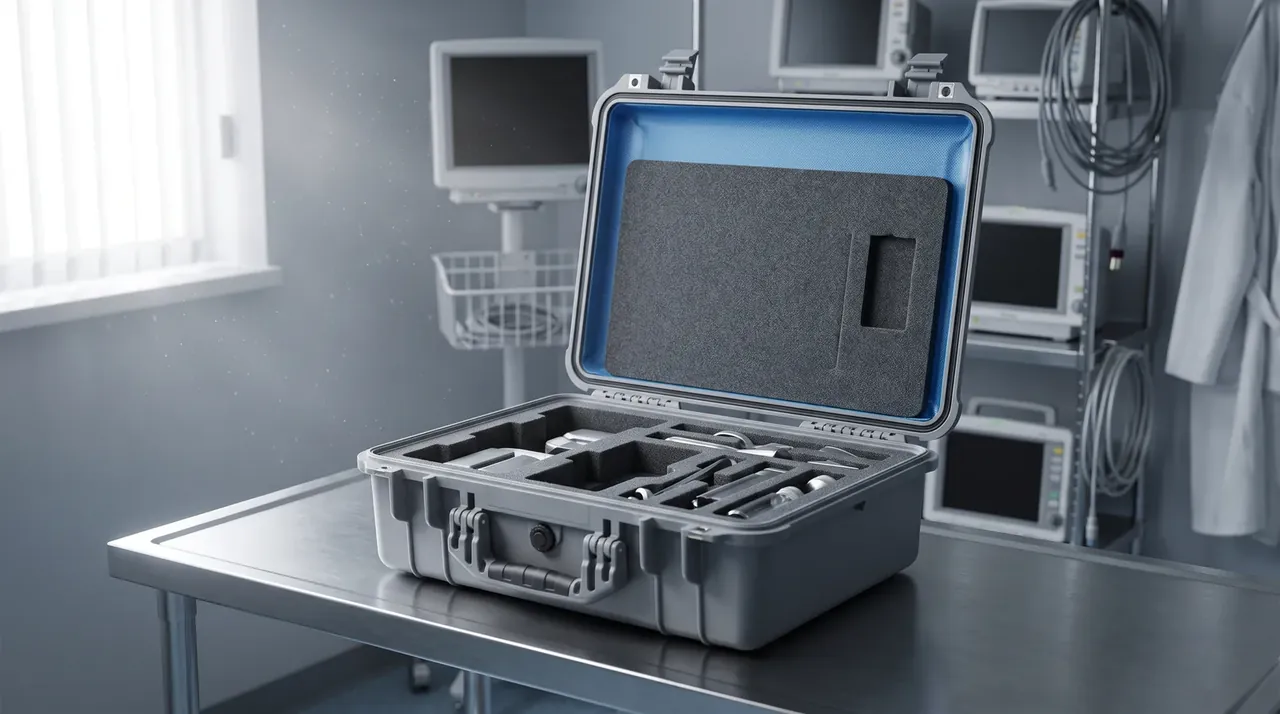
Quick answer:Medical Equipment Case Cleaning and Maintenance runs in a fixed order: empty, dry wipe, wet wipe, air dry, reload. A neutral cleaner at pH 6–8, a disinfectant dwell of 1–3 min followed by a clean-water wipe, 30×30 cm cloths, silicone oil on the gasket every 3 months, and storage at 40%–60% RH.
Table of contents
- Two jobs before any cloth comes out
- Choosing the cleaner and the cloth
- Strip-down order for a deep clean
- A gasket on a maintenance clock
- Solvents to ban and how to store a case
- FAQ
1. Two jobs before any cloth comes out
Eighty percent of the cost of keeping these bodies in service goes on wiping, not repairing. Wipe wrongly and one ingress event rusts a latch seat and blooms mould through the foam. Medical Equipment Case Cleaning and Maintenance therefore opens with two jobs that matter more than the wiping.
First, empty the case and record where everything sat: lay items out by cavity number, photograph the inside, reload against the photo. One misplaced item slows every later retrieval.
Second, decide whether the body may be washed at all. A shell with a through-crack, a chewed groove or a loose latch is repaired first; water put on it now tracks into the sandwich, where a week of drying will not reach.
2. Choosing the cleaner and the cloth
The window is narrow. A neutral product at pH 6–8 lifts dust, fingerprints and most drug residue; alkaline cleaners leave PP and ABS chalky, acidic ones attack aluminium edging and rivets. Nine in ten rework jobs in Medical Equipment Case Cleaning and Maintenance come from the wrong bottle.

Cut cloths at 30×30 cm: microfibre for walls and lid skin, non-woven for the groove and latch wells. Fold each into four faces, one per pass, never flipping the edge back, which returns the dirty side to the shell. On grained bodies, brush along the grain first, then take the water off dry.
Disinfectant gets its full 1–3 min dwell and is then wiped off with a clean damp cloth. Chlorine left to dry leaves salt crystals that pull moisture and keep seams tacky.
| Surface | Product | Strength | Dwell | Follow-up |
|---|---|---|---|---|
| Outer walls, lid skin | Neutral cleaner | pH 6–8 | Wipe and take off | Dry cloth |
| Sealing groove, latch wells | Neutral cleaner, soft brush | pH 6–8 | Under 1 min | Blot dry |
| Drug or blood residue | Disinfectant | Diluted per label | 1–3 min | Clean-water wipe |
| Foam surface | 75% alcohol | Spray only, never soak | Under 1 min | Air dry |
3. Strip-down order for a deep clean
Medical Equipment Case Cleaning and Maintenance follows the water downhill: insert out, lid fittings next, the mouth groove third, outer walls fourth, base last. Cleaning top-down keeps a freshly wiped mouth from being soiled again.
The insert comes out in one piece. Foam that has taken water does not spring back, and left inside it never dries; two days later the mould shows. Bloomed foam is the most common rework item here, and the cause is nearly always an insert left in place.
The groove gets its own pass. Grit settles at the bottom and grinds the gasket, so brush along the channel, blot it dry and wait ten minutes before the lid closes.
Walls and base finish the job. Floor grime is still a neutral-cleaner task; stand the case upside down on a rack so water drains from the latch wells.
4. A gasket on a maintenance clock
Silicone oil goes on the gasket every 3 months, on a groove that is already dry: oil over water floats and runs off within a day. Apply a thin film with a fingertip and wipe the excess out of the corners.
Intervals step with duty: a case that leaves the store daily drops to 2 months, so the action stays routine rather than a judgement call.
| Task | Interval | Action | If it fails |
|---|---|---|---|
| Silicone oil on gasket | 3 months | Thin film on a dry groove | Hardened section: replace |
| Grit out of groove | 3 months | Soft brush, blot dry | Groove damage: repair |
| Latches and hinges | 6 months | Clear dust, check pin play | Visible play: swap parts |
| Airtight re-check | 6 months | Pressure hold, log the drop | Failure: inspect groove |
| Insert inspection | 12 months | Look for debonding, mould | Replace the sheet |
An airtight re-check after cleaning is the step most often skipped in Medical Equipment Case Cleaning and Maintenance. A brush can roll the gasket out of its seat with nothing visible outside.
5. Solvents to ban and how to store a case
Chlorinated solvents are the worst offenders: after five wipes the PP or ABS surface crazes in fine lines that follow the mould flow, and no second clean removes them. Acetone and thinner whiten the surface at once.
Storage figures belong in a written procedure, not in habit. Between 5 ℃ and 35 ℃ at 40%–60% RH suits shell and insert; below 40% the foam crumbles at the rim, above 60% the metal parts spot first.
| Parameter | Range | Outside it | Fix |
|---|---|---|---|
| Temperature | 5–35 ℃ | Above 35 ℃ the gasket ages faster | Out of direct sun |
| Relative humidity | 40%–60% | Below 40% the foam crumbles | Humidify or move inside |
| Stack height | 3 high maximum | Lid skin creeps under load | Rack in layers |
| Floor clearance | 100 mm or more | Ground moisture climbs | Pallet or shelf |
Store with the latches released one notch, lid resting closed but unclamped, so the gasket is not held under load.
Related Reading
- General rules for medical case upkeep
- Disinfectants and what they do to case materials
- A five-step airtight diagnosis after cleaning
- Upkeep intervals by working scene
Conclusion
Three habits decide whether Medical Equipment Case Cleaning and Maintenance works: how many faces the cloth has left, whether the groove was blotted, whether the case dried long enough. Fix the neutral cleaner, the cloth, the quarterly silicone oil and the 40%–60% humidity band, and the repair queue becomes a wiping routine.
This article covers the case side of the specification only, not the use or loading of the equipment inside.
Related Products
- 8 Series — Gun Cases; Military Equipment Cases; Camera Equipment Cases; Drone Cases; Watch Cases; Knife Cases; First Aid Cases; Electronics Equipment Cases
- WL8-2812 PP Gun Case — model WL8-2812
- All protective cases and toolboxes: 7 series, 158 models