

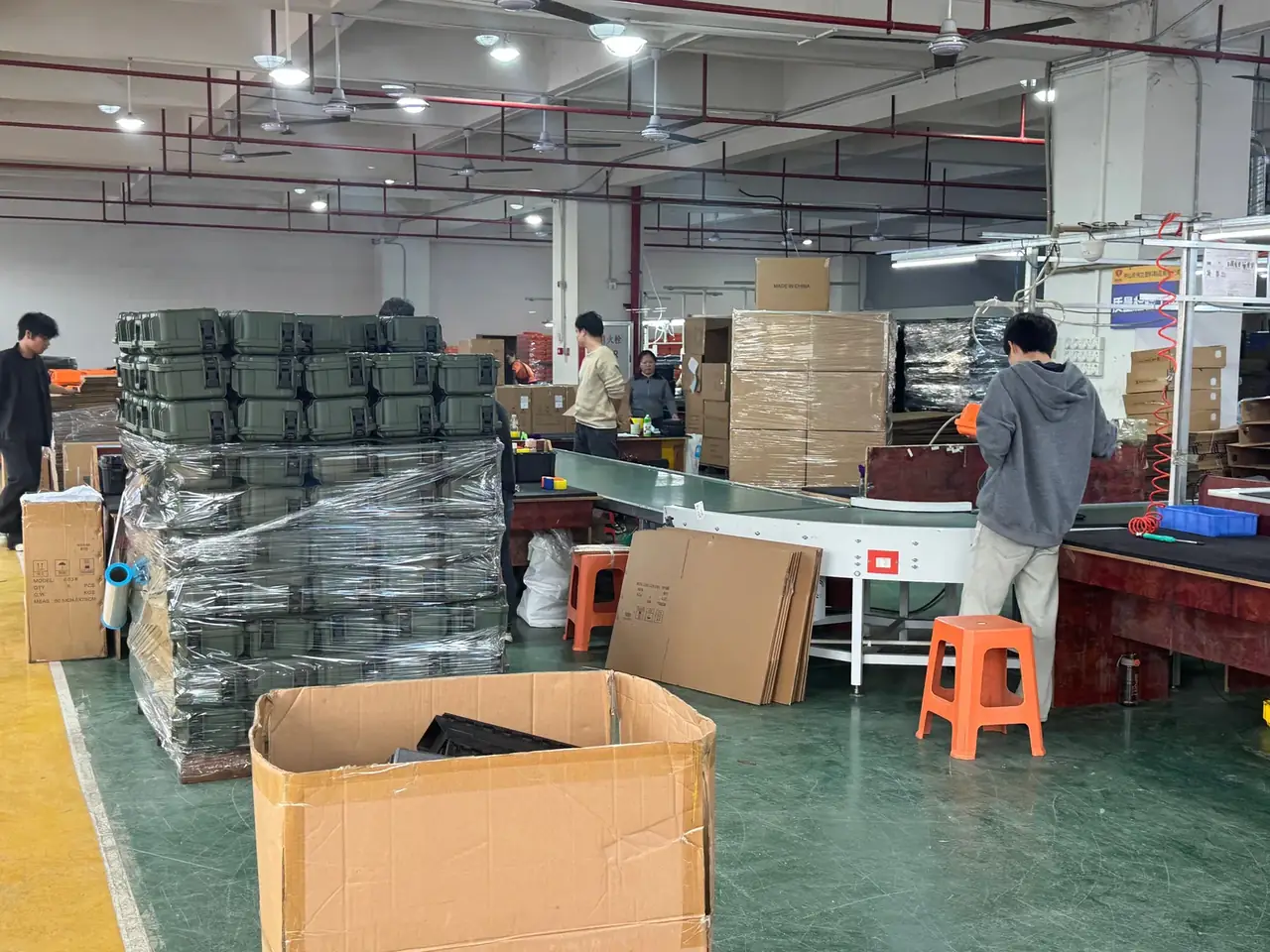
Quick answer:A Medical Equipment Case with Wheels and Handle is judged on three figures: castor diameter from 50 mm to 100 mm sets obstacle clearance, play at full handle extension stays under 5 mm, and centre-of-gravity height maps to a 15° to 20° towing angle. Moving 35 kg over 500 m rests on 85 A PU castors. Fix those three and the fittings follow.
Table of contents
- Castors set the rolling resistance
- Wheel diameter and floor surfaces
- Handle sections and lateral play
- Centre-of-gravity height and towing angle
- Thresholds, kerbs and stairs
- FAQ
1. Castors set the rolling resistance
Rolling effort comes down to three figures: wheel diameter, handle play and centre-of-gravity height. The castors are the part most often taken for granted. At the same 35 kg load, a 50 mm PU castor needs about 60 N to break away on epoxy flooring, while a 100 mm castor cuts that breakaway effort by roughly 30%. Across a 500 m hospital run, that difference is what the arm remembers.
Resistance has two sources: rolling friction at the tyre and self-aligning torque from the offset. A small offset steers easily but shimmies; a large one tracks straight and fights the turn. A Medical Equipment Case with Wheels and Handle usually sits at 20 mm to 25 mm, between the two.
Floor finish matters more than the wheel: epoxy rolls cheaply, vinyl is compliant and slightly heavier, and joints and thresholds deliver impact on every crossing. At 35 kg the load per castor approaches 12 kg, so the bracket joint is checked against that.
2. Wheel diameter and floor surfaces
Diameter settles both obstacle clearance and effort. A larger wheel needs less force for the same step height, at the cost of raising the base and taking space in a boot.
| Wheel diameter | Floor it suits | How it passes |
|---|---|---|
| 50 mm | Ward corridors, epoxy | Light on flat ground, lifted over a 15 mm threshold |
| 75 mm | Vinyl, outdoor concrete | Balanced, rolls a 25 mm threshold |
| 100 mm | Paving, speed humps | Best clearance, base raised 40 mm |
Hardness and width together set the pressure. PU at 85 A is the common grade: softer sinks into carpet, harder slips on glazed tiles. Widths of 25 mm to 32 mm spread the load on carpet.
Four castors need a layout rule: two swivelling plus two fixed, swivel leading and fixed trailing. All-swivel turns neatly in a lift but wanders in a straight line. A Medical Equipment Case with Wheels and Handle puts the swivels on the handle side, so the wheels follow the pull.
3. Handle sections and lateral play
Play comes from the clearance between tubes. Three sections at 0.3 mm each accumulate at full extension, and the tip starts to move. A Medical Equipment Case with Wheels and Handle holds full-extension play under 5 mm; beyond that the body swings and the wrist pays for it at distance.
| Sections | Extended length | Play control |
|---|---|---|
| One | 300 mm to 400 mm | Lowest, longest when retracted |
| Two | 500 mm to 700 mm | Moderate, suits a 1.6 m user |
| Three | 700 mm to 1000 mm | Absorbed by 0.3 mm clearance and locks |
More sections shorten the retracted handle; fewer stiffen it. The difficulty with three is that every lock has to engage, since one missed lock lets the handle collapse under load. Locks run on eccentric clamps or ball detents: the clamp adjusts, the detent resists vibration.
Handle mounting has to match the castor layout. On the narrow face the pull is mostly axial; on the wide face it tracks better but turns wider. At 35 kg the base needs at least 4 fixing points no closer than 60 mm apart.
4. Centre-of-gravity height and towing angle
Centre-of-gravity height sets the towing angle. Tilted to 15° to 20°, the mass sits close to the castor axle line, the lifting effort in the hand drops to its minimum, and the case will not tip either way.
A low centre allows a smaller angle and a nearly upright body; a high centre demands a bigger angle to bring the mass over the axle. Loading heavy items on the wheel side lowers the centre by 30 mm to 50 mm, which buys back a notch of angle.
Past 25° the mass moves ahead of the axle and the case dives when released; under 10° it sits behind and the handle has to be pressed down the whole way. A Medical Equipment Case with Wheels and Handle states the band in its loading note, so a packed case does not set off already out of range.
5. Thresholds, kerbs and stairs
Thresholds are the usual sticking point. At 15 mm a 75 mm wheel rolls straight over; at 25 mm the case goes at an angle, one wheel at a time; past 40 mm it has to be lifted. Ward thresholds run 15 mm to 20 mm, and lift sills sometimes reach 30 mm.
| Obstacle | Typical size | Method |
|---|---|---|
| Ward threshold | 15 mm to 20 mm | Straight over, handle pressed slightly |
| Lift sill | 25 mm to 30 mm | 45° approach, one wheel at a time |
| Stair riser | 150 mm to 170 mm | Off the wheels, carried by two |
Stairs are not a rolling surface. With 150 mm to 170 mm risers no wheel climbs, and forcing it shears the bracket. Collapse the handle and lift between two people, wheels facing out so the treads clear the nosing.
Door width limits passage too: a ward door gives 800 mm to 900 mm clear, so a body under 450 mm still turns, while 500 mm needs about 1.2 m at a right angle.
Related Reading
- The travel items on a medical case specification
- How cartons and rigid cases differ in transit
- Rolling routes inside a hospital transfer
- Where wheeled medical cases are used
Conclusion
A Medical Equipment Case with Wheels and Handle lives or dies on three figures: 50 mm to 100 mm of diameter marking the clearance band, 0.3 mm of tube clearance per section adding up to 5 mm at the tip, and 15° to 20° of tilt bringing the mass over the axle. Whether 35 kg covers 500 m in one go is answered there, not in the accessory list.
This article covers the case side of the specification only, not the use or loading of the equipment inside.
Related Products
- 8 Series — Gun Cases; Military Equipment Cases; Camera Equipment Cases; Drone Cases; Watch Cases; Knife Cases; First Aid Cases; Electronics Equipment Cases
- WL8-2812 PP Gun Case — model WL8-2812
- All protective cases and toolboxes: 7 series, 158 models