

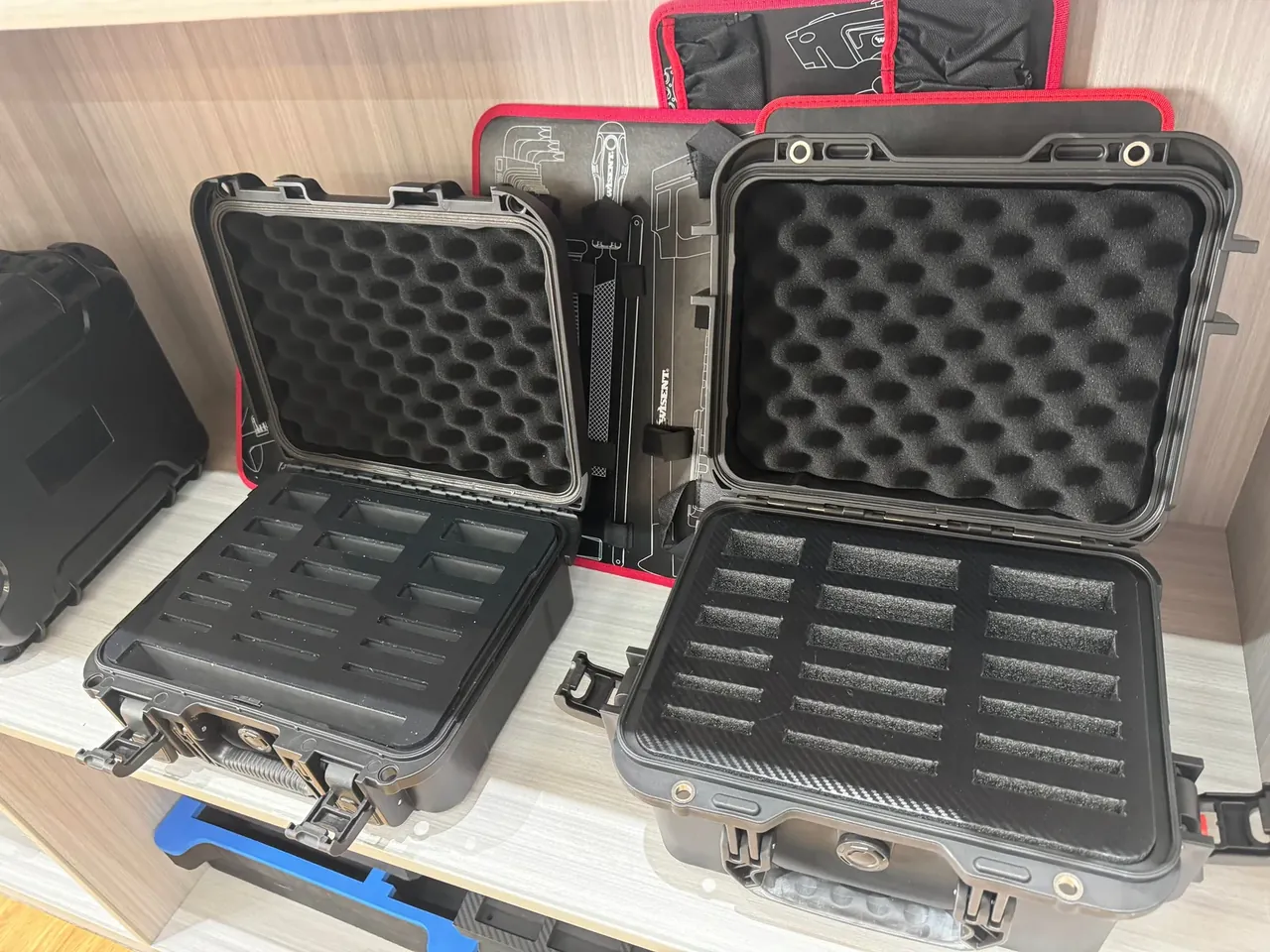
Quick answer: Medical Equipment Transport Case design follows the test, not experience: drop, random vibration, stacking and thermal cycling.
Table of contents
- Drop Tests Hit Corners Before Flat Faces
- Foam Compaction Under Random Vibration
- Wall Creep Through 72 Hours of Stacking
- Thermal Cycling and Gasket Recovery
- The Two Questions Buyers Ask of the Report
- FAQ
1. Drop Tests Hit Corners Before Flat Faces
The page most people skip in a Medical Equipment Transport Case report records how much spring the wall keeps after seventy-two hours under load. It has no neat curve, only a few millimetre readings, and they decide whether the lid still compresses the gasket after a night in a stacked trailer.
A 1.2 m drop does not load a corner and an edge alike. A corner joins three faces, so the impact squeezes into a small volume and must pass bumper, wall radius and insert before it reaches the device. An edge is a line contact shared by wall thickness and the nearest rib. On a 1200 x 800 mm footprint, the part a forklift touches first is usually an edge.
The sequence runs one corner, three edges, six faces. Read the attitude photographs before the height figure. A bumper that whitens without splitting has absorbed the energy; a split or a dented radius means the shock went straight into the cavity.
| Attitude | Load path | Where a Medical Equipment Transport Case needs material | Field reading |
|---|---|---|---|
| Corner | Bumper and three-face radius | Bumper depth, corner radius | Whiten is fine, split is failure |
| Edge | Wall plus adjacent rib | Rib pitch, rim flange | Dent past 2 mm needs review |
| Face | Whole wall and insert | Even wall thickness | Bulge makes the lid bind |
Deceleration of 50 g is what the device sees inside that 1.2 m. Move insert density from 30 to 45 kg per cubic metre at the same height and the peak shifts noticeably. When density is short the device bottoms out, and the shell receives only the remainder.
2. Foam Compaction Under Random Vibration
Random vibration differs from a drop in duration. A drop is one impact in tens of milliseconds; vibration is a continuous input for many minutes. At 1.05 Grms the foam does not shatter, it compacts: air leaves the bonded layers, cell walls take a plastic set, and clearance between cavity and device grows from 1 to 2 mm into 3 mm or more.
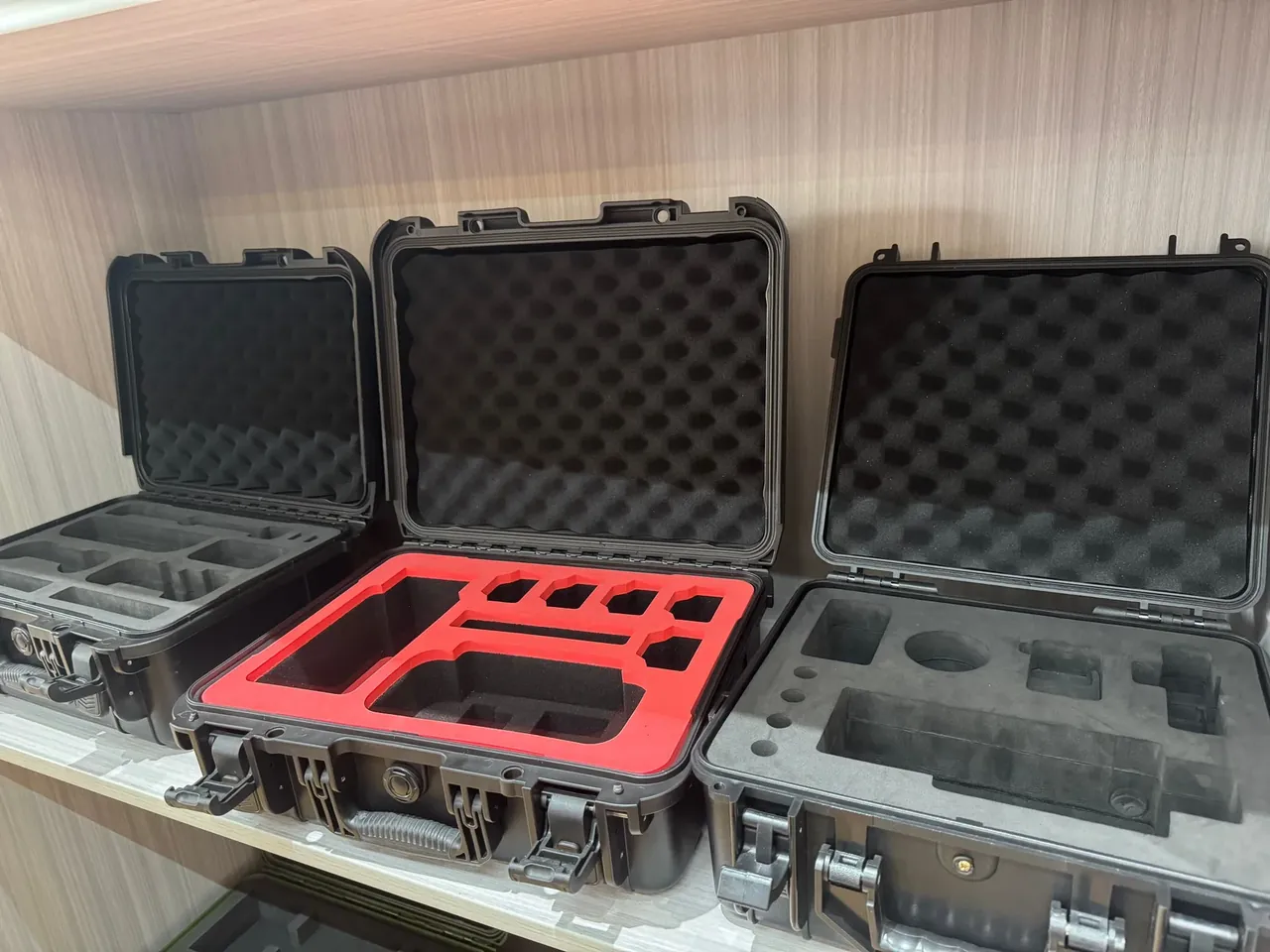
Once clearance opens, the vibration changes character. A cavity that cradled the device across a full contact face degrades into small shifting and intermittent knocks. There are tens of thousands of them, and the first casualties are shell edges and connector roots.
EVA commonly runs 25 to 45 kg per cubic metre: a chassis with a metal base plate wants the dense end, a face panel or probe the light end, and in a three-layer stack the middle layer is the transition. Whether a Medical Equipment Transport Case survives compaction depends on the hardest-worked layer, not on the mean of three.
3. Wall Creep Through 72 Hours of Stacking
Three tiers for 72 hours applies a steady load, not an impact. Plastic creeps under steady load, faster as temperature rises. On a 2.0 to 3.5 mm wall, local stiffness comes from ribs, and where rib pitch is wide the panel bows between them first.
The criterion is read after unloading: residual deformation beyond 3 mm fails. Measure one hour after the load comes off, because an immediate reading is flattered by elastic recovery and an overnight one is inflated by creep.
| Stack case | Watch point | How to record | Pass line |
|---|---|---|---|
| 3 tiers, 72 h | Mid wall | Fixed-point gauge 1 h after unload | Residual under 3 mm |
| 3 tiers, 72 h | Rim flange | Diagonal span change | Splay under 2 mm |
| 3 tiers, 72 h | Gasket groove | Print width after closing | Continuous, unbroken |
Stacking failure rarely shows as a crushed box. It shows as a splayed rim, and a splayed rim loses gasket compression along the middle span. A Medical Equipment Transport Case then carries its old rating on paper while leaking in fact, so stacking and sealing are two links of one chain.
4. Thermal Cycling and Gasket Recovery
On a Medical Equipment Transport Case, cycling pulls temperature between −20 and 55 °C and lifts humidity to 85 percent, testing dimensional stability and seal recovery. The wall moves very little; the gasket does.
Compression set is the mechanism. Measured at 25 percent compression, 23 °C and 24 hours, set should stay within 5 percent. In a real cycle cold stiffens the material and slows its return while heat accelerates permanent set, so recovery shrinks round after round.
The limit is fixed: recovery below 60 percent of the initial compression fails. A gasket short on recovery looks perfect and carries no contact stress, so vapour enters through a gap nobody can see.
Groove geometry moves with the material. A 25 to 30 percent compression gives the steadiest contact band; too shallow under-compresses, too deep pushes the cord out and raises closing effort.
5. The Two Questions Buyers Ask of the Report
At the back of the report, buyers ask two things: the residual deformation after the 72 hour stack, and the recovery the gasket retained after cycling. Those numbers describe the case three years out; the word pass describes nothing.
These questions concern boundary conditions. In one ISTA 3A sequence, stacking three tiers or the declared warehouse height gives very different verdicts, and cycling at 85 percent humidity or dry heat alone can invert the gasket result. A Medical Equipment Transport Case report that omits these cannot be compared with the next shipment.
| Buyer question | What the report should show | Risk of a summary page only |
|---|---|---|
| Deformation after stacking | Gauge points, delay after unload, measured value | No way to judge margin |
| Gasket recovery | Initial compression, post-cycle compression, ratio | Looks sound, already failed |
| Sample count | Units tested, serials tied to photos | One pass read as a batch pass |
Conclusion
Four tests map onto four structures: drop works the corner and radius, vibration works the foam reserve, stacking works the wall and rim, cycling works the gasket. Run the Medical Equipment Transport Case design in reverse: fix the tests first, then wall, ribs, foam and gasket.
This article discusses only the container (case body) side of specifications and design intent, and does not cover any handling, loading or use of the contents.
Related Reading
- Sealing and labelling in hospital sterile supply cases
- Medical case acceptance: test items and verdicts
- Hard case or carton: the boundary for e-commerce shipping
- How to set packaging levels for medical device transport
Related Products
- 8 Series — Gun Cases; Military Equipment Cases; Camera Equipment Cases; Drone Cases; Watch Cases; Knife Cases; First Aid Cases; Electronics Equipment Cases
- WL8-2812 PP Gun Case — model WL8-2812
- All protective cases and toolboxes: 7 series, 158 models