

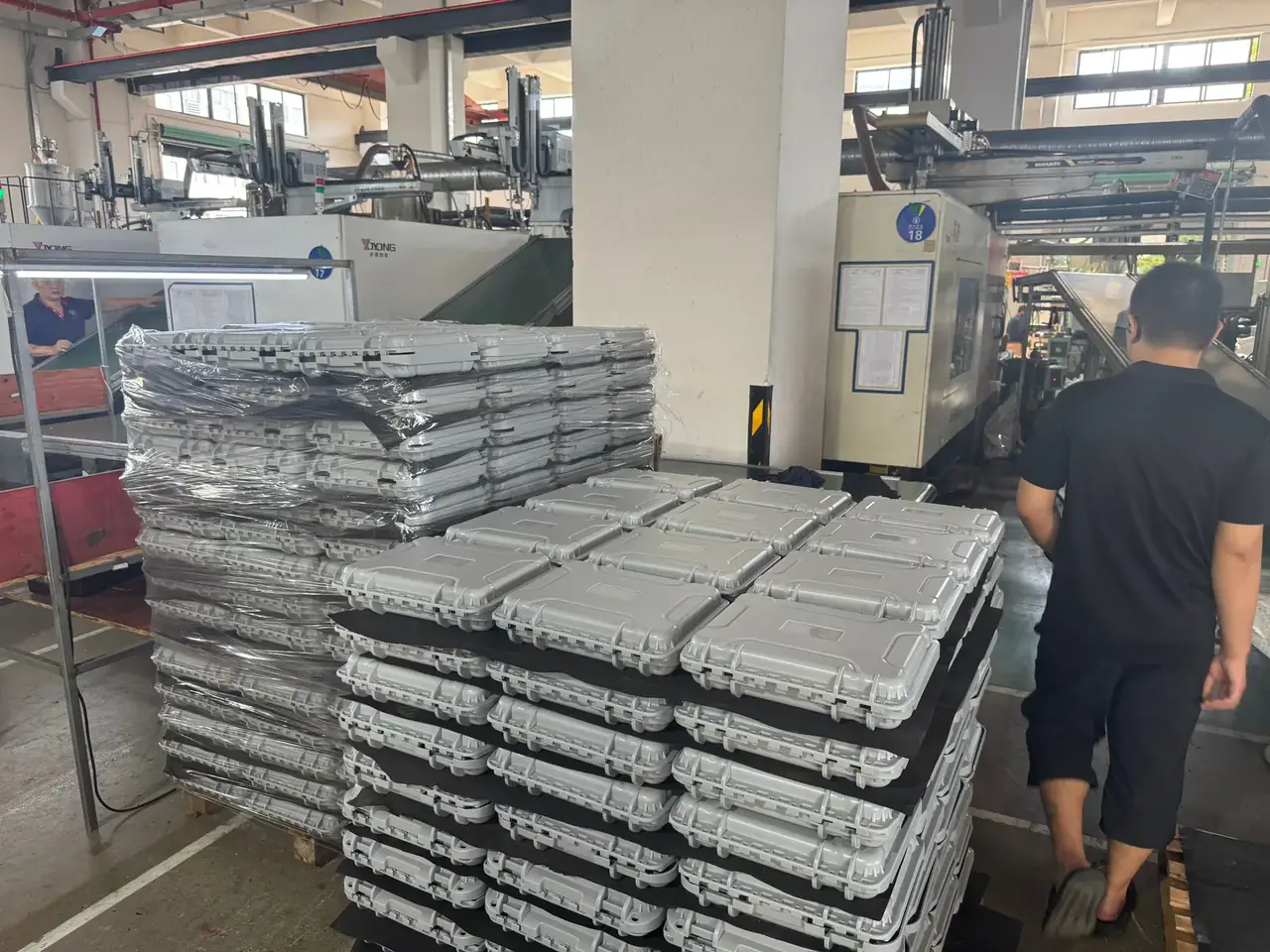
Quick answer: Medical formulation bottle foam lined plastic box holds 24 Ø32 mm wells on an 8 mm web, with 35 kg/m³ foam keeping a 1.2 m drop under 2500 m/s².
Table of contents
- Well fit rules for a medical formulation bottle foam lined plastic box
- Ø32 mm wells on an 8 mm web
- The cushion curve at 35 kg per cubic metre
- Holding peak acceleration under 2500 metres per second squared
- Handle load from 2.3 kg empty to 8.8 kg loaded
- FAQ
1. Well fit rules for a medical formulation bottle foam lined plastic box
Twenty-four bottles go into foam one at a time; twenty-two slide in, the last two need a thumb and leave a pale ring on the palm. That press depends on the gap between well and bottle.
Bore is bottle diameter plus 0.5 to 1.0 mm; depth is height minus 5 mm so the lid foam presses the shoulder; base foam never goes under 30 mm, because that layer takes the drop first. The bottles here are 30.0–31.0 mm across and 85–95 mm tall at about 270 g, so 24 come to 6.5 kg and each well is Ø32 mm by 90 mm deep.
| Array parameter | Value | What sets it |
|---|---|---|
| Well bore | Ø32 mm | 31.0 mm bottle plus 1.0 mm clearance |
| Well depth | 90 mm | 95 mm bottle less 5 mm press |
| Centre pitch | 40 mm | 32 mm bore plus 8 mm web |
| Base foam | 30 mm | stroke budget at 1.2 m |
One box also carries one bottle diameter: mixed bottles compress the foam unevenly, and a drop tips a loose bottle until its shoulder meets the next wall.
2. Ø32 mm wells on an 8 mm web
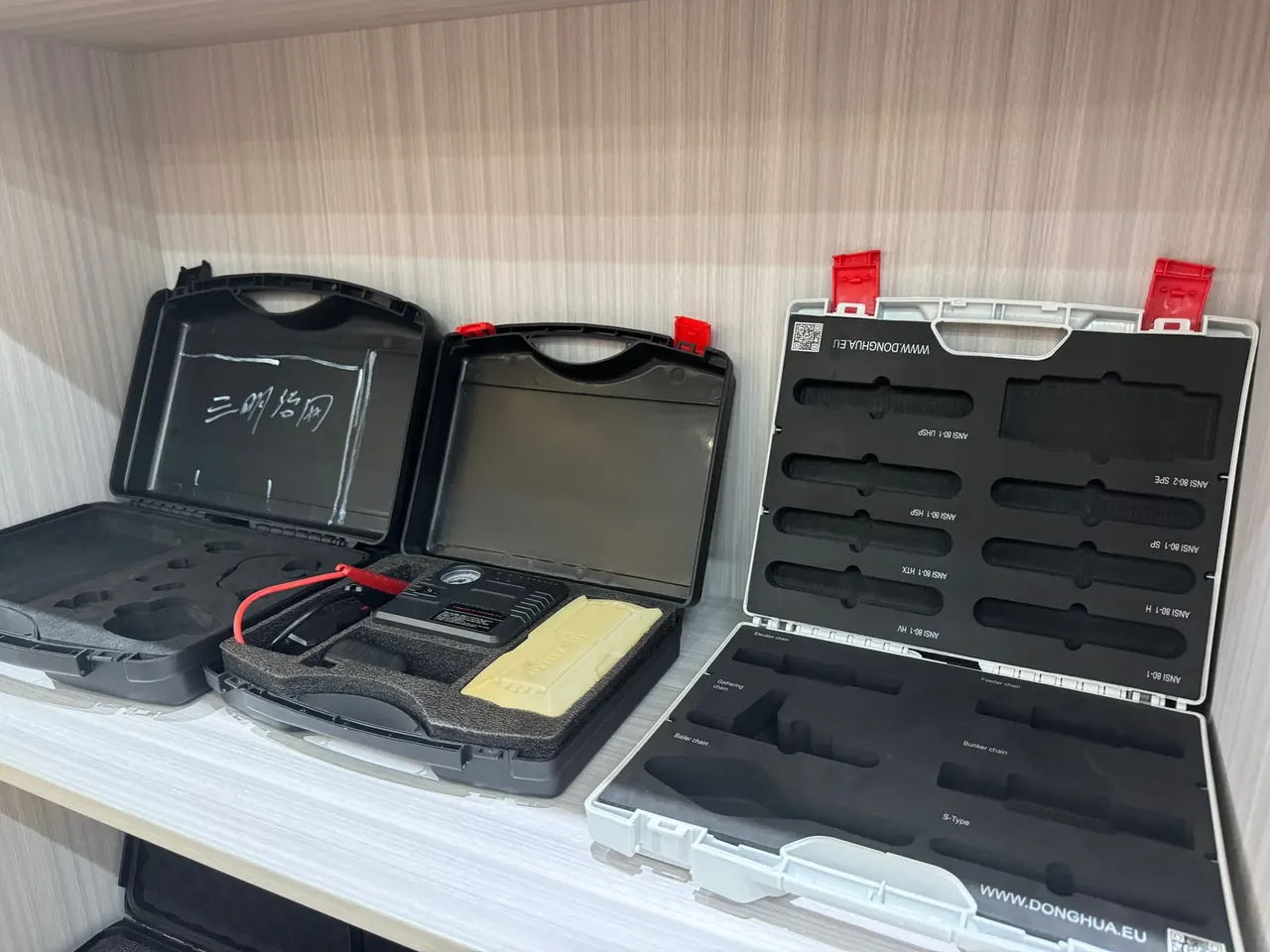
The 8 mm is solid foam between two bores, not the pitch. The Medical formulation bottle foam lined plastic box gets there from two directions: a rib under 6 mm collapses when die-cut and sheds fibre on every insert, while a thicker rib grows the block and squeezes the margin a corner drop lands on.
| Web | Array footprint | Static stress |
|---|---|---|
| 6 mm | 222×146 mm | 2.0 kPa |
| 8 mm | 232×152 mm | 1.8 kPa |
| 12 mm | 252×164 mm | 1.6 kPa |
Six columns at 6×32 plus 5×8 give 232 mm; four rows give 152 mm. In a 380 by 280 mm cavity that leaves 74 mm and 64 mm each side. At 12 mm the block is 252 by 164 mm and the margin falls to 58 mm.
Stress moves with the web. A 6.5 kg payload over 0.0353 m² gives 1.8 kPa, while 0.0413 m² at 12 mm gives 1.6 kPa, a step toward the left arm.
Die-cut tolerance runs ±0.5 mm on the bore and ±1 mm on the block outline, so the drawing quotes the web as a minimum instead of a nominal: an 8 mm rib that comes off the tool at 7.4 mm still clears the 6 mm collapse threshold.
3. The cushion curve at 35 kg per cubic metre
A cushion curve plots peak acceleration against static stress, U shaped: too much area on the left, densification on the right, trough between. Peak acceleration equals dynamic stress divided by static stress.
At 35 kg/m³ the 25% compression stress is near 110 kPa and 50% near 190 kPa, with 4% set after 22 h at 25% strain. At 1.8 kPa static stress, 25% compression passes about 110 kPa, 61 times gravity or 600 m/s²; at 35% it passes 140 kPa and 78 times. The Medical formulation bottle foam lined plastic box takes 35 over 45, where 142.7 kPa at 25% lifts the peak to 79 times.
30 kg/m³ reads softer at 88.3 kPa and fails the other way: a 1.2 m drop drives it past 50% into densification and the curve turns up.
The range is −5 °C to 45 °C, 5 °C above where EPE loses a fifth of its cushioning, so a 0.9 factor applies at the peak; 45 °C is far below the 80 °C limit.
4. Holding peak acceleration under 2500 metres per second squared
1.2 m is the acceptance drop. An 8.8 kg case lands at 4.85 m/s carrying 103 J; an accelerometer on the bottle wall takes three drops and the highest peak, ceiling 2500 m/s², near 255 times gravity.
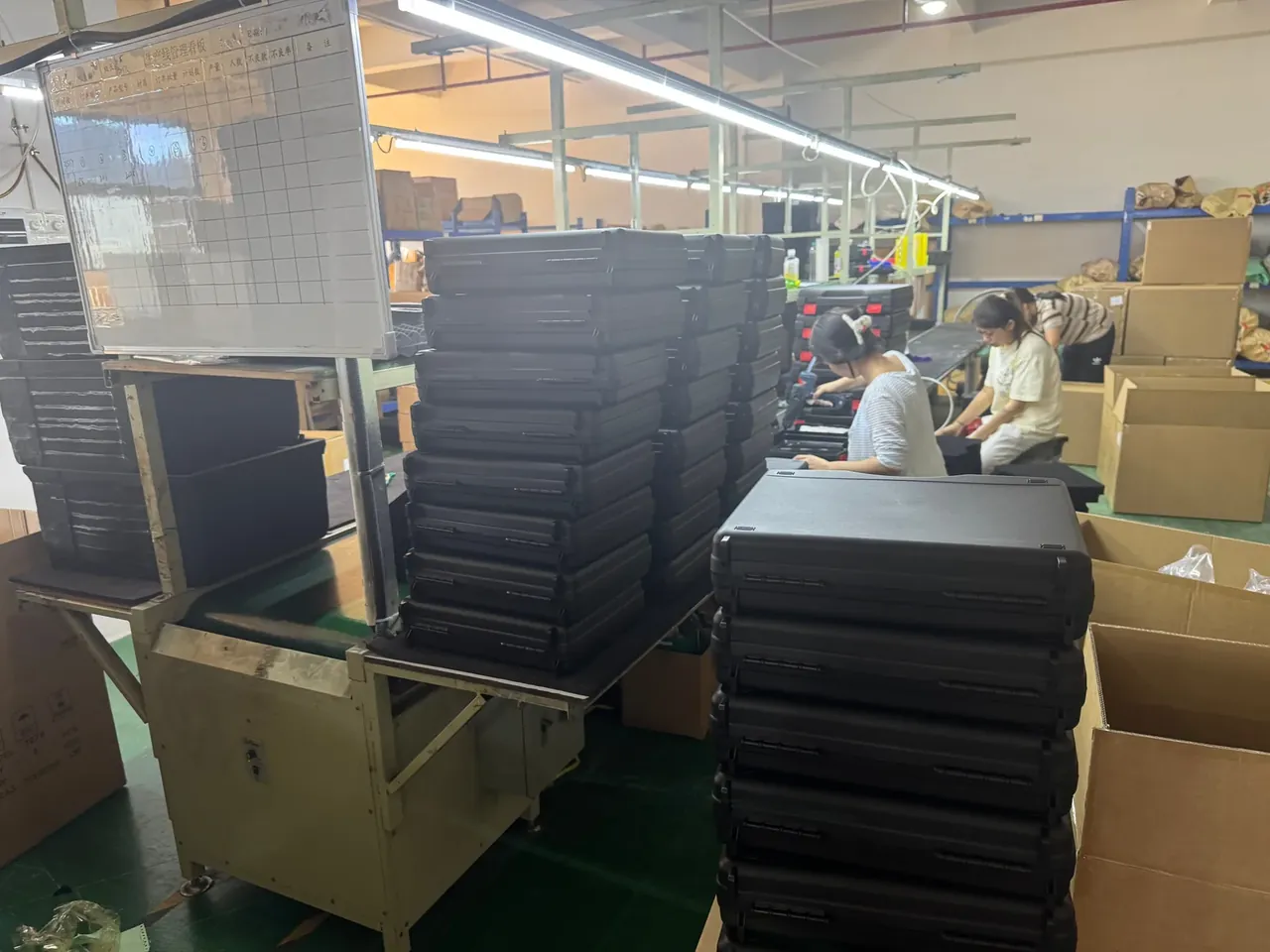
That ceiling is a stopping distance: 4.85 m/s at 2500 m/s² stops in v² over 2a, about 4.7 mm. The Medical formulation bottle foam lined plastic box has 30 mm of base foam, six times that.
| Drop | Contact | What is checked |
|---|---|---|
| 1 | Bottom corner | corner foam compression, shell whitening |
| 2–4 | Three bottom edges | tears in well walls |
| 5–10 | Six faces in turn | bottle peak, lid foam imprint |
ASTM D4169 Level II gives 330 mm for 9.1–18.1 kg, so 1.2 m is three times that; these boxes travel as single units. Two units per batch are cut open after the run, and a tear longer than 3 mm in any well wall retires the tool until the cavity is repolished.
5. Handle load from 2.3 kg empty to 8.8 kg loaded
The 2.3 kg empty mass is three items: 1.9 kg of PP shell and lid at 0.90–0.91 g/cm³ on a 3.0 mm wall, 0.18 kg of foam at 0.005 m³ and 35 kg/m³, and 0.2 kg of hinges, hardware and label plate.
At 8.8 kg the load is 86 N, about 21.5 N per finger on a 130 mm grip with a 30 by 14 mm section, against 15 N for a loaded bag. Two radiused transitions keep fingers off square edges.
The Medical formulation bottle foam lined plastic box opens on a 0.9 kg lid, hinged along the long side.
Supply splits: a foam and colour swap is semi-custom at 300–500 pieces and 15–20 days; a new shell needs 35–50 days plus 25–35 days.
Conclusion
Wells, web, density, drop criterion and mass are one problem in five hats: put static stress in the trough of the curve, then use stroke to hold the peak. The Medical formulation bottle foam lined plastic box fixes that with 24 wells of Ø32 mm, an 8 mm web, 35 kg/m³ foam and a 2500 m/s² ceiling, and a 420 by 320 by 160 mm outer size follows.
This article covers the box side only, meaning shell, foam and well dimensions. It does not describe any handling, filling or use of what goes inside.
Related Reading
- Well layout in reagent bottle cases
- Case dimensions for trial drug transport
- Foam lining for glassware in transit
- Usable cavity ratio in case volume
Related Products
- 8 Series — Gun Cases; Military Equipment Cases; Camera Equipment Cases; Drone Cases; Watch Cases; Knife Cases; First Aid Cases; Electronics Equipment Cases
- WL8-2812 PP Gun Case — model WL8-2812
- All protective cases and toolboxes: 7 series, 158 models