

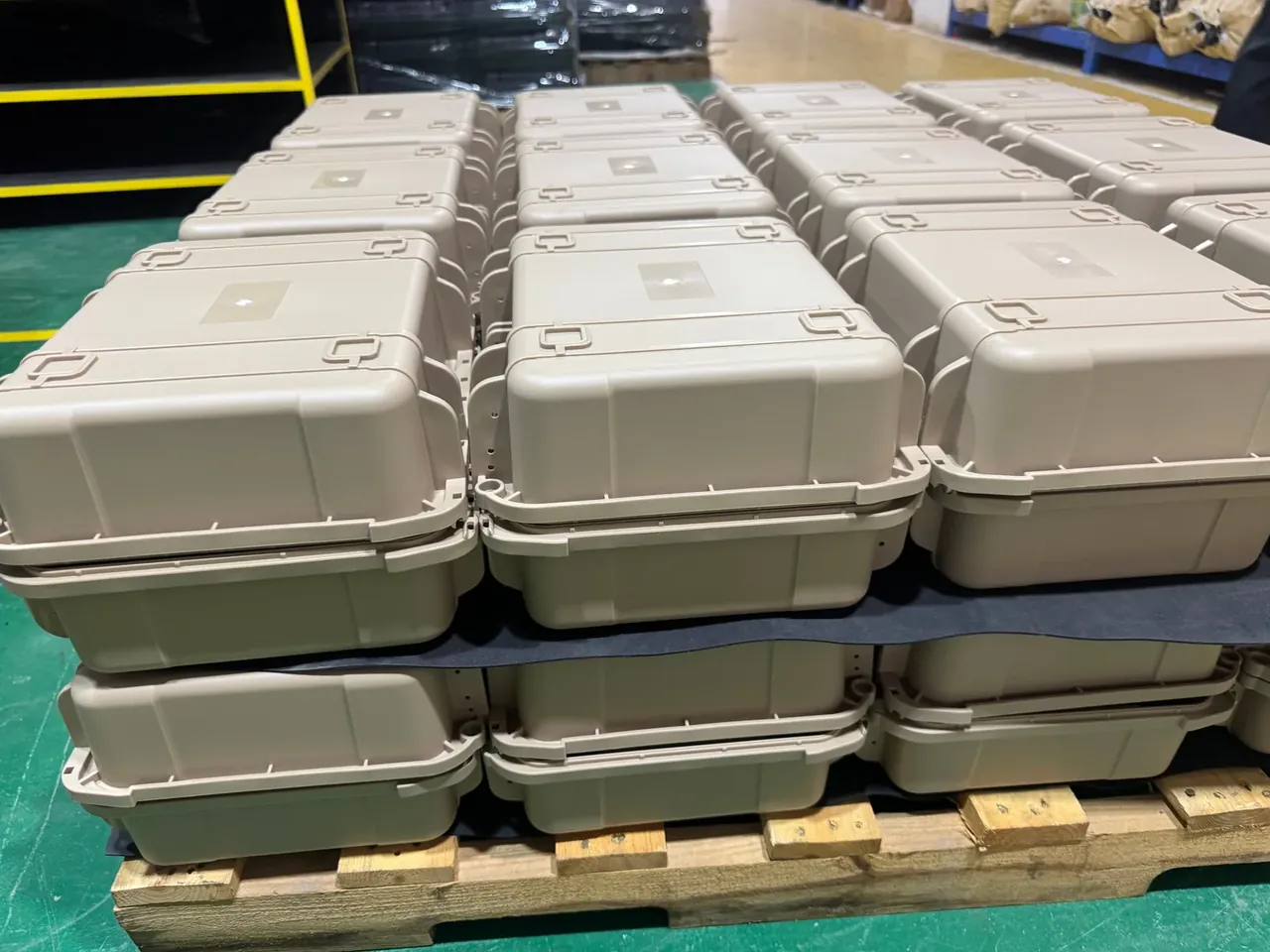
Quick answer: A medical grade waterproof shockproof transport case fails at three interfaces, not at the lid: shell against the stretcher, cavity against the instrument, gasket against the disinfectant. A 3.0 mm wall, a 6.0 x 4.5 mm groove and a 50 g peak on a 1.2 m drop fix all three at once.
Table of contents
- Shell Structure and Transit Loads
- Gasket Groove, Cleanable Surfaces, Disinfectant Resistance
- Cavity Dividers, Fixing and Access
- Drop, Vibration and Stacking Tests
- Temperature Hold and Cleaning Cycle
- FAQ
Shell Structure and Transit Loads
The medical grade waterproof shockproof transport case takes load from three directions: 0.5 g of vibration through an ambulance floor, a 1.2 m drop at the tailgate, and 36 kg of static load from three stacked units. The shell is moulded in PC/ABS at 3.0 mm with R10 outer corners, three base ribs and two vertical ribs per side.
| Part | Material | Size | Role |
|---|---|---|---|
| Lid | PC/ABS | 3.0 mm | Double ribs, 36 kg compressive |
| Base | PC/ABS | 3.5 mm | Three ribs, R10 corners |
| Gasket groove | Same shell | 6.0 x 4.5 mm | Silicone, Shore A50 |
| Hinge boss | PC/ABS | 8 mm local | Stainless pin, 4 mm |
| Handle boss | PC/ABS | 9 mm local | Steel axle, 30 kg |
PC/ABS rather than PP, because of cold. At minus 10 degC PP loses about 60 percent of its notched impact strength and a shell sliding off a stretcher onto concrete cracks at the corner; PC/ABS keeps roughly 70 percent at minus 20 degC for 12 percent more weight.
Stacking is the item most often left out of the drawing. Three loaded units at 18 kg put 36 kg on the bottom shell, and the lid may sag no more than 2 mm after 72 hours. A shell with rib pitch beyond 55 mm takes a 2.4 mm set after three days at 40 degC, the groove stops lining up, and immersion fails at the first attempt.
Gasket Groove, Cleanable Surfaces, Disinfectant Resistance
The medical grade waterproof shockproof transport case uses silicone rather than nitrile, for the disinfectant rather than the water. The groove runs 6.0 mm wide and 4.5 mm deep against a 5.8 mm section, giving 25 to 30 percent compression. Below 20 percent, 1 m for 30 minutes seeps at the corners; above 33 percent the lid needs 100 N instead of 60 N, too much for a nurse in double gloves.
Surface finish decides whether the case can be cleaned at all. Every internal radius is R3, and the floor falls 1.5 degrees toward a 3 mm drain hole with a silicone plug, so fluid leaves during wiping. The outside carries a fine grain at Ra 1.6 um, letting 75 percent ethanol lift blood or iodine within 30 seconds.
| Disinfectant | Concentration | Wipes | Hardness change |
|---|---|---|---|
| Ethanol | 75% | 500 | 3 Shore A or less |
| Chlorine | 500 mg/L | 300 | 5 Shore A or less |
| Hydrogen peroxide | 3% | 200 | 4 Shore A or less |
| Quaternary ammonium | 1000 mg/L | 400 | 2 Shore A or less |
Chlorine is the dividing line. After 300 wipes at 500 mg/L available chlorine, a nitrile gasket rises 8 Shore A, the lip hardens and the seal stops holding the groove; silicone rises 5 Shore A. The 18 percent price gap buys a 12-month replacement interval instead of six.
Cavity Dividers, Fixing and Access
No single block of foam inside. EVA dividers at 30 kg/m3 and 15 mm are cut to the instrument outline with 2 mm of interference, and 10 mm of convoluted foam in the lid presses on the top face, cutting vertical movement from 5 mm to under 1 mm.
Straps are 25 mm webbing at 30 N preload with plastic side-release buckles, so nothing throws a reflection under theatre lighting. Two latches at 60 to 90 N sit 180 mm apart, a 12 mm finger recess works with gloves, and the cavity splits into three bays with the most-used items on the hinge side.
Drop, Vibration and Stacking Tests
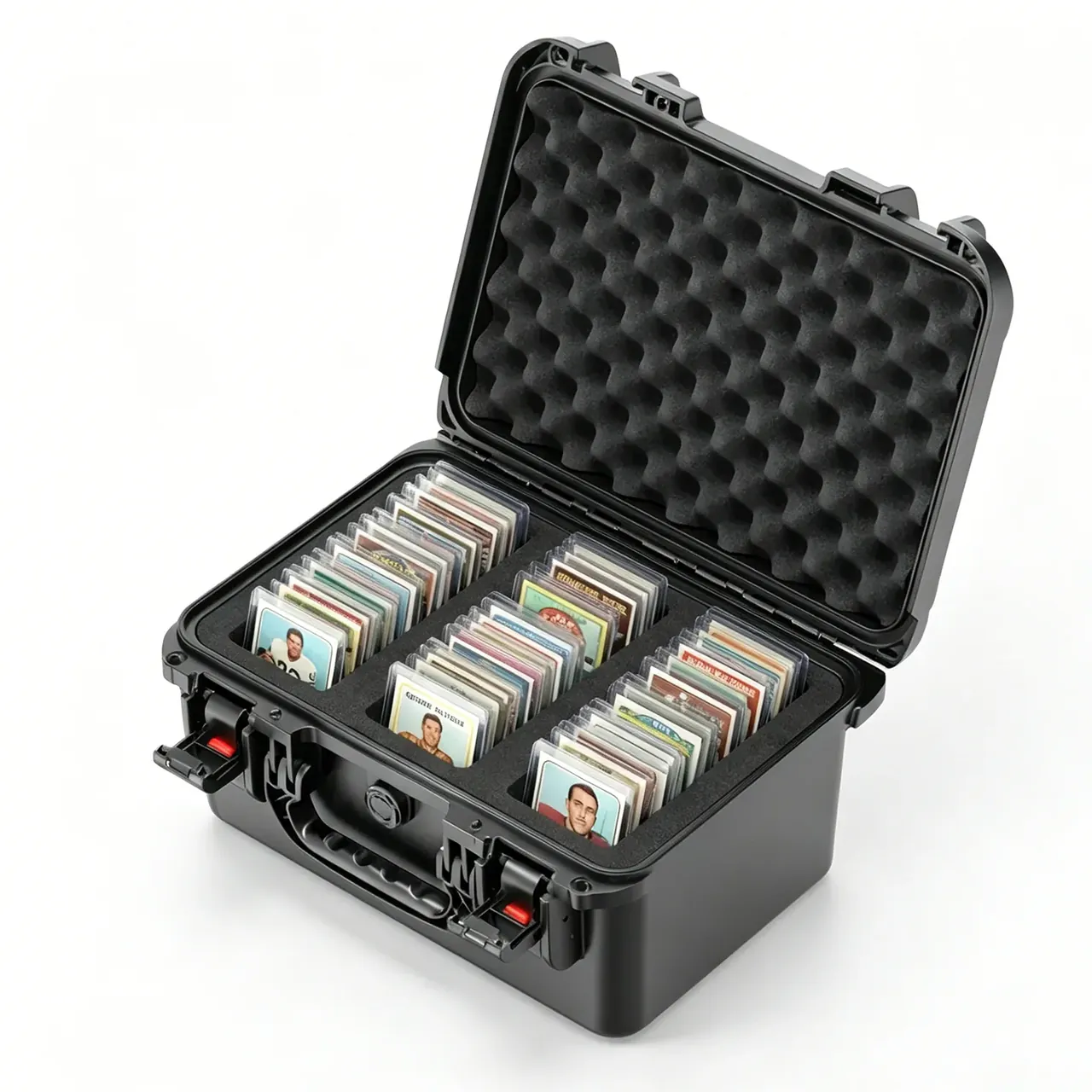
Transit testing cannot be copied from warehouse standards. Vibration follows the ambulance profile: 5 to 200 Hz at 0.5 g for 40 minutes per axis, gentler than the 1.5 g used for shipping packaging but long enough to fatigue fasteners and liners.
| Test | Condition | Pass | Sampling |
|---|---|---|---|
| Drop | 1.2 m, six faces, 18 kg | Peak 50 g or less | 3 per batch |
| Vibration | 5 to 200 Hz, 0.5 g, 40 min | Fixture shift 2 mm or less | 1 per batch |
| Stacking | 36 kg, 72 h, 40 degC | Lid sag 2 mm or less | 1 per batch |
| Immersion | 1 m, 30 min | Gain 0.5 g or less | 2 per batch |
| Salt spray | Neutral, 48 h | No red rust | 1 per quarter |
Reports need peak traces and weigh-in records: an acceptance that only looks at the outside misses a 2 mm shift of the internal fixture.
Temperature Hold and Cleaning Cycle
For temperature-controlled transport the shell is only the outer layer; the hold comes from insulation and ice packs. A 20 mm polyurethane layer with two 0.6 kg packs keeps a 2 to 8 degC cavity within 3 degrees for 6 hours at 25 degC ambient; at 15 mm the same load breaks 8 degC at 4.5 hours.
Cleaning runs on a tiered schedule: 75 percent ethanol after every trip, 500 mg/L chlorine weekly, and the gasket lifted out monthly to check for crystalline residue. Replace it at 24 months or 800 openings, whichever comes first.
Lubricate hinges and latches with silicone grease, never mineral oil: mineral oil brings stress cracks in PC/ABS within three months, starting as a white haze at the latch boss, while silicone grease still flows at minus 20 degC.
Conclusion
A medical grade waterproof shockproof transport case is three interfaces on one drawing: contact faces set the rib layout, fixing faces set the dividers, sealing faces set the material. Get them aligned and drops, vibration and immersion give stable results; get them wrong and a costlier latch only changes where the failure happens.
This article covers only the specification and design meaning of the case (body) side, and does not deal with any handling, loading or use of the contents.
Related Reading
- Case structure and material choice for medical use
- Disinfectant resistance and cleaning of medical cases
- Measuring latch holding force on transit cases
- Cold chain case hold times compared
Related Products
- 8 Series — Gun Cases; Military Equipment Cases; Camera Equipment Cases; Drone Cases; Watch Cases; Knife Cases; First Aid Cases; Electronics Equipment Cases
- WL8-2812 PP Gun Case — model WL8-2812
- All protective cases and toolboxes: 7 series, 158 models