

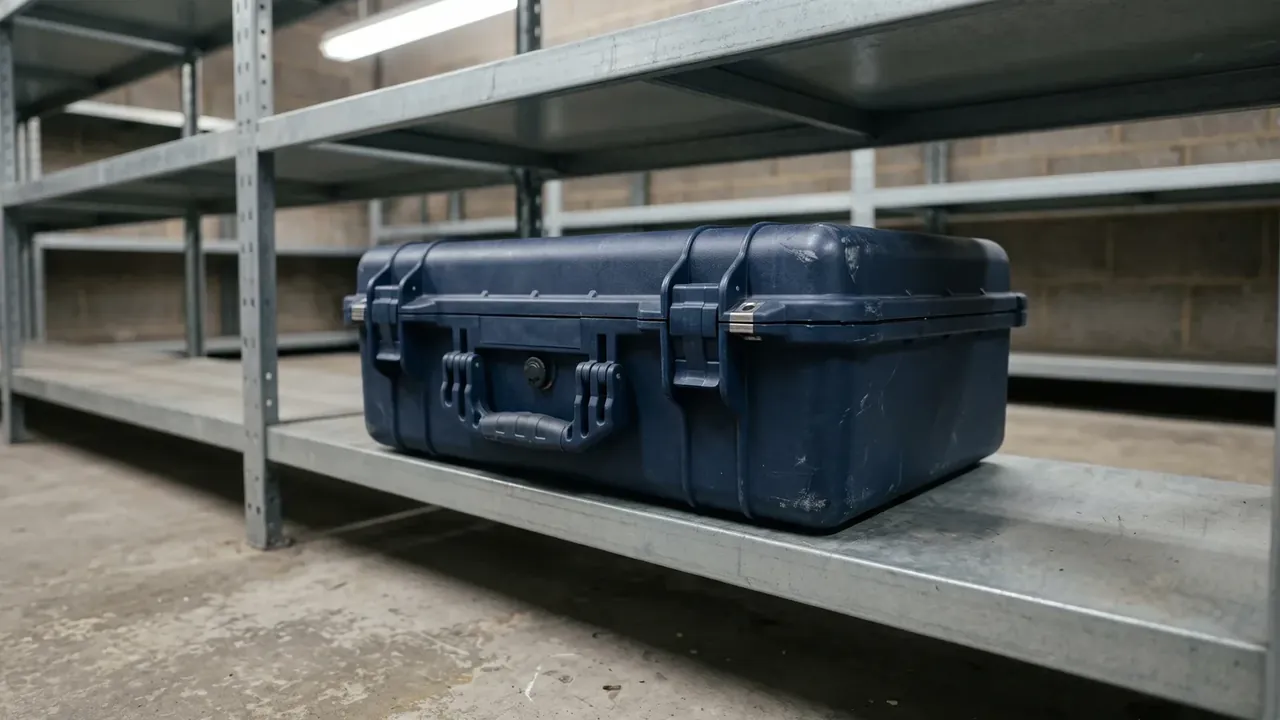
Quick answer: Medical handheld analyzer safety hard box holds one-hand lid lift at ≤35 N, carries 3.4 kg in a 340 by 265 by 120 mm shell and clears a 1.2 m drop.
Table of contents
- One-Hand Opening Sequence on the Walk-Round Route
- Wall Gauge and Cavity Allowance at 300 by 225 by 85 mm
- Screen Face Angle and Foam Pocket Fit
- Drop and Immersion Checks at 1200 mm
- Handle, Hanger and Wrist Strap Load Split
- FAQ
1. One-Hand Opening Sequence on the Walk-Round Route
Halfway up a stair tower the right hand is on the rail, so the left hand gets one attempt at the lid. The Medical handheld analyzer safety hard box puts release, lift and draw inside one thumb-and-web span, and the lid stops at 105 degrees on hinge friction.
Both catch pads sit on the front long edge, 45 mm in from each corner, each pad 20 mm wide. The heel of the hand braces the front rim as the lid rises.
| Stage | Where the hand lands | Tolerance |
|---|---|---|
| Release | thumb on the 20 mm press pad | ≤8 mm off centre |
| Lift | heel of hand under the front rim | lid rebound ≤3 degrees |
| Draw | web of hand across the folding handle | case tilt ≤10 degrees |
Release carries the tightest tolerance. Slide 8 mm off the pad and the thumb rides the catch sidewall, the lever arm shortens, and the press feels gritty. The Medical handheld analyzer safety hard box fixes pad position with two ribs under each catch seat, so assembly never depends on a fitter nudging the part.
2. Wall Gauge and Cavity Allowance at 300 by 225 by 85 mm
Outside is 340 by 265 by 120 mm; inside is 300 by 225 by 85 mm. The 2.8 mm gauge is deliberate: ABS shows 15 to 35 kJ/m² notched Izod at 23 ℃, and 1.8 kg landing on a corner from 1.2 m concentrates that energy into a small patch. Under 2.8 mm the inner corner whitens before the outer shell cracks.
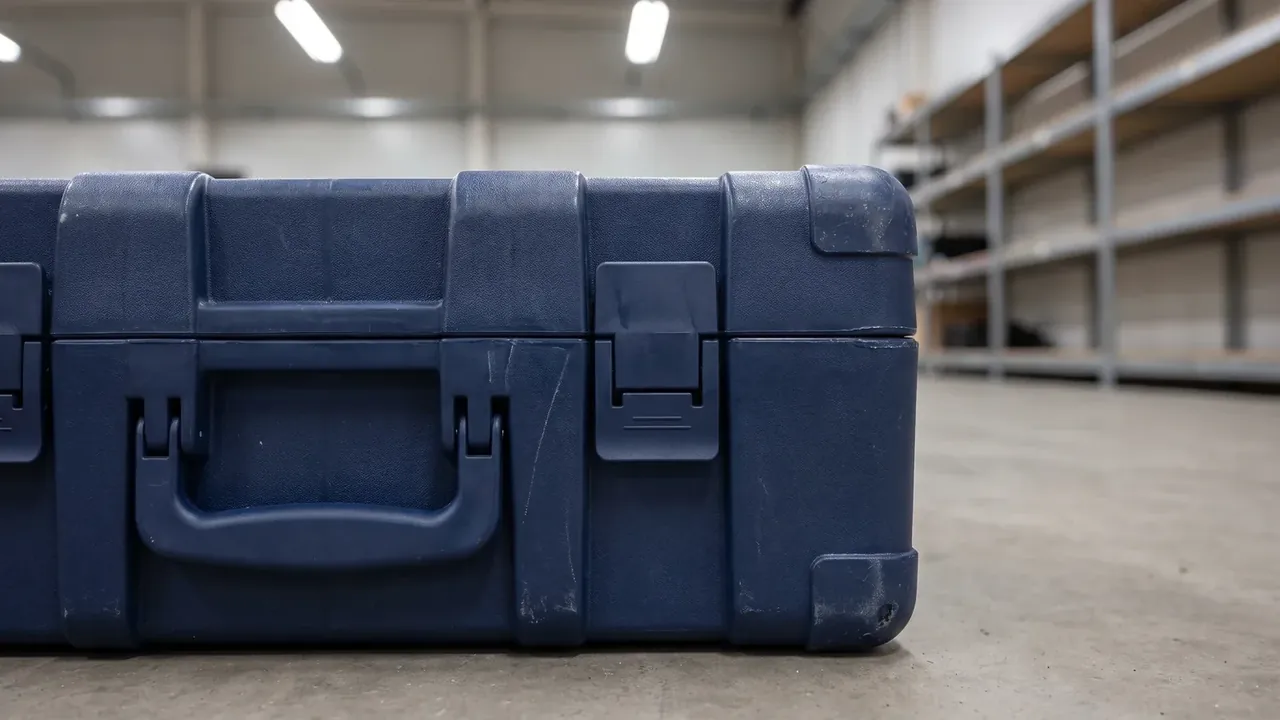
ABS runs 1.04 to 1.06 g/cm³ at 0.4 to 0.7 percent mould shrinkage, holding batch drift inside 0.6 mm; 2.8 mm sits mid-window, so rib roots stay free of sink marks.
| Item | Value | Where it comes from |
|---|---|---|
| Outer | 340 by 265 by 120 mm | 210 mm thumb-to-web span plus corner guards |
| Cavity | 300 by 225 by 85 mm | outer minus 20 mm structure and 35 mm lid depth |
| Wall | 2.8 mm | lower bound before corner whitening at 1.2 m |
| Loaded mass | 3.4 kg | 1.6 kg empty plus 1.8 kg load |
All four figures sit on one chain in the Medical handheld analyzer safety hard box. Thin to 2.5 mm and whitening starts near 0.9 m; thicken to 3.2 mm and 0.2 kg of shell pushes the loaded case past 3.6 kg.
3. Screen Face Angle and Foam Pocket Fit
Screen orientation decides how the pocket is cut. Stand the unit with the screen tilted 15 degrees toward the lid and the reading lands on the glass the moment the lid opens; lay it flat and the screen runs parallel to the base, forcing a 40 degree head drop. The pocket is cut 55 mm deep to keep that sight line.
Pocket foam runs EVA at 45 to 60 kg/m³, with compression set under 5 percent at 50 percent deflection, so the walls still hug the body after 500 cycles. Three criteria govern the cut on the Medical handheld analyzer safety hard box: screen normal within 5 degrees of the rim plane, side clearance 1.0 to 1.5 mm per side, and 2 mm of preload from the lid liner, held to ±0.5 mm.
Below 1.0 mm a finger cannot get in; above 1.5 mm the body walks 3 mm sideways and hits the pocket wall. Preload at 2 mm holds vertical travel under 0.5 mm.
4. Drop and Immersion Checks at 1200 mm
The 1200 mm figure comes from rail height on an inspection platform. ISTA 3A calls 76 cm for a 3.4 kg parcel; MIL-STD-810H sits at 122 cm. Nine drops cover six faces, two edges and one corner, with the corner last, on a shell that has taken eight hits.
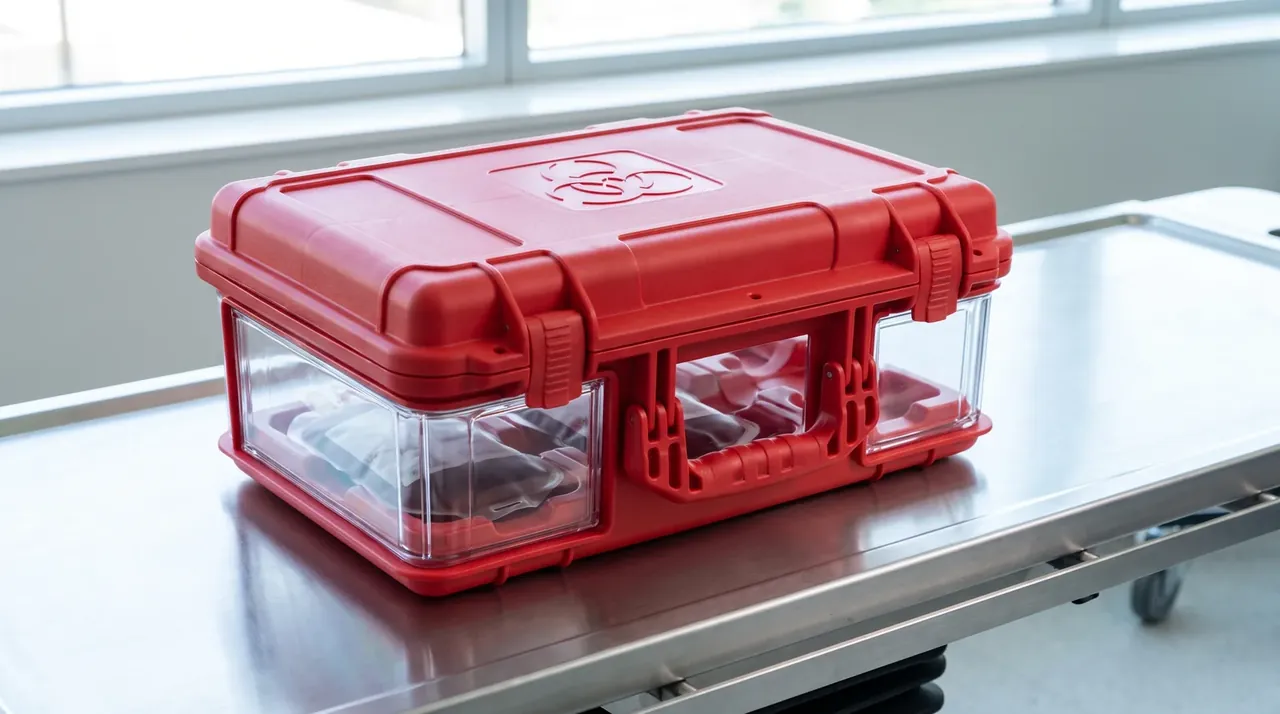
Immersion follows the IP67 wording. IEC 60529 fixes the second digit at 7 to 1 m of water for 30 min, with the lowest point 1000 mm below the surface; IPX8 demands more than IP67, for at least 1 h, at a depth the maker defines, so quoting IP67 needs no IPX8 language. The seal groove compresses to 30 percent and two catches press along the long edge.
Temperature and finish are separate checks. A range of −20 ℃ to 60 ℃ covers a winter platform and a van in summer sun; ABS loses about half its notched impact at −20 ℃, so cold drops read on shell cracking, not deflection. The Medical handheld analyzer safety hard box lists 500 ethanol wipes as a surface test, never as ingress proof.
5. Handle, Hanger and Wrist Strap Load Split
On the Medical handheld analyzer safety hard box, three points share 3.4 kg. The folding handle takes the whole weight, checked at 100 N or three times static, with four bosses on a 76 mm pitch feeding ribs along the lid centreline. The side hanger sees 33 N in a single-point hang, checked at 66 N, on a metal insert through the full wall. The wrist strap carries no case weight; it takes the ≤35 N reaction at lid opening and is checked at 50 N without release.
| Point | Share of load | Check value |
|---|---|---|
| Folding handle | all 3.4 kg of the loaded case | 100 N, three times static |
| Side hanger | 33 N single-point hang | 66 N, twice static |
| Wrist strap | ≤35 N lid reaction | 50 N without release |
None substitutes for another. The Medical handheld analyzer safety hard box spaces the three more than 90 mm apart, so one failure cannot take a second.
Conclusion
The Medical handheld analyzer safety hard box answers one moment: the single left-hand opening on a platform. A ≤35 N lift, a catch 45 mm from the corner and a 105 degree stop fix that sequence. A 340 by 265 by 120 mm outer, a 300 by 225 by 85 mm cavity and a 2.8 mm wall hold 3.4 kg loaded. Nine drops from 1.2 m and 30 min at 1 m are the case-side checks. JUNZHIJIA delivers to that specification.
This article covers case-side specification and design intent only. It does not address any handling, loading or use of the items carried inside.
Related Reading
- Working out usable volume from cavity size and corner radii
- How a custom foam insert pocket gets cut
- Anti-static lining in precision instrument cases
- Waterproof and shock-rated terms for portable instrument cases
Related Products
- 8 Series — Gun Cases; Military Equipment Cases; Camera Equipment Cases; Drone Cases; Watch Cases; Knife Cases; First Aid Cases; Electronics Equipment Cases
- WL8-2812 PP Gun Case — model WL8-2812
- All protective cases and toolboxes: 7 series, 158 models