

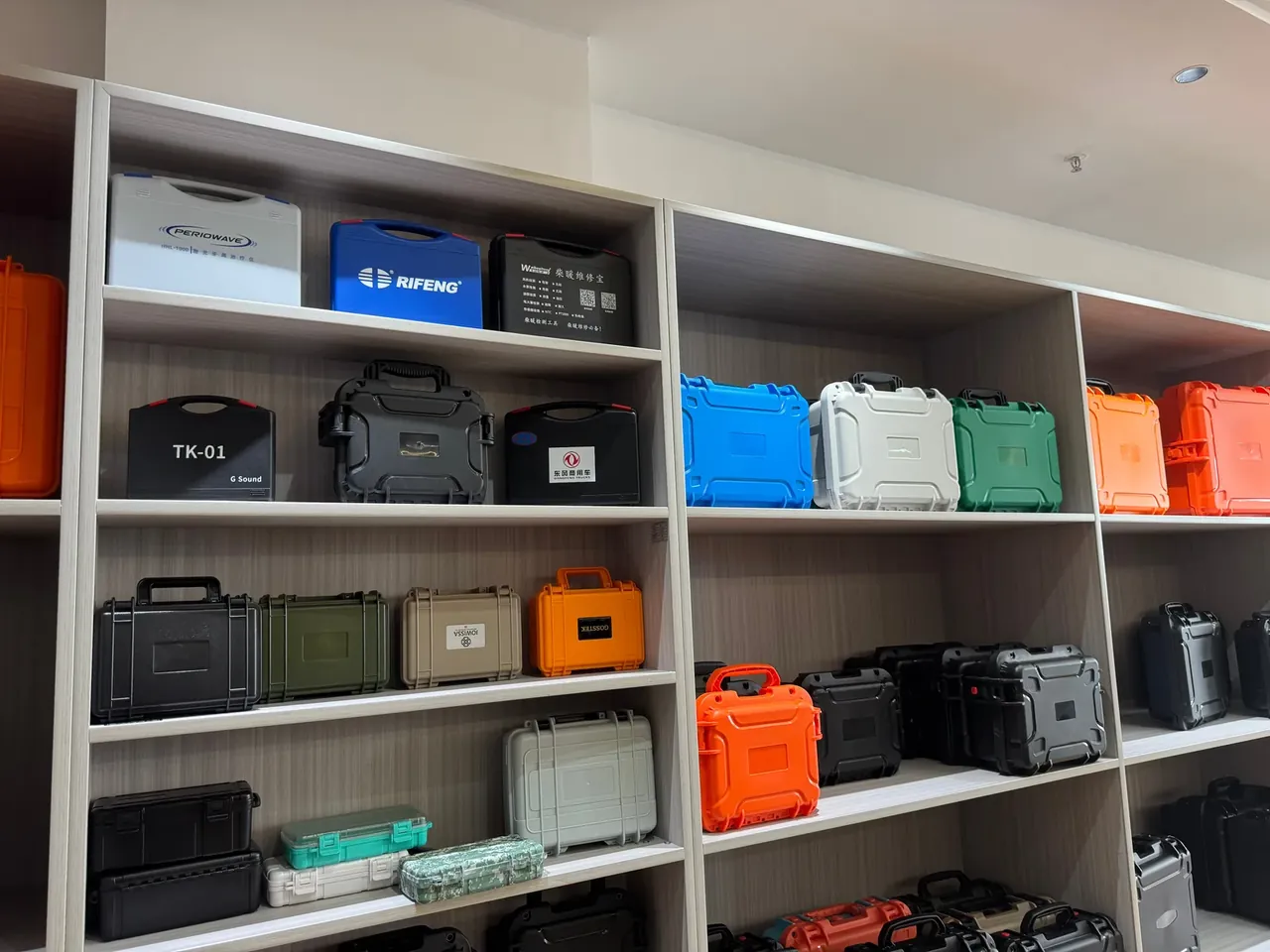
Quick answer: Medical infrared thermometer protective box takes six units per lid lift, turning a 4 s open-and-close cycle into 0.7 s per unit.
Table of contents
- Batch handling rhythm of the Medical infrared thermometer protective box
- Why six bays measure 90 by 70 by 95 mm
- Lid travel of 105° and the one-hand clearance
- How five stacked cases load the bottom shell
- What wiping does to the moulded grain
- FAQ
1. Batch handling rhythm of the Medical infrared thermometer protective box
At a screening lane the lid cycles a hundred times a day, and pace is set by how many units one lift covers. The Medical infrared thermometer protective box splits its cavity into six bays, so one lift carries six cycles; at 4 s for lift plus close, cost per unit falls to 0.7 s. Footprint is 420 by 320 mm with 60 mm of finger clearance front and back.
A 3.0 mm rim chamfer then guides the lid home, so nobody looks down to align it, and a 90 by 70 mm bay leaves 60 mm of width at 95 mm depth.
2. Why six bays measure 90 by 70 by 95 mm
The cavity is 380 by 280 by 110 mm: six cells, two along the 380 mm axis and three along the 280 mm, with 2.0 mm dividers. The cells cover 37,800 mm² of a 106,400 mm² floor, 35.5 percent, with the rest going to handle bosses, ribs and end buffer chambers.
The 15 mm gap covers the rib grid and seating tolerance. Ribs stand 6 mm at 70 mm pitch in line with the dividers, so each divider foot lands on a rib and load reaches the base rather than a 3.0 mm floor. Dividers run full depth, so the lid gasket shuts each bay as its own compartment.
| Axis | Occupied length | Where the rest goes |
|---|---|---|
| 380 mm | 2 by 90 = 180 mm | 200 mm to handle bosses and end chambers |
| 280 mm | 3 by 70 = 210 mm | 70 mm, 35 mm of rib land each side |
| 110 mm depth | 95 mm | 15 mm to rib height and seating tolerance |
The Medical infrared thermometer protective box uses a 2.0 mm divider wall that bridges the rim joint and closes in one motion.
3. Lid travel of 105° and the one-hand clearance
The lid is 320 mm on a rear hinge. At 105° the leading edge rises 320 by sin 75°, about 309 mm, and the open case stands near 459 mm, which on a 900 mm bench puts the edge 1,359 mm off the floor.
The stop also settles the lid: its centre of gravity passes 15° beyond the hinge vertical, so it rests on its own weight. At 90° the centre sits on that vertical, and a knock tips it forward and costs one hand.
The cost lands behind the case. The edge crosses 320 by sin 15°, about 83 mm, past the hinge, so a Medical infrared thermometer protective box against a wall stops near 75° with the edge over the opening. Damping changes fall speed, not which side of the vertical the centre sits on.
| Lid angle | Edge rise | Edge relative to hinge |
|---|---|---|
| 75° | 309 mm | 83 mm over the opening, blocking |
| 90° | 320 mm | on the vertical, tips forward |
| 105° | 309 mm | 83 mm behind the hinge, self-supporting |
Keep 85 mm clear behind the case; where that is impossible, use 90° with a stay.
4. How five stacked cases load the bottom shell
A loaded Medical infrared thermometer protective box is 7.9 kg, 2.5 kg empty plus 5.4 kg. Five high, the bottom unit carries 4 by 7.9, or 31.6 kg, about 310 N. The force enters four locating bosses and follows the shell posts down at 77.5 N per corner over an 8 mm radius.
Held 24 hours under static load, the bottom case must settle no more than 2.0 mm and recover to within 1.0 mm. A case can survive 31.6 kg and still take a set past 1.0 mm, after which the next stack creeps.
| Tier | Mass from above | Criterion |
|---|---|---|
| Bottom | 31.6 kg from four cases | settle ≤2.0 mm at 24 h, set ≤1.0 mm |
| Middle | 15.8 kg from two cases | locating bosses stay seated |
| Top | none | lid face free of dents, bosses intact |
The top tier looks unloaded yet is most often marked: anything set down lands over a bay, with the lid land the only path. The Medical infrared thermometer protective box runs that land the full divider width.
5. What wiping does to the moulded grain
The Medical infrared thermometer protective box takes its grain from an etched mould at 0.08 mm depth, 4° draft per side, roughness Ra 1.6 to 3.2 µm. Past 0.15 mm the valleys hold wipe solution and streak white; below 0.03 mm the finish stops hiding scuffs. At 0.08 mm with 4° draft a 3.0 mm wall releases without dragging.
Three passes a day makes 90 a month, so 500 passes is about five and a half months. Acceptance is no chalking and a depth change within 0.01 mm, with a chlorine set checked for bloom in the valleys.
The Medical infrared thermometer protective box is benchmarked to IP54, dust against the 8 h talc cycle of IP5X and water against the 10 L/min spray of IPX4. The −10 °C to 55 °C band covers a sunlit lane mouth and a winter tent. These are targets verified by method, not certificates.
Conclusion
The Medical infrared thermometer protective box treats rhythm as three parts: a 105° lid resting on its own weight, six 90 by 70 by 95 mm bays turning one lift into six cycles at 0.7 s, and a rim chamfer that lets the case close unaimed. Five-high stacking puts 31.6 kg on the bottom unit against 2.0 mm of settling and 1.0 mm of set, while the 0.08 mm grain and 4° draft survive 500 wipe passes. The 420 by 320 by 150 mm shell and 3.0 mm wall keep size, mass and hardware on one dimension chain.
Related Reading
- Hard case terms for infection-control test devices
- Divided inserts and reach channels in diagnostic cases
- Cavity volume and usable ratio after corner radii
- Surface finishes for frequently wiped medical plastic boxes
Related Products
- 8 Series — Gun Cases; Military Equipment Cases; Camera Equipment Cases; Drone Cases; Watch Cases; Knife Cases; First Aid Cases; Electronics Equipment Cases
- WL8-2812 PP Gun Case — model WL8-2812
- All protective cases and toolboxes: 7 series, 158 models