

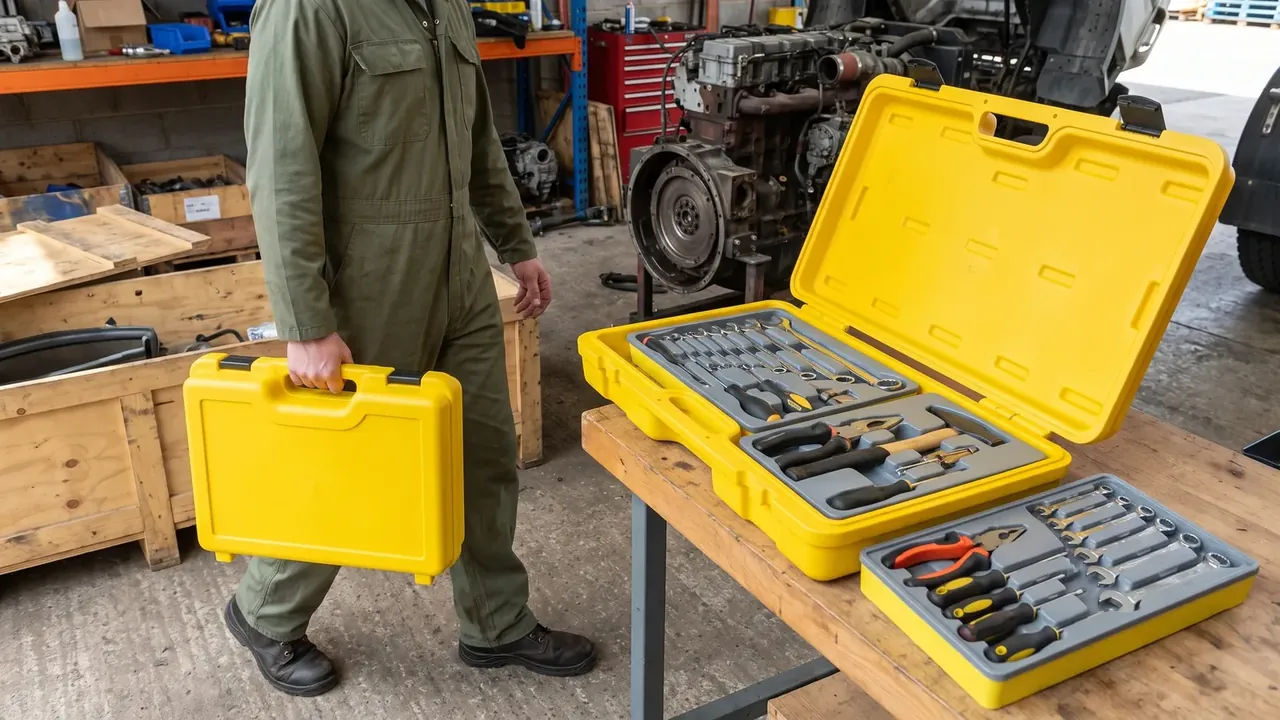
Quick answer: A Medical polymer plastic sealed tool box pairs a 4.8 mm groove with 6.2 mm of latch travel, reading the mouth drop after 48 h at 40 °C and 93% RH.
Table of contents
- Groove depth on a Medical polymer plastic sealed tool box
- Latch compression travel
- Mouth pressure drop after damp-heat cycling
- Groove recovery after unloading
- Depth setting for the medical batch
- FAQ
1. Groove depth on a Medical polymer plastic sealed tool box
How tightly a gasket seats depends on whether groove depth and latch travel are matched; after damp-heat cycling the mouth pressure drop reads the difference straight out. The shell is 420 by 310 by 150 mm outside, 375 by 265 by 110 mm inside, with a 3.6 mm wall, and a 4.8 mm gasket groove milled around the mouth. A Medical polymer plastic sealed tool box lists groove depth in the first cell of the damp-heat ledger, and voids the grade whenever the mould or groove profile changes.
Three groove grades run on one pressure rig and one gasket. Once depth drifts outside moulding tolerance, the drop is skewed by the groove wall before latch travel enters.
| Groove grade | Groove depth | Latch travel |
|---|---|---|
| Shallow | 4.2 mm | 6.2 mm |
| Nominal | 4.8 mm | 6.2 mm |
| Deep | 5.4 mm | 6.2 mm |
The shallow grade lifts the third-cycle drop to 0.31 kPa; the deep grade pulls it to 0.18 kPa but pushes each latch toward its 300 N limit. Only the 4.8 mm grade holds drop and recovery inside both limits at once. On a Medical polymer plastic sealed tool box the shallow grade is not a resin failure: a short groove wall cannot hold 17% compression through recovery.
2. Latch compression travel
A 6.2 mm latch travel is the second grading quantity, the distance the lid plate moves from engaging the catch to seating the rim. The single gasket must be compressed evenly to 17% around the mouth, not merely pressed down. Two latches at 300 N each share one sheet with the travel figure, and a missing cell keeps the shell out of the damp-heat ledger.
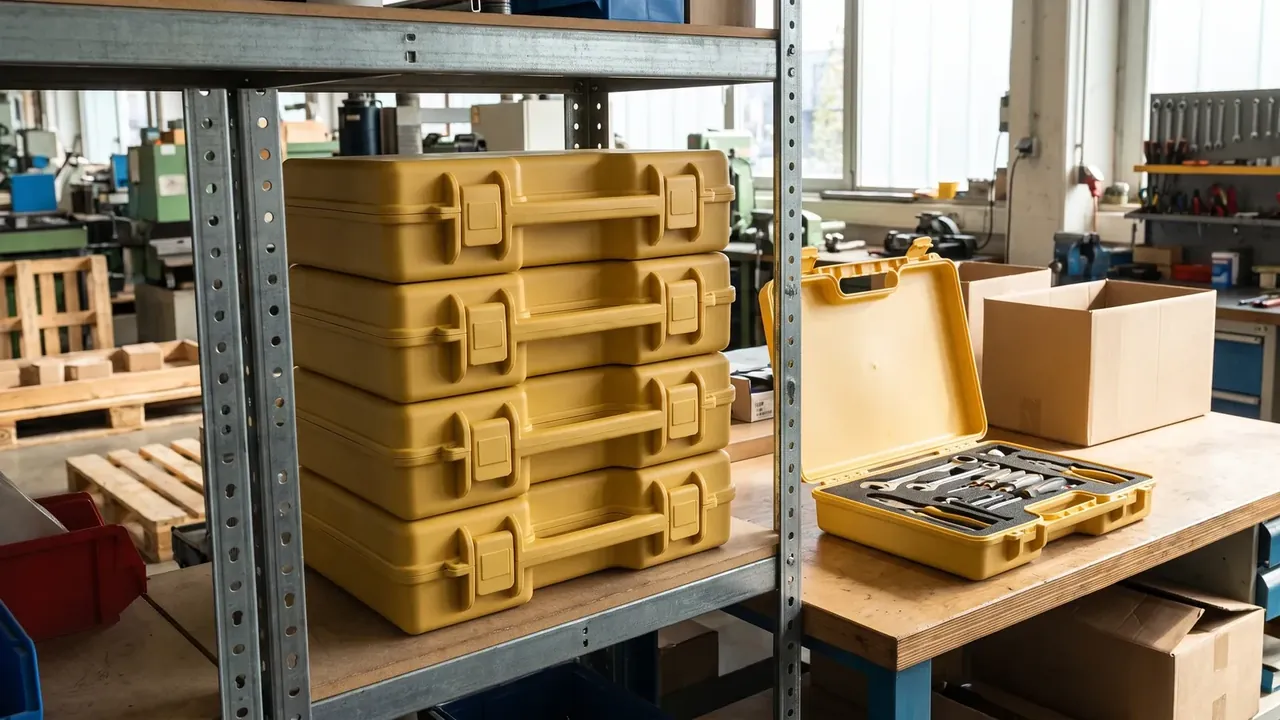
Tightening the two latches independently is not enough. A left-right travel difference beyond 0.3 mm slackens one side of the mouth first, and a high drop is then wrongly blamed on groove depth. The lid record for a Medical polymer plastic sealed tool box files travel and latch force together, with the 2.9 kg empty and 6 kg loaded limits frozen alongside; a new mould sends travel and cycling back to the start.
3. Mouth pressure drop after damp-heat cycling
The damp-heat cycle is fixed at 40 °C, 93% RH and 48 h, with the closed shell run through 3 cycles. After each round it settles, then a differential gauge reads the mouth drop over 10 min to 0.01 kPa. Judgment uses the third-cycle reading, not a running total, since the limit asks whether groove and latch still hold seal margin after damp heat. A Medical polymer plastic sealed tool box sets its gate on round three; earlier rounds are direction only.
| Cycle index | Mouth drop | Groove recovery |
|---|---|---|
| First | 0.14 kPa | 96% |
| Second | 0.20 kPa | 94% |
| Third | 0.25 kPa | 92% |
The drop reads 0.14 kPa, 0.20 kPa and 0.25 kPa across the three cycles, growing faster late in the run as damp heat accumulates. A drop of 0.25 kPa per 10 min and a recovery of 92% fill two cells of one release sheet; one filled cell is no pass. A Medical polymer plastic sealed tool box files the stretch beyond three cycles without a grade, and the ledger takes only the third-round row.
4. Groove recovery after unloading
Cycling does not end in a verdict; the latches are released and the groove remeasured after settling. Recovery is the share of the 4.8 mm depth the gasket returns to once freed from 17% compression, taken as the smallest of four points around the mouth. Drop asks whether the mouth leaks now; recovery asks whether the groove still springs back.
| Drop value | Groove recovery | Open-close cycles |
|---|---|---|
| 0.14 kPa | 96% | 4600 |
| 0.20 kPa | 94% | 4600 |
| 0.25 kPa | 92% | 4600 |
Across the rows, 0.14 kPa pairs with 96% recovery and 0.25 kPa with 92%: the closer the drop sits to the limit, the thinner the gasket margin. A shell weighed but never unloaded earns no grade, and this recovery counts only after the 48 h cycle. The Medical polymer plastic sealed tool box files both cells side by side, and an empty one blocks release.
5. Depth setting for the medical batch
The medical batch closes on one line rather than rereading every cycle. The depth setting is the shallowest groove whose third-round drop stays under 0.25 kPa; anything shallower goes to non-sealed stock. A batch freezes 2.9 kg empty, 6 kg loaded, the 40 °C / 93% RH / 48 h cycle, 4600 cycles and two latches at 300 N; a new mould restarts the checks.
No single sample stands for the batch. Groove grade, latch travel, third-round drop and unloaded recovery are logged for every shell, and four matching cells admit it; one crossed cell sends only that shell back. For a Medical polymer plastic sealed tool box moulding parameters and damp-heat readings sit in separate columns, and IP67 is logged against a benchmark method only.
Conclusion
Setting a Medical polymer plastic sealed tool box means lining up three cells of readings, not one drop figure: a 4.8 mm groove holds the drop to 0.25 kPa, a 6.2 mm travel keeps the gasket at 17% through 40 °C and 93% RH, and unloaded recovery stops at 92%. A crossed cell sends that shell back, borrowing no margin from another. JUNZHIJIA files 4600 open-close rig records by batch; drawing tolerances come from Kexin New Materials (Guangdong) Co., Ltd.
Related Reading
- EPE Foam vs EVA Foam in a Tool Box: What Is the Difference?
- Autoclave Sterilizer Cases: Chamber & Door Seal Component Protection
- Medical Case: Instrument Zoning and Sterilization Compatibility
- What Do the Hinge, Latch and Gasket on a Toolbox Actually Do?
Related Products
- 8 Series — Gun Cases; Military Equipment Cases; Camera Equipment Cases; Drone Cases; Watch Cases; Knife Cases; First Aid Cases; Electronics Equipment Cases
- WL8-2812 PP Gun Case — model WL8-2812
- All protective cases and toolboxes: 7 series, 158 models