

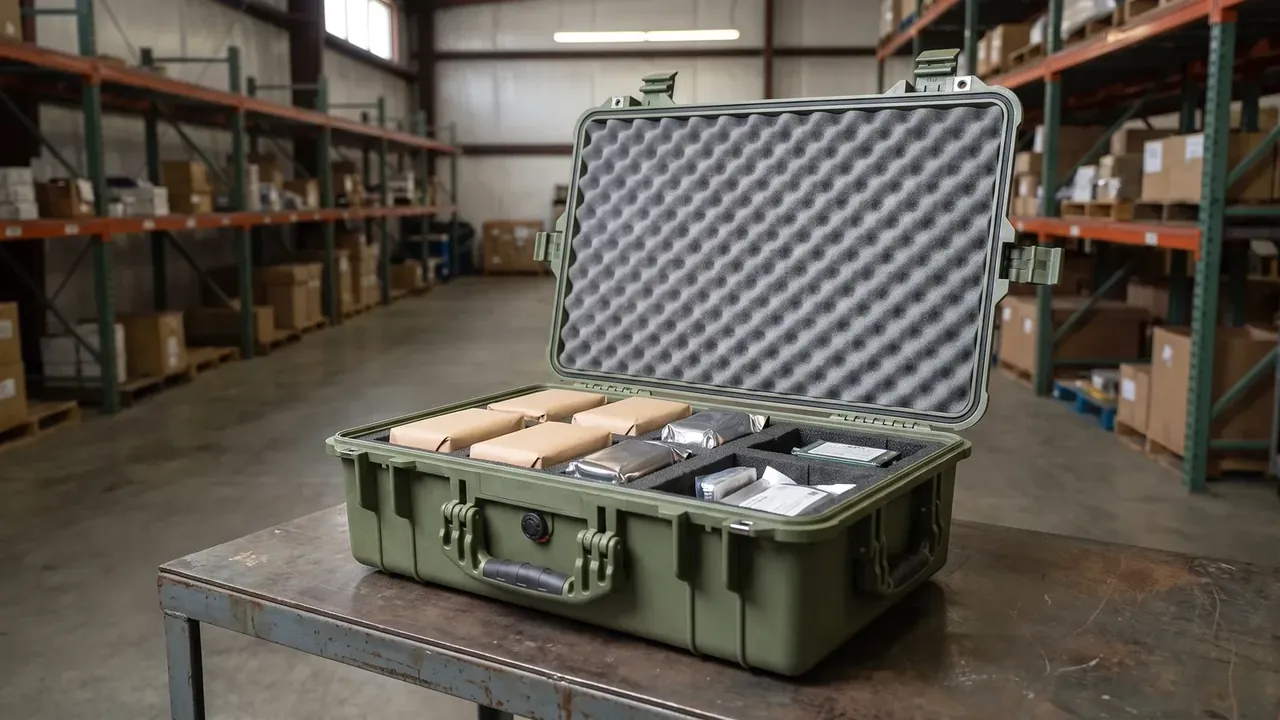
Quick answer: Medical portable X-ray machine hard case pairs a 9 mm platform with 55 A corner pads, holding flatness to 0.6 mm after a 5-200 Hz / 3 h sweep.
Table of contents
- Medical portable X-ray machine hard case load-platform thickness
- Stiffness matching of the four corner damping pads
- Flatness readings across the sweep band
- Bench judgement for resonance avoidance
- Platform scrap threshold for the portable batch
- FAQ
1. Medical portable X-ray machine hard case load-platform thickness
The Medical portable X-ray machine hard case measures 590 x 410 x 240 mm outside, with a 520 x 345 x 170 mm cavity, a 4.3 mm shell wall and a separate 9 mm load platform. The platform seats on a recessed step over the base ribs, giving one datum face that can be measured before and after vibration, with its four corners locked by screws. JUNZHIJIA takes its top surface as the geometric reference for all flatness, gap and latch readings.
A thicker platform is not automatically better. The 9 mm tier matches a 6.1 kg empty case and a 13 kg loaded case; drop to 7 mm and corners sag after a sweep, while 11 mm eats the 170 mm cavity height. The Medical portable X-ray machine hard case writes 9 mm into the drawing tolerance band and checks each platform at three points.
A sealing lip closes the joint, with one gasket at 21% compression and 2 front latches each rated 365 N. Weak latch preload lets the lid chatter during a sweep and folds shell deformation into the platform reading. The Medical portable X-ray machine hard case tightens the two latches diagonally before the bench log starts.
2. Stiffness matching of the four corner damping pads
One damping pad sits under each corner, four in total at 55 A Shore hardness. Together with the 9 mm platform and the 13 kg load, that value keeps natural frequency clear of 18 Hz; mixing hardness values twists the platform into diagonal warp. The Medical portable X-ray machine hard case lists all four pads under one part number and one lot, rejecting anything more than 3 A off.
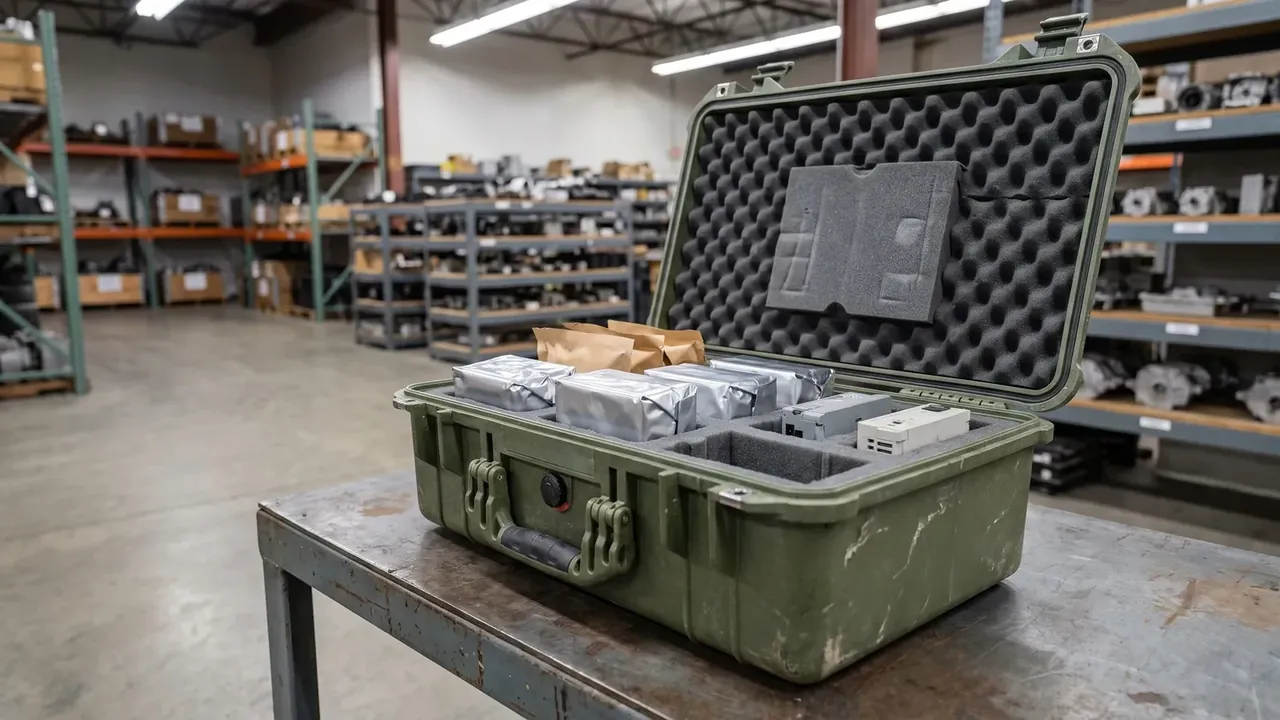
Stiffness matching also fixes pad travel. At 6.1 kg empty the pad compresses little, at 13 kg loaded it reaches its working range, and the height delta between the two must stay predictable. The Medical portable X-ray machine hard case logs both readings in one table and remeasures the delta after 4400 open-close cycles, sending a drifting pad back for a permanent-set check.
Keyed by platform thickness tier, the table below records corner sag and natural-frequency landing after a 5-200 Hz / 3 h sweep.
| Platform thickness tier | Corner sag | Natural frequency |
|---|---|---|
| 7 mm | 0.9 mm | 16.4 Hz |
| 9 mm | 0.2 mm | 22.1 Hz |
| 11 mm | 0.1 mm | 25.8 Hz |
The 9 mm tier lands at 22.1 Hz, clear of 18 Hz, with corner sag of 0.2 mm inside the 0.6 mm flatness budget.
3. Flatness readings across the sweep band
The sweep runs from 5 Hz to 200 Hz over 3 h across the 5-200 Hz / 3 h band. The Medical portable X-ray machine hard case is not opened mid-run; at fixed points it samples nine platform heights, fits a datum plane by least squares, and takes the largest deviation as flatness. Verdicts come from a static remeasure after vibration: flatness of 0.6 mm or less is kept, and anything above returns to check platform and pad fit.
Low frequencies test pad travel, high frequencies test platform stiffness. Keyed by frequency band, the table below records peak flatness and the dominant site.
| Frequency band | Peak flatness | Dominant site |
|---|---|---|
| 5-20 Hz | 0.34 mm | Corner pad compression |
| 20-80 Hz | 0.51 mm | Long-edge midspan |
| 80-200 Hz | 0.28 mm | Recessed step edge |
The 80-200 Hz value falls back because the 9 mm platform stops following shell resonance at high frequency. The Medical portable X-ray machine hard case concentrates remeasurement on 20-80 Hz and keeps other bands as trend logs. Ambient temperature and clamp force are filed with the readings.
4. Bench judgement for resonance avoidance
Keeping natural frequency clear of 18 Hz is the hardest line here. A low-level sine sweep locates the resonance peak; if it lands within plus or minus 2 Hz of 18 Hz, pad hardness or platform thickness is adjusted before the formal 3 h sweep. The Medical portable X-ray machine hard case uses this as an entry gate, accepting one extra clamp rather than letting resonance pollute the flatness data.
Two rechecks follow. Drop testing is 1.0 m on all six faces with flatness measured right after, and open-close runs 4400 cycles before latch force and gasket compression are remeasured. The Medical portable X-ray machine hard case requires flatness still at 0.6 mm or less, each latch at 365 N or more, and gasket compression near 21% before release. IP65 dust and spray conditions serve only as a mouth-sealing reference, kept out of flatness verdicts.
5. Platform scrap threshold for the portable batch
The batch closes on the flatness value; the table below gives the three dispositions.
| Flatness value | Bench verdict | Batch action |
|---|---|---|
| 0.4 mm or less | Ample margin | Release directly |
| 0.4-0.6 mm | On the line | Add one sweep |
| above 0.6 mm | Over budget | Return for platform and pad check |
A 0.4-0.6 mm unit takes one more 5-200 Hz / 3 h run, and both readings must sit on the line before release.
The 0.6 mm scrap line absorbs 9 mm machining spread, 55 A hardness scatter and residual deformation after 3 h sweeping. JUNZHIJIA works to one drawing tolerance band, with the bench method written as reproducible steps.
Conclusion
The Medical portable X-ray machine hard case ties a 9 mm load platform, 55 A corner pads and a 5-200 Hz / 3 h sweep into one reproducible reading chain, closing on flatness of 0.6 mm or less and natural frequency clear of 18 Hz. The 590 x 410 x 240 mm outside, 4.3 mm wall, 2 latches and one gasket keep shell deformation out of the readings. JUNZHIJIA draws to one shared tolerance band, so one lot reads like the next.
Related Reading
- Medical anti-static precision instrument safety case
- Hospital transfer case sealing and marking
- Medical equipment and device case series
- Medical case applications at first-aid points and in vehicles
Related Products
- 8 Series — Gun Cases; Military Equipment Cases; Camera Equipment Cases; Drone Cases; Watch Cases; Knife Cases; First Aid Cases; Electronics Equipment Cases
- WL8-2812 PP Gun Case — model WL8-2812
- All protective cases and toolboxes: 7 series, 158 models