

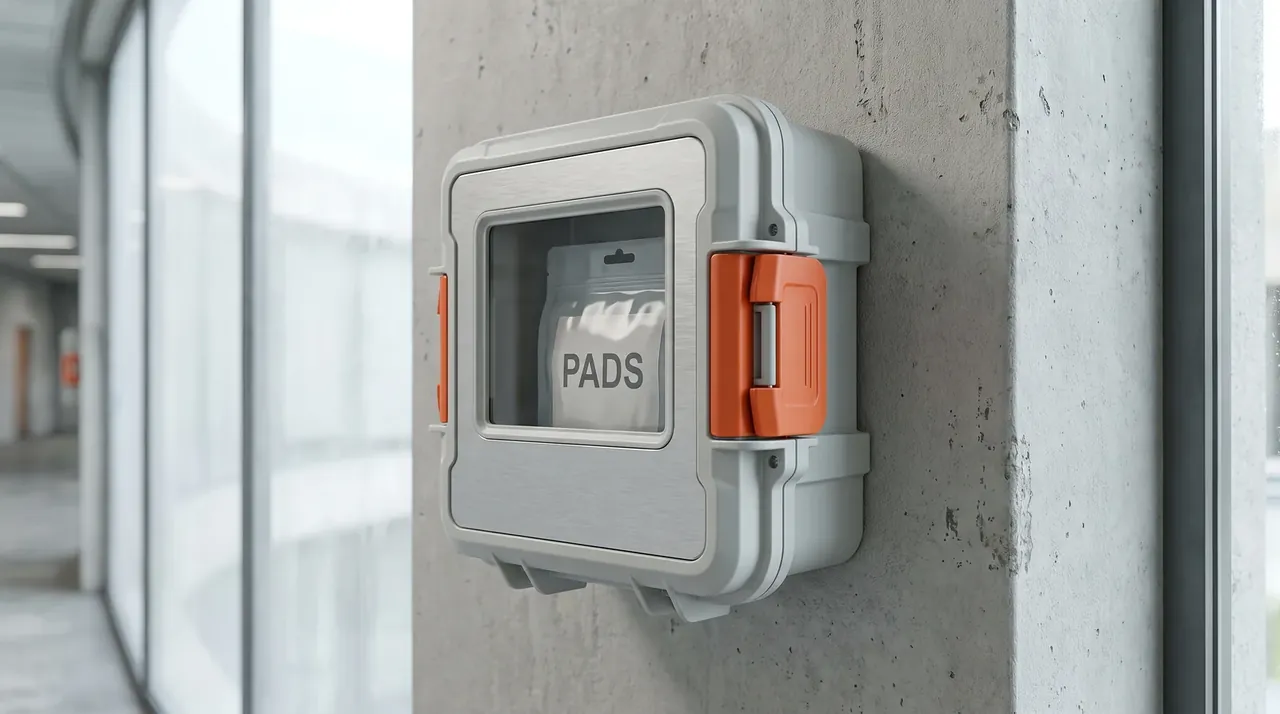
Quick answer: A Medical Power Equipment Case must balance heat, insulation and leakage current at once. Open too many vents and dust wins; close them and heat wins.
Table of contents
- Heat: offsetting the intake and exhaust
- Insulation: shell material and creepage
- Leakage current and the earth terminal
- A separate battery bay
- Charging versus storage
- FAQ
Heat: offsetting the intake and exhaust
Two vents, one in and one out, is the cheapest layout and the easiest to get wrong. Put them face to face and air runs straight from entry to exit while the middle of the Medical Power Equipment Case sits at the edge of the stream. Move the exhaust to another face and air has to travel past the boards and the transformer, which is where the heat is. The offset costs static pressure, so choose the fan on pressure rather than free-air flow.
Forced air has a price: an opening ends the sealed shell, and any immersion rating goes with it. Most Medical Power Equipment Case designs use a labyrinth instead, louvres facing down outside, a second bend inside, a replaceable filter mat between the two. That mat is the only consumable on a schedule, and once it loads, airflow falls faster than expected and the interior warms before any component derates.
Natural convection still works at low power. Bolt hot parts to a spreading face, mould ribs outside, and the vent becomes a breather rather than a duct. Decide by measuring after two hours at full load, with 45 ℃ as the ceiling on that line.
| Vent layout | Air path | What it costs |
|---|---|---|
| In and out on one face | Shortest possible route | Mid-case parts get no air |
| Offset to an opposite face | Diagonal across the shell | Higher resistance, needs pressure |
| Low in, high out | Buoyancy assists | Intake blocks with floor dust |
Insulation: shell material and creepage
A plastic shell is an insulator, and trouble starts where it is thin or dirty. Creepage is quoted at a typical 8 mm, the shortest path along an insulating surface between two live parts, and the places that shorten it are vent cut-outs, screw bosses and metal inserts. Split the high-voltage and low-voltage halves to opposite ends and keep an unbroken band between them.
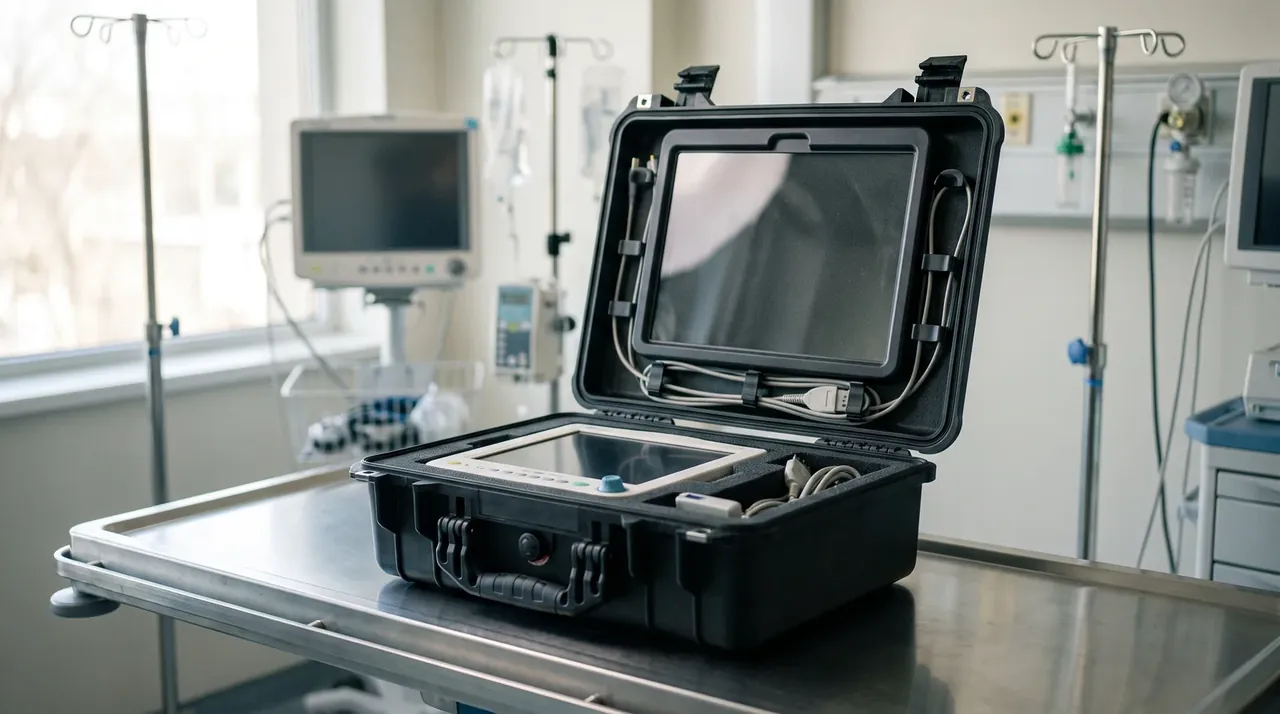
Material choice turns on comparative tracking index. Ordinary ABS carbonises a conductive track across a damp, contaminated surface, and that track does not heal. Near the live side, a higher-tracking grade is worth the money, or simply widen creepage one step. A withstand of 4 kV for 1 min is the figure usually quoted here, and it tests thickness and surface path together.
Metal inserts are the part everyone forgets. Handle bosses, hinge bosses and earth studs all need brass inserts, and a Medical Power Equipment Case checked on air clearance alone misses the surface route, so the 8 mm is cut in two at the boss root. Mould a raised pad so the surface path has to travel around it.
Leakage current and the earth terminal
Leakage current is the only one of the three a meter can settle. The industry figure for enclosure leakage in normal condition is 100 µA or less, and that number decides how the earth is routed, not the reverse. Run a dedicated conductor from the terminal to the metalwork; a hinge has clearance and a latch has coating, and neither is a dependable bond.
Position matters. A terminal low on the shell, near the cable entry, gives the shortest lead and is least likely to be crushed. A terminal inside the lid looks tidy, but every opening flexes the same length of wire, and after a few hundred cycles the strand breaks inside the ferrule. An earth stud on a Medical Power Equipment Case also has to be checkable with the lid open, without peeling back foam.
Filter capacitance bleeding to earth is the other source, and it sits inside the supply where the shell has no say. What the shell controls is not adding a path of its own: a metal bracket one thin layer from a live part becomes a shunt the moment moisture arrives.
A separate battery bay
The bay has to stand alone: its own walls, clamping points and vent direction, not one extra divider. A 24 V/10 Ah pack can release enough energy in a short circuit to burn through the inner wall, so the divider needs a flame-retardant grade and the seams need pressure relief rather than a full seal.
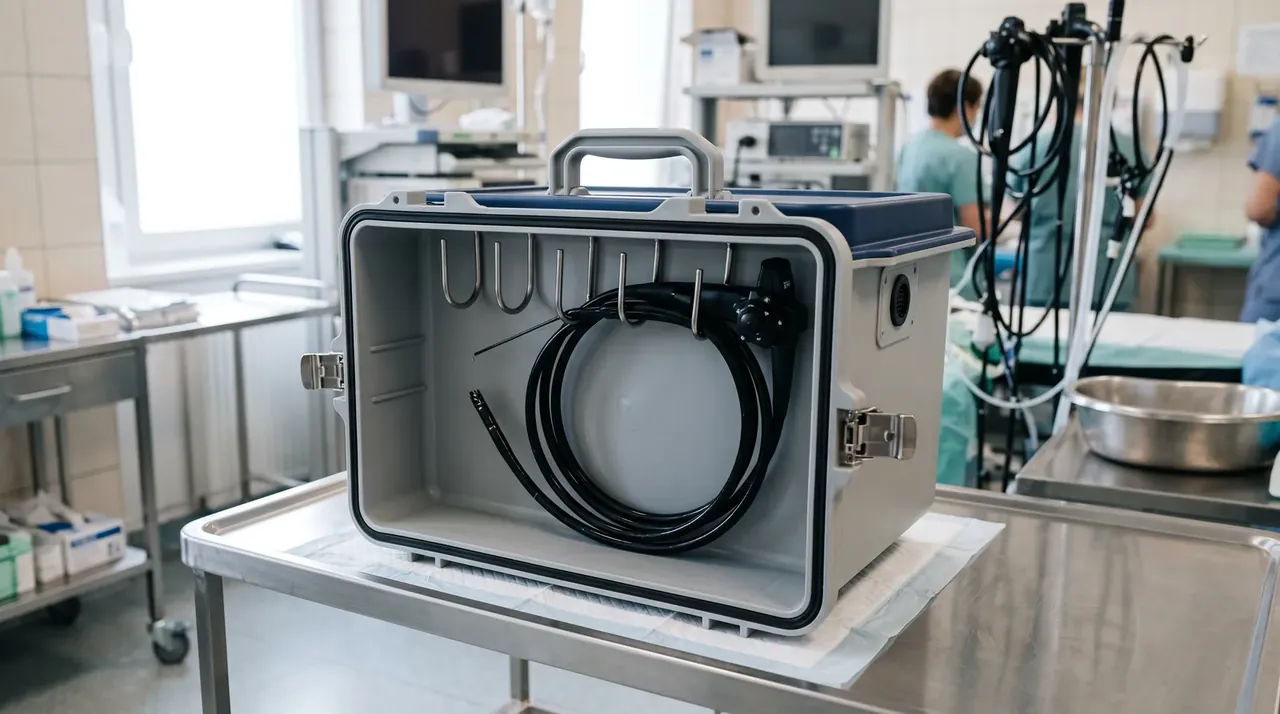
Service is the second reason the bay stands apart on a Medical Power Equipment Case. A battery is life-limited, and a swap should touch the bay alone, so build it as a tray that slides out whole with terminals facing outward. Three hours is a normal charge time, and the bay needs room to shed that heat, which rules out stacking the pack against the adapter.
Charging versus storage
Charging and storage behave differently inside a Medical Power Equipment Case. While charging, pack and adapter both produce heat and the interior peaks; in storage the interior follows ambient, but a pack held at full charge ages faster. The usual compromise is to charge with the lid open or half open, then store closed at about half charge.
A 10 ms UPS transfer belongs to the equipment specification, yet it decides how much undisturbed volume the pack and board need: the transfer lasts 10 ms, while the shell must hold both blocks for a service life. Once their position is fixed, the foam cavities should not be redrawn.
The two states want opposite things from the vents, since charging needs airflow and storage needs closure. A sliding shutter beats two fixed openings: shut, it is a dust-resistant case; open, it is a cooled one. Half the temperature rise of a Medical Power Equipment Case comes from the components, the other half from that shutter.
Conclusion
Heat wants more openings, insulation wants more distance, and leakage current has the final vote. Shutter the vents with a labyrinth, route the 8 mm surface path around the inserts rather than through them, and put the earth stud where a lid-open check can reach it. Settle those three and the Medical Power Equipment Case stops going back for another round.
This article discusses the enclosure side of specifications and design intent only, not the handling, loading or use of anything carried inside.
Related Reading
- Transport protection and fixing for infusion pumps
- Transport fixing and cushioning for medical devices
- Choosing a gasket-sealed protective case
- What an IP67 protective case rating really covers
Related Products
- 8 Series — Gun Cases; Military Equipment Cases; Camera Equipment Cases; Drone Cases; Watch Cases; Knife Cases; First Aid Cases; Electronics Equipment Cases
- WL8-2812 PP Gun Case — model WL8-2812
- All protective cases and toolboxes: 7 series, 158 models