

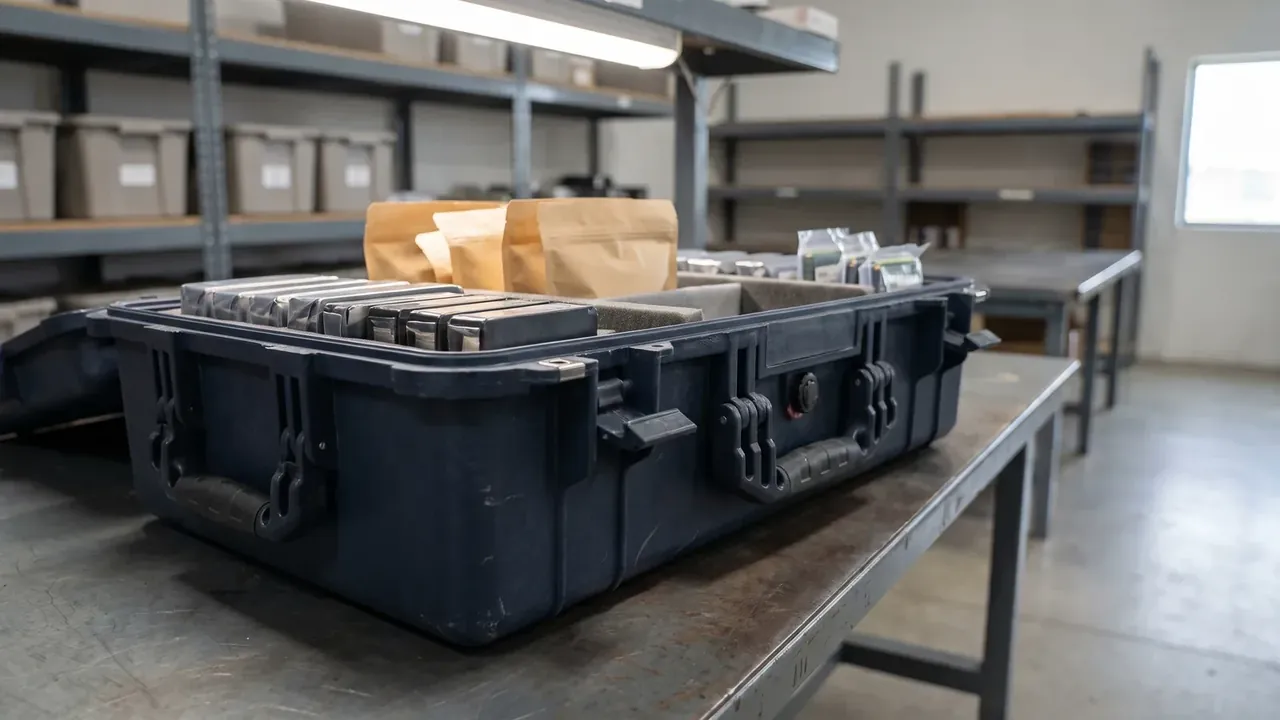
Quick answer: A Medical sterile dressing moisture-proof box keeps 7.5 mm lid overlap and 16% compression; after 168 h at 40°C / 90%RH the cavity stays below 32% RH.
Table of contents
- Lid overlap of the Medical sterile dressing moisture-proof box
- Gasket compression bands
- Cavity humidity after 168 hours of damp heat
- Lid-rim offset on reopening
- Overlap setting for the moisture-proof batch
- FAQ
1. Lid overlap of the Medical sterile dressing moisture-proof box
Seven full days inside a damp-heat rig come down to one question: does the hatch still lap the rim, and has cavity humidity crept upward? Read the indicator card once on reopening and the answer is plain. The Medical sterile dressing moisture-proof box puts that whole barrier on a single lap between the desiccant hatch and the case mouth. With an outer 470×335×165 mm shell, a 405×275×115 mm cavity and 3.8 mm walls, the hatch overlap is set to 7.5 mm, and the lap edge is felt by hand before the rig is even switched on.
A wider lap is not automatically the easier choice. The 7.5 mm value is worked back from two gasket rings held at 16% compression: go narrower and the rings will not seat, go wider and the two latches rated at 310 N each may fail to pull the lid down fully. When the Medical sterile dressing moisture-proof box is moulded, hatch ribs line up with the mouth ribs, rivet points are spaced evenly along the lap, and the liner is pressed flat against the inside of the lid.
2. Gasket compression bands
The 16% figure is derived from the 40°C / 90%RH condition, so banding leaves it fixed and varies only the hatch overlap. The Medical sterile dressing moisture-proof box writes that compression on the top line of the spec sheet and counts each of the two rings on its own.
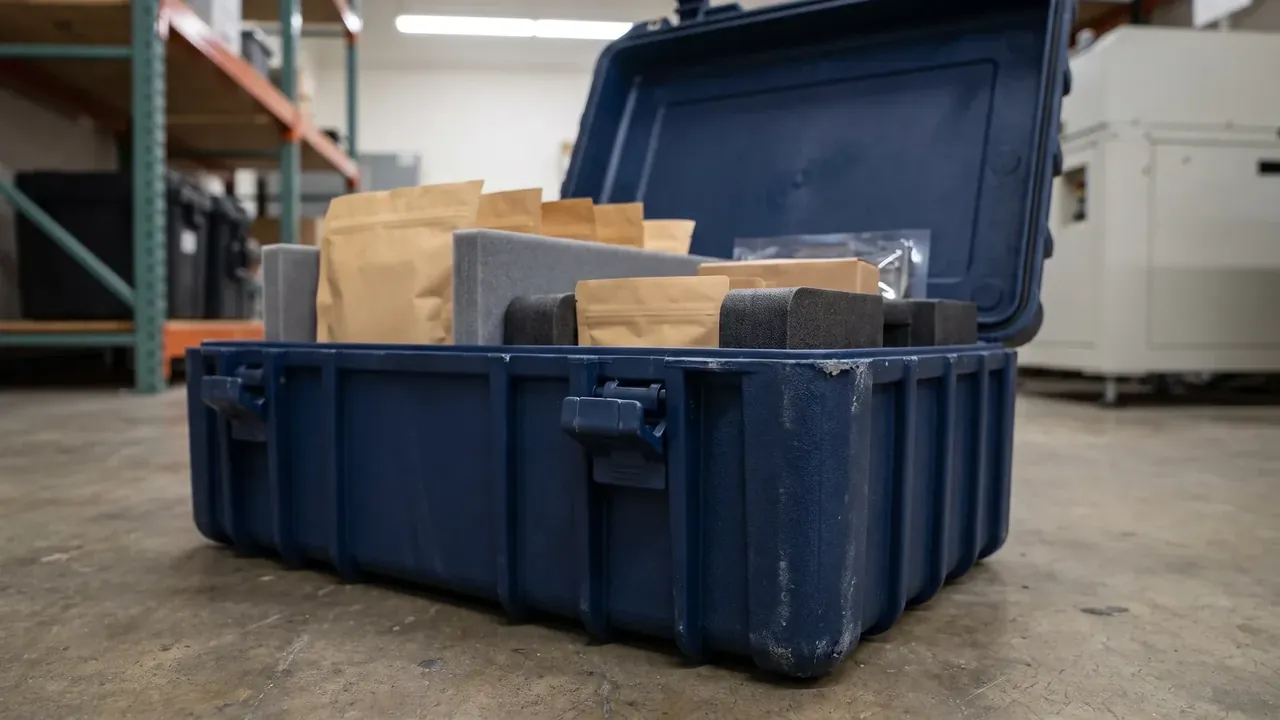
Banding is not guesswork. Each overlap band maps onto a set of rig readings, compression and overlap move together, and the Medical sterile dressing moisture-proof box simply drops from the moisture-proof case spec sheet any band the table cannot support.
| Overlap band | Hatch overlap | Cavity humidity at 168 h |
|---|---|---|
| Undersize band | under 7.5 mm | above 32% RH |
| Narrowest pass | 7.5 mm | below 32% RH |
| Oversize band | over 7.5 mm | below 32% RH |
3. Cavity humidity after 168 hours of damp heat
The seven-day account finally settles on the reading taken at the 168 h mark. With 40°C / 90%RH held without a break, cavity humidity still under 32% RH at the 168th hour counts as a pass. The Medical sterile dressing moisture-proof box holds 16% across two rings as a constant rather than a figure that changes with rig stage.
| Damp-heat stage | Rig condition | Cavity humidity trend |
|---|---|---|
| Initial load | 40°C / 90%RH | starts below 32% RH |
| Mid hold | 40°C / 90%RH | flat, no climb |
| 168th hour | 40°C / 90%RH / 168 h | still below 32% RH |
The last reading is not the only one that matters. Initial load, mid hold and close-out are all logged, and whichever stage climbs first identifies the overlap band that cannot survive damp heat. The Medical sterile dressing moisture-proof box keeps those three logs together with the batch.
4. Lid-rim offset on reopening
Reopening is about lid-rim offset. A feeler gauge run around the lap has to stay within 0.26 mm before the case can be called unwarped by the damp heat. At this step the desiccant hatch of the Medical sterile dressing moisture-proof box is checked only for loose rivet points and a lifted liner.
| Humidity reading | Verdict | Next step |
|---|---|---|
| below 32% RH | pass | enter the case spec sheet |
| at 32% RH | recheck | add a lid-rim offset reading |
| above 32% RH | reject | re-spec the whole hatch batch |
Offset and humidity are booked separately: one covers whether the rim stays flat, the other whether the ring stays dry, and neither stands in for the other. The Medical sterile dressing moisture-proof box moves on to the next visual inspection only when both are clear.
5. Overlap setting for the moisture-proof batch
Putting a value on the spec sheet means choosing one hatch overlap for the entire batch. The overlap setting takes the narrowest band whose cavity humidity at the 168th hour still sits below 32%, and any narrower hatch stays out of the moisture-proof case spec sheet altogether.
Nothing is stacked on top of that line: an empty case of 3.5 kg, a 7.8 kg load, 4900 open-close cycles, two latches at 310 N each, two gasket rings and verification against the IP65 method are all fixed items written into the drawing alongside that overlap, with no second rule invented for them. The Medical sterile dressing moisture-proof box locks just this one overlap tolerance on the batch drawing. JUNZHIJIA freezes that drawing tolerance first, and the cases change only shell colour from batch to batch, never the overlap and never the 16% held on the two rings.
Conclusion
The Medical sterile dressing moisture-proof box folds moisture defence into three readings: a 7.5 mm hatch overlap, 16% compression and cavity humidity below 32% RH after 168 h of damp heat. A lid-rim offset of 0.26 mm is a second gate applied on reopening, kept apart from the humidity log, and neither covers for the other. The spec sheet ends with one overlap band narrow enough to save material yet tight enough to hold the line, and JUNZHIJIA builds to that drawing without inventing a fresh rule for each batch.
Related Reading
- Camera Gear Case Humidity
- Cases for SE Asia: Humidity and Mould
- Drone Case Waterproofing: What IP67 Really Means for Your Drone
- How to Choose a Gasket-Sealed Protective Case: Five Checks
Related Products
- 8 Series — Gun Cases; Military Equipment Cases; Camera Equipment Cases; Drone Cases; Watch Cases; Knife Cases; First Aid Cases; Electronics Equipment Cases
- WL8-2812 PP Gun Case — model WL8-2812
- All protective cases and toolboxes: 7 series, 158 models