

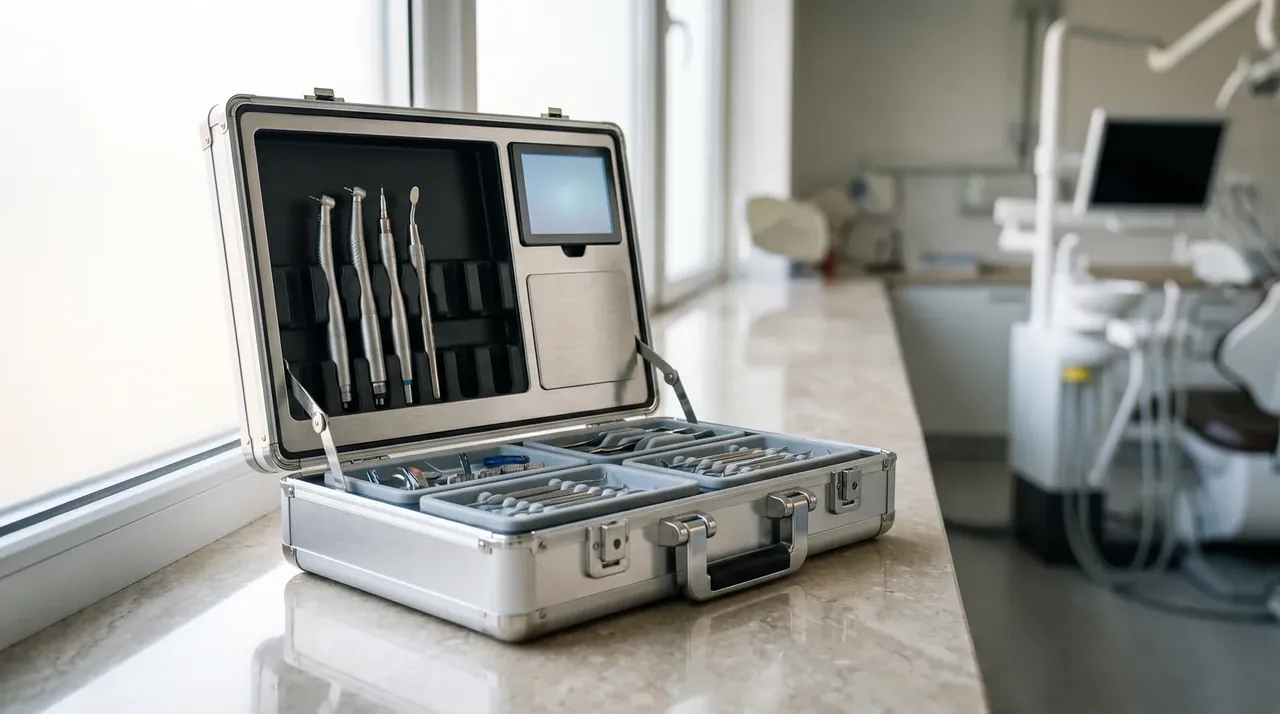
Quick answer: Medical ultrasound probe protective case floats the 0.9 kg probe on 3 contact points with EVA 15 mm liner, keeping lens pressure at or below 20 N.
Table of contents
- The lens-face pressure boundary of a Medical ultrasound probe protective case
- How three floating supports and EVA 15 mm share the point load
- Cavity allocation and wall thickness under a 340 x 260 x 110 mm shell
- Two latches, 5000 cycles and the lid hinge
- Benchmarking IP65, -10 °C to 50 °C and 500 wipes
- FAQ
1. The lens-face pressure boundary of a Medical ultrasound probe protective case
The load a Medical ultrasound probe protective case must resist is not a whole-box drop but the point pressure on the acoustic lens once the lid closes. Outer size 340 x 260 x 110 mm and cavity 300 x 220 x 80 mm fix the space inside; a 2.8 mm wall and 1.4 kg empty mass fix shell weight; a 2.8 kg load and a 0.9 kg probe define what the liner carries. One question remains: will the lens press through the liner onto the base.
A drop is a shock; liner contact exists at every closing. Built on drop logic, a Medical ultrasound probe protective case piles material into walls and corners while the lens still sits at the liner low point. What works is holding the 0.9 kg probe on three raised supports, not on the base. An over-thick liner lets one support touch the curve first, and a 2.8 mm wall only stops shell twist in transit, never replacing the clearance. This piece stays on the box side.
Pressure sets the supports.
2. How three floating supports and EVA 15 mm share the point load
Three floating supports are the first constraint a Medical ultrasound probe protective case uses to lift the lens clear of the base; the points land on rigid areas near the handle and connector, so the lens stays in an air gap with single-point pressure at or below 20 N.
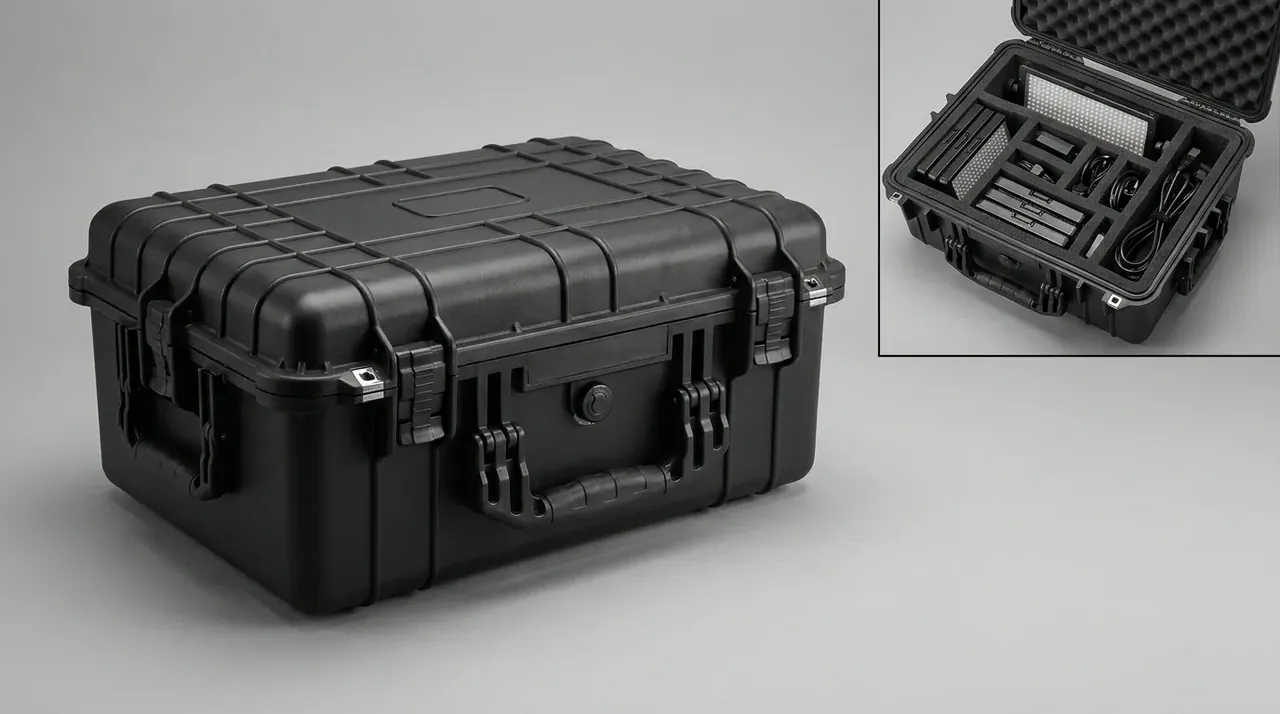
The EVA 15 mm liner handles the other side: whether foam still rebounds after compression, instead of being shaved thin to dodge contact. The three points split the 0.9 kg mass across three supports, each at or below 20 N, leaving no lens mark. A 15 mm thickness is a compromise: thinner rebounds too little, thicker lets the lid press the curve first.
| Probe part | Form | Liner treatment |
|---|---|---|
| Acoustic lens | Soft curve | 3-point air gap, pressure at or below 20 N |
| Handle | Slender cylinder | EVA 15 mm formed cradle |
| Cable root | Bend sensitive | Liner leaves a loop recess |
A Medical ultrasound probe protective case states 0.9 kg and 20 N first; only then do support count and liner thickness have a starting point.
3. Cavity allocation and wall thickness under a 340 x 260 x 110 mm shell
A 340 x 260 x 110 mm shell with a 300 x 220 x 80 mm cavity is the full budget a Medical ultrasound probe protective case has for supports and liner. The 80 mm height must hold an EVA 15 mm base pad, support height and the air layer above the lens without touching the lid. The 2.8 mm wall carries closing force down the ribs to the base, then back through the three supports; stopping the load is not its job.
The gap between a 1.4 kg empty shell and a 2.8 kg load says the shell should not spend mass on thicker walls. A long channel follows the handle, a loop zone serves the cable root, and the divider between them works with the lid liner to limit drift once closed. Chaining these into one locating path, a Medical ultrasound probe protective case turns the cavity question from fit into no-shift.
| May take pressure | Criterion | Value |
|---|---|---|
| Lens face | No | 3 floating supports, at or below 20 N |
| Handle shell | Yes | Load 2.8 kg, probe 0.9 kg |
| Lid | Yes | 2 latches at 200 N each |
Lens and lid cannot be set apart: raise the supports and cavity height needs a recheck.
4. Two latches, 5000 cycles and the lid hinge
Two latches at 200 N each are the holding values of a Medical ultrasound probe protective case once closed; with the lid hinge they set liner shift after 5000 cycles.
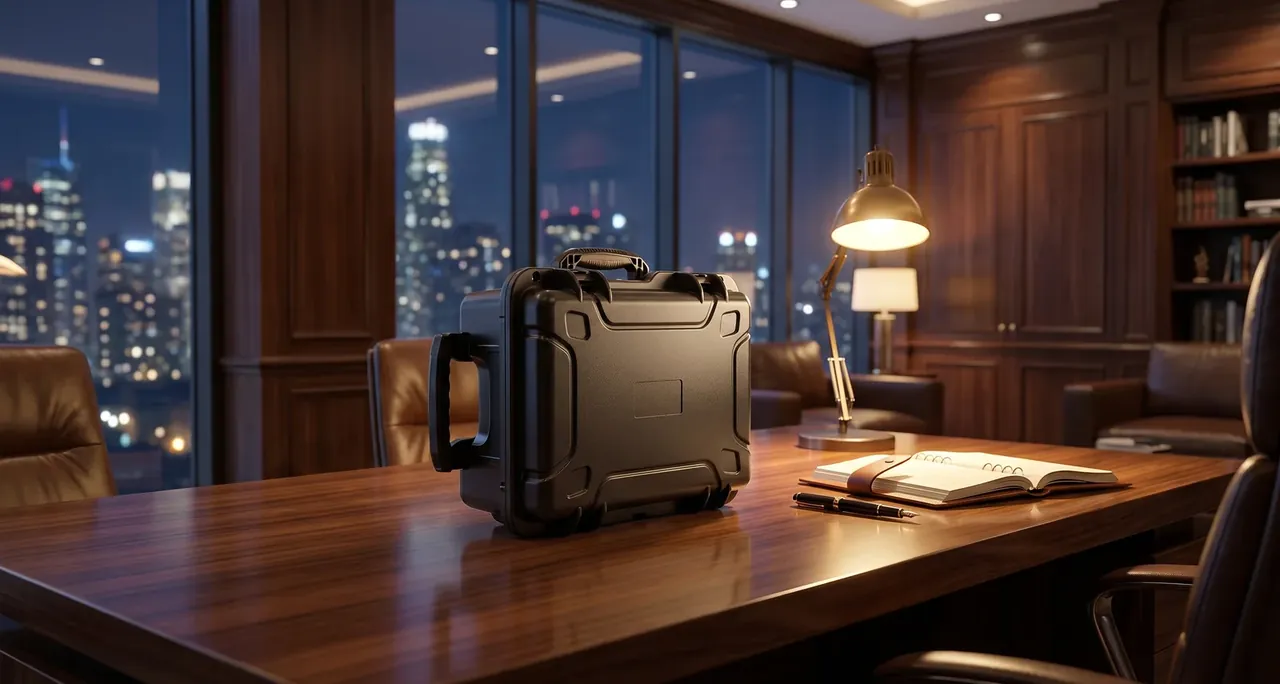
The two latches sit in a pair along the long mouth edge, and 200 N per latch holds against liner rebound pushing the lid open; two only lets one closing motion seat both. A 5000-cycle life measures hinge pin and latch tongue wear, judged by the lid still reaching its rebate with the liner unshifted. A 1.0 m drop is the slip case, judged by latches not springing and no lens mark.
The working range of -10 °C to 50 °C covers indoor and outdoor transfer: cold stiffens the EVA liner, heat slows rebound, and both erode the 20 N point pressure. IP65 gives the mouth sealing wording, its verification benchmarked against the matching method only.
5. Benchmarking IP65, -10 °C to 50 °C and 500 wipes
The 1.0 m drop, the -10 °C to 50 °C band, IP65, 5000 cycles and 70% ethanol wiped 500 times each map to one method: free-fall inspection of shell and lens marks, rebound rechecks after hot and cold storage, the matching dust and jet method on the mouth seal, a 5000-cycle rebate check, and a 500-wipe shell surface check. Every benchmark is written as method plus criterion.
| Support value | Belongs to | Benchmark method |
|---|---|---|
| 3 points | Floating supports | Verify by pressure method |
| 15 mm | EVA liner | Measure thickness |
| 1.0 m | Drop | Benchmark by free-fall method |
| 5000 cycles | Open-close life | Benchmark by cycle method |
| 500 wipes | 70% ethanol wipe | Benchmark by wipe method |
The pressure method measures contact force at each support; thickness measurement covers geometric values such as EVA 15 mm; the free-fall benchmark checks whether the shell cracks and the lens marks after 1.0 m. All numbers come from the fixed set for this piece.
Conclusion
Starting from an unloaded lens face, a Medical ultrasound probe protective case takes a 0.9 kg probe and a 20 N point limit, then spreads the force through 3 floating supports and an EVA 15 mm liner. A 300 x 220 x 80 mm cavity inside a 340 x 260 x 110 mm shell, a 2.8 mm wall, 1.4 kg empty mass and 2.8 kg load are boundary conditions. Check two latches at 200 N each, then benchmark IP65, -10 °C to 50 °C, 5000 cycles and 500 wipes; with no lens mark after 1.0 m this box-side specification closes.
Related Reading
- Medical instrument protective case specifications
- Medical protective case selection points
- Medical sample transport protective case
- Medical equipment protective case applications
Related Products
- 8 Series — Gun Cases; Military Equipment Cases; Camera Equipment Cases; Drone Cases; Watch Cases; Knife Cases; First Aid Cases; Electronics Equipment Cases
- WL8-2812 PP Gun Case — model WL8-2812
- All protective cases and toolboxes: 7 series, 158 models