

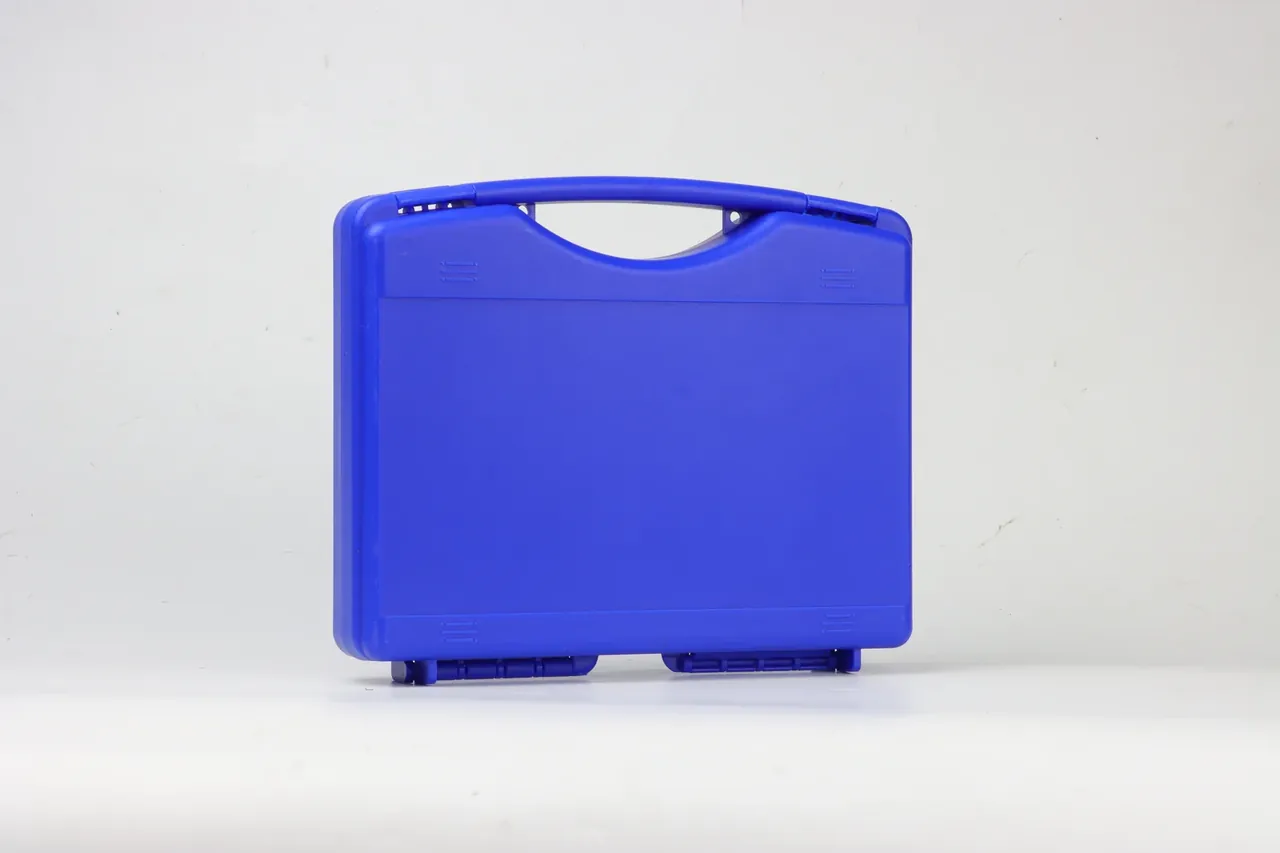
Quick answer: Inside one plant, Mil-Spec and industrial cases run on separate lines: 1300 t against 800 t of clamp force, 3.0 mm against 2.2 mm walls, 26 drops against 6, heat-lot against shift tracking, with a 30%–45% cost gap.
Table of contents
- Where the two lines split
- Material and wall thickness
- Testing: 26 drops and 6
- Sealing, tooling isolation and changeover
- Traceability and the cost gap
- FAQ
1. Where the two lines split
Both lines sit in one hall, split by a tooling rack. A Mil-Spec case runs on a 1300 t press with a 3.0 mm mould and its own gauges; an industrial case runs on 800 t at 2.2 mm, with a separate mould and gauge set. Changeover takes 4 h, so the schedules are planned apart.
The split is not about looking organised; it keeps the two process windows apart.
Share one press and the 2.2 mm window starves a 3.0 mm part, while 3.0 mm settings flash a 2.2 mm part. Gauges hang by line, red for Mil-Spec and blue for industrial, and one mix-up scraps a first article.
| Item | Mil-Spec case | Industrial case |
|---|---|---|
| Clamp force | 1300 t | 800 t |
| Wall | 3.0 mm | 2.2 mm |
| Resin | Copolymer PP + antistatic | HDPE or ABS |
| Seal | Two-lip silicone | Single-lip EPDM |
| Trace | Heat lot | Shift code |
2. Material and wall thickness
Wall thickness is back-calculated from a cold drop. After 4 h at -40 °C a 2.2 mm wall falls to 6 kJ/m² on notched Izod and cracks from the corner at the first hit; 3.0 mm in copolymer PP returns 9 kJ/m² at the same temperature and survives all 26 drops.
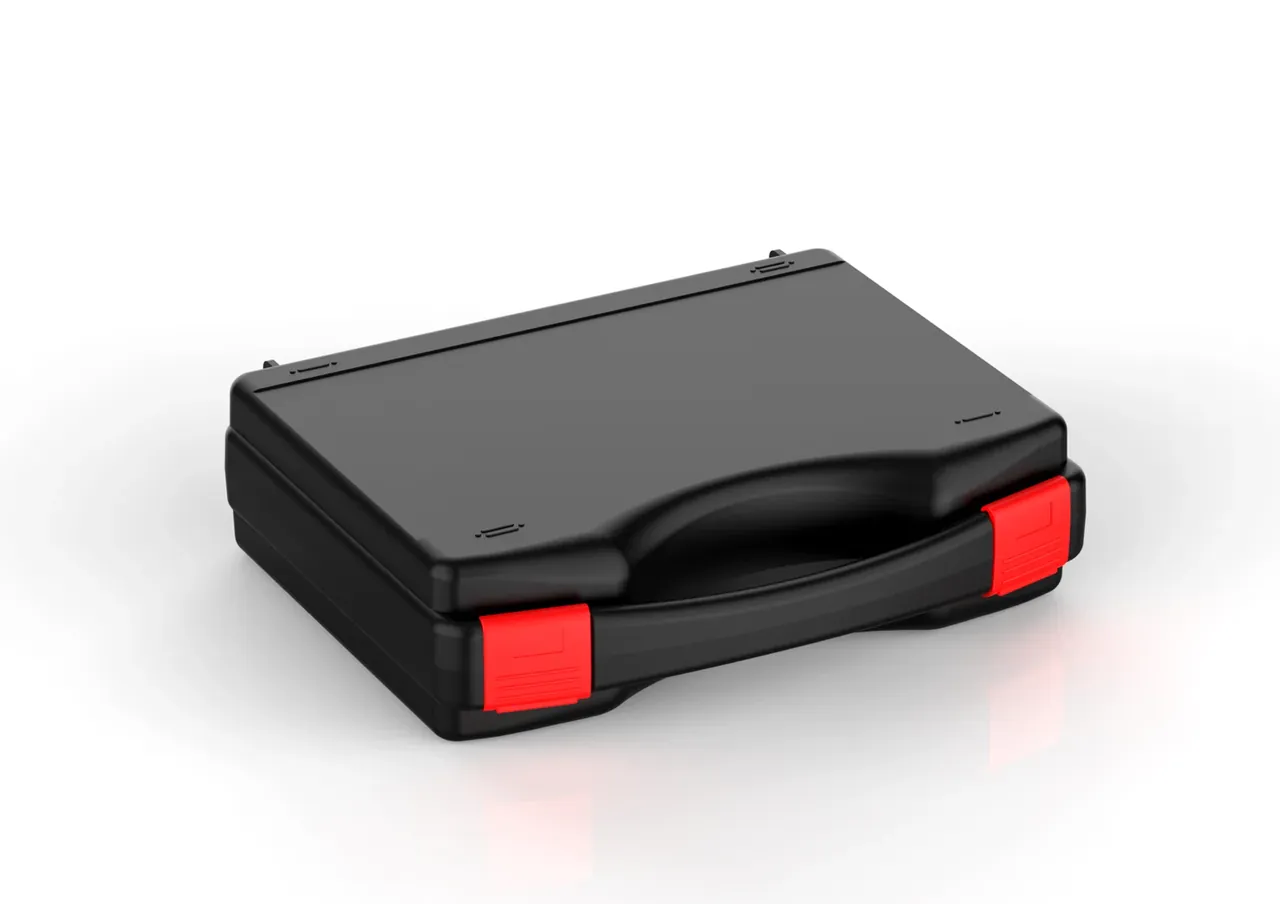
The resin differs. A Mil-Spec case runs copolymer PP with 8%–12% antistatic masterbatch, reaching 10⁶–10⁹ Ω so a dry hall builds no charge; industrial cases run HDPE for chemical resistance or ABS for surface hardness, neither antistatic.
The masterbatch is a trade: too little leaves resistance above 10⁹ Ω, too much drops impact strength 15%. PP reads 45 kJ/m² at room temperature and 38 kJ/m² at 10% loading, holding the 9 kJ/m² a cold drop needs.
The extra 0.8 mm adds 27% to part weight. It buys a wall that holds at -40 °C and a shot profile a 1300 t press fills; at 800 t the same part starves at the far end.
3. Testing: 26 drops and 6
A Mil-Spec case takes 1.2 m, 26 times, six faces and three edges in rotation, after 4 h at -40 °C and 4 h at +60 °C. An industrial case takes 0.8 m, 6 times, at ambient, on 3 per batch.
The count matters less than the preconditioning.
At -40 °C a PP chain cannot move in time, so a crack starts at a corner and runs along the weld line; the same corner at ambient only dents. Air tightness is the second gate: 0.3 bar charged, 60 s held, under 0.02 bar of decay, a test industrial cases skip.
Drop order matters too. Faces first, then edges, then corners, because faces pre-stress the wall and later corner hits open micro-cracks along the weld line. Six of the 26 are corners, where uneven rib thickness shows.
A case failing air tightness is refitted and retested; only a second failure demotes it to industrial stock.
| Item | Mil-Spec case | Industrial case |
|---|---|---|
| Drop height | 1.2 m | 0.8 m |
| Drops | 26 | 6 |
| Preconditioning | -40 °C and +60 °C, 4 h | Ambient |
| Sampling | Every unit | 3 per batch |
| Air test | 0.3 bar, 60 s | None |
4. Sealing, tooling isolation and changeover
Sealing comes down to lip count. A Mil-Spec case uses a two-lip silicone gasket at 55 Shore A with a pressure valve on the body; an industrial case uses a single EPDM lip at 65 Shore A and no valve.
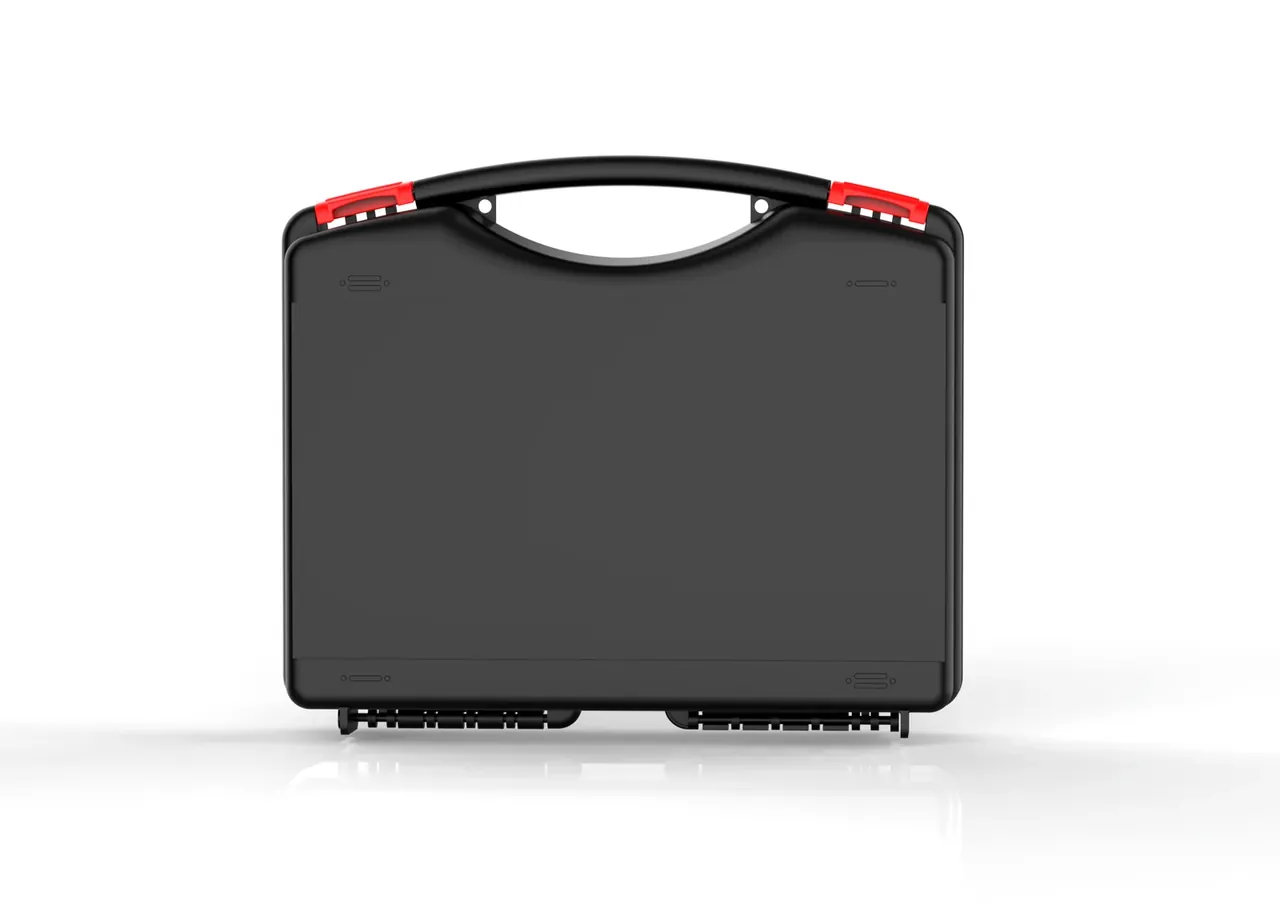
A single lip is fine at ambient until a 30 °C swing pulls about 0.03 bar of vacuum and lifts it off the rim, leaving a water ring by morning. Two lips plus a valve at 0.03 bar vent that differential first.
Valve size follows volume: 8 mm diaphragm for 20 L, 12 mm for 45 L, at 0.6 and 1.4 L/min. Undersize it and a 40 °C swing will not vent.
Changeover is the second isolation line. The Mil-Spec mould is cut for 3.0 mm walls and an antistatic flow path, so a change takes 4 h and the first article is measured on a dedicated gauge: wall at three points, rim flatness 0.5 mm, latch holes to ±0.2 mm. Industrial changeover is 2 h and checks outline only.
5. Traceability and the cost gap
Traceability runs at different resolution. A Mil-Spec case carries a heat lot, so one lot maps to one set of drop and air records and a batch problem walks back to that melt; an industrial case carries a shift code, which says when it was moulded, not what went in.
Same cavity and colour, a Mil-Spec case costs 30%–45% more: grams from the extra 0.8 mm, the masterbatch, 26 drops, an air test on every unit and 4 h of changeover over a small batch. Under 300 units the gap is widest; above that it settles near 30%.
Changeover cost is plain: at 300 units, 4 h adds CNY 12 per case, against CNY 1.2 at 3,000; industrial adds CNY 6.
An industrial case is enough for ambient transport, with no cold preconditioning, no antistatic requirement, 40 kg or less per unit and replacement instead of repair.
| Condition | Mil-Spec case | Industrial case |
|---|---|---|
| Minimum temperature | -40 °C | -15 °C |
| Antistatic | 10⁶–10⁹ Ω | None |
| Drops | 1.2 m × 26 | 0.8 m × 6 |
| Trace | Heat lot | Shift code |
| Relative cost | 100 | 55–70 |
Conclusion
The gap is not a label but four measurable things: 1300 t against 800 t, 3.0 mm against 2.2 mm, 26 drops against 6, heat lot against shift code. The 30%–45% buys a wall that holds at -40 °C, a surface that builds no charge and a batch that can be traced. Check the four against your lane, and upgrade only the one that fails.
This article discusses only the container (case body) side of specifications and design intent, and does not cover any handling, loading or use of the contents.
Related Reading
- How a GJB case body is built and accepted
- Military box and military case: two formats
- Standards a military flight case has to pass
- Where an industrial tool box stops being enough
Related Products
- 8 Series — Gun Cases; Military Equipment Cases; Camera Equipment Cases; Drone Cases; Watch Cases; Knife Cases; First Aid Cases; Electronics Equipment Cases
- WL8-2812 PP Gun Case — model WL8-2812
- All protective cases and toolboxes: 7 series, 158 models