

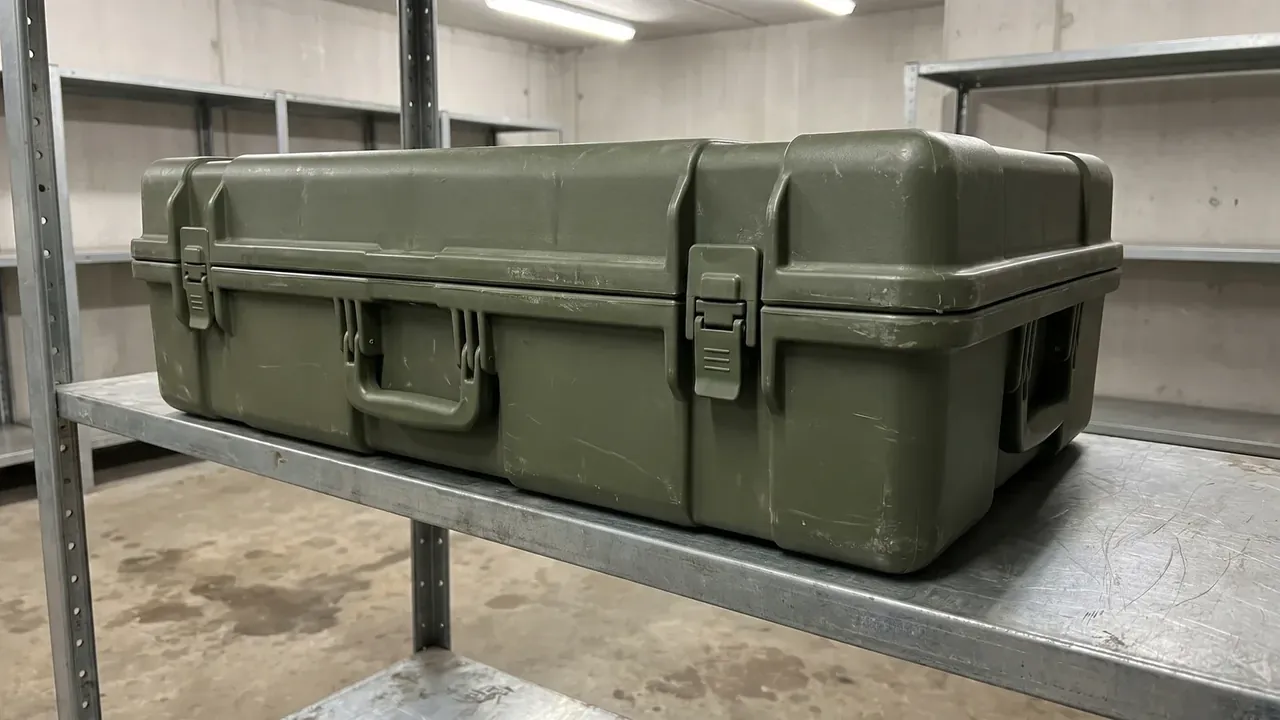
Quick answer: A Military Battery Transport Case vents at ±6 kPa through a 20 mm valve, stays dry at 1.0 m for 30 min, and holds 0.6 kPa/min after 3000 cycles.
Table of contents
- Where a Military Battery Transport Case Seats the Vent
- How the Valve Conducts a Pressure Gap in Stages
- Reading Soak and Opening Force as One Pair
- Leak Readings After Repeated Open-Close Cycles
- Shell and Latch Recheck Across Temperature Swings
- FAQ
1. Where a Military Battery Transport Case Seats the Vent
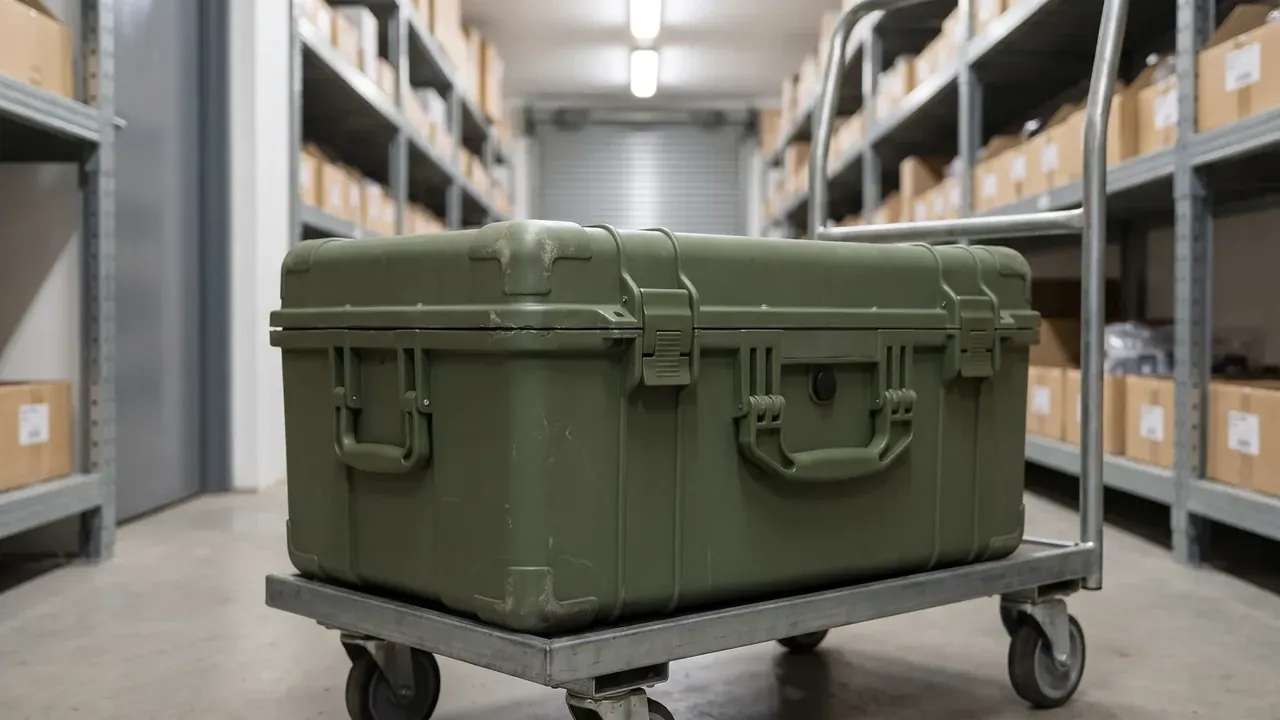
A Military Battery Transport Case measures 760×500×340 mm outside and 695×435×275 mm inside, with a 4.6 mm wall, 8.8 kg empty, 24 kg payload and 32.8 kg loaded. The 20 mm vent seat is cut not into the lid but into the upper flat stretch of the shell front, where moulding leaves the least warp and a full rib fits around the bore clear of the two gasket runs. The valve body threads in first, the dust cap follows, then the four latches are pressed at 480 N each, pulling the lid onto the shell. The vent carries air, not clamp load, so the ±6 kPa balance figure and the 1.0 m drop can be checked apart. JUNZHIJIA fixes the seat-to-rim distance on the drawing to keep gasket compression from drifting by lot.
2. How the Valve Conducts a Pressure Gap in Stages
The gap across a Military Battery Transport Case is not erased in one step. Moving the shell from −30 °C to 60 °C, or across a change in transport altitude, builds a difference of a few kPa; the membrane inside the 20 mm vent cracks open near the set band and bleeds air until the peak sits within ±6 kPa. Once it reseats, the passage closes and the 1.0 m / 30 min soak applies again. Venting and water blocking are two states of one part switched by the membrane, not two unrelated pieces.
| Pressure stage | Membrane state | Shell response |
|---|---|---|
| Static balance | Reseated | Gap at 0 kPa |
| Rising gap | Cracked open | Peak ≤±6 kPa |
| Soak pressure | Closed | 1.0 m / 30 min dry |
| Reseat retest | Reset | Leak ≤0.6 kPa/min |
3. Reading Soak and Opening Force as One Pair
A Military Battery Transport Case has to satisfy two limits that pull against each other. A dry 1.0 m / 30 min soak wants the rim tight; a ≤55 N opening force wants it not too tight. The answer is a fixed compression window: two gaskets at a nominal section, four latches at 480 N each, and a slight lid preload at the closed position. Outside water pressure pushes the lid harder onto the shell during a soak, so the seal tightens; on opening, the latch lever travel sheds that preload and the peak lands under 55 N. The test runs soak first, opening second: the loaded 32.8 kg case sits at 1.0 m for 30 min, is wiped and checked for ingress, then the opening force is read at room temperature. Reverse the order and open-close motion changes gasket compression, which spoils the soak result.
4. Leak Readings After Repeated Open-Close Cycles
Cycle life for a Military Battery Transport Case is set at 3000, with leakage still ≤0.6 kPa/min and opening force still ≤55 N afterwards. The measurement pressurises the shell to a set gap, closes the 20 mm valve and records pressure drop per minute; a smaller drop means a steadier rim seal. Across 3000 cycles the two gaskets compress and rebound repeatedly, and the 480 N at each of the four latches wears clearance into the catch seats. Those two spots drive the drift in the leak curve, not the vent itself.
| Balance part | Mounting point | Check value |
|---|---|---|
| 20 mm vent | Upper flat shell face | Balance ±6 kPa |
| Two gaskets | Rim perimeter | Leak ≤0.6 kPa/min |
| Four latches | Four rim load points | 480 N each |
| Lid | Closed position | Opening ≤55 N |
5. Shell and Latch Recheck Across Temperature Swings
Working range for a Military Battery Transport Case is −30 °C to 60 °C, over which the shell expands and the two gaskets change rebound rate. The recheck holds the loaded case at both ends, returns it to room temperature, then reads opening force and leakage: a shrinking cold shell pushes opening force toward the 55 N ceiling, while soft hot gaskets bring the pressure drop toward 0.6 kPa/min. The 1.0 m drop comes last. After the 32.8 kg loaded shell lands on corner, edge and face, the inspector checks for cracks and corner-guard response, rechecks seat-to-gasket concentricity and reruns both readings. The four latches must not pop open, or every earlier reading loses its premise. IP67 is an outcome resting on the 20 mm vent, two gaskets, four 480 N latches and a 4.6 mm wall together.
| Limit | Retest moment | Judged part |
|---|---|---|
| Opening ≤55 N | After soak, after drop | Rim preload |
| Leak ≤0.6 kPa/min | After 3000 cycles | Two gaskets |
| Balance ±6 kPa | After temperature cycle | 20 mm vent |
| 1.0 m / 30 min dry | Valve reseated | Whole shell seal |
Conclusion
A Military Battery Transport Case treats the pressure valve as a functional shell part, not an add-on: 760×500×340 mm outside and a 4.6 mm wall fix the seat, the 20 mm vent holds the gap at ±6 kPa, two gaskets and four 480 N latches keep the 1.0 m / 30 min soak dry, and 3000 cycles still close at ≤0.6 kPa/min and ≤55 N. Reading a Military Battery Transport Case along the seat-to-rim-to-hardware-to-retest line catches more than watching IP67 alone. JUNZHIJIA folds the −30 °C to 60 °C swing and the 1.0 m drop onto one check card so the set can be reproduced lot after lot.
Related Reading
- Battery case shell structure and selection
- Battery module test case sealing and hold-down specs
- Air transport case pressure and shell selection
- Military equipment case shell design baseline
Related Products
- 8 Series — Gun Cases; Military Equipment Cases; Camera Equipment Cases; Drone Cases; Watch Cases; Knife Cases; First Aid Cases; Electronics Equipment Cases
- WL8-2812 PP Gun Case — model WL8-2812
- All protective cases and toolboxes: 7 series, 158 models