

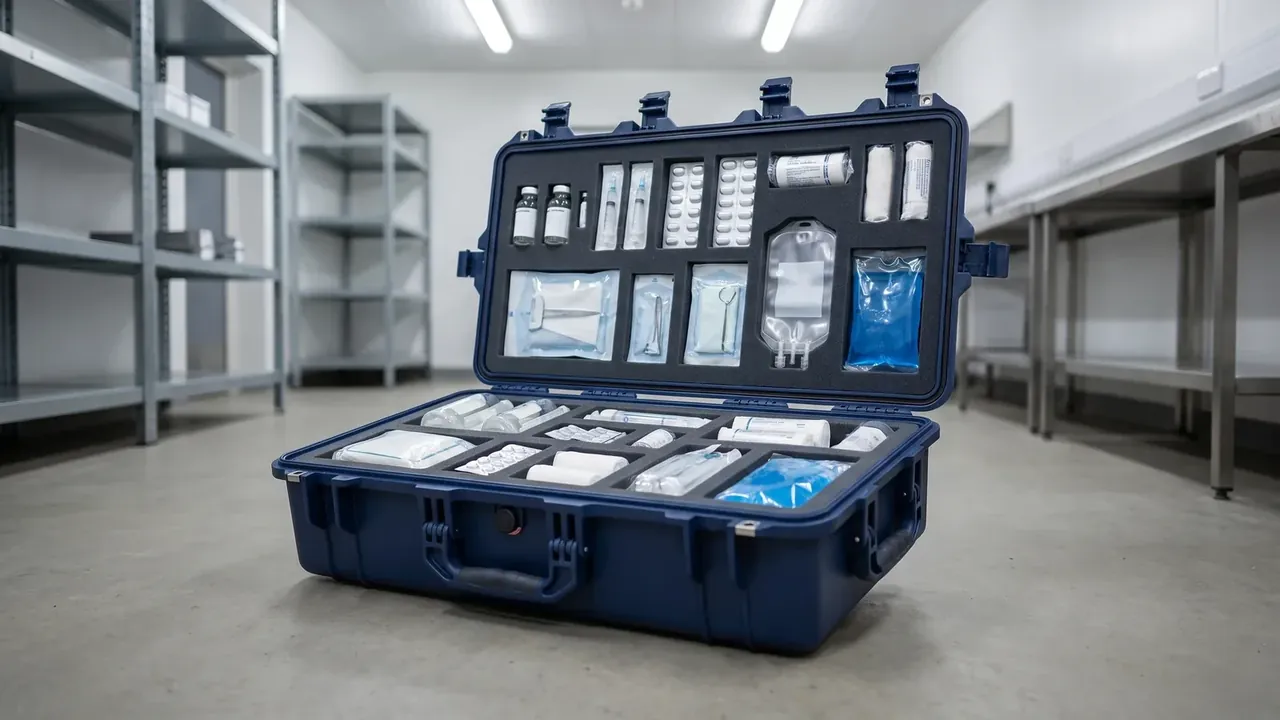
Quick answer: A Military Equipment Protective Case is limited less by single-unit strength than by lid deflection after 48 hours under a four-high stack and by gasket recovery at −30 °C. A 4.0 mm main wall, 60 mm rib pitch and 28% gasket compression keep a 96 kg stack and a cold-open test from working against each other.
Table of contents
- Shell structure and stack capacity
- Wide temperature: −30 °C to 60 °C
- Latches, hinges and anti-release design
- Modular cavities and 90-second changeover
- Warehousing, transfer and batch marking
- FAQ
1. Shell structure and stack capacity
A Military Equipment Protective Case is designed from the stack load first, wall thickness second. On a 600×400×300 mm body, use a 4.0 mm main wall, 3.5 mm lid and 4.5 mm base, with a 60 mm rib grid on the lid and R12 corners over an 8 mm corner pad. One case holds 32 kg; four high puts 96 kg on the bottom lid, and after 48 hours that lid may dish no more than 1.5 mm.
| Part | Wall | Structure | Duty |
|---|---|---|---|
| Lid | 3.5 mm | Rib grid at 60 mm | 96 kg from four-high stack |
| Side wall | 4.0 mm | Three vertical ribs at 120 mm | Side squeeze in a vehicle |
| Base | 4.5 mm | Twin rings plus pallet feet | Forklift and floor impact |
| Corners | 7 mm local | R12 arc plus pad | First contact in a 1.2 m drop |
| Hinge seat | 10 mm local | φ6 mm stainless pin | 10,000 cycles |
Stack capacity is decided about 80% by the lid ribs. Widen the pitch from 60 mm to 80 mm and the same 96 kg pushes deflection from 1.2 mm to 2.8 mm; past 2 mm the groove opens 0.4 mm and a 30-minute immersion leaks at 8 minutes. One cross rib costs 0.8 CNY against 3.2 CNY for another millimetre of wall.
2. Wide temperature: −30 °C to 60 °C
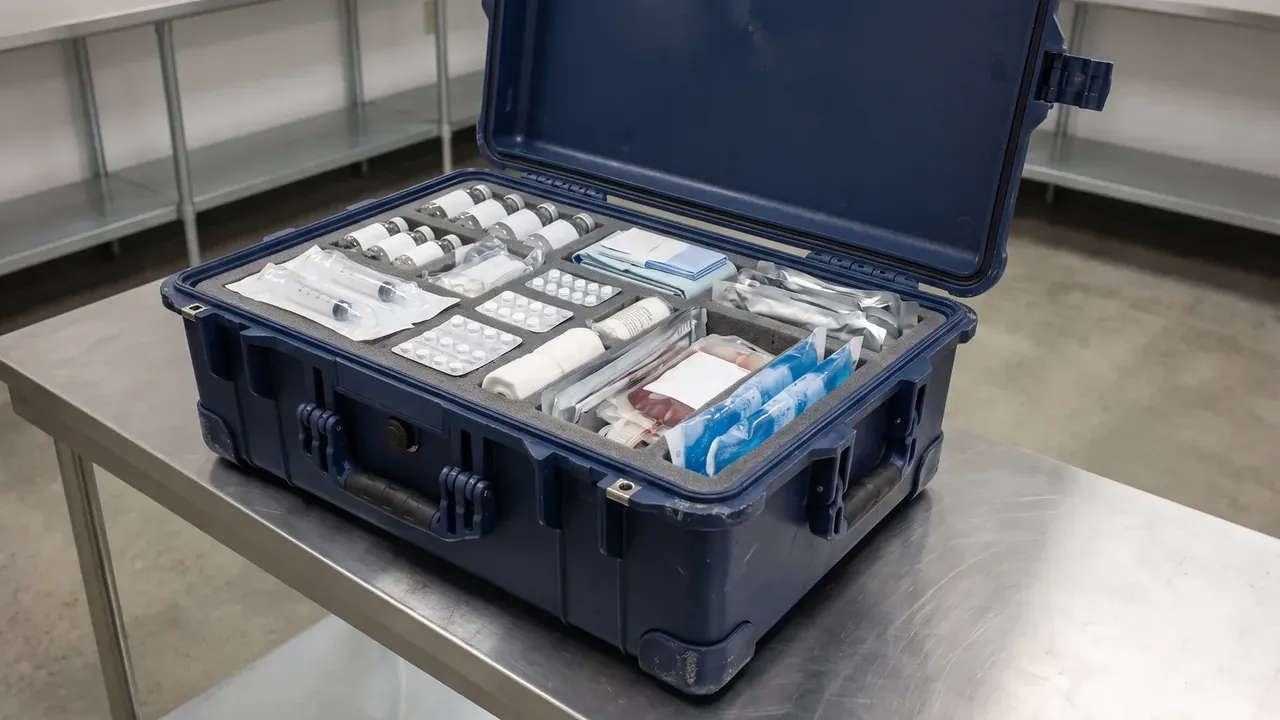
A Military Equipment Protective Case has to open and close from −30 °C to 60 °C, which makes the shell and the gasket two separate decisions. Use PC/ABS for the shell: at −30 °C it keeps 65% of its notched impact strength, where plain PP keeps 38% and cracks at the corner when a case slides off a tailgate. The penalty is 0.6 kg per unit.
Specify silicone rather than nitrile. Silicone stays elastic at −40 °C and holds compression set under 25% after 22 hours at 70 °C; nitrile stiffens at −20 °C and drops compression from 28% to 19%, leaving a bright line where the lip never seated. A 6.0 mm wide, 4.5 mm deep groove with a 5.8 mm cord at 28% covers both ends.
| Temperature | Material state | Gasket compression | Opening force | Verdict |
|---|---|---|---|---|
| −30 °C | 65% impact retained | 24% | 110 N | Opens |
| −10 °C | Normal | 27% | 95 N | Opens |
| 23 °C | Normal | 28% | 85 N | Reference |
| 60 °C | Modulus down 18% | 30% | 78 N | Opens |
3. Latches, hinges and anti-release design
Latches on a Military Equipment Protective Case must satisfy two opposite demands: open with gloves on, and stay shut over washboard roads. Four draw latches at 120 to 150 N each give more than 480 N total holding force, while opening force stays at 60 to 90 N, so a thumb on the tongue and a finger under the body opens it in 3 seconds. Under 60 N it self-releases in transit; over 90 N it takes two hands.
| Item | Value | Method | Frequency |
|---|---|---|---|
| Holding force per latch | 120 to 150 N | Push-pull gauge | 5 units per batch |
| Total holding force | 480 N or more | Sum of four | 5 units per batch |
| Opening force | 60 to 90 N | Push-pull gauge | 3 units per batch |
| Open-close life | 10,000 cycles | Cycling rig | 1 unit per quarter |
| Padlock hole | φ8 mm | Go/no-go gauge | 100% |
Anti-release works on two levels: a secondary hook that needs 4 mm of travel before letting go, and φ8 mm padlock holes on both lid ears. Hinges use a φ6 mm stainless pin at 0.15 to 0.25 mm clearance; past 0.35 mm the lid shifts 2 mm, the groove misaligns and cold closing gets harder.
4. Modular cavities and 90-second changeover
A Military Equipment Protective Case works better with swappable trays than with a fixed cavity. Standardise the tray at 540×340×40 mm, line it with 30 mm EVA cut to the equipment outline, and hold it down with four 25 mm webbing straps rated 300 N each. Three tray types interchange in under 90 seconds without tools.
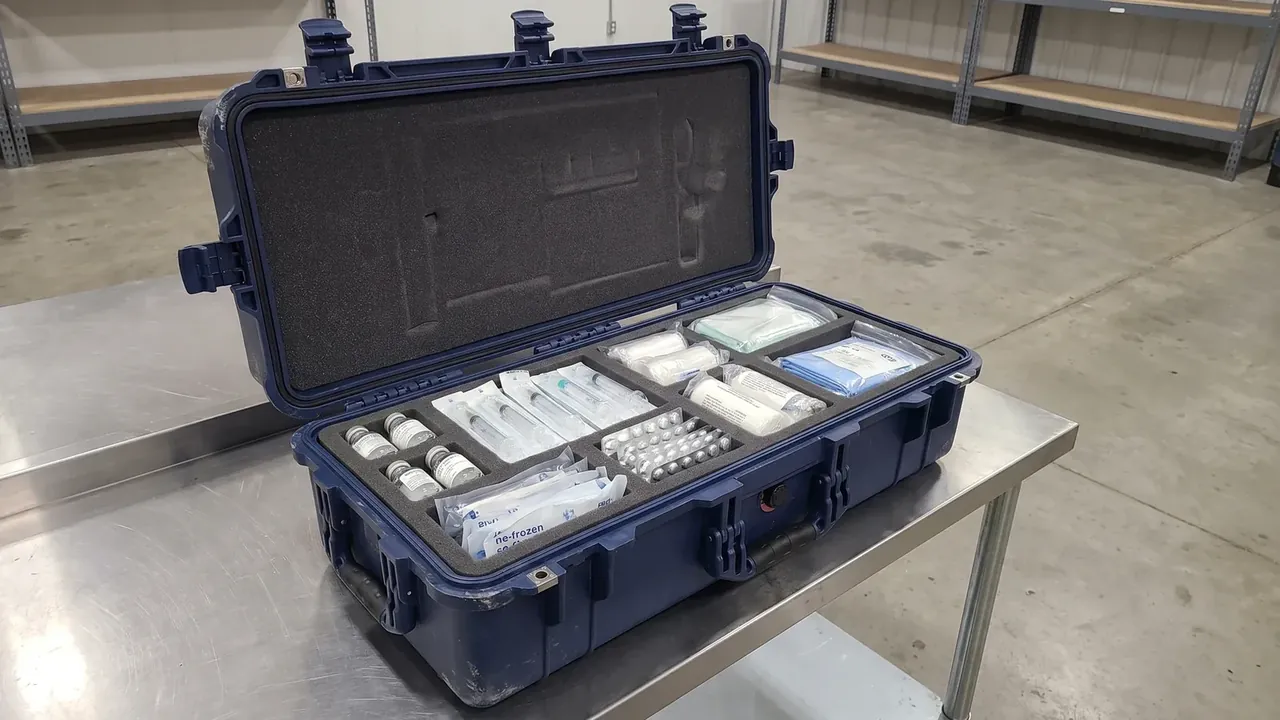
The point of trays is batch management. One shell carries a communications, test-set or spares tray; stores issue trays by task rather than whole cases, which roughly doubles shell turnover. Four tapered pins, 8 mm high at 5 degrees, seat with 0.5 mm of interference so vibration never walks a tray out.
Do not line the lid with a full foam slab: 15 mm is enough, and thicker foam preloads the tray and adds 30 N of latch force.
5. Warehousing, transfer and batch marking
Storage efficiency for a Military Equipment Protective Case comes down to pallets and marking. A 1200×1000 mm pallet takes four cases per layer and four layers, 16 cases, with two straps; keep the store between 5 °C and 35 °C and under 60% humidity, because a warm store creeps the lid ribs. At five layers the bottom lid reaches 2.4 mm of deflection, past the 1.5 mm limit.
Marking has to survive wiping. Rivet a 40×60 mm anodised aluminium plate at the four corners and laser-mark the number 0.05 mm deep; a paper label smears after 20 wipes with 75% ethanol. Print the batch on the top line and the case number below, bound one-to-one with the tray.
Conclusion
The order is: lid rib pitch from stack height, shell material and gasket from the lowest temperature, latch holding force from opening frequency, tray or fixed cavity from the number of equipment types. Rib pitch is the one usually skipped, and it decides sealing four years out rather than appearance on day one.
This article covers container-side specifications and design implications only.
Related Reading
- Military case selection and load classes
- Inspection items and limits for military transit cases
- Material and structural standards for military packing boxes
- Rotomoulded military cases in service
Related Products
- 8 Series — Gun Cases; Military Equipment Cases; Camera Equipment Cases; Drone Cases; Watch Cases; Knife Cases; First Aid Cases; Electronics Equipment Cases
- WL8-2812 PP Gun Case — model WL8-2812
- All protective cases and toolboxes: 7 series, 158 models