

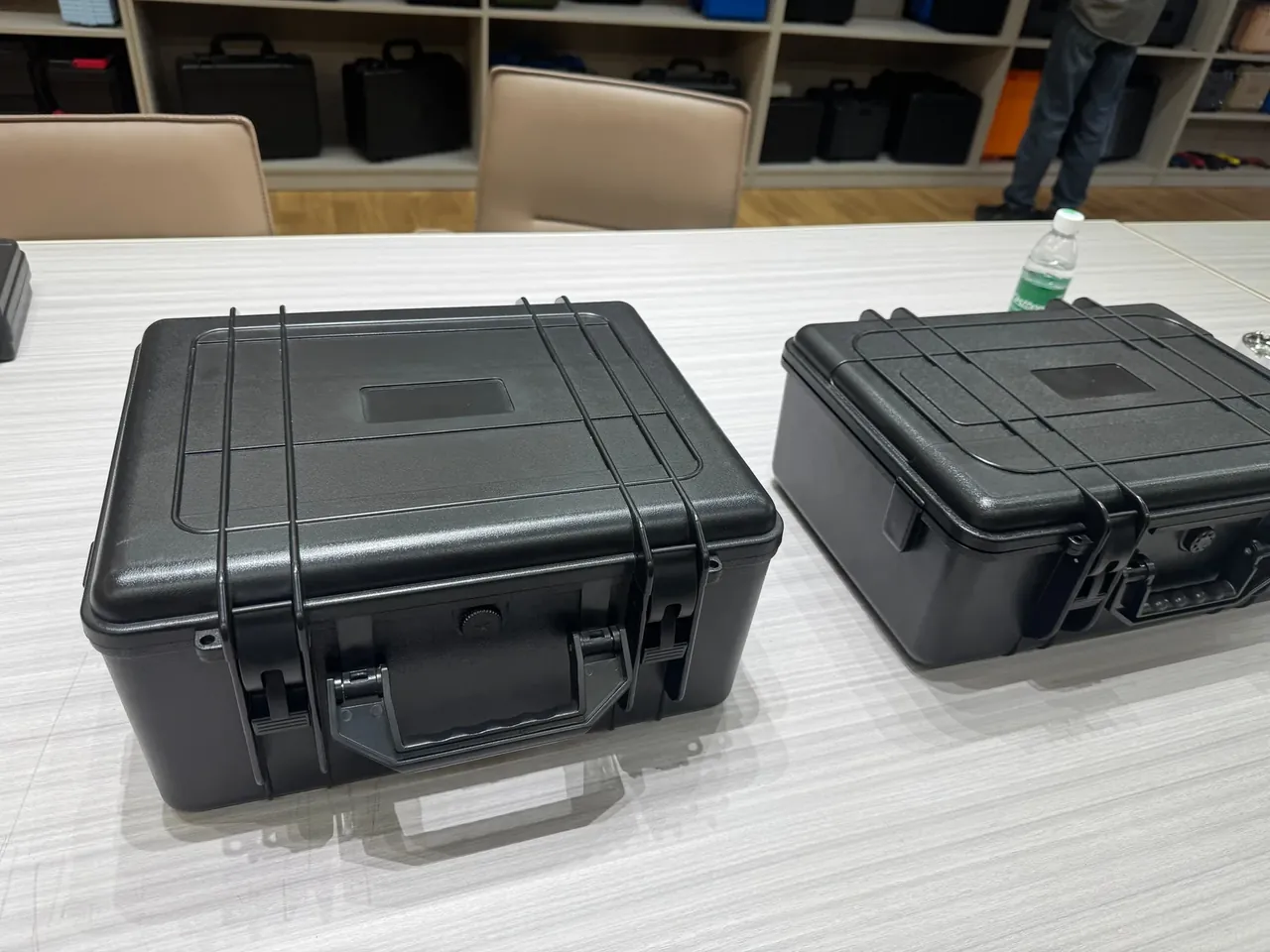
Quick answer: Military Case Latches and Hinges endure 900 cycles at -20 C, with a 1.6 mm spring leaf returning under 0.9 mm and pin play below 0.10 mm.
Table of contents
- Spring leaf thickness of Military Case Latches and Hinges
- Hinge pin-hole fit clearance
- Return travel after cold cycling at minus twenty degrees
- Pin-hole play rechecked after warm-up
- Leaf thickness setting for the hardware batch
- FAQ
1. Spring leaf thickness of Military Case Latches and Hinges
Cycle a latch again and again at minus twenty degrees: whether the spring leaf returns and the pin-hole wobbles both settle after nine hundred repetitions.
The shell is formed to 590 by 405 by 215 mm outside, 520 by 345 by 160 mm inside, with a 4.4 mm wall; four front latches deliver 395 N each. The spring leaf inside a latch is nominally 1.6 mm thick and pushes the tongue back after release. Military Case Latches and Hinges treats leaf thickness as a candidate tier, since return depends on that one strip.
The parting seam and reinforcing ribs sit around each latch seat. Cross ribs are pressed into the lid, a lap seam runs around the mouth, and the seat lands where ribs cross so force spreads into the walls. Military Case Latches and Hinges forms the seat hole in the same shot; a hole drilled later drifts off centre.
2. Hinge pin-hole fit clearance
A pin passes through the hinge-seat hole at an initial fit clearance of 0.16 mm; too tight and the lid binds, too loose and the mouth wobbles. Military Case Latches and Hinges holds clearance to this one value so the lid neither fights nor loosens across repeated flips.
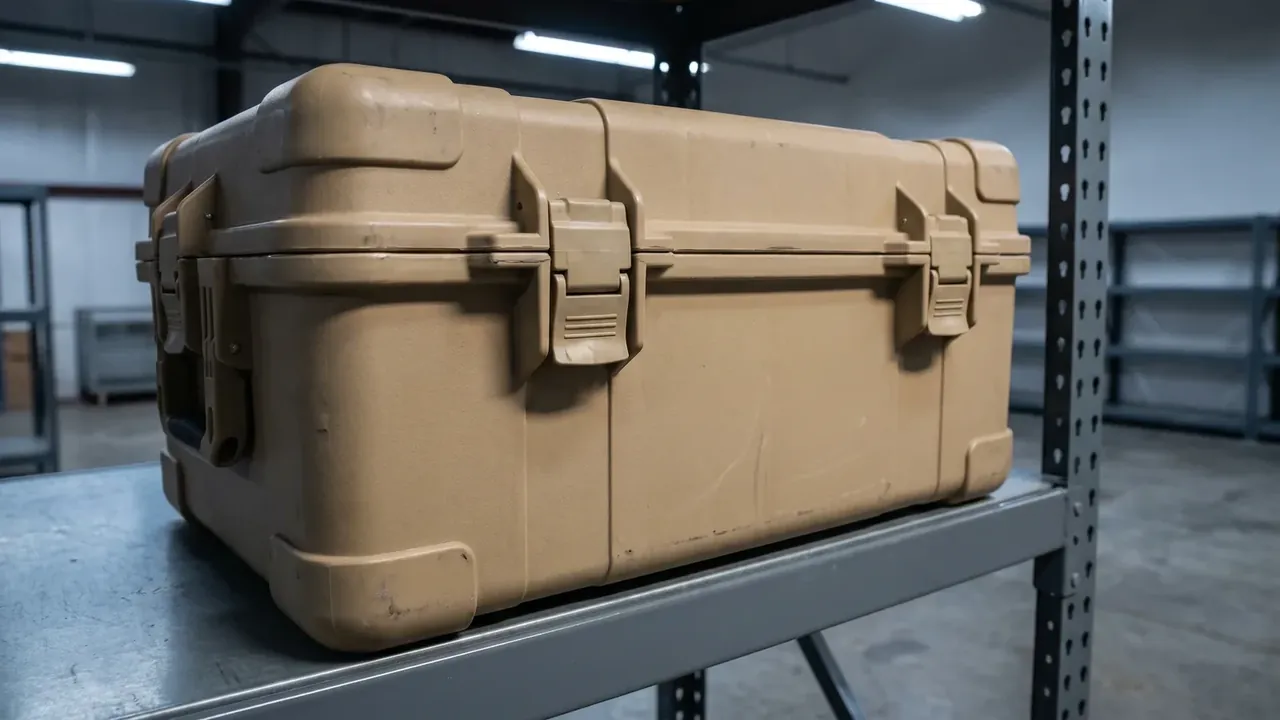
Wrap layers and corner radii belong to the same stage. A thickened guard covers each corner, all four corners round off, and the hinge seat tucks inside the guard. The lid-to-base lap presses one horizontal seam, its width read at 3 points around the rim.
Pin-holes wear in, they are not fixed by one reading. The 0.16 mm gap leaves room for wear and for the recheck after warm-up.
3. Return travel after cold cycling at minus twenty degrees
The cold rig holds the shell at -20 C and runs 900 open-close cycles, one round every 15 min. At the end the tongue offset from its start is read, with a limit of 0.9 mm. Military Case Latches and Hinges probes the tongue tip, where a failed return shows most clearly.
| Leaf-thickness tier | Measured leaf thickness | Return travel after 900 cycles |
|---|---|---|
| Thin tier | 1.3 mm | 1.15 mm |
| Nominal tier | 1.6 mm | 0.72 mm |
| Thick tier | 1.9 mm | 0.48 mm |
Three leaf tiers, three cases each, went into the cold chamber together and the readings separated cleanly. The 1.3 mm thin tier left 1.15 mm of return, past the 0.9 mm line, the tongue clearly short of home. The 1.6 mm nominal tier returned 0.72 mm, inside the line, still clicking shut in the cold. The 1.9 mm thick tier managed 0.48 mm, quickest of all, yet needed more hand force to close. Military Case Latches and Hinges does not pick the smallest return, because a thicker leaf forces the 395 N latch load up and loads the seat. Cold makes steel brittle and grease stiff, and the two effects stack: the first 200 cycles move fastest, then the drift flattens. The rig logs a return reading every 100 cycles.
4. Pin-hole play rechecked after warm-up
Reading in the cold is not the end; the shell rests 4 h at room temperature and is measured again. A feeler gauge enters the pin-hole for play, held to 0.10 mm. Military Case Latches and Hinges schedules this warm-up recheck, since a cold-tightened gap can reopen once warmed.
| Cycle sequence | Cumulative cycles | Pin-hole play |
|---|---|---|
| Early stage | 300 cycles | 0.04 mm |
| Middle stage | 600 cycles | 0.07 mm |
| Late stage | 900 cycles | 0.10 mm |
A swing from -20 C to 55 C skews the hole load as metal pins and wrap layers expand unevenly. Play is read before and after; if the two differ by over 0.03 mm, seat rivets and pin straightness are inspected, not the leaf tier.
5. Leaf thickness setting for the hardware batch
Setting the batch follows one line: take the thinnest tier whose return after the nine hundredth cold cycle still stays under 0.9 mm, and keep thinner leaves only as sample-case records. Military Case Latches and Hinges writes that on the hardware batch sheet, pinning the boundary between 1.3 mm and 1.6 mm.
| Return reading | Matching leaf tier | Batch disposition |
|---|---|---|
| 1.15 mm | 1.3 mm thin tier | Kept as sample-case record |
| 0.72 mm | 1.6 mm nominal tier | Adopted as thickness setting |
| 0.48 mm | 1.9 mm thick tier | Reassigned as heavy-load reserve |
The empty case is 5.7 kg and the loaded case 14 kg, with two gasket rings at 19% compression checked to an IP66-style spray routine. Before handover Military Case Latches and Hinges runs one more room-temperature cycle set; the drawing leaves leaf thickness at plus or minus 0.08 mm, beyond which it returns to stamping.
Conclusion
Nine hundred cycles in a -20 C chamber turn return travel and pin-hole play into the two proofs Military Case Latches and Hinges can hand over. The 1.6 mm leaf, the 0.16 mm clearance, and the 0.9 mm and 0.10 mm read lines hold one another; skip one and repeated flipping is not supported. What matters is not the latch click but the tongue and pin-hole landing back inside drawing tolerance after warm-up.
Related Reading
- What Do the Hinge, Latch and Gasket on a Toolbox Actually Do?
- Air-tight sealed instrument latch case
- Case Latch: Pressure and Theft Resistance Hardware for Protective Cases
- How to Choose a Gasket-Sealed Protective Case: Five Checks
Related Products
- 8 Series — Gun Cases; Military Equipment Cases; Camera Equipment Cases; Drone Cases; Watch Cases; Knife Cases; First Aid Cases; Electronics Equipment Cases
- WL8-2812 PP Gun Case — model WL8-2812
- All protective cases and toolboxes: 7 series, 158 models