

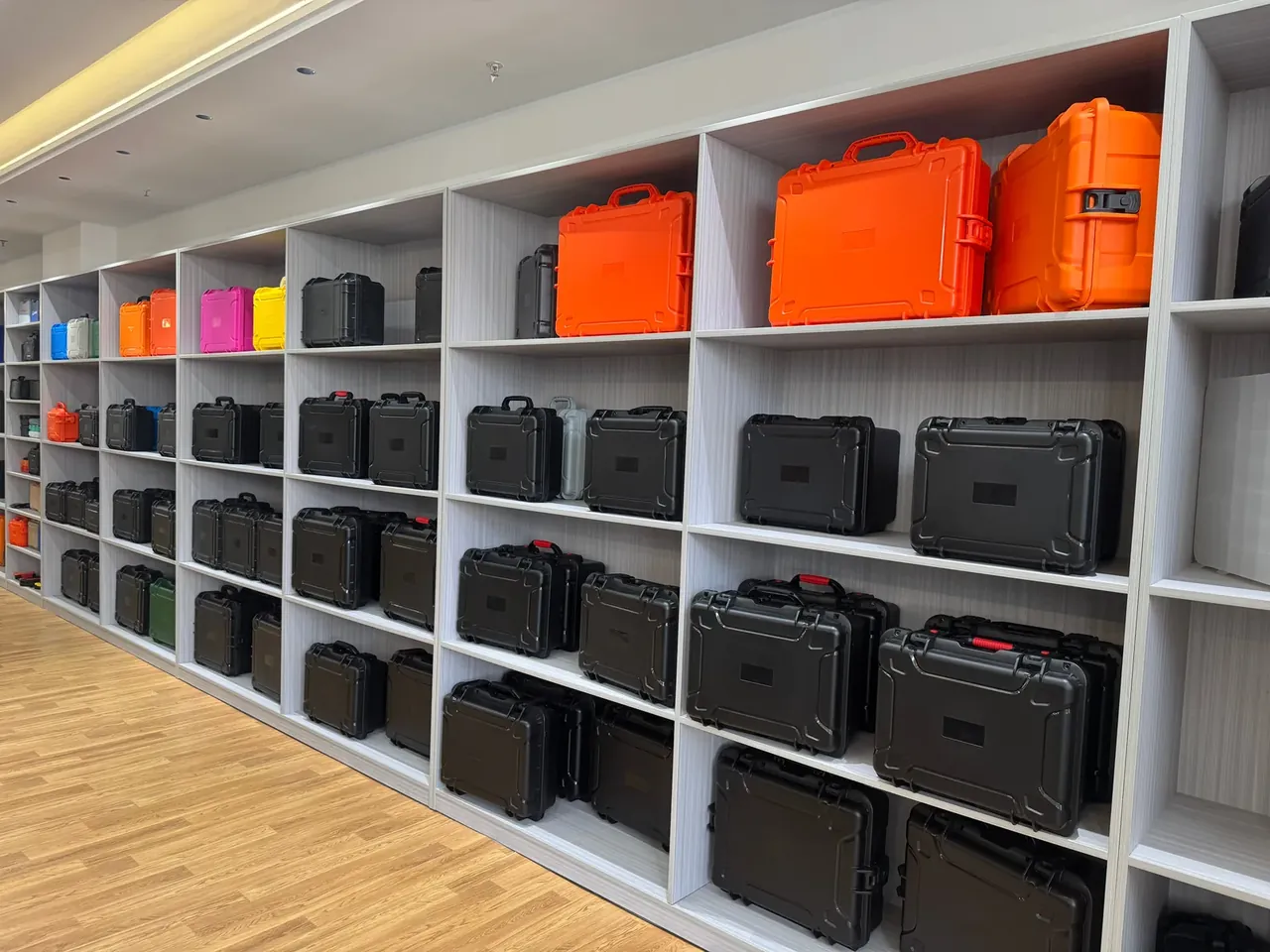
Quick answer: A Military Case OEM Manufacturer holds inner cavity tolerance to ±1.5 mm by pressing parting-line mismatch under 0.5 mm across 3 trial moulding rounds.
Table of contents
- Parting-line mismatch at a Military Case OEM Manufacturer
- Layer thickness of the lid lining
- Tolerance readings after trial moulding rounds
- Cavity fit rechecked at assembly
- Mismatch release line for contract batches
- FAQ
1. Parting-line mismatch at a Military Case OEM Manufacturer
A contract build and a standard shell part company on the tolerance chain: change the lid layering and parting-line mismatch carries the inner cavity size away with it. A Military Case OEM Manufacturer receives a drawing that gives one cavity of 570×395×200 mm, yet the upper and lower mould halves meet along a parting face, and if they shift by a fraction the offset enters cavity width, depth and diagonal together.
Measure it by setting a trial shell on a coordinate measuring table, squaring it to the cavity floor, and sampling nine points along each of four walls for the offset between lid side and body side. On a 640×460×270 mm outer shell the parting face crosses the long edge, whose midpoint sits furthest from the gate and yields most. A Military Case OEM Manufacturer writes the target into the drawing column: at or below 0.5 mm after 3 trial rounds, with wall thickness of 4.7 mm as the other bound and measured spread inside 0.3 mm.
| Mismatch value | Disposition | Drawing datum |
|---|---|---|
| ≤0.5 mm | Joined to datum | 570×395×200 mm |
| Above 0.5 mm | Marked separately | Not joined |
| Recheck fall-back | Re-zeroed | To last-round reading |
The ±1.5 mm band and the 0.5 mm line are different quantities on this sheet and are never converted into one another.
2. Layer thickness of the lid lining
Lid layering is about how the cushion sheets bonded inside the lid stack up, not how anything is arranged inside the shell. A Military Case OEM Manufacturer works with 12 mm and 25 mm sheet stock, combined into a 12/25 mm stack matched to cavity depth: the thin sheet against the lid crown, the thick one toward the mouth.
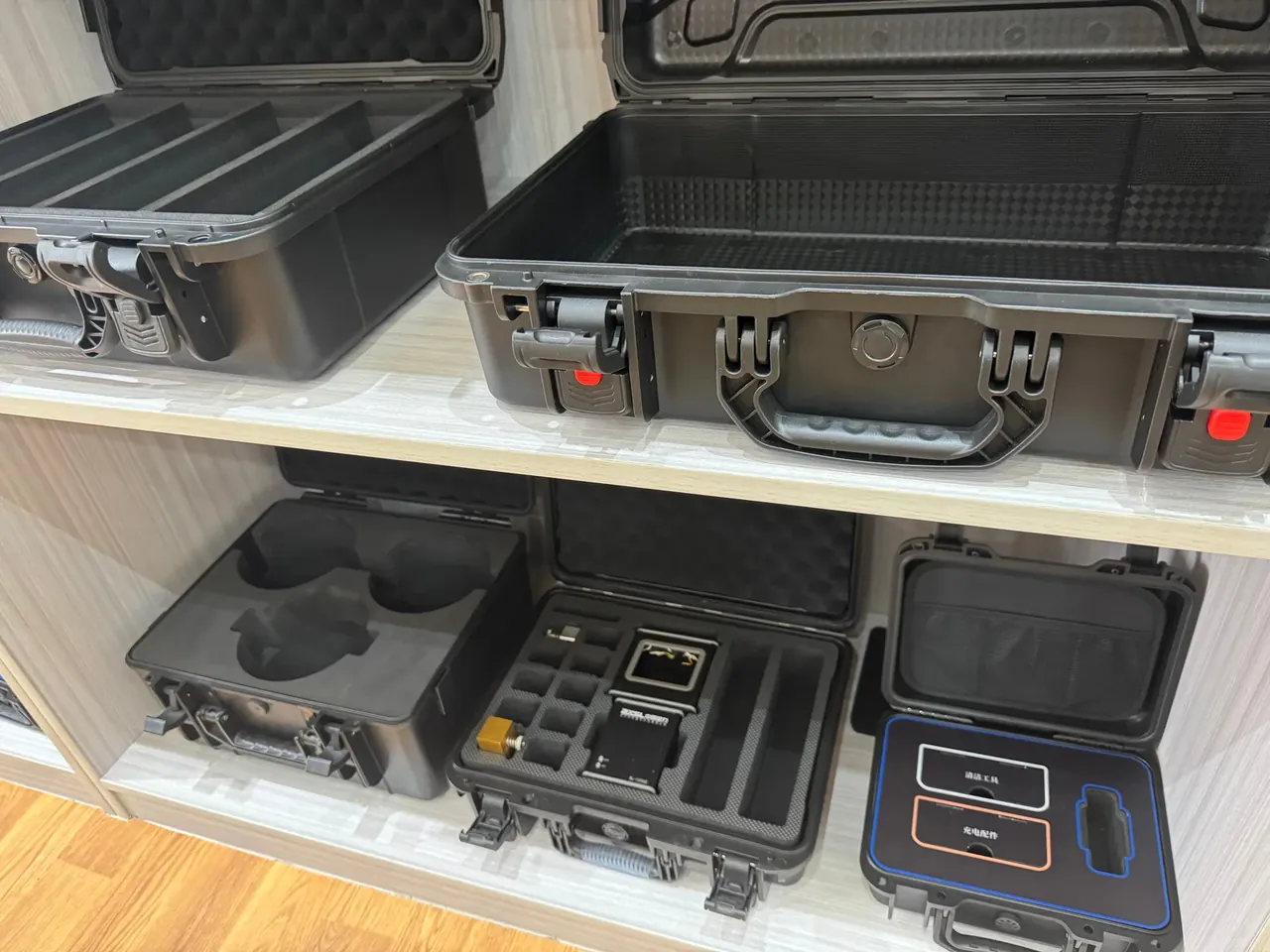
Every extra millimetre on the lid removes a millimetre of cavity depth, so the remaining depth after close has to stay inside ±1.5 mm. Cut-sheet tolerance is held to ±0.4 mm, and errors add when two sheets are stacked.
| Layer step | Measured lid build | Depth after close |
|---|---|---|
| Thin step | 12 mm | 199.6 mm |
| Base step | 12/25 mm | 198.5 mm |
| Thick step | 25 mm doubled | 196.2 mm |
The thin step sits closest to 200 mm but leaves little cushion margin; the thick step drops to 196.2 mm and has dragged the band below the drawing. A Military Case OEM Manufacturer writes the 12/25 mm measured build onto the cut card and re-matches the whole lot if incoming sheet thickness drifts.
3. Tolerance readings after trial moulding rounds
A Military Case OEM Manufacturer schedules 3 trial rounds with six sample shells each, measures cavity width, depth and diagonal on every piece, and spreads the eighteen readings across one sheet. The criterion is not a single passing part; the spread of the whole round has to shrink each time and the last round's centre has to sit inside ±1.5 mm.
| Trial round | Measured mismatch | Cavity tolerance band |
|---|---|---|
| First | 0.78 mm | ±2.4 mm |
| Second | 0.61 mm | ±1.9 mm |
| Third | 0.46 mm | ±1.5 mm |
The first round shows 0.78 mm of mismatch and ±2.4 mm of band. The second drops to 0.61 mm and the third to 0.46 mm, with mismatch and band narrowing together, confirming the parting face drives this stretch of the chain. A Military Case OEM Manufacturer also logs the 7.6 kg empty and 18 kg loaded attitudes apart, since a closed reading differs from an open one by about 0.2 mm and delivery uses the closed figure.
4. Cavity fit rechecked at assembly
A Military Case OEM Manufacturer puts a recheck on the assembly line: close the lid onto four latches at 445 N each, let it rest 30 min, then run go/no-go gauges along the four cavity corners.
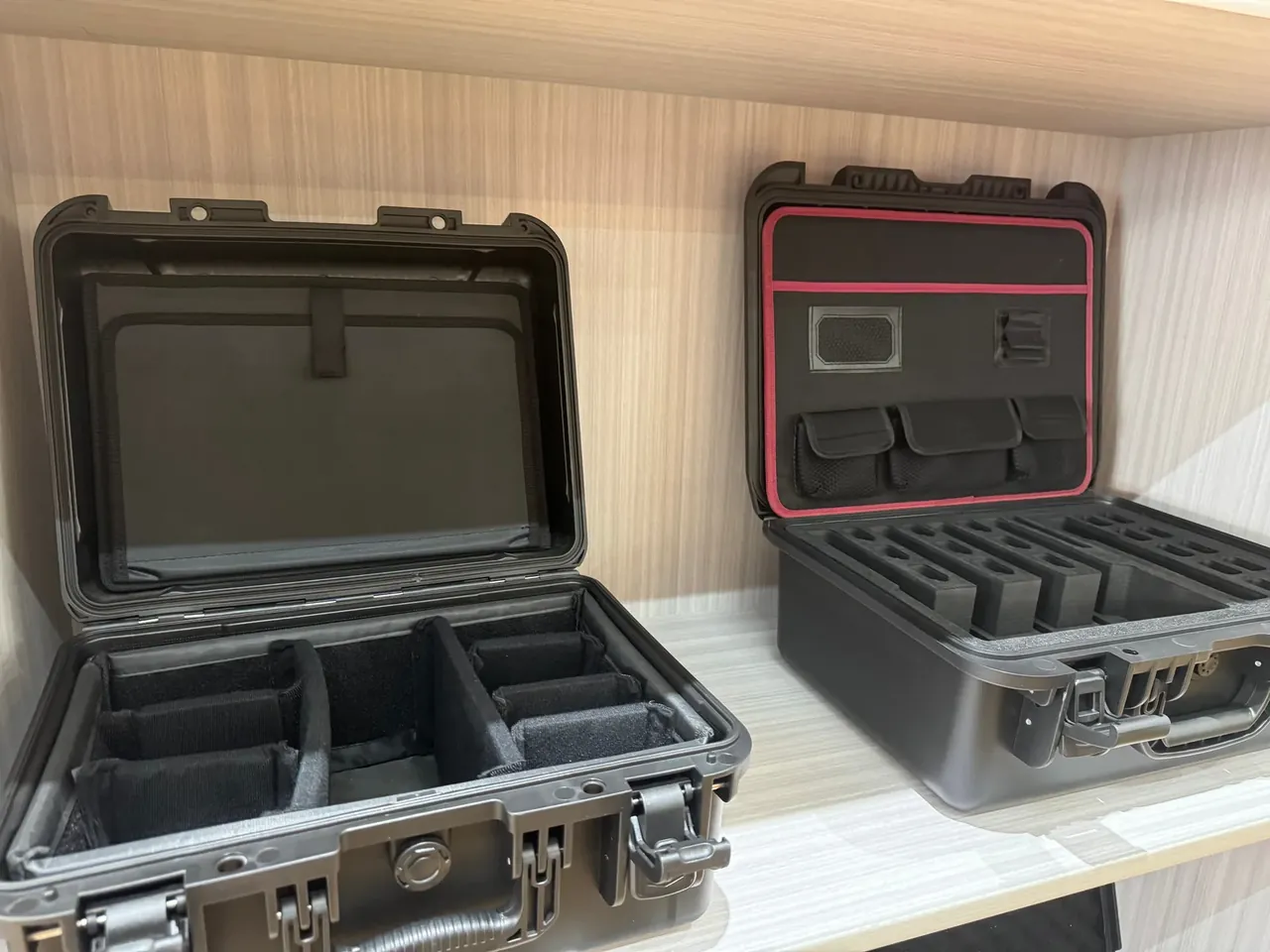
The recheck also verifies two seal rings at 23 percent compression: a thicker lid lifts the mouth flange slightly and reads the cavity width small, while falling compression leaves the seal target benchmarked to IP67 unbedded. Reread the cavity after 3700 open cycles and log the creep drift rather than editing the drawing.
5. Mismatch release line for contract batches
The release line is set at 0.5 mm; cavities that cross it in trial samples are marked on their own and kept out of the drawing datum. On the record sheet, third-round cavities at 0.46 mm join the datum while first-round 0.78 mm and second-round 0.61 mm samples are filed but not shipped and not used in any average.
For a contract batch with a 200-piece minimum, one shell in every 40 goes on the coordinate table and the readings are joined into a line watched for creep toward 0.5 mm. The Guangdong moulding plant files the record under this rule, and every JUNZHIJIA batch from a Military Case OEM Manufacturer carries the release-line card. A Military Case OEM Manufacturer keeps the release line and the drawing tolerance on two separate sheets: one governs whether the mould may run, the other whether a shell may ship, and a disagreement returns the lot to the trial rounds rather than picking parts.
Conclusion
A Military Case OEM Manufacturer delivers cavity tolerance by holding parting-line mismatch and lid layering each to their own stretch of the chain. Three trial rounds press mismatch under 0.5 mm and pull the band into ±1.5 mm, while a 12/25 mm stack leaves the 570×395×200 mm drawing size untouched. The release line accepts only the last-round closed reading, and a breach returns the lot instead of picking parts. Written onto two sheets, this gives the contract build of a Military Case OEM Manufacturer a delivery basis separate from a standard shell.
Related Reading
- How to choose a protective case OEM factory: ten audit points
- Custom molded plastic cases: OEM procurement
- Setting acceptance standards for a custom case
- Custom protective case manufacturer procurement: quote, MOQ and lead time
Related Products
- 8 Series — Gun Cases; Military Equipment Cases; Camera Equipment Cases; Drone Cases; Watch Cases; Knife Cases; First Aid Cases; Electronics Equipment Cases
- WL8-2812 PP Gun Case — model WL8-2812
- All protective cases and toolboxes: 7 series, 158 models