

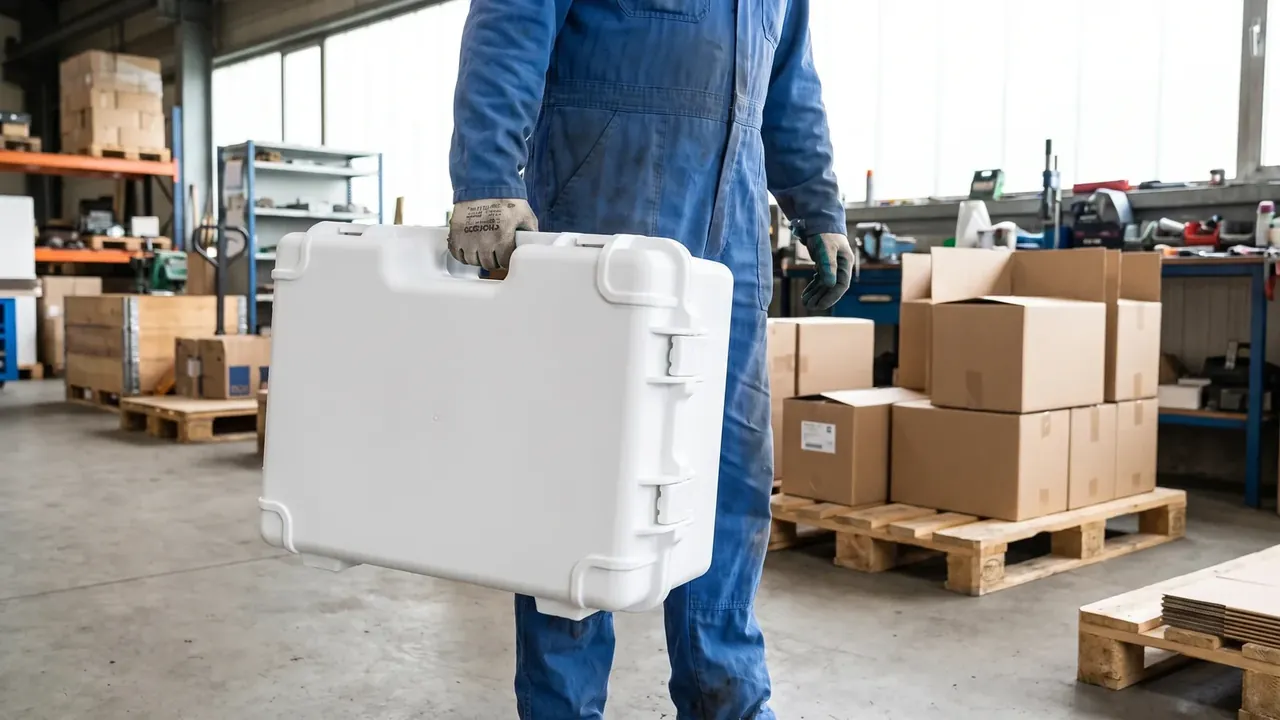
Quick answer: Military Case Sealing Design fixes a 3.2 mm lip at 19% compression, holds 12 kPa for 72 h, then checks rebound above 93% after a 30 min spray.
Table of contents
- Seal Lip Height in Military Case Sealing Design
- Lid Compression Rate in Steps
- Lip Rebound After 72 h of Constant Pressure
- In-Case Water Ingress after the Spray Retest
- Fixing the Lip Height for a Sealing Batch
- FAQ
1. Seal Lip Height in Military Case Sealing Design
Press a lid down for two days, spray it for half an hour, then open it: rebound and inner water answer most of the question. Military Case Sealing Design centres on one continuous seal lip. A 605×425×230 mm shell, a 540×360×170 mm cavity and a 4.6 mm wall carry a 3.2 mm lip along the parting line; two gasket rings and four 400 N latches hold 19% compression. A shorter lip loses rebound margin; a taller one exhausts latch travel and changes the drawing tolerance. Fix the height first, and the later pressure hold and spray share one ruler.
| Lip-height tier | Lip value | Lid compression | Latch reading |
|---|---|---|---|
| Low | below 3.2 mm | 19% | tightest margin, indoor transfer |
| Base | 3.2 mm | 19% | candidate, same drawing as 4.6 mm wall |
| High | above 3.2 mm | 19% | 400 N runs short, hinge seats rechecked |
Lip height, compression and latch force sit on one drawing, or the rig cannot tell which tier to keep. Military Case Sealing Design covers only the shell-to-lid fit. JUNZHIJIA logs lip height, compression and cycles in one column so a retest traces back to the same batch.
2. Lid Compression Rate in Steps
More compression is not better; 19% is the middle value from repeated trial closings. On the constant-pressure rig, four latches tightened diagonally to 400 N flatten the lip by about one fifth while two gasket rings push back. At 16% the gap runs loose; at 22% the lip root whitens. Military Case Sealing Design draws that boundary as a stepped table, so the fit is not judged by feel.
The steps also cover two states: an empty 6.2 kg case and one carrying 15 kg. Under load the lid bows and the lip loads unevenly, so each tier is read in both states. Military Case Sealing Design treats 4600 open-close cycles as a life backdrop and rechecks the steps only before and after, with no mid-run criterion. Stiffening ribs are checked against both loads too.
3. Lip Rebound After 72 h of Constant Pressure
The rig applies 12 kPa for a full 72 h without loosening a latch. Rebound depends on recovery after long compression, not on the feel a second after closing. Military Case Sealing Design writes rebound ≥93% into acceptance: release at hour 72, rest, then measure the lip against the pre-test 3.2 mm. Below that line the tier cannot survive two days of clamp. The rig is levelled at four corners or the case weight skews the reading.
| Pressure-hold interval | Rig pressure | Rebound reading | Action |
|---|---|---|---|
| Hour 24 | 12 kPa | 95% | record only, lid shut |
| Hour 48 | 12 kPa | 94% | retorque four latches, then read |
| Hour 72 | 12 kPa | ≥93% | compare with reject line |
Military Case Sealing Design keeps the hold apart from 4600 cycles, which are a separate durability set; the 72 h hold tests recovery alone. Benchmarked this way, the IP67 note on the drawing rests on readings, not a phrase.
4. In-Case Water Ingress after the Spray Retest
A case passing the hold moves to the spray bench: angled 30 min at 10 L·min⁻¹ along the parting seam. Military Case Sealing Design closes on in-case ingress ≤0.3 mL: open the lid, wipe the inner lip with measured filter paper, weigh the gain. Ingress near the hinge seats means the lip lost a tier on the long side; an even ring sends the check back to compression steps.
| Ingress reading | Spray condition | Measured inside | Disposition |
|---|---|---|---|
| Dry zone | angled 30 min, 10 L·min⁻¹ | ≤0.1 mL | filed directly |
| Mid | angled 30 min, 10 L·min⁻¹ | 0.2 mL | repeat spray at same setting |
| Limit | angled 30 min, 10 L·min⁻¹ | ≤0.3 mL | lip height back to review |
The repeat keeps the same angle and duration; Military Case Sealing Design wants a small reading reproduced. Water on the outer shell does not count, only the gain inside.
5. Fixing the Lip Height for a Sealing Batch
Put hold and spray readings on one sheet and the lip height lands. The fixed value is the shortest tier whose hour-72 rebound still stays above 93%; shorter lips go to indoor transfer. Military Case Sealing Design picks the shortest tier because a short lip saves latch travel and only weak-recovery batches return; raise it too high and the four 400 N latches need redrawing.
Once fixed, the two gasket rings, the 4.6 mm wall and the lid tolerance freeze together. Each batch is sampled against that sheet, one empty 6.2 kg case and one at 15 kg, with the 4600-cycle record for traceability. Military Case Sealing Design does not tighten one item to cover another: lip height, compression, rebound and ingress each hold their own reading.
Conclusion
Every trade-off in Military Case Sealing Design returns to four readings: lip height, compression, rebound and ingress. A 3.2 mm lip at 19% holds 72 h at 12 kPa with rebound ≥93%, and an angled 30 min spray at 10 L·min⁻¹ keeps ingress ≤0.3 mL. Four 400 N latches, two gasket rings and a 4.6 mm wall bring the 605×425×230 mm outline under one tolerance. Verified by method, fixed by reading, Military Case Sealing Design does not argue from a model number.
Related Reading
- Waterproof box with lid: a 6 yuan gasket, 3,200 yuan of rework
- Case Gasket and O-Ring Materials: EPDM, Silicone and Closed-Cell Foam Compared
- Drone Case Waterproofing: What IP67 Really Means for Your Drone
- How to Choose a Gasket-Sealed Protective Case: Five Checks
Related Products
- 8 Series — Gun Cases; Military Equipment Cases; Camera Equipment Cases; Drone Cases; Watch Cases; Knife Cases; First Aid Cases; Electronics Equipment Cases
- WL8-2812 PP Gun Case — model WL8-2812
- All protective cases and toolboxes: 7 series, 158 models