

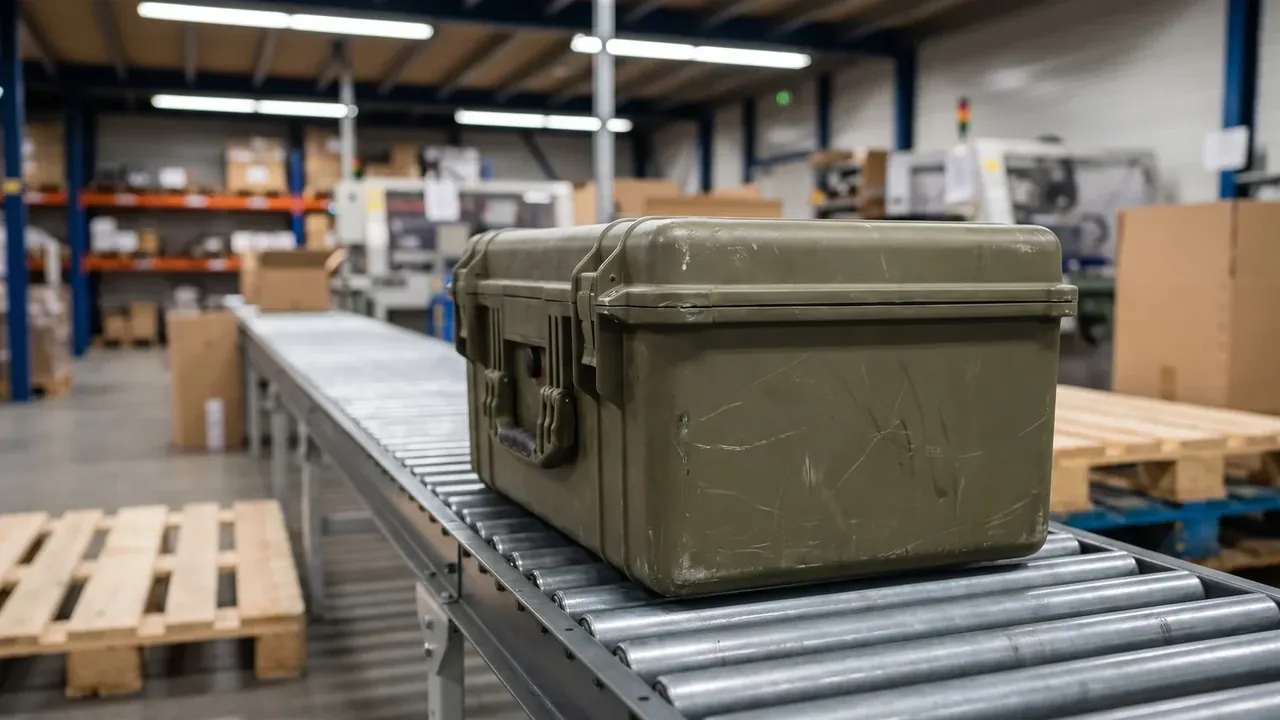
Quick answer: Sizing a military chemical agent container runs one way: 220 kg of payload and a 1.2 m drop fix the cavity, then span and pressure fix the wall. At 860 mm of cavity the landing point is 8 mm sides, a 10 mm base and a 7 mm lid.
Table of contents
- Cavity Size From the Load
- Cavity Span to Wall Thickness
- Ribs and Lid Structure
- Seal Groove and Hardware
- Stacking Lifting and Total Weight
- FAQ
1. Cavity Size From the Load
Fill a sheet from the dimensions down and every later row pays for it. A military chemical agent container is sized the other way: spread the load first, then let the cavity hold it. Agent at 1.3 kg per litre over 158 litres gives 205 kg; liner and cradle add 15 kg, so the working load is 220 kg.
| Item | Value | Basis |
|---|---|---|
| Agent charge | 205 kg | 158 L at 1.3 kg per litre |
| Liner and cradle | 15 kg | Weighed parts |
| Working load | 220 kg | Sum of the two |
| Case weight | 32 kg | 8 mm wall, measured |
| Loaded case | 252 kg | Load plus shell |
The 860 by 460 by 400 mm cavity holds 158 litres and still takes a fork. Another 100 mm pushes the centre of gravity out.
The 1.2 m drop height, the usual fumble for a two-person carry, governs the wall: 252 kg arrives on one corner.
2. Cavity Span to Wall Thickness
Wall thickness is derived, not looked up. A military chemical agent container bends its side across the 460 mm cavity width; polyethylene falls to 480 MPa at 60 °C and a 1.5 safety factor puts the floor at 8 mm. Under 8 mm, a loaded case shows a belly within 30 days.
| Part | Plan size | Wall | Basis |
|---|---|---|---|
| Side | 860 by 400 mm | 8 mm | 460 mm span |
| Base | 860 by 460 mm | 10 mm | Carries 252 kg |
| Lid | 860 by 460 mm | 7 mm | Stack load only |
| Corner | R30 mm | 8 mm | Drop stress |
On a military chemical agent container the base is thickened on its own: 252 kg plus the odd fork point, and 10 mm keeps deflection inside 2 mm.
3. Ribs and Lid Structure
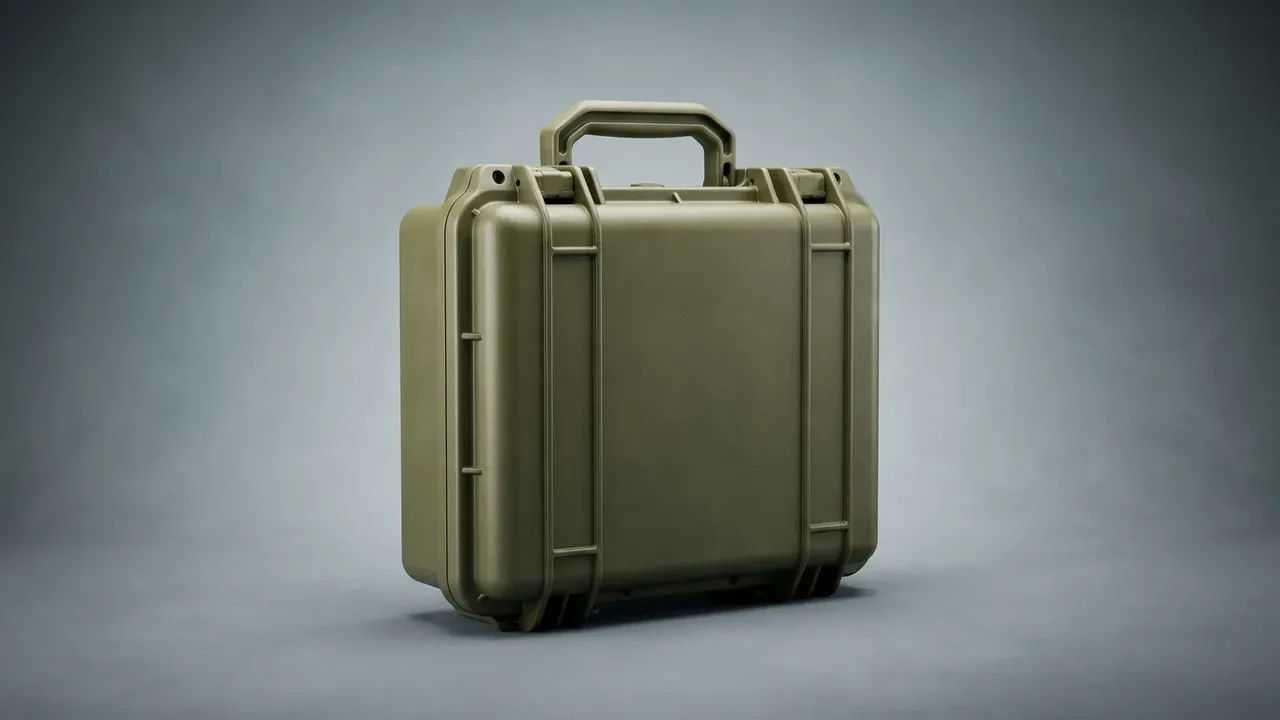
Ribs cut an 8 mm panel into smaller ones: at 14 mm high and 6 mm thick at 150 mm pitch, the 860 mm wall breaks into 5 bays and modulus rises to 3.2 times the flat sheet.
| Rib | Height | Thickness | Pitch | Duty |
|---|---|---|---|---|
| Side longitudinal | 14 mm | 6 mm | 150 mm | Side belly |
| Side transverse | 12 mm | 6 mm | 160 mm | Twist |
| Lid | 10 mm | 5 mm | 140 mm | Stack load |
| Corner | 14 mm | 8 mm | One side | Drop impact |
Lid ribs on a military chemical agent container sit over the four feet: three high, the bottom lid carries 504 kg and the walls take it.
4. Seal Groove and Hardware
On a military chemical agent container the groove runs in the lid flange, 8 mm wide and 6 mm deep, taking a 10 mm EPDM cord at 25 percent compression. Depth against cord section sits at 0.6: below that it never beds, above 0.75 the cord squeezes out.
| Part | Spec | Count | Load or torque |
|---|---|---|---|
| Seal cord | 10 mm, 25 percent | 1 ring | 30 kPa, 24 hours |
| Draw latch | 900 N closing | 4 | Pitch 215 mm |
| Hinge | 6 mm pin | 2 | Location only |
| Lifting eye | 1200 N each | 4 | 4800 N total |
| Lid screw | M6 | 12 | 8 N·m |
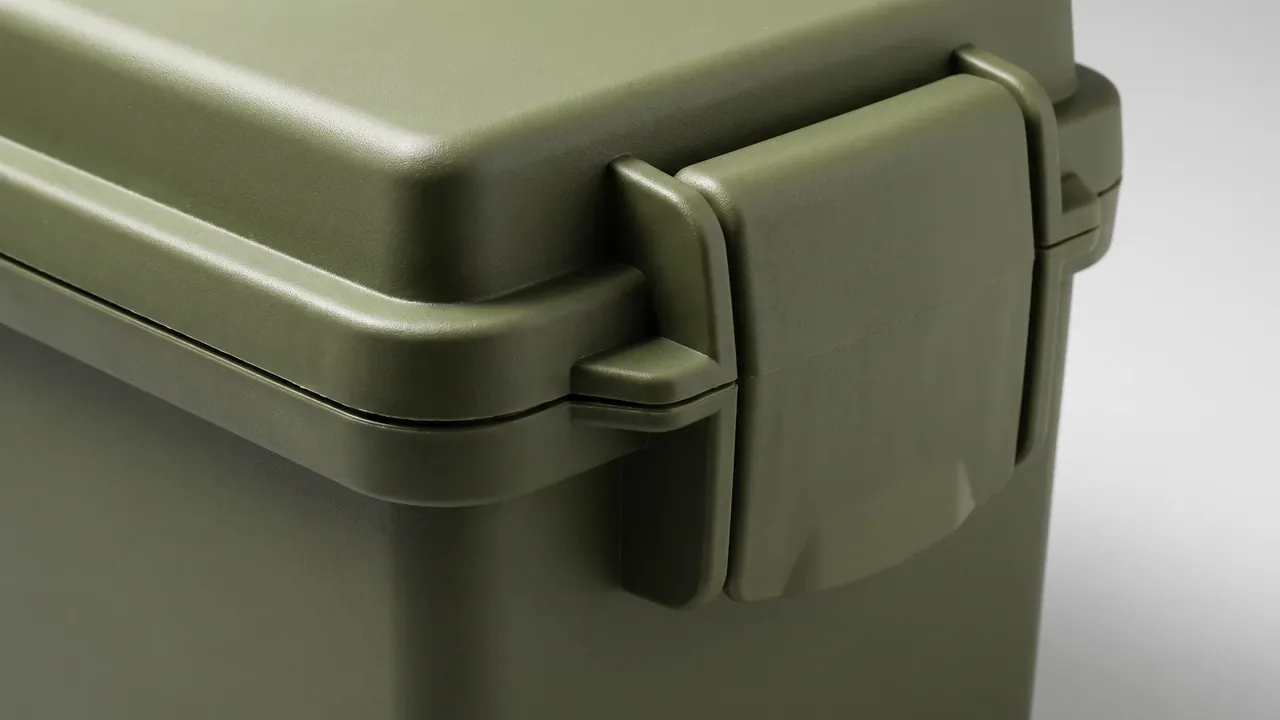
Hardware on a military chemical agent container follows the load path: four latches at 900 N sit along the 860 mm edge at 215 mm pitch, keeping the lid line down. Two hinges only locate.
5. Stacking Lifting and Total Weight
Stack height comes from clear height and case weight together. At 252 kg and 3 high, the bottom lid carries 504 kg over 0.4 square metre, or 1.26 kPa, below the yield of polyethylene. Three is safe without dunnage.
Lifting a military chemical agent container gets its own check. Four eyes give 4800 N against 2470 N, a factor of 1.9, or 1.27 once a 1.5 dynamic factor lands. Sling angle therefore stays inside 60 degrees.
At 252 kg it is 5 times the 50 kg two-person limit, so it moves by machine: 4 to a pallet gives 1008 kg and needs a 1200 kg pallet.
Conclusion
A specification is a chain, not a table: load sets the cavity, span sets the wall, ribs set stiffness, groove depth sets the seal. Move one figure and the rest follow: 8 mm against a 460 mm span, 10 mm against 252 kg, 3 high against 1.26 kPa. Walk that chain and a military chemical agent container holds its size.
This article discusses only the container (case body) side of specifications and design intent, and does not cover any handling, loading or use of the contents.
Related Reading
- Packaging standards and protection levels side by side
- Rotomoulding and how the seal works
- Load and layer maths for stackable cases
- Impact structure figures for warhead boxes
Related Products
- 8 Series — Gun Cases; Military Equipment Cases; Camera Equipment Cases; Drone Cases; Watch Cases; Knife Cases; First Aid Cases; Electronics Equipment Cases
- WL8-2812 PP Gun Case — model WL8-2812
- All protective cases and toolboxes: 7 series, 158 models