

Quick answer: Military drone protective case with wheels and pull handle: 620 mm span fixes a 655 mm cavity, 90 degree lid lift, 28.4 kg on 90 mm wheels, IP67 seal.
Table of contents
- Why an intact airframe fixes the inner width
- What a 90 degree lid opening leaves clear
- Wheel mounts rated at 80 kg against a 28.4 kg load
- Where the seal, latches and trolley bar sit
- Drop, temperature and seal checks by method
- FAQ
1. Why an intact airframe fixes the inner width
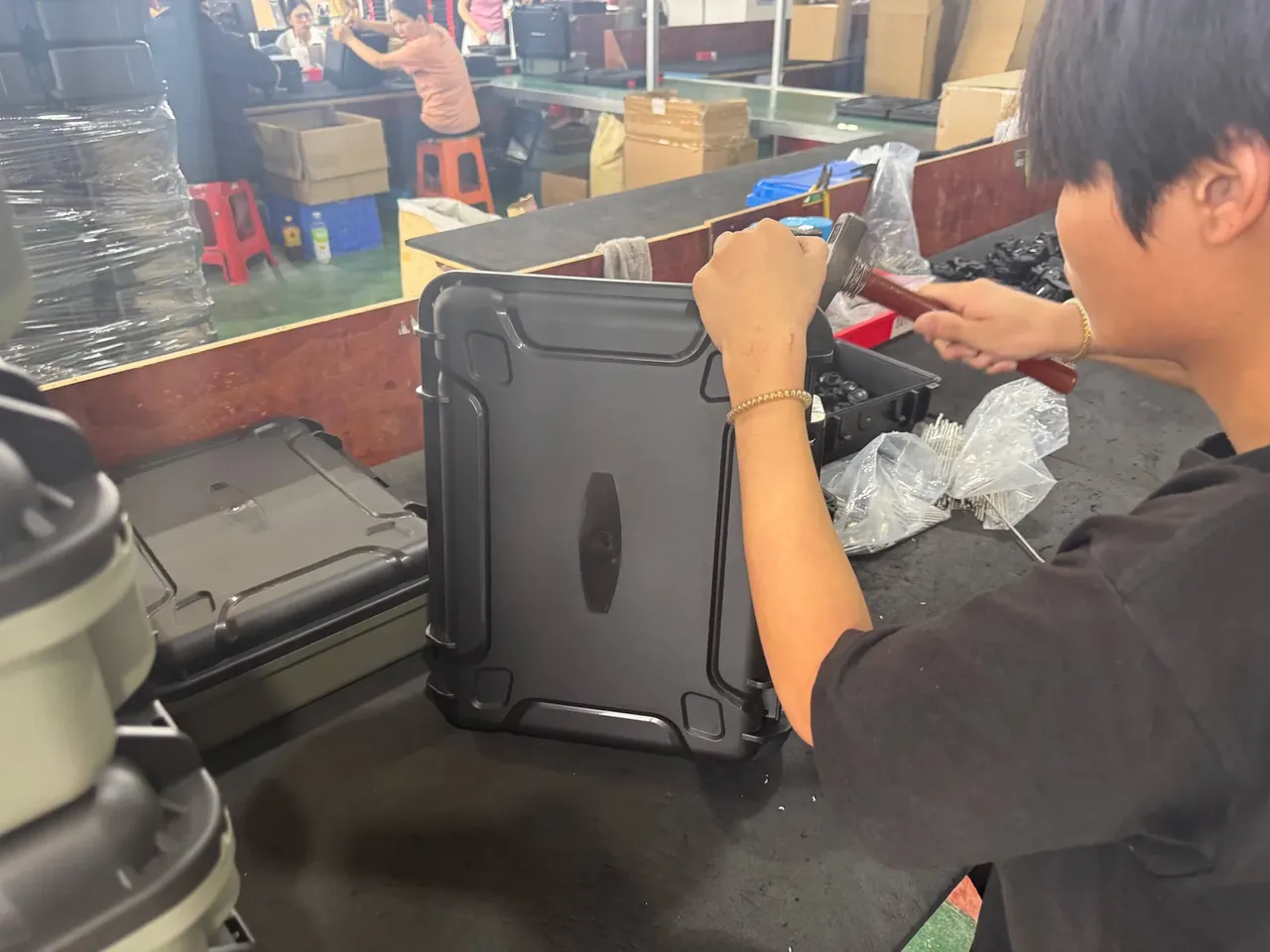
The first dimension is the packing state, not the outer outline. A Military drone protective case with wheels and pull handle ships the airframe intact, arms extended, so the 620 mm span is a hard floor for cavity width and fixes the 655 x 455 x 265 mm cavity, the 720 x 520 x 320 mm outer size and the 4.2 mm wall.
Empty 10.4 kg, payload 18 kg and packed 28.4 kg are one trade. With width pinned at 620 mm on a Military drone protective case with wheels and pull handle, mass can only be cut by rib layout.
| Packing state | What sets it | Design value |
|---|---|---|
| Intact, arms extended | cavity width floor | 620 mm |
| Lifting the airframe out | lid swing clearance | 90 degrees |
| Closed and rested | outer outline | 720 x 520 x 320 mm |
2. What a 90 degree lid opening leaves clear
The second decision is a 90 degree lid. Lifting an intact airframe out needs a vertical lane clear of hinge and lip; below 90 degrees the lid leans in and the edge rubs foam. At 90 degrees a Military drone protective case with wheels and pull handle gets headroom equal to the 265 mm cavity, with no exit pinch.
To hold that lane, the hinge sits outside the long edge. The rim is a continuous ledge and the gasket lands on it, not the lid edge, so a 90 degree swing never peels the seal. Die-cut foam leaves a perimeter frame and an open centre, with soft pads at the two arm-span corners. The lid liner is a bonded sheet that holds at vertical. Corner guards meet base guards on closing, so a drop drives impact into the corners first. At 90 degrees one person can lift the airframe out alone. Angle, liner and guards form one arrangement; changing one moves the lane.
3. Wheel mounts rated at 80 kg against a 28.4 kg load
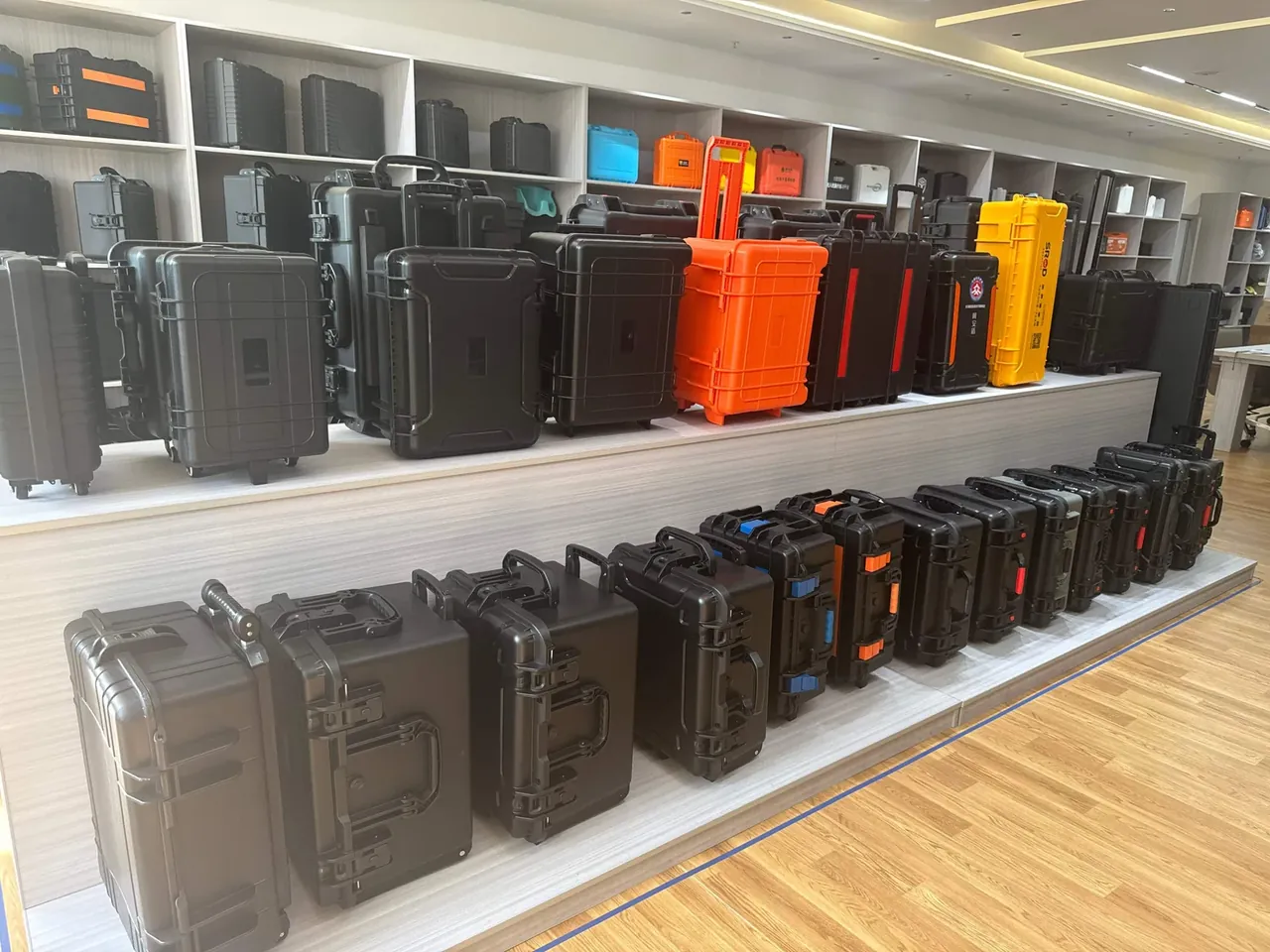
Whether one person can tow it separates this shell from a carry case. The packed 28.4 kg of a Military drone protective case with wheels and pull handle is empty 10.4 kg plus payload 18 kg, and the mount is rated at 80 kg for joint shock, not extra load. The bar runs 3 sections and extends 350 mm; towing tilts the body and loads the mount-to-floor joint.
| Part that sets size | Linked reading | Value |
|---|---|---|
| Wheel mount | packed 28.4 kg | rated 80 kg |
| Trolley bar | towing tilt | 3 sections, 350 mm extension |
| Floor | empty 10.4 kg | 4.2 mm wall |
The 80 kg figure is the level the joint is checked against by static method, not a claim the case carries 80 kg. What rests on the wheels is still 28.4 kg. Too short a bar drags the floor, too long a lever loosens the mount. A Military drone protective case with wheels and pull handle marks mount, wheels and bar as one chain; thickening one link alone does not count.
4. Where the seal, latches and trolley bar sit
Seal and latches are the two gates once closed. A continuous gasket presses on the rim ledge, checked against IP67 by method, and 4 latches at 460 N each clamp the lid evenly. Corner guards meet base guards, so a 1.0 m drop sends impact to the corners before the seam.

The bar and wheels change the load path, not the seal. The mount sits in a reinforced floor, the 90 mm wheel keeps the floor off the ground, and the 3-section bar folds into a back recess so 720 x 520 x 320 mm stays regular. A Military drone protective case with wheels and pull handle budgets these projections into the outer tolerance.
5. Drop, temperature and seal checks by method
Checks are written as alignment by method. A 1.0 m drop is verified, then corner guards and mount are inspected for loosening, the rim ledge for flatness and the gasket for rebound. Working temperature is aligned by method at -25 C to 60 C: low end for a stiff gasket, high end for a warped lid. A Military drone protective case with wheels and pull handle holds its cavity at both ends, the proof the 4.2 mm wall was chosen correctly.
The 90 degree lid and 350 mm bar are checked by cycling, so the hinge does not droop and the bar does not jam. Rechecking the seal against IP67 by method comes after drop and temperature, since reversing the order hides seam deformation. All 4 latches at 460 N pass a pull check first. Together these checks ask one thing: does the shell side drift out of size or shape.
| Reading | Linked part | Check by method |
|---|---|---|
| 28.4 kg | packed towing | static method against 80 kg mount |
| 90 degrees | lid opening | open-close cycling |
| 460 N | single latch | pull, each unit |
| IP67 | rim seal | dust and water recheck |
Six readings, each tied to its own part.
Conclusion
Every choice on a Military drone protective case with wheels and pull handle grows from one point: the airframe stays intact. The 620 mm span fixes the cavity, 90 degrees fixes lift-out, and an 80 kg mount against a packed 28.4 kg fixes towing. Put the packing state on the first line of the drawing and outer size, wall, latches and seal share one source. Confirm the arms stay extended before acceptance.
Related Reading
- Sizing a plastic case with a pull handle and wheels
- Matching trolley handles and caster load
- Cavity and lid opening for a drone case
- Structural requirements of a military protective case
Related Products
- 8 Series — Gun Cases; Military Equipment Cases; Camera Equipment Cases; Drone Cases; Watch Cases; Knife Cases; First Aid Cases; Electronics Equipment Cases
- WL8-2812 PP Gun Case — model WL8-2812
- All protective cases and toolboxes: 7 series, 158 models