

Quick answer: A Military Field Maintenance Case holds its lid at 95 degrees on a 3.2 N·m hinge, with latch gap under 0.6 mm after 3000 cycles read on the shell.
Table of contents
- Self-locking hinge torque of the Military Field Maintenance Case
- Latch-seat inserts and shell-wall stress
- Angle-stop verification on site
- Latch-gap readings over the cycling rig
- Seal re-check after hardware replacement
- FAQ
1. Self-locking hinge torque of the Military Field Maintenance Case
A Military Field Maintenance Case holds a 95 degree lid stop as a measurable outgoing condition, set not by lid weight but by a 3.2 N·m self-lock damper on the hinge axis. A shell of 640×460×280 mm outside and 575×395×215 mm inside, 4.4 mm wall, 7.6 kg empty and 14 kg rated, puts the lid centre of gravity a fixed distance beyond the hinge line. Torque is sized from that distance: high enough to hold at 95 degrees, low enough for one-handed lifting. JUNZHIJIA logs hinge torque apart from latch force and seal compression. The hinge seat sits on a thickened, ribbed back plate with an insert, so repeated torque does not pile up at the screw-hole rim. Benchmark cycling re-reads the torque every 500 cycles; decay beyond the set band marks the seat for replacement.
The table lists angle against torque; the stop carries load only at 95 degrees.
| Opening angle | Hinge torque reading | Lid behaviour |
|---|---|---|
| Below 95 degrees | Rising with travel | Free, not locked |
| 95 degrees | 3.2 N·m | Stop locked, block loaded |
| Above 95 degrees | Block cut-off | Stress back to shell plate |
2. Latch-seat inserts and shell-wall stress
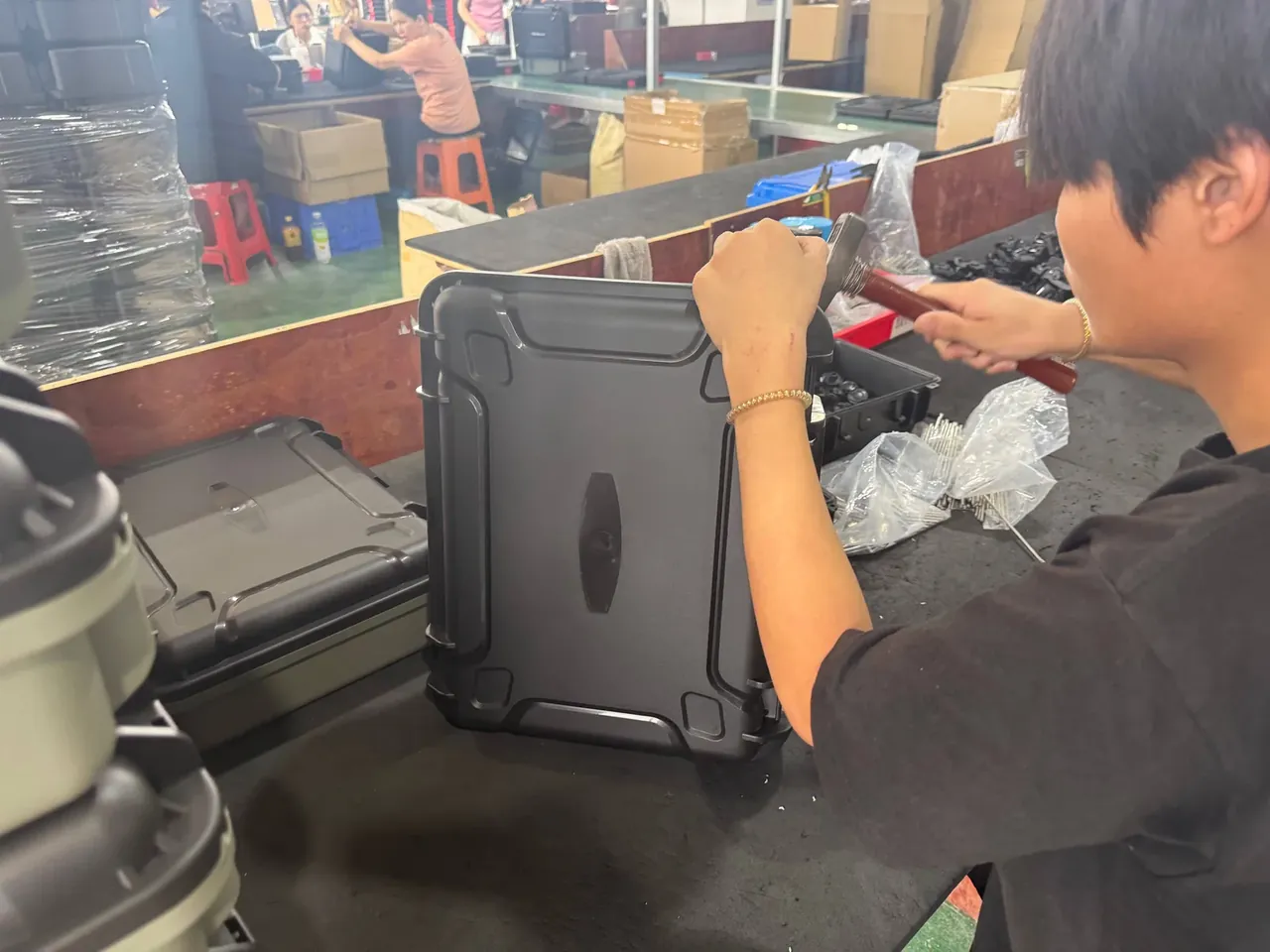
Four latches on the Military Field Maintenance Case press the lid rim at 460 N each, the force passing through the latch seat into the shell wall and out to the ribs. A metal insert is moulded into the seat hole so repeated closing lands on metal rather than the plastic bore, keeping the rim from whitening or micro-cracking. Insert and shell are moulded as one piece, while the seat face is a removable pad, so one latch can be swapped without touching the shell body.
The table groups hardware by insert method and stress path.
| Loaded hardware | Insert method | Stress path |
|---|---|---|
| Latch seat | Metal insert moulded in | Seat hole to shell ribs |
| Hinge seat | Thickened ribbed plate | Torque to plate to shell |
| Lid frame | Elastic rim | Compression to seal edge |
After a 96 h salt spray the insert rim shows no rust and closing force still reads inside 460 N; stacked three layers high, the shell wall carries the load with the latches taking no part.
3. Angle-stop verification on site
The 95 degree stop of the Military Field Maintenance Case is not a locked hinge but a pair of stops on the back plate meeting a boss at the lid root. Verification raises the lid to contact, releases it, then reads the resting angle with a protractor; three readings at 95 degrees count as a pass.
Angle and hinge torque are logged apart. A passing stop does not guarantee the torque still sits at 3.2 N·m.
Across −30 °C to 60 °C, dimensional change shifts the contact moment, so the rig re-checks the angle at both ends against the 95 degree baseline; the offset is recorded, not used for rejection. After a 1.2 m drop, stop displacement is traced to a loose insert first, then the 95 degree angle is re-read.
4. Latch-gap readings over the cycling rig
The cycling rig of the Military Field Maintenance Case folds the lid at a fixed cadence for 3000 cycles, each close by the four latches, recording only the latch gap and simulating no internal load. The gap is the free play between tongue and seat along the closing direction, measured at both ends with a feeler gauge and taken as the larger value. At 3000 cycles it must be no more than 0.6 mm, with a value kept every 500 cycles to separate wear from impact.

The table lists gap readings by stage; only the final 3000-cycle value decides.
| Gap reading | Cycle stage | Use of reading |
|---|---|---|
| Initial | 0 cycles | Assembly baseline |
| Intermediate | Every 500 cycles | Wear trend |
| No more than 0.6 mm | 3000 cycles, final | Outgoing decision |
Seal re-check for the Military Field Maintenance Case runs off this rig; the two IP66 benchmark tests finish later, so no early conclusion is drawn.
5. Seal re-check after hardware replacement
Whenever a latch, hinge damper or lid frame on the Military Field Maintenance Case is replaced, the case goes through seal re-check again, because disassembly shifts how far the lid rim compresses the seal. The re-check measures compressed seal-edge height, then runs immersion and dust tests by benchmark method, recording only whether each figure falls inside its band. Lid opening force and latch closing force are re-read after the 96 h salt spray, and a new part must not drift the 460 N setting.
The change record aligns part position, before-and-after gap and compression, while the other dimensions — 640×460×280 mm outside, 575×395×215 mm inside, 4.4 mm wall — stay untouched; replacement happens only in the removable hardware layer. Empty mass of 7.6 kg and rated load of 14 kg are weighed before and after the swap.
After re-check the Military Field Maintenance Case still takes one 1.2 m drop before gap and compression return to the pre-change values.
Conclusion
A Military Field Maintenance Case separates its three acceptance readings — the 95 degree lid stop, the 3.2 N·m hinge torque and the 0.6 mm latch gap after 3000 cycles — onto three replaceable layers, while the shell body supplies only the 4.4 mm wall and the 640×460×280 mm geometry. JUNZHIJIA validates each reading by benchmark method, and the record covers shell-side geometry, force and seal behaviour only.
Related Reading
- GJB-aligned military case shell benchmarking
- Measuring latch opening and locking force
- Protective case outgoing inspection checklist
- Shell hardware and latch-seat selection
Related Products
- 8 Series — Gun Cases; Military Equipment Cases; Camera Equipment Cases; Drone Cases; Watch Cases; Knife Cases; First Aid Cases; Electronics Equipment Cases
- WL8-2812 PP Gun Case — model WL8-2812
- All protective cases and toolboxes: 7 series, 158 models