

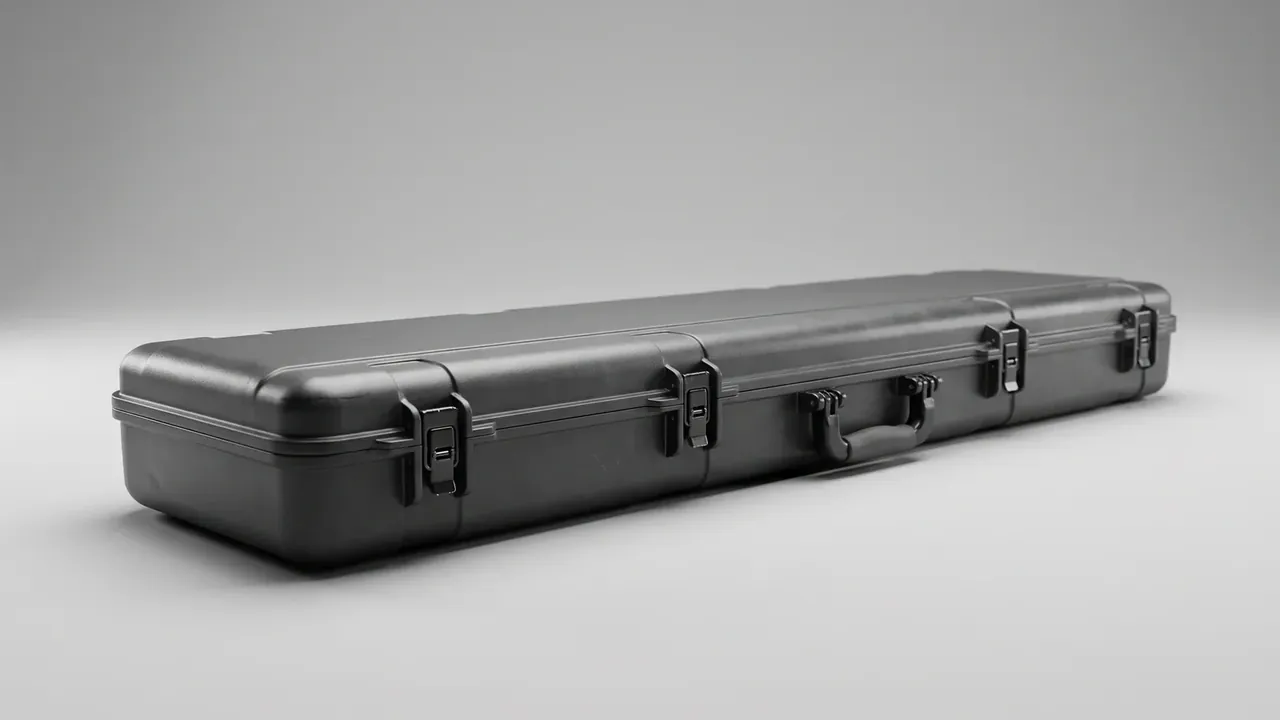
Quick answer: A military firearm case is five zones — lid, body, seal groove, hinge and latch — formed by injection or rotational moulding, tied together by wall thickness, ribs and insert tolerances.
Table of contents
- The Five Load-Bearing Zones of a Military Firearm Case
- How the Shell Is Formed: Injection vs Rotational Moulding
- How the Seal Groove, Hinge and Latch Form a Load Path
- Insert Cavities and Case-Level Tolerances
- What the Factory Inspection Actually Checks
- FAQ
1. The Five Load-Bearing Zones of a Military Firearm Case
A military firearm case is a shell system; the visible skin is its outer layer. Survival in transit depends on how five zones divide the load.
The lid spreads top impact; the body takes side compression and bottom drops; the groove holds the gasket; the hinge carries pivot and rear tension; the latch preloads both halves.
| Zone | Carries | Weak-point symptom |
|---|---|---|
| Lid | Top impact | Centre sags into foam |
| Body | Side load, base drop | Base cracks, corners whiten |
| Groove | Gasket compression | Gasket shifts, seam leaks |
| Hinge | Rear tension | Lid droops, halves misalign |
| Latch | Preload | Seam gaps, latch pops open |
Dimension chain first: cavity from footprint plus insert, wall both sides, latch last.
2. How the Shell Is Formed: Injection vs Rotational Moulding
The split is wall thickness, not machine cost. Injection forces melt into steel and ejects in under two minutes, holding 2.5 to 3.5 mm. Rotomoulding swings a powder-filled sheet-steel mould on a biaxial arm and fuses the charge at 6 to 10 mm.
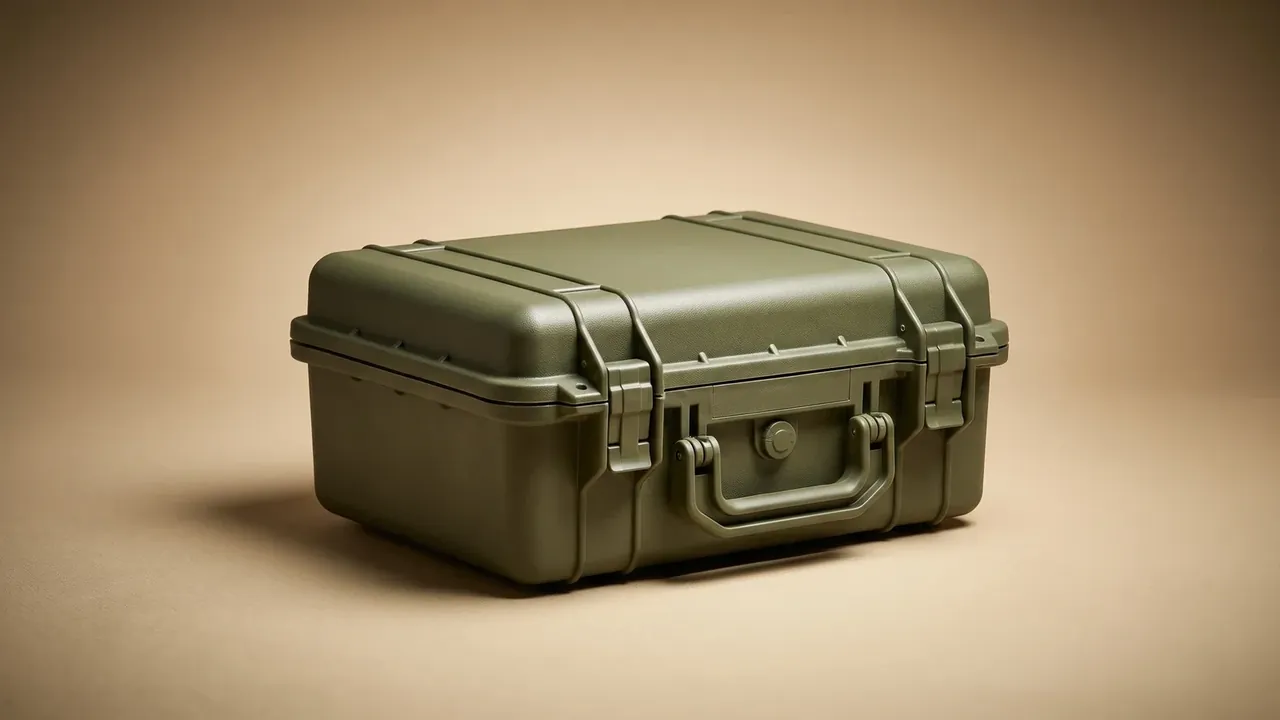
Injection is stiff and accurate but thin-walled, with little cold margin; rotomoulding is uniform and hard to crack, at the cost of weight. Rotomoulded ribs need an 8 to 12 mm root radius, or shrinkage sinks the base.
| Item | Injection | Rotational |
|---|---|---|
| Wall | 2.5 to 3.5 mm | 6 to 10 mm |
| Tooling | Steel, 800 to 2500 t | 3 to 5 mm sheet steel |
| Cycle | 60 to 120 s | 15 to 25 min |
| Tolerance | plus or minus 0.5 mm | plus or minus 2 mm |
The rule is long side against volume: under 900 mm at a thousand a year, injection amortises; past one metre, rotomoulding.
3. How the Seal Groove, Hinge and Latch Form a Load Path
Groove profile decides whether the gasket compresses or slides aside. Rectangular with a tapered mouth, cut to 0.72 times the section, gives 25 to 30 percent compression; under 20 percent it never seats.
Hinge pins run 5 mm 304 stainless on a pad 6 mm thick, aligned with a body rib. A pad alone on a flat face dumps load into four screw holes.
Latches need 3 to 5 degrees past centre and centres under 60 percent of the long side, or the mid-span seam opens — which is why long cases carry four latches.
4. Insert Cavities and Case-Level Tolerances
CNC cavities run 1.5 to 2 mm interference per side, 60 to 70 percent of part height. Too little and the item shifts, too much and every draw fights the wall.
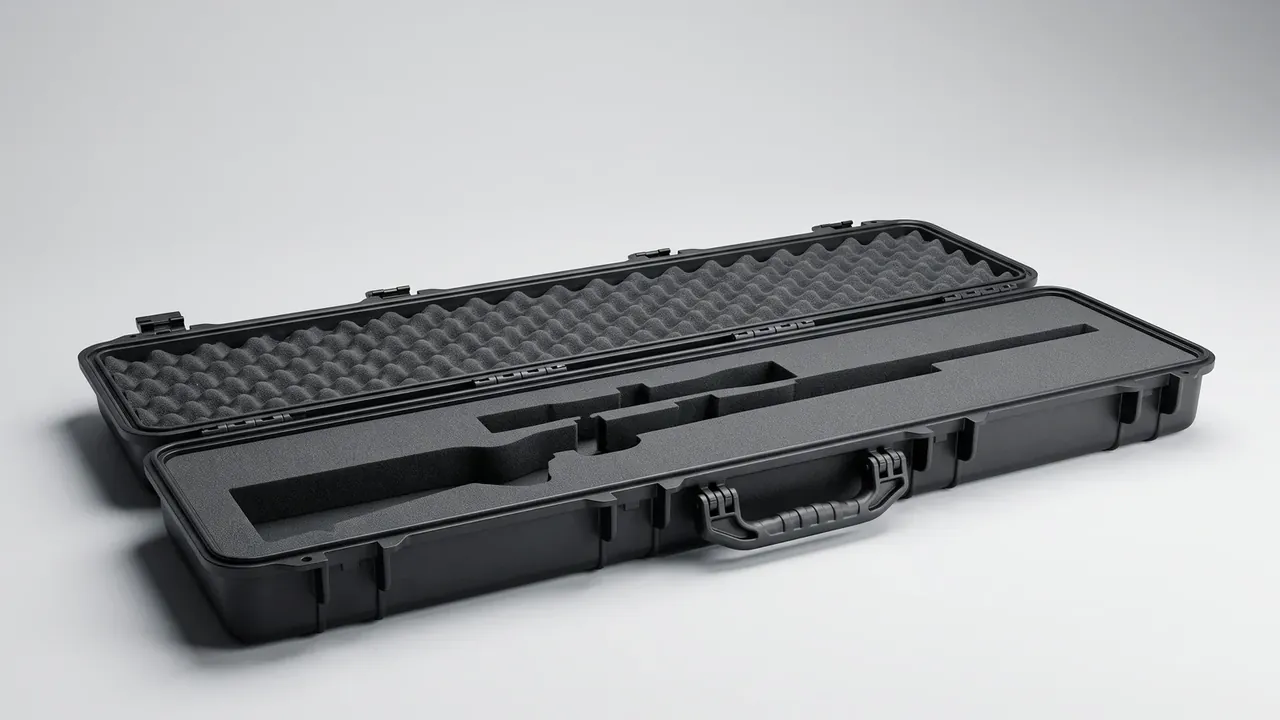
Laminate three layers of 45 kg/m³ foam, cut with a 6 mm cutter at 0.4 diameter step-over, then profile finish.
Lid-to-body misalignment stays under 1.5 mm or the gasket shears; depth within plus or minus 1 mm keeps foam in contact. Rotomoulded inserts run about 2 mm thicker.
5. What the Factory Inspection Actually Checks
Six checks, one per weak point.
| Item | Method | Criterion |
|---|---|---|
| Drop | 1.2 m concrete, six faces, three edges, one corner | No through crack |
| Seal | 20 kPa vacuum, 60 s | Decay within 1 kPa |
| Latch life | 5000 empty cycles | Preload loss under 20 percent |
| Hinge life | 3000 empty cycles | No loosening or play |
| Salt spray | 96 h neutral | No red rust on metal |
| Thermal | minus 40 C and plus 60 C, 4 h each | No distortion |
The drop test exercises all five zones: edge drop the body corner, face drop the lid centre, corner drop the rib intersections. A seal re-test should follow the thermal cycle, since cold stiffens EPDM.
Conclusion
The order is fixed: split load paths by zone, pick the route by size, close seal, hinge and latch into one loop, lock consistency by tolerances and inspection. Service life depends on whether all five zones share the load at impact — the line between a military firearm case and an ordinary storage box.
This article discusses only the container (case body) side of specifications and design intent, and does not cover any handling, loading or use of the contents.
Related Reading
- How to read military firearm case specifications
- Four hard criteria for a military firearm case
- What a rotomoulded case is
- Injection machine and clamp tonnage for cases
Related Products
- 8 Series — Gun Cases; Military Equipment Cases; Camera Equipment Cases; Drone Cases; Watch Cases; Knife Cases; First Aid Cases; Electronics Equipment Cases
- WL8-2812 PP Gun Case — model WL8-2812
- All protective cases and toolboxes: 7 series, 158 models