

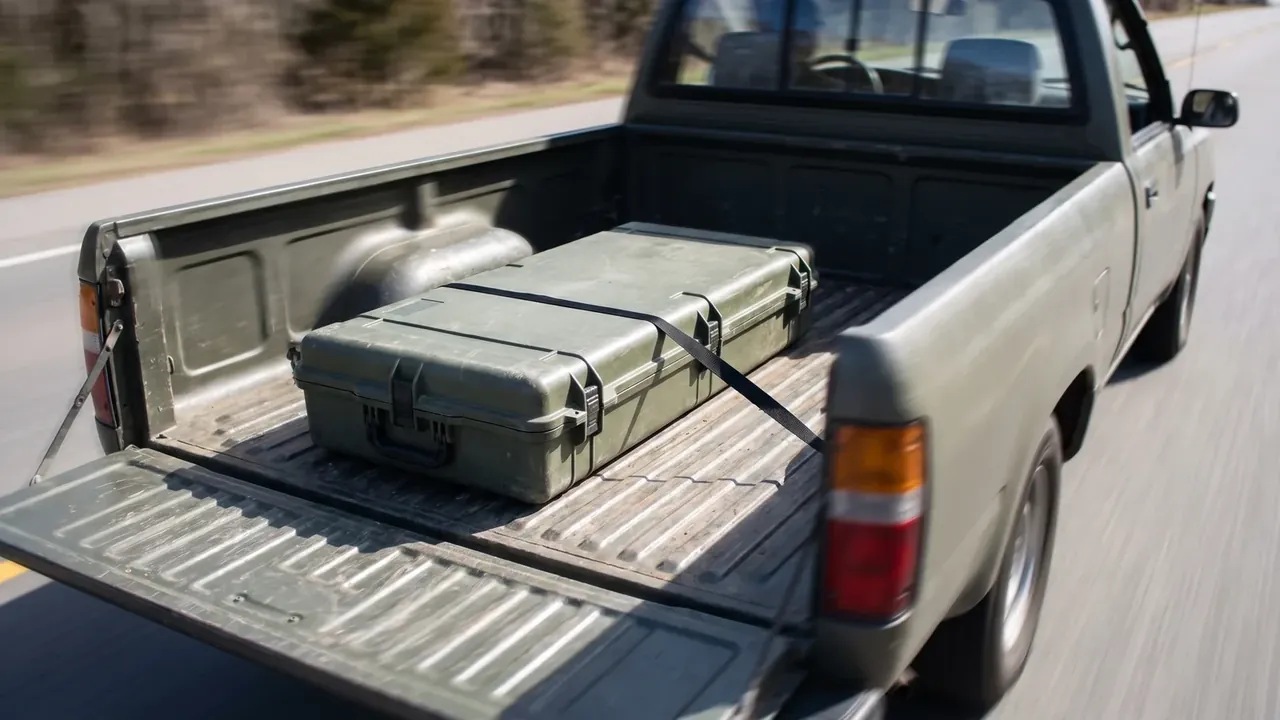
Quick answer: A Military Firearm Case specification is not a number from a catalogue. Cavity size and tolerance decide fit, wall and ribs trade weight for stiffness, load rating decides what the bottom case survives, sealing and temperature set the limit. Fix the duty first, then work backwards.
Table of contents
- How to Set Military Firearm Case Specifications
- Cavity Size and Tolerances
- Wall Thickness, Ribs and Weight Budget
- Load Rating, Stacking and Lifting
- Sealing Class and Temperature Range
- FAQ
1. How to Set Military Firearm Case Specifications
A drawing with one outside dimension comes back. Outside size serves transport and pallet layout, cavity size serves the contents, usable cavity serves the hand.
| Dimension set | Definition | Derived from | Common error |
|---|---|---|---|
| Outside | Outline, lid shut | Cavity, wall, protrusion | Wheel bosses missed |
| Cavity | Clear volume, lid to base | Contents plus foam | Base depth as full height |
| Usable cavity | Cavity minus foam, ribs | Thinnest point | Quoted at deepest point |
The order is fixed: contents plus foam give the usable cavity, foam and rib height the cavity, wall and protrusion the outside. Work backwards and the outside bows to a pallet size, foam falling to 5 mm.
2. Cavity Size and Tolerances
Tolerance follows the process. A moulded case holds ±1.5 mm on length; a rotomoulded one needs ±3 mm within a batch. Height sits at ±2 mm, base flatness at 1.2 mm/m, past which the case rocks. Diagonal difference stays under 2 mm.
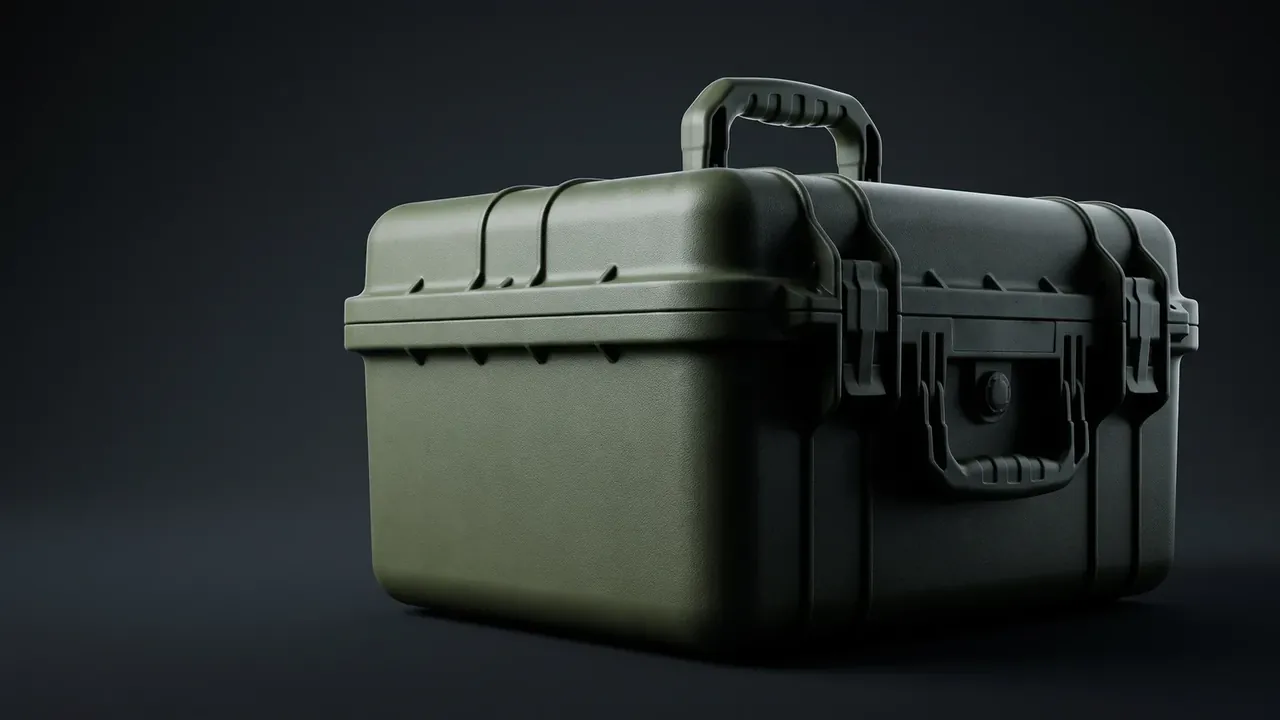
Polypropylene moves 0.4 to 0.6 percent, 4 to 6 mm across a 1000 mm case, while rotational moulding varies wall thickness by ±0.8 mm, so the cavity drifts. A Military Firearm Case tolerance table should name the process route. Fit allowance is 2 to 3 mm per side, foam at 10 percent compression.
3. Wall Thickness, Ribs and Weight Budget
Moulded side walls run 2.8 to 3.5 mm over a 3.5 to 4.0 mm base that carries the stack; rotomoulded bodies run 4 to 6 mm. Below 2.5 mm the wall cracks at −20 °C, above 5 mm it sinks and traps stress.
| Side wall | Case weight | Side compression, empty | Typical use |
|---|---|---|---|
| 2.8 mm | 6.6 kg | about 1.8 kN | Short transfers, one layer |
| 3.2 mm | 7.4 kg | about 2.4 kN | Routine stacking, road freight |
| 3.8 mm | 8.6 kg | about 3.1 kN | Multi-layer stacks, sea freight |
Rib height stays under twice the wall with an R1.5 root at 80 to 100 mm pitch, or the panel between ribs bows. On a 1200 × 450 × 180 mm case, target 7.5 kg: 1.1 kg of hardware over a 6.4 kg shell.
4. Load Rating, Stacking and Lifting
Two figures matter. Rated payload, 25 to 40 kg, is what may go inside. Stack capacity is what the lid survives, as layers times gross weight; 30 kg gross, four layers, 30 days, lid set under 2 mm is a parameter, stackable is not.
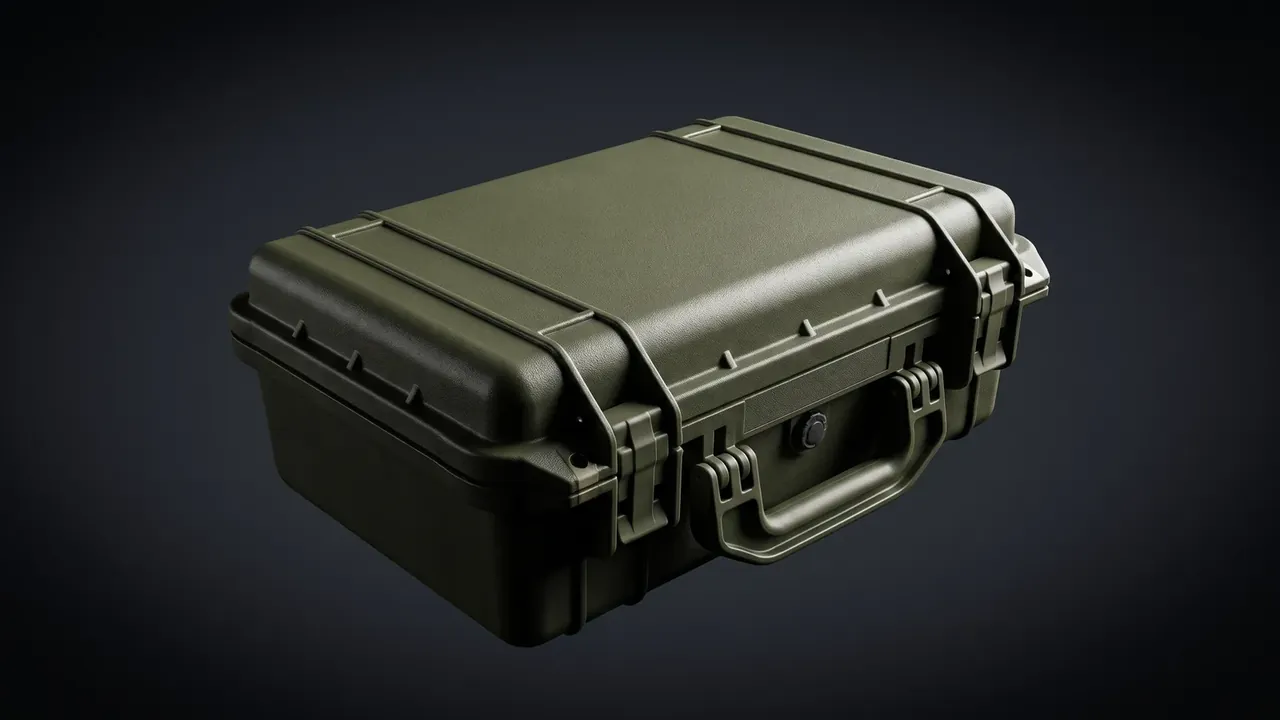
Pressure at the bottom sets the design: (30 + 7.4) × 3 × 1.5, about 168 kg on the lowest lid, which decides the rib grid. Side handles rated near 25 kg are not lifting lugs; slings go at a quarter of the length.
5. Sealing Class and Temperature Range
IP67 is a conclusion, not a specification. Use silicone or EPDM at Shore A50 to A60, compressed 25 to 30 percent: under 20 percent stress is too low, over 35 percent the gasket takes a set.
| Parameter | Range | Consequence outside it |
|---|---|---|
| Gasket compression | 25 to 30 percent | Seepage below 20, stiff lid above 35 |
| Groove clearance | 0.3 to 0.5 mm per side | Cord sheared when tighter |
| Storage temperature | −30 °C to +65 °C | Brittle wall or aged gasket beyond |
Temperature comes in bands: storage −30 °C to +65 °C, peaks to +70 °C, low-temperature drop after four hours at −20 °C. Polypropylene loses impact strength near −20 °C, a Military Firearm Case for air freight needs a valve opening at 0.35 bar.
Conclusion
A specification translates duty into numbers: three dimension sets in order, tolerance tied to the process, wall traded against ribs inside a weight budget, stack sized by pressure at the bottom. One sheet then replaces a season of verbal confirmation, which is what a workable Military Firearm Case specification is.
This article discusses only the container (case body) side of specifications and design intent, and does not cover any handling, loading or use of the contents.
Related Reading
- Military Firearm Case acceptance standards: items and decisions
- Four hard criteria when choosing a Military Firearm Case
- How a firearm storage case is built
- Layout of a long weapon case cavity
Related Products
- 8 Series — Gun Cases; Military Equipment Cases; Camera Equipment Cases; Drone Cases; Watch Cases; Knife Cases; First Aid Cases; Electronics Equipment Cases
- WL8-2812 PP Gun Case — model WL8-2812
- All protective cases and toolboxes: 7 series, 158 models