

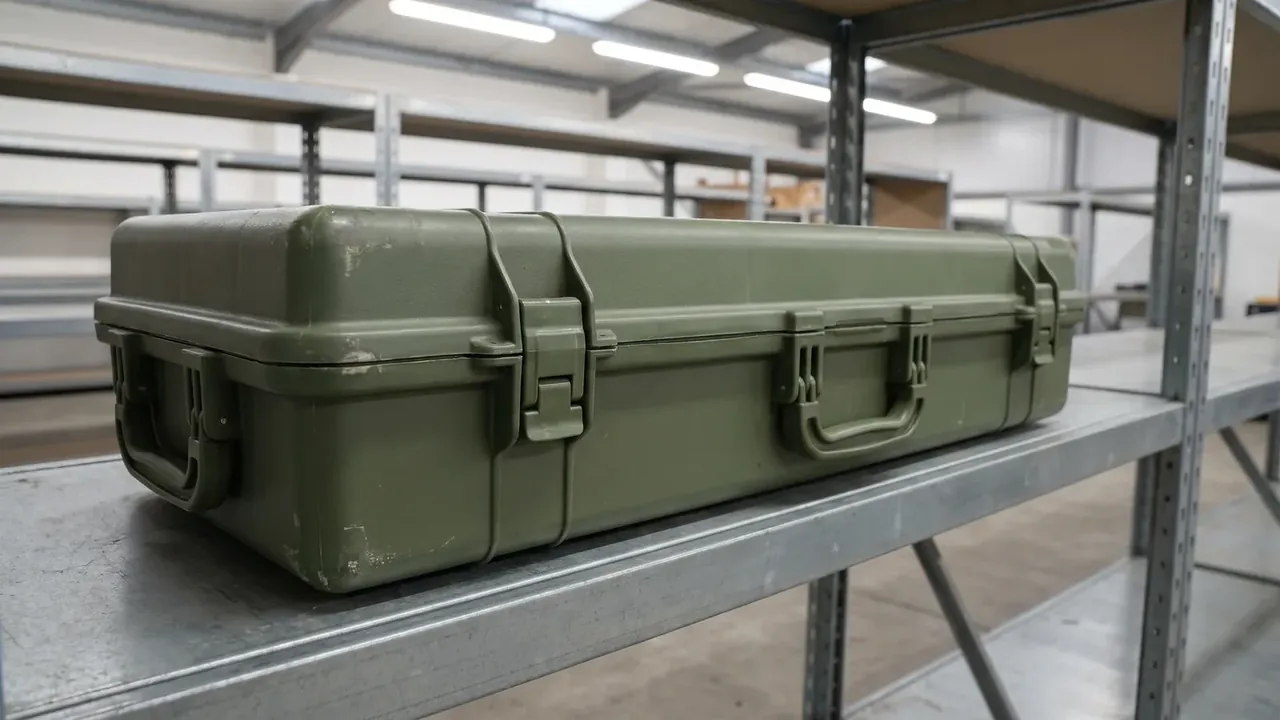
Quick answer: A Military Navigation Equipment Case clears ferrous parts from a 120 mm datum zone with 304 stainless and nylon fittings, holding a 90 degree lid to 2 mm.
Table of contents
- Why a Military Navigation Equipment Case clears ferrous parts from the datum zone
- Replacing steel with 304 stainless and nylon by position
- The 120 mm clearance and torsion through two supports
- A 90 degree self locking lid and diagonal drift
- Four latches, three stacking layers and the temperature band
- FAQ
1. Why a Military Navigation Equipment Case clears ferrous parts from the datum zone
A Military Navigation Equipment Case starts with a ring on the hardware list: within 120 mm of the device datum face no ferrous part may sit. The ring states only which material may appear in which band. Hinges, latch seats, handle seats and corner guards are logged, and plain steel parts inside are replaced.
Material is fixed before position can be set.
| Hardware position | Fitting | Count |
|---|---|---|
| Lid hinges | 304 stainless fittings | part of 14 |
| Latch seats | 304 stainless fittings | part of 14 |
| Handle seats | nylon fittings | part of 8 |
| Corner guards | nylon fittings | part of 8 |
| 120 mm datum ring | ferrous parts barred | 0 |
The table fixes the band, so all 14 stainless and 8 nylon fittings have a place.
2. Replacing steel with 304 stainless and nylon by position
Dimensions work from a 640 by 460 by 280 mm outer shell and a 575 by 395 by 225 mm cavity. Replacement follows the load path: hinges and latch seats become 14 304 stainless fittings; handle seats, corner guards and liner plates become 8 nylon ones. A Military Navigation Equipment Case uses no plain steel screws; washers and pins follow the same list.
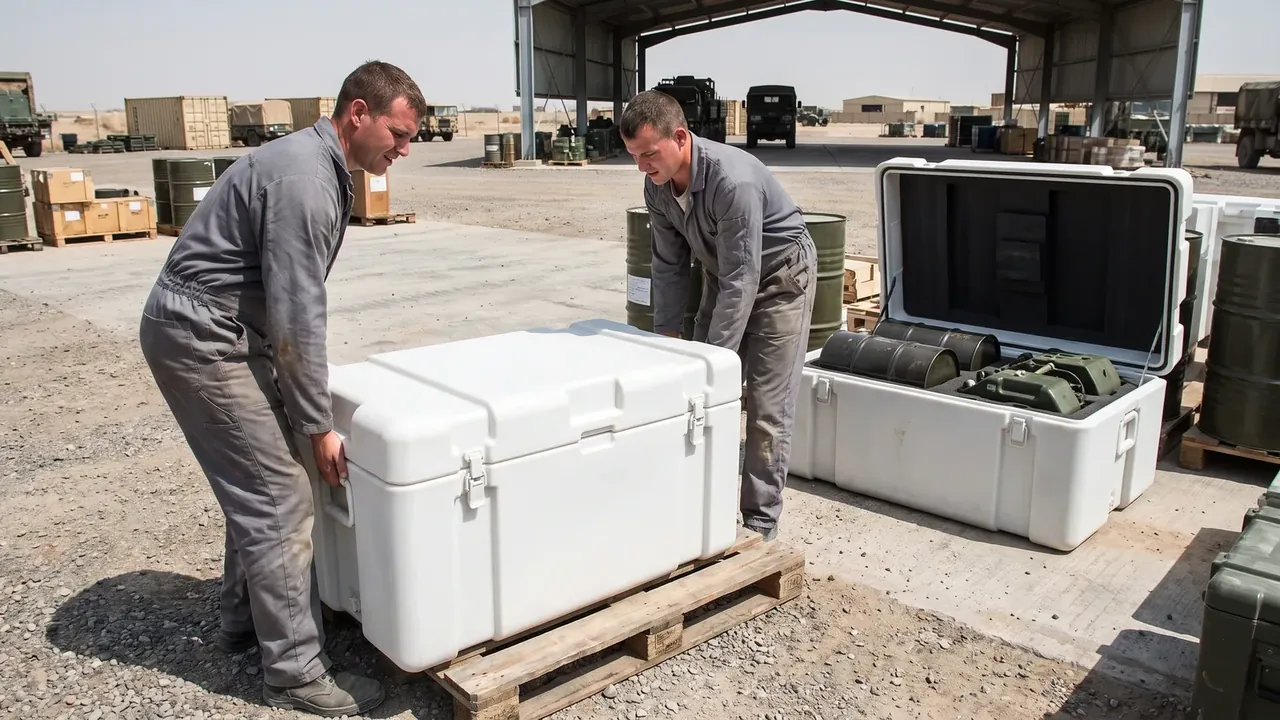
14 is not a round number. Two lid hinges, four latch seats, two rim stops and four base support seats add to exactly 14 stainless fittings, each outside or on the edge of the 120 mm ring. The 8 nylon fittings follow: two handle seats, four guards and two plates on the shell edge. A Military Navigation Equipment Case checks the list piece by piece, logging part numbers and holes. The 4.4 mm wall only provides a mounting base. A missed steel part means the whole lid is refitted and the 90 degree lock retested.
Piece by piece logging fits this rule better than batch sampling, since one miss breaks the ring.
3. The 120 mm clearance and torsion through two supports
With ferrous parts pulled out of the 120 mm ring, only two supports remain between lid and base, so a one-end lift puts torsion on them. A Military Navigation Equipment Case wraps two reinforcing bands around the shell so torsion travels through the walls, not the hinges.
| Material rule | Part | Check |
|---|---|---|
| Ferrous parts barred | inside 120 mm | logged one by one |
| 304 stainless | hinges and latch seats | 14 fittings |
| nylon | handle seats and guards | 8 fittings |
| two-material joint | washers and pins | insulating pad |
120 mm is measured to a fitting outer edge, not the wall; any part over the line goes back to replacement. After a 1.2 m drop the two lid diagonals are measured, with 2 mm or less showing the supports held. A Military Navigation Equipment Case keeps both on one retest sheet.
4. A 90 degree self locking lid and diagonal drift
The lid angle is fixed at 90 degrees by hinge stops, not propped by a strut. A Military Navigation Equipment Case requires the lid to self lock at 90 degrees without falling back, so the lid posture stays fixed while the diagonal is read.
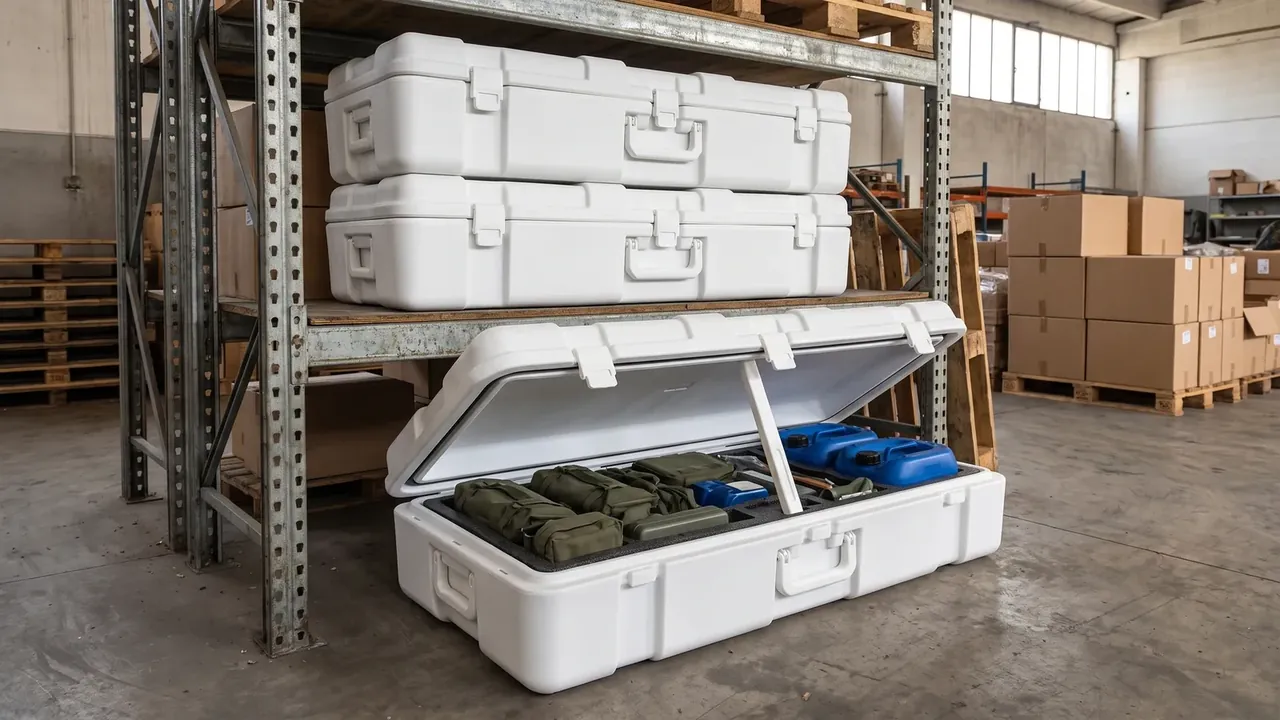
Drops run base, lid, long side and short side at 1.2 m, with the lid reopened to 90 degrees before each reading. Four latches at 460 N each decide whether the closed lid is knocked skew; once it shifts, the drift breaks 2 mm. A Military Navigation Equipment Case logs the diagonals before and after, and a drift over 2 mm sends the check back to the hinge stops and bands.
Read the diagonal before rechecking the angle. JUNZHIJIA keeps that order on the card.
5. Four latches, three stacking layers and the temperature band
Handling numbers: 4 latches at 460 N each, 3 stacking layers, IP66, minus 30 to 60 degrees Celsius, a 7.8 kg shell carrying 16 kg. None rewrite the 120 mm clearance, but they decide whether it survives stacking and temperature swing.
| Clearance value | Part | Reason |
|---|---|---|
| 120 mm | datum clearance | clean datum band |
| 90 degrees | self lock angle | no fall back |
| 2 mm or less | lid diagonal drift | after 1.2 m drop |
| 3 layers | stacking | bottom load |
At 3 stacked layers the bottom lid carries two cases; if wall bow reaches the hinge seats, all 14 stainless fittings shift and the 90 degree stop loosens. A Military Navigation Equipment Case routes stacking load into the reinforcing bands so the 120 mm clearance stays fixed. IP66 is the sealing rim benchmark, with the gasket around the full lid rim. At the cold end of minus 30 to 60 degrees Celsius the 8 nylon holes keep a clearance against shrinkage.
Conclusion
A Military Navigation Equipment Case folds a clean datum band and torsion into one shell: a 120 mm ferrous-free ring, 14 304 stainless and 8 nylon fittings, and two reinforcing bands. The lid self locks at 90 degrees, a 1.2 m drop holds the diagonal to 2 mm or less, and 4 latches at 460 N, 3 stacking layers and minus 30 to 60 degrees Celsius support the clearance. Ask where torsion goes, then read the diagonal.
Related Reading
- Structure and selection of military equipment protective cases
- Rating benchmarks for military standard protective cases
- Selection points for military air transport equipment cases
- Specification criteria for heavy duty military plastic cases
Related Products
- 8 Series — Gun Cases; Military Equipment Cases; Camera Equipment Cases; Drone Cases; Watch Cases; Knife Cases; First Aid Cases; Electronics Equipment Cases
- WL8-2812 PP Gun Case — model WL8-2812
- All protective cases and toolboxes: 7 series, 158 models