

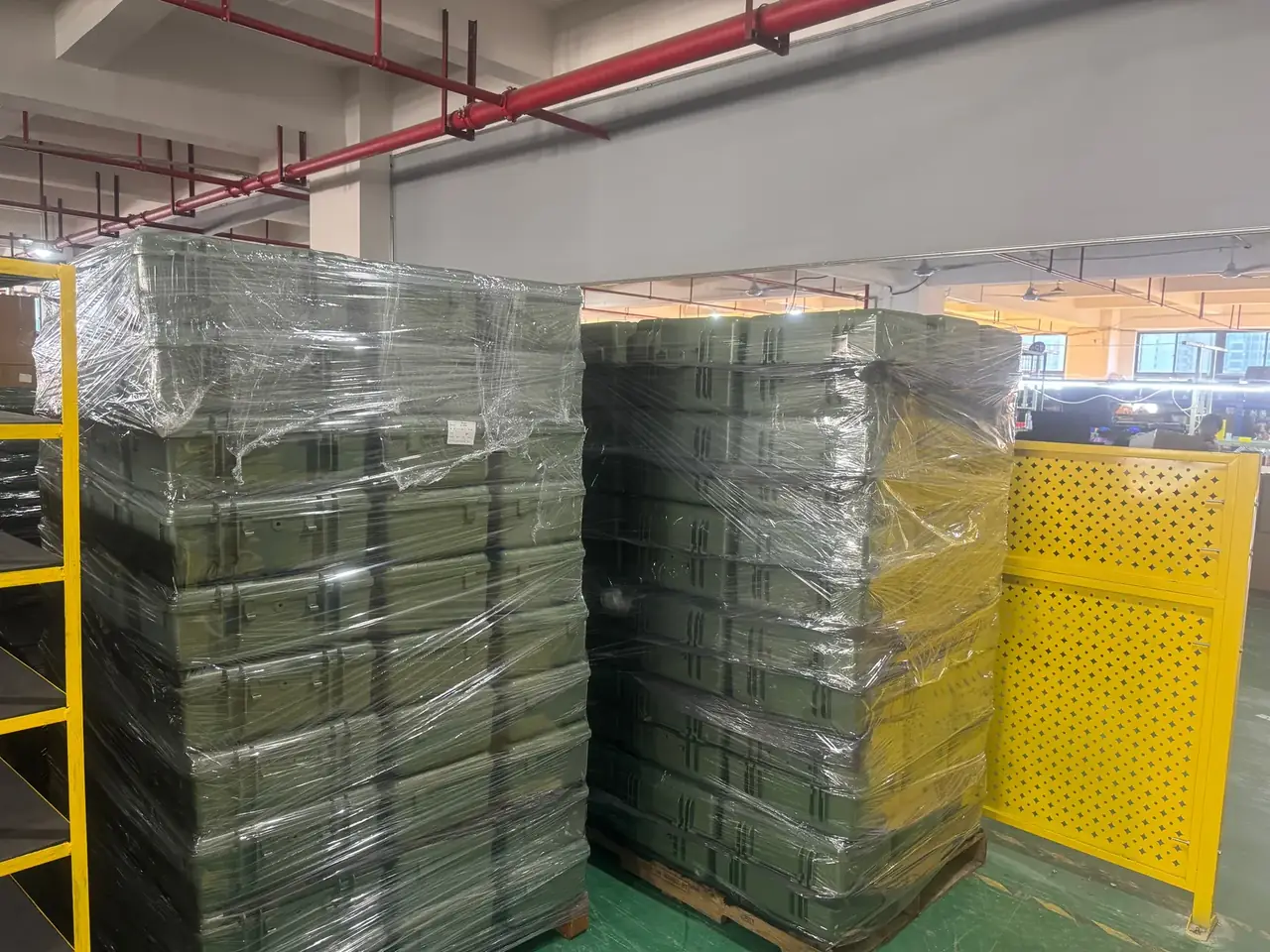
Quick answer: Military optical scope protective hard box sets corner wrap at 3.5 mm and R16 mm radius; four 0.8 m drops keep cracks under 2.4 mm and springback at 94%.
Table of contents
- Military optical scope protective hard box corner wrap thickness
- Corner radius at the transition
- Wrap cracking after four-corner drops
- Wall springback after a resting retest
- Wrap setting for the protection batch
- FAQ
1. Military optical scope protective hard box corner wrap thickness
Four corners take the floor in turn; whether the wrap splits, whether the wall springs back, and how generous the radius is decide the answer. The Military optical scope protective hard box measures 610 x 430 x 235 mm outside, 545 x 365 x 170 mm inside, with a 4.7 mm wall and a separate 3.5 mm elastomeric wrap bonded to each corner. A second overmould presses a softer grade onto the corner so a point impact spreads across a small pad instead of one sharp edge.
Each shell is numbered by corner zone before the wrap is gauged. A digital calliper takes three readings per corner, and a spread beyond 0.3 mm sends that case back for re-bonding. The empty case weighs 6.4 kg; loaded to 16 kg it goes onto the drop rig with ballast bolted to base inserts. JUNZHIJIA logs this wrap thickness as the first corner reading.
| Wrap tier | Measured wrap | Mean crack after drops |
|---|---|---|
| Thin | 2.6 mm | 3.1 mm |
| Middle | 3.5 mm | 2.4 mm |
| Thick | 4.4 mm | 1.5 mm |
2. Corner radius at the transition
The R16 mm radius settles how well the wrap lies and where stress travels. A sharp corner on the Military optical scope protective hard box stretches the wrap thin at the bend, exactly where the first crack appears; open the radius to R16 mm and the wrap follows an arc, so its thickness falls away gradually. The mould carries this arc as a separate insert so the radius can be trialled in steps.
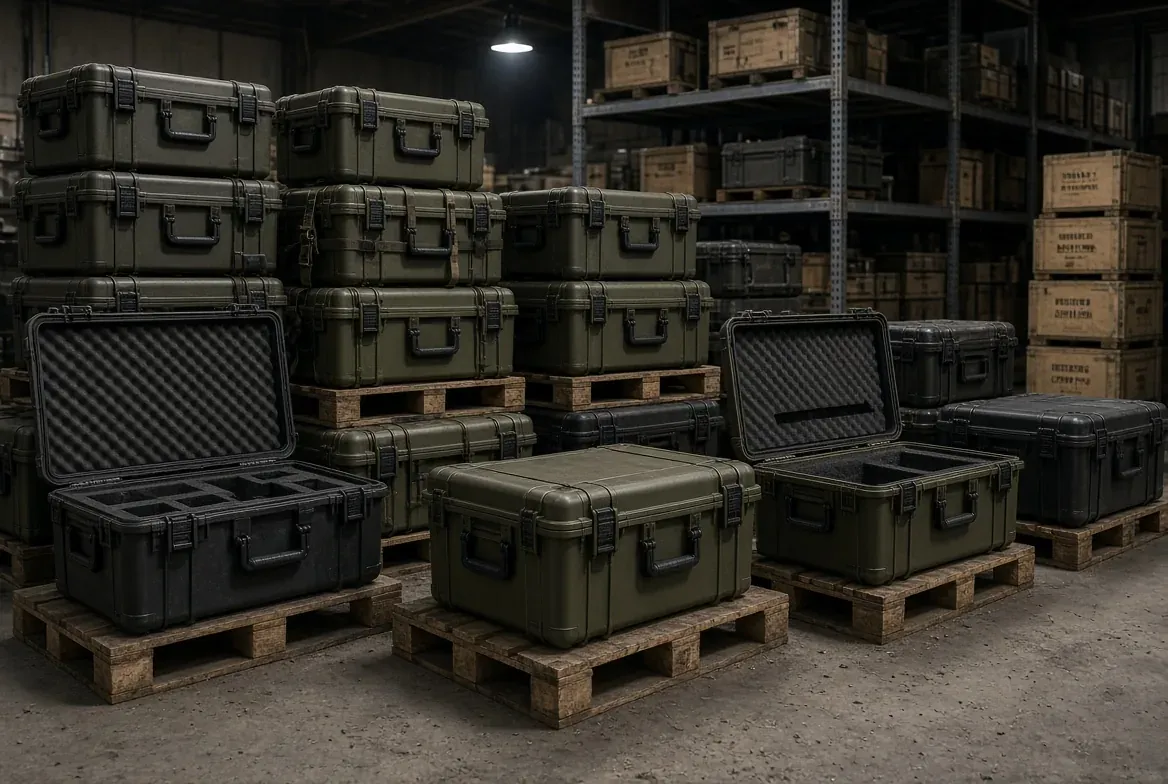
Trial pieces at R12, R16 and R20 run six units each through one drop sequence. Smaller radii leave the crack nearer the tip, meaning stress is still piled at the bend; the R16 mm step pushes the origin furthest out and loads the wrap most evenly. The Military optical scope protective hard box keeps the middle step.
Lid and rim overlap belong elsewhere; these numbers cover only the corner arc. Radius samples stay on file until the lot closes so a later compound change can be compared against the same arcs.
| Drop sequence | Corner ID | Measured radius |
|---|---|---|
| 1st corner | A | R16.0 mm |
| 2nd corner | B | R16.0 mm |
| 3rd corner | C | R15.8 mm |
| 4th corner | D | R16.1 mm |
3. Wrap cracking after four-corner drops
The rig lifts the case to 0.8 m and releases it once per corner, cycling A through D; a magnifier scans the wrap after each landing. The Military optical scope protective hard box records crack length in the wrap itself, not wall damage, taking the longest line from origin to end.
A corner passes only inside 2.4 mm. One corner over the line sends the whole case back with no retest. The steel landing plate is swept clear between corners so debris cannot cushion the next impact, and the 0.8 m height is rechecked after each cycle; a drift past 2 mm voids that round. The Military optical scope protective hard box files its four readings in corner order, A to D, never reshuffled by length. Two units failing on the same corner stop the rig for a mould-arc check rather than blaming one case.
| Crack reading | Corner | Remeasure after 30 min |
|---|---|---|
| 2.4 mm | A | 2.4 mm |
| 1.9 mm | B | 1.9 mm |
| 2.2 mm | C | 2.2 mm |
| 2.1 mm | D | 2.1 mm |
4. Wall springback after a resting retest
After the four corners the case rests, and a dial indicator presses each wall midpoint; the loaded-to-unloaded gap becomes a springback figure. The Military optical scope protective hard box calls for at least 94 percent, measuring whether impact left a permanent dent in the wall, separate from whether the wrap cracked.
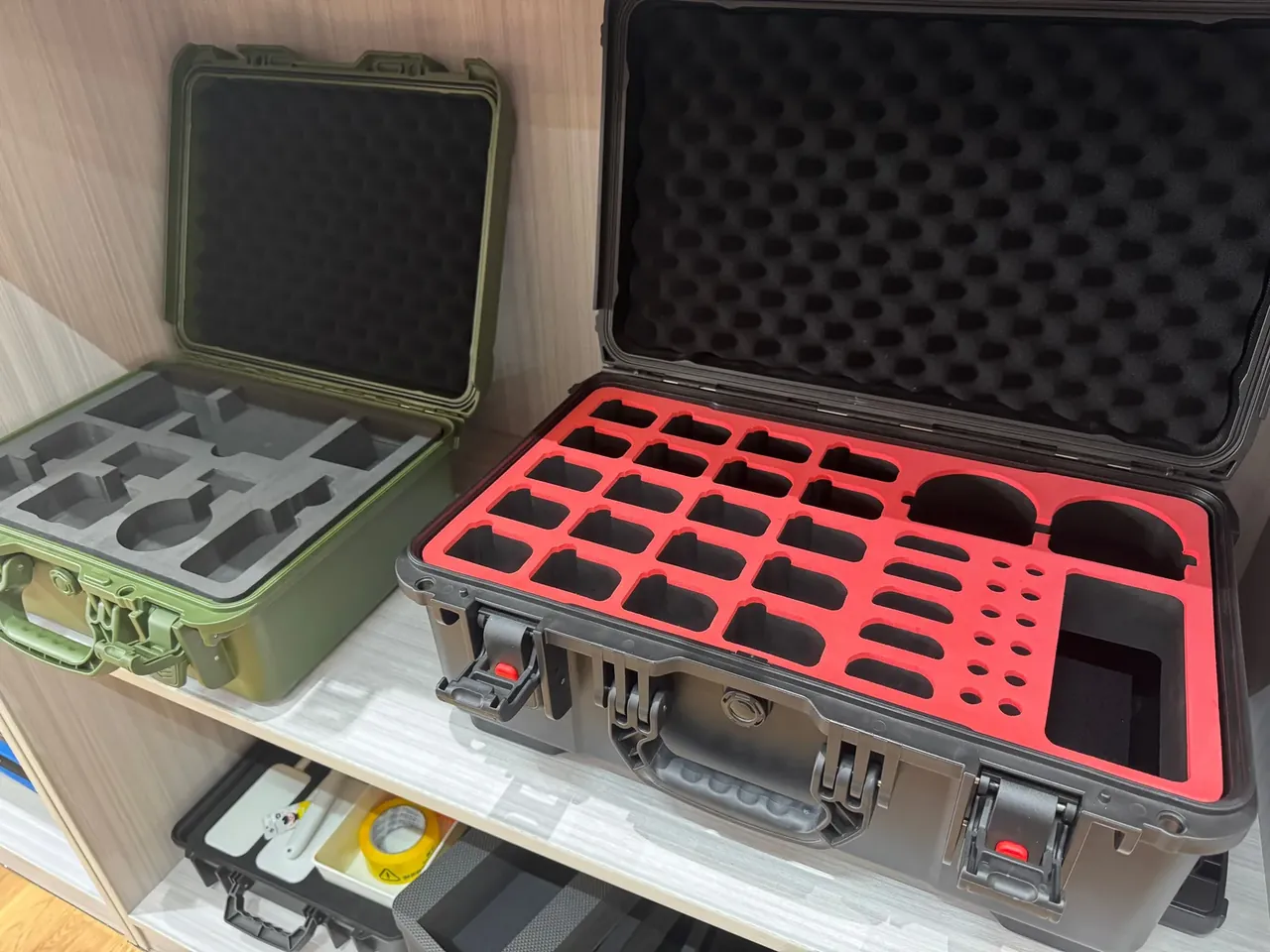
Gauge points sit midway between corners clear of ribs. The head holds a set travel for 10 s, three spots per case, and even the lowest must reach 94 percent. A case failing springback is rejected even with clean cracks, since the corner passed energy into the wall.
Springback and crack figures are logged apart and never traded. Only when both records are clean does the case join the pending lot.
5. Wrap setting for the protection batch
Folding the three tiers, the corner sequence and the retest into one line puts the wrap setting of the Military optical scope protective hard box on a fixed reject phrase: the setting is the thinnest tier whose crack stays under 2.4 mm after the fourth drop, and anything thinner goes to static handling for the whole lot.
Written onto the process card, the lot is no longer sorted tier by tier; a sampling ratio rechecks corner thickness only. Cases rated for 4000 cycles and four latches each holding 405 N carry two lid seals at 21 percent compression, all booked on the release sheet. The IP67 target is not carried by the corner wrap, so the two are recorded apart. JUNZHIJIA schedules the next run against this setting when compound changes.
Conclusion
Choosing the corners of the Military optical scope protective hard box aligns wrap thickness, radius and drop inspection: 3.5 mm at R16 mm, four 0.8 m drops with cracks under 2.4 mm and springback at 94 percent or better. The setting takes the thinnest passing tier, leaving no extra compound and not pushing impact onto the wall. Writing these readings into the process card gives the Military optical scope protective hard box a reference whenever tooling later changes.
Related Reading
- Custom EVA foam lined precision instrument case
- Custom precision electronic instrument protective box
- How to Choose a Precision Instrument Protective Case: Shock Protection and Safety for Metrology and Calibration Equipment
- Custom Foam Insert Protective Case: Size, Wall Thickness, Load
Related Products
- 8 Series — Gun Cases; Military Equipment Cases; Camera Equipment Cases; Drone Cases; Watch Cases; Knife Cases; First Aid Cases; Electronics Equipment Cases
- WL8-2812 PP Gun Case — model WL8-2812
- All protective cases and toolboxes: 7 series, 158 models