

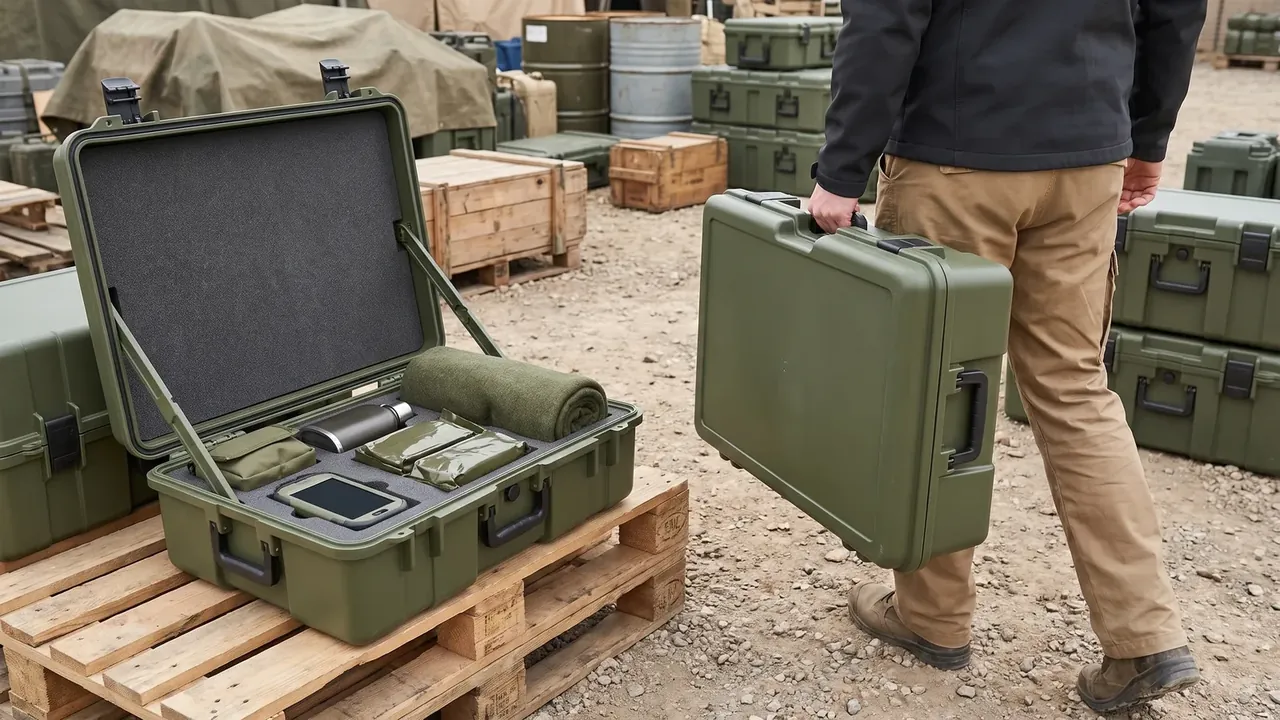
Quick answer: A military optics transport case needs three channels: retention for vibration, 200 g of desiccant to a −40 ℃ dew point, and an 8 kPa valve for pressure.
Table of contents
- Three failure paths a military optics transport case must close
- Vibration: retention, wall and drop consistency
- Humidity: desiccant load and dew point
- Pressure: valve and O-ring compression
- Salt spray and stacking
- FAQ
1. Three failure paths a military optics transport case must close
A military optics transport case is not loaded in one direction only. Vibration enters through the floor and reaches the instrument via the insert, moisture crosses the seal by partial pressure, and a temperature swing makes the sealed cavity expand and then contract, pulling damp air back in.
The shell is 520×400×240 mm outside and 465×345×195 mm inside behind a 4.0 mm wall, leaving 27.5 mm per side in plan. Empty weight 6.4 kg plus a 10 kg load gives 16.4 kg inside a 31 L cavity.
| Optical failure mode | Case response | Value |
|---|---|---|
| Reticle shift after vibration | Three-point retention plus floor ribs | 4.0 mm wall, 1.2 m drop |
| Condensation on optical faces | Desiccant chamber plus double seal | 200 g, −40 ℃ dew point |
| Pressure-driven ingress | One-way valve relief | 8 kPa opening |
| Salt corrosion at hardware | Material and surface finish | 96 h neutral salt spray |
2. Vibration: retention, wall and drop consistency
In a military optics transport case vibration starts at the floor, which is also the first face to land in a 1.2 m drop. Impact runs through the ribs, the side walls and the insert, so any rigid link passes the shock straight on.
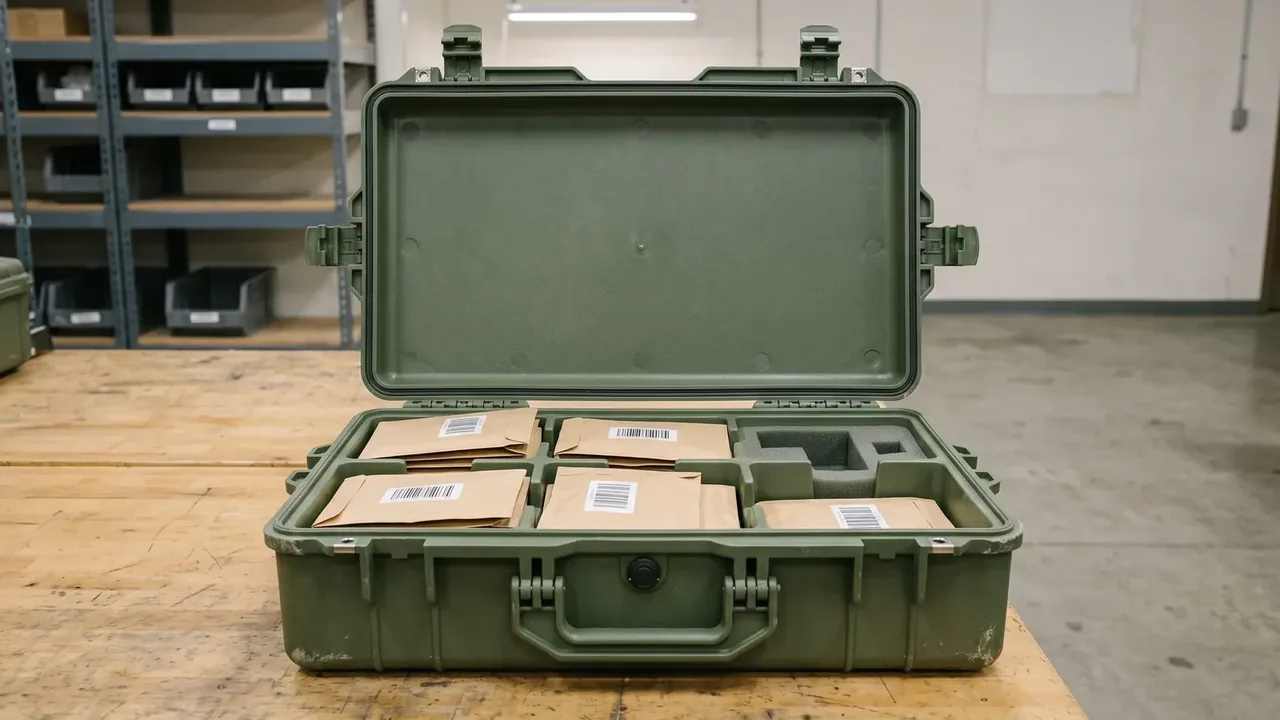
Retention uses three points rather than four clamped walls. The points sit on a triangle in the floor, so a 10 kg load gives about 3.3 kg each and a 6 g factor puts the peak near 200 N, a level the foam absorbs; clamping four sides turns the same shock into shear. A 4.0 mm wall with 6 mm ribs at 45 mm pitch holds floor deflection under 0.7 mm.
The post-drop criterion is consistency: after one 1.2 m drop on each of six faces, slots must not shift more than 2 mm and all four 420 N latches stay closed.
3. Humidity: desiccant load and dew point
Humidity is the channel most often underestimated in a military optics transport case, since no single mechanical test exposes it. A gasket stops convection, not vapour moving down a partial pressure gradient; the 31 L cavity holds about 0.4 g of water at 25 ℃ and 60% relative humidity, enough to condense below the dew point.
In a military optics transport case the desiccant sits in a chamber of 90×60×25 mm behind a 5 μm membrane that blocks powder but passes vapour. Its capacity is hundreds of times that 0.4 g, and the margin covers what the gasket lets through over 12 months. A dew point of −40 ℃ is the pass criterion, measured 24 h after filling and equal to roughly 0.1 g/m³ of residual water; one opening resets it, so the chamber opens separately.
4. Pressure: valve and O-ring compression
The cavity of a military optics transport case is sealed, so any temperature change becomes a pressure difference. By ideal gas estimate, the 90 K span from −30 ℃ to 60 ℃ would build over 30 kPa inside, enough to lift the lid off its seal.
The valve opens at 8 kPa and is covered by a hydrophobic membrane. Below 8 kPa gas equalises slowly through the membrane; above it the disc lifts and multiplies the flow area, venting well before 30 kPa.
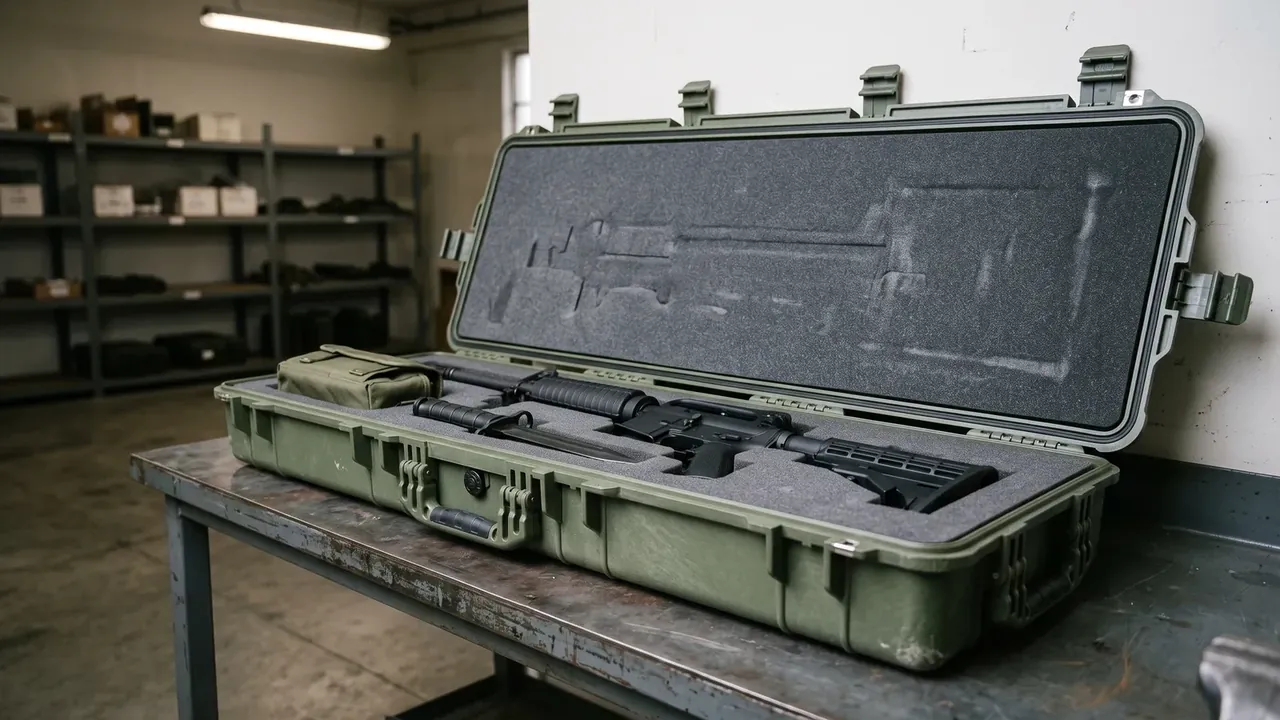
The O-ring is φ6 mm at 22% compression, a 4.68 mm section in a groove cut to that depth, 1.32 mm of squeeze. Below 15% contact stress is too low and 8 kPa lifts the seal; above 30% the compound stiffens at −30 ℃ and fails to recover, so the second closure seats on a displaced ring.
| Case response | Channel | Design value |
|---|---|---|
| Three-point retention | Vibration | 3.3 kg static per point, 200 N peak |
| Desiccant chamber | Humidity | 200 g in a 90×60×25 mm chamber |
| Hydrophobic valve membrane | Pressure | 8 kPa opening, vapour only |
| φ6 mm O-ring | Pressure | 22% compression, 4.68 mm groove |
5. Salt spray and stacking
Salt spray is the one criterion on a military optics transport case that looks only at hardware. Neutral salt spray at 5% sodium chloride and 35 ℃ for 96 h must leave no red rust on latches, hinges or the valve body.
Stacked 4 high, the bottom lid carries three finished cases, about 49.2 kg. Held 24 h, residual deformation must stay within 2 mm; past that the lid-to-body face opens and the IP67 immersion at 1 m for 30 min fails behind it.
From −30 ℃ to 60 ℃, soaked 4 h at each end and cycled once, latch release force must stay within 30% and the valve must still lift at −30 ℃. Low temperature is where it fails first: a stiff silicone disc pushes the opening point from 8 kPa past 12 kPa.
| Value | Test item | Acceptance |
|---|---|---|
| 4.0 mm | Wall thickness | Six-point check, minimum 3.8 mm |
| 1.2 m | Six-face drop | Latches closed, slot shift ≤2 mm |
| 200 g | Desiccant fill | Weight within ±2 g |
| 8 kPa | Valve opening | Lifts and reseats |
| 96 h | Neutral salt spray | No red rust |
Conclusion
Reliability in a military optics transport case comes from three channels holding at once, not from one good gasket. Vibration goes to three-point retention and a 4.0 mm wall, humidity to 200 g of desiccant and a −40 ℃ dew point, pressure to an 8 kPa valve and 22% squeeze on a φ6 mm O-ring. Then a 1.2 m drop, 96 h of salt spray and a 4-high stack test all three together.
Related Reading
- Structural and process points for military air transport cases
- How to read a military air transport case specification
- Insert and sealing layout for optical instrument cases
- When a case gasket has to be replaced
Related Products
- 8 Series — Gun Cases; Military Equipment Cases; Camera Equipment Cases; Drone Cases; Watch Cases; Knife Cases; First Aid Cases; Electronics Equipment Cases
- WL8-2812 PP Gun Case — model WL8-2812
- All protective cases and toolboxes: 7 series, 158 models