

Quick answer: Military spec multi-functional mobile equipment case holds bushing play at 0.18 mm, pulls 3000 times at 25 kg, then checks radial play under 0.35 mm.
Table of contents
- Castor Bushing Clearance in Military spec multi-functional mobile equipment case
- Trolley Handle Wall Thickness
- Radial Play After 3000 Pull Cycles
- Handle Wobble after the Unloaded Retest
- Fixing the Bushing for a Mobile Batch
- FAQ
1. Castor Bushing Clearance in Military spec multi-functional mobile equipment case
A three-thousand-cycle drag on the rig ends with the case lifted; one gauge reading on the axle separates a sound bushing from a loose one. Military spec multi-functional mobile equipment case leaves a 645×410×230 mm cavity inside a 720×480×300 mm outline, with a 5.2 mm wall bracing each castor mount. A bushing pressed into that mount starts at 0.18 mm clearance against a 1.6 mm handle wall. Widen it and the castor drifts; clamp it too close and the axle binds, so both limits go on the drawing.
| Bushing tier | Initial clearance | Fit method | Reading before the pull |
|---|---|---|---|
| Tightest | 0.18 mm | reamed once after press-in | smallest play margin, mobile-case candidate |
| Middle | a touch over 0.18 mm | pressed, not reamed | same drawing as 5.2 mm wall, kept as control |
| Looser | half a tier wider | assembly slack left | axle wobble shows early, castor mount rechecked |
Military spec multi-functional mobile equipment case keeps the discussion to three joints: shell, castor mount and handle root. Per batch, JUNZHIJIA stamps an assembly card; the unloaded retest is filed under that card number.
2. Trolley Handle Wall Thickness
Working back from 0.18 mm of clearance and a 25 kg pull load gives a 1.6 mm handle wall. Military spec multi-functional mobile equipment case pins stiffness and ballast to that single wall value, so the assembler takes the figure from the drawing instead of flexing the handle by hand.
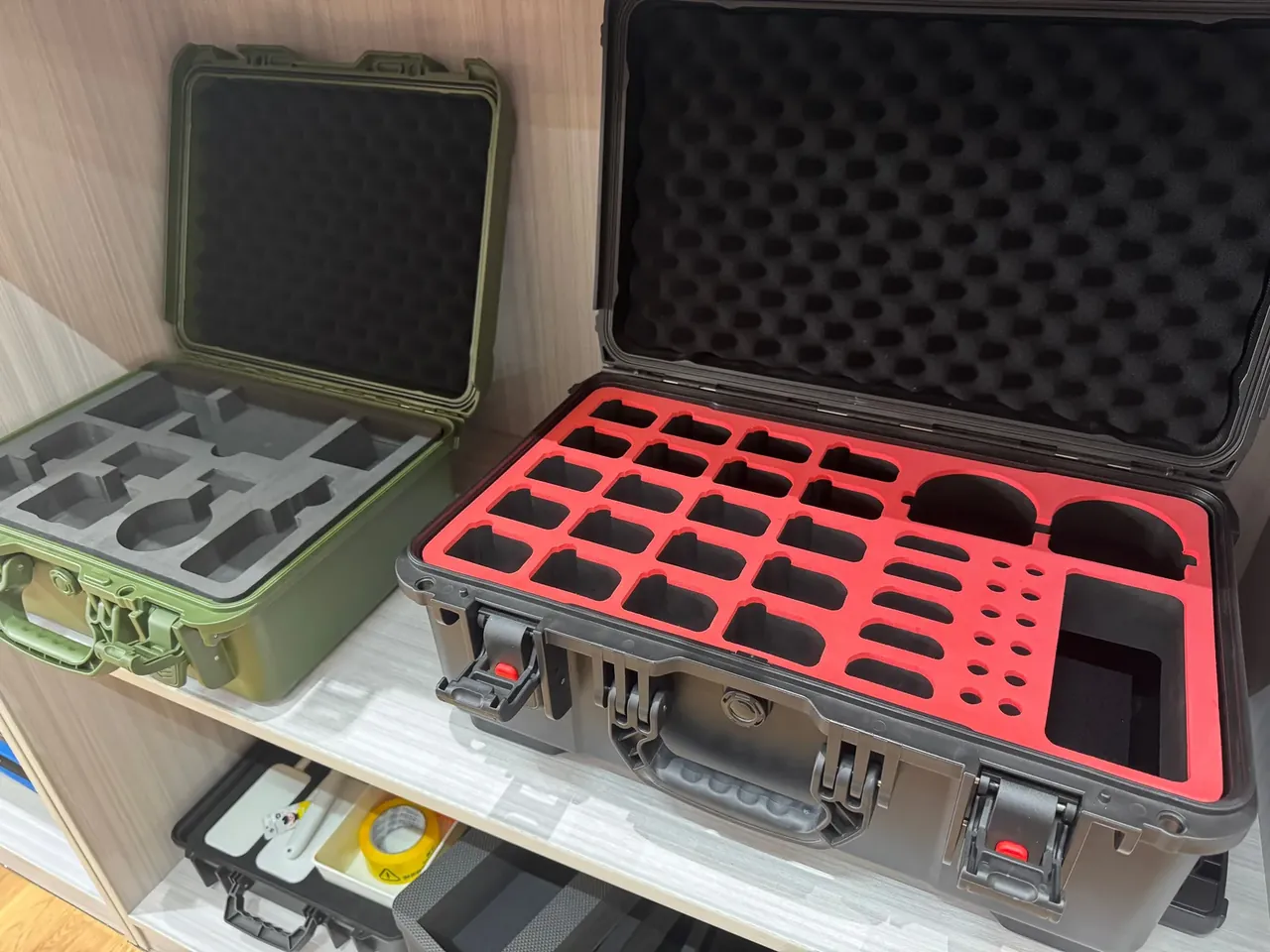
An empty 9.4 kg case and one loaded to 26 kg load the handle root differently, so both get their own wobble reading. Military spec multi-functional mobile equipment case uses 3800 open-close cycles as a background count: one wall reading before that run, one after, and nothing judged in between.
3. Radial Play After 3000 Pull Cycles
With 25 kg hung on the rig, the case is pulled back and forth 3000 times while castor and bushing stay put. What gets measured after the stop is axle displacement once the load is off: Military spec multi-functional mobile equipment case caps it at ≤0.35 mm against the 0.18 mm starting clearance.
| Pull sequence | Rig load | Radial play reading | Action at that stage |
|---|---|---|---|
| Cycle 1000 | 25 kg | 0.22 mm | record only, castors stay down |
| Cycle 2000 | 25 kg | 0.28 mm | retorque four latches diagonally, then read |
| Cycle 3000 | 25 kg | ≤0.35 mm | compare with reject line, decide the bushing |
Open-close 3800 and pull 3000 go on separate sheets for Military spec multi-functional mobile equipment case; neither is allowed to stand in for the other, and bushing retention is read only from the pull sheet.
4. Handle Wobble after the Unloaded Retest
Once the 3000 pulls finish, the 25 kg comes off and the handle is lifted; a wobble at ≤0.8 mm marks a batch that stayed tight. Military spec multi-functional mobile equipment case schedules this check after the pull because a loaded bushing masks its own slack; take the force away and the swing at the handle root appears.
| Play reading | Retest condition | Measured at handle | Disposition |
|---|---|---|---|
| Steady | rested after unload | ≤0.3 mm | filed directly |
| Mid | rested after unload | 0.5 mm | repeat lift at same setting |
| Limit | rested after unload | ≤0.8 mm | bushing back to review |
The lift angle is fixed and no load goes back on; Military spec multi-functional mobile equipment case repeats it to see whether the small wobble holds steady after unloading.
5. Fixing the Bushing for a Mobile Batch
The batch keeps the tightest bushing whose play at cycle 3000 is still under 0.35 mm; looser ones stay off the mobile-case assembly list. Military spec multi-functional mobile equipment case favours the tight end: it is the only fit that pins radial play down, the rejected batches are the ones that lost retention, and widening the value would force a redraw of the 1.6 mm handle wall before anything else.
Freezing the drawing locks the castor-mount rivets, the 5.2 mm wall and the two gasket rings at once. Sampling then takes two cases per batch — 9.4 kg empty, 26 kg loaded — and files the 3800-cycle log under the batch number. Military spec multi-functional mobile equipment case gives clearance, wall, radial play and handle wobble a separate ceiling each; a breach sends that one item back alone rather than borrowing margin from another.
Conclusion
Specifying a castor and a handle for Military spec multi-functional mobile equipment case means watching four figures from start to finish: bushing clearance, handle wall, radial play and wobble. At 0.18 mm clearance against a 1.6 mm wall, 3000 pulls at 25 kg hold radial play to ≤0.35 mm, and the unloaded retest brings wobble under ≤0.8 mm. Four 430 N latches, two gasket rings at 21% compression and a 5.2 mm wall put the 720×480×300 mm outline under a single drawing tolerance. Military spec multi-functional mobile equipment case is argued from rig readings, not from a model name.
Related Reading
- Custom Case with Foam Insert Specs: Cavity, Layers, Drawings
- Custom EVA Foam Insert for Cases: Size, Wall and Load
- Can a Protective Case Be Fitted with Wheels? Matching Trolley Handle and Castor Load Capacity
- Custom Internal Partition Plastic Box Specs: Size, Wall and Load
Related Products
- 8 Series — Gun Cases; Military Equipment Cases; Camera Equipment Cases; Drone Cases; Watch Cases; Knife Cases; First Aid Cases; Electronics Equipment Cases
- WL8-2812 PP Gun Case — model WL8-2812
- All protective cases and toolboxes: 7 series, 158 models