

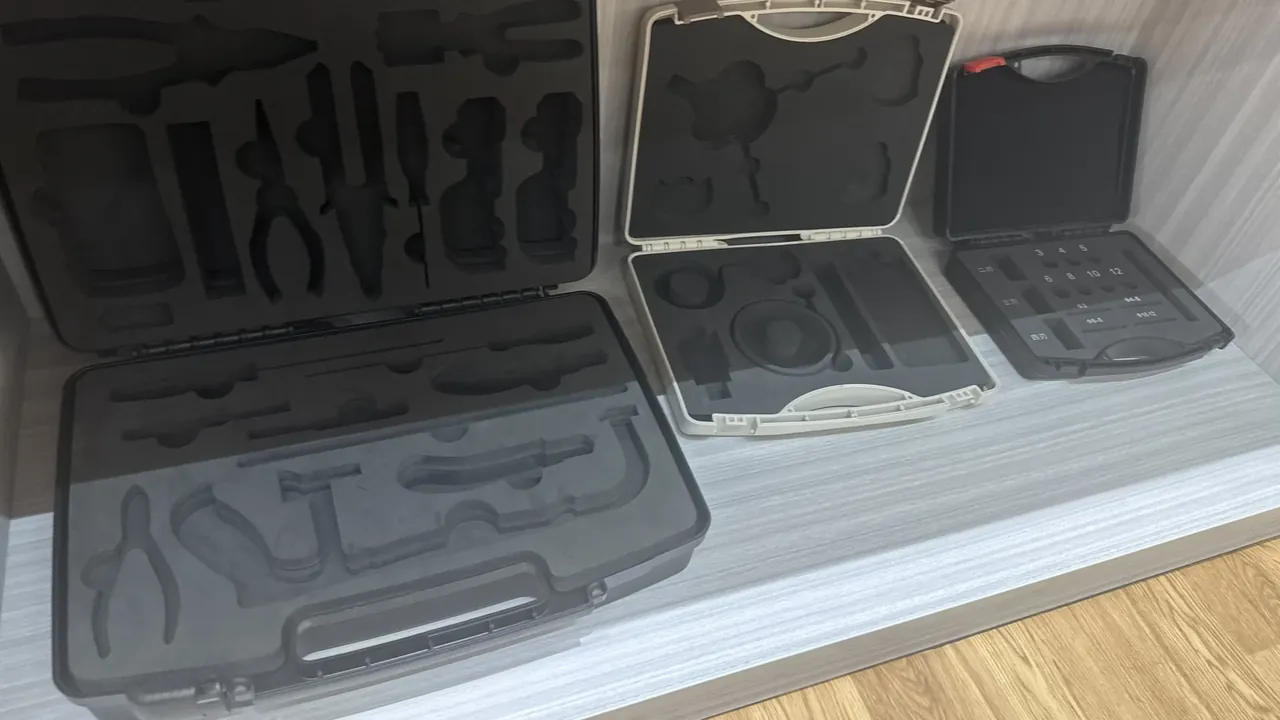
Quick answer: A Military Supply Transport Case comparison needs six figures: empty weight, stack height, seal class, trip count, empty return ratio and cost per trip. Fix those, and steel pallet boxes, wooden crates, carton packs and ordinary plastic totes separate clearly; the price tag alone explains almost nothing.
Table of contents
- Comparing a Military Supply Transport Case on One Set of Numbers
- Against Steel Pallet Boxes: Weight and Stacking
- Against Wooden Crates: Moisture and Quarantine
- Against Carton and Honeycomb Packs: Trip Count
- Against Ordinary Plastic Totes: Seals and Latches
- FAQ
1. Comparing a Military Supply Transport Case on One Set of Numbers
In the 60 litre class a carton with honeycomb panels costs just over 100 CNY and a steel pallet box near 1,000 CNY, yet the steel box lasts a thousand trips and the carton one. A Military Supply Transport Case comparison must fix payload, trip count and stacking height first.
| Dimension | Unit | How to read it | Common mistake |
|---|---|---|---|
| Payload ratio | percent | loaded minus tare, over loaded | quoting tare only |
| Stack height | layers | creep under 2 mm after 24 h | stacking empty units |
| Seal class | IP code | pressure hold plus immersion | writing waterproof |
| Trip count | trips | to first structural failure | warranty term |
| Return ratio | ratio | empty volume over loaded | assuming lids nest |
| Cost per trip | CNY per trip | price plus repair, over trips | ranking by price |
Pallet tare is skipped most often: eight units fit a 1,200 by 1,000 mm pallet, so 6.5 kg against 18 kg adds 92 kg before loading.
2. Against Steel Pallet Boxes: Weight and Stacking
A 1.5 mm cold-rolled shell with pressed ribs takes two tonnes static and a forklift ding is fixed with a weld bead. But tare eats payload, fork openings rust after 480 hours of salt spray, and twelve bolts must be torqued on every close.
| Item | Steel pallet box | Moulded Military Supply Transport Case |
|---|---|---|
| Tare, same volume | about 18 kg | 6.5 kg |
| Unit static load | over 2 t | 1.2 t |
| Stack under 4.5 m clearance | 4 layers | 5 layers |
| Empty return volume | 100 percent | about 35 percent |
At 4.5 m clearance the 420 mm steel box stacks four high against five for the 380 mm case, 12 percent less volume per storey.
3. Against Wooden Crates: Moisture and Quarantine
A crate of the same volume costs around 260 CNY, real at the invoice. Timber is dried to 12 to 18 percent moisture, a 30 day voyage pushes humidity past 75 percent, and a half millimetre gap opens along the gasket land.
Quarantine is the second charge: cross-border wood is heat treated under ISPM 15 and ships within 21 days or is redone. After 30 cycles the corners split and nails back out into the liner; against 1,000 trips the crate amortises at over thirty times the cost.
4. Against Carton and Honeycomb Packs: Trip Count
Five-ply corrugated over a 20 mm honeycomb core weighs 4.2 kg, takes 6.8 kN in compression and costs 110 CNY, and it is built for one trip. A Military Supply Transport Case is built for the return leg. Fifteen minutes of rain halves that figure, a second transshipment wears the corners through, and separation leaves recovery under 30 percent.
The dividing line is the route: one-way delivery justifies 120 CNY per trip, a resealed route does not.
5. Against Ordinary Plastic Totes: Seals and Latches
The ordinary tote is the cheap substitute: 2.0 mm walls against 4.5 mm bow by the third layer, a tongue-and-groove land instead of a gasket lets rain in, and the latch is single-point or absent.
| Option | Price (CNY) | Repair and return (CNY) | Usable trips | Cost per trip (CNY) |
|---|---|---|---|---|
| Moulded Military Supply Transport Case | 420 | 70 | 1000 | 0.49 |
| Steel pallet box | 980 | 330 | 1000 | 1.31 |
| Wooden crate | 260 | 250 | 30 | 17.0 |
| Carton with honeycomb | 110 | 10 | 1 | 120 |
| Ordinary plastic tote | 130 | 85 | 500 | 0.43 |
The tote shows the lowest figure at 0.43 CNY, and that is its whole argument; its seal and stacking margins will not carry an intermodal route, so the saving returns as rework.
Conclusion
The options are separated by six numbers, not by the price tag: tare sets payload, stack height sets capacity, seal class sets damage, trip count sets amortisation. Strike out what the route disqualifies, then pick the cheapest of the rest; rerun the table with your own payload and the Military Supply Transport Case comparison starts deciding.
This article discusses only the container (case body) side of specifications and design intent, and does not cover any handling, loading or use of the contents.
Related Reading
- Sizing a Military Supply Transport Case for payload and handling
- How air transport cases differ from alternatives
- Standardising logistics support boxes
- Inspection items for military supply cases on receipt
Related Products
- 8 Series — Gun Cases; Military Equipment Cases; Camera Equipment Cases; Drone Cases; Watch Cases; Knife Cases; First Aid Cases; Electronics Equipment Cases
- WL8-2812 PP Gun Case — model WL8-2812
- All protective cases and toolboxes: 7 series, 158 models