

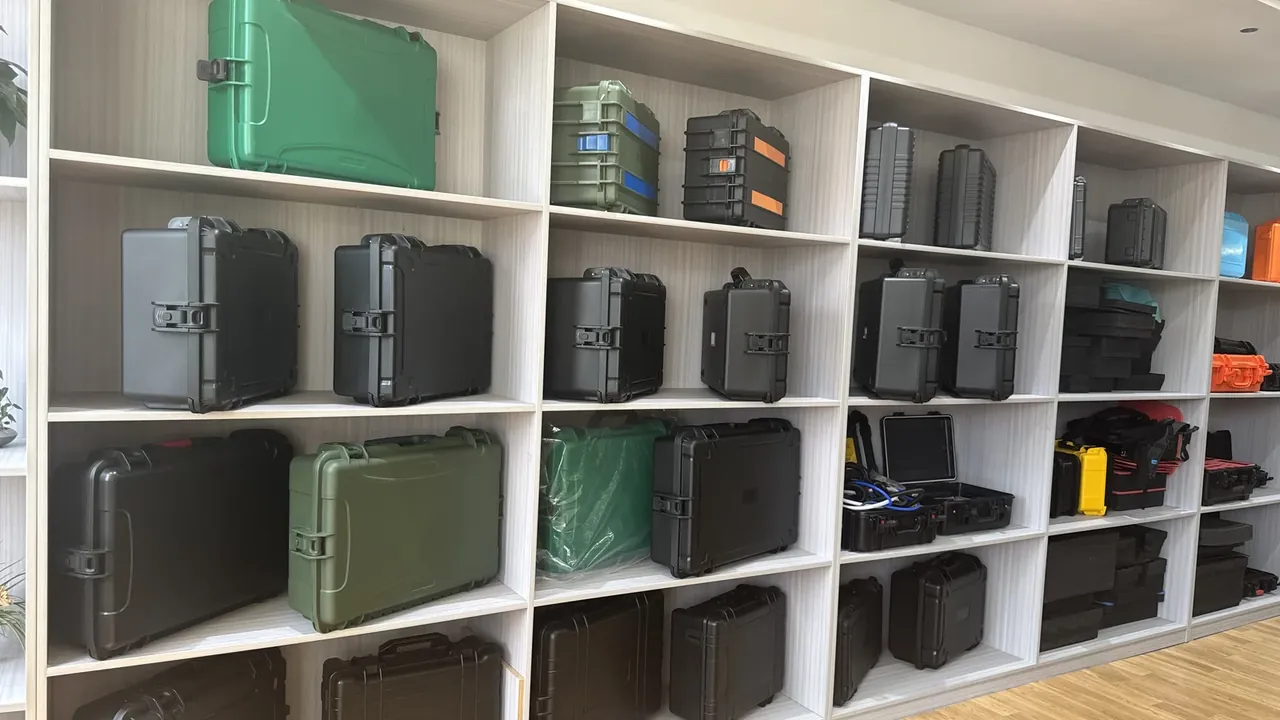
Quick answer: A Military Supply Transport Case is decided by five steps: forming sets the frame, wall and ribs set stiffness, gasket compression sets sealing, latches and hinges set life, and the liner sets how impact travels.
Table of contents
- How the Military Supply Transport Case Body Is Formed
- Wall Thickness and Rib Layout
- Gasket Compression and Pressure Hold
- Latch and Hinge Configuration
- Liner and Dividers
- FAQ
1. How the Military Supply Transport Case Body Is Formed
The body is the frame, so the forming route of a Military Supply Transport Case caps everything downstream. Rotational moulding gives a seamless wall; injection moulding forms body and lid on two tools joined by hinges. Batch size and wall target decide, not machine age.
| Item | Rotational moulding | Injection moulding |
|---|---|---|
| Wall | 5 to 8 mm, thickenable | 3 to 4.5 mm, flow dependent |
| Tool | Aluminium, fast to build | Steel, long lead time |
| Unit cost | Moderate, small batches | Low, above 3,000 units |
Three parameters move together: oven at 300 degrees Celsius, 28 minutes, biaxial ratio 4 to 1. Ten degrees cooler and the powder never fuses; three minutes longer and thickness spreads by 1.5 mm. On the injection route, a 900 mm body needs a 1,250 tonne press and steel grade 718H at 30 to 32 HRC.
2. Wall Thickness and Rib Layout
Thickness sets stiffness and weight at once. A Military Supply Transport Case moulded rotationally runs 6 mm, with base and lid at 8 mm because the base carries stacking and the lid carries the case above; the spread across one body stays within 0.8 mm.
Ribs work by depth and spacing, not count. Ribs 18 mm high at 220 mm centres with a 3 mm root radius are standard; a sharp root sinks while the measured wall drops under the limit. A 500 mm base span deflects 4 mm under 60 kg, and two ribs cut that to 1.2 mm; past 2 mm the base rubs the pallet and the bottom case of a three-high stack fails first.
3. Gasket Compression and Pressure Hold
Sealing is a compression figure. On a Military Supply Transport Case an EPDM cord of 8 mm sits in a 5.6 mm groove, a 30 percent squeeze. Less and water tracks along the parting line; more and the cord takes a permanent set.
Mould the groove with the body, because a bonded groove lifts in cold weather. A groove 0.2 mm wider than the cord, wiped with silicone grease, seats without changing compression. Pressure hold gives the verdict: 30 kPa held 90 seconds, a drop of 0.8 kPa or less. At 20 degrees below zero the same case drops 1.5 kPa, so cold stores judge on that figure.
4. Latch and Hinge Configuration
Latch count follows body length: two to 600 mm, four from 600 to 1,000 mm, six beyond. Each latch holds 1,200 N, so four give 4,800 N against 30 percent gasket compression; one short and the lid crown lifts.
| Body length | Latches | Hinge | Holding force |
|---|---|---|---|
| Up to 600 mm | 2 | Two internal segments | 1,200 N |
| 600 to 1,000 mm | 4 | Two internal segments | 1,200 N |
| Above 1,000 mm | 6 | Full-length pin | 1,200 N |
Hinge pins are 6 mm stainless, with play under 0.4 mm after 8,000 cycles; a loose pin tilts the lid and unloads one side of the gasket. Opening torque of 2.5 N·m keeps a gloved hand working one-handed. Hinge blocks belong inside the wall, since surface-mounted ones tear out on the first drop.
5. Liner and Dividers
The liner is the last cushion and the first item cut. Polyethylene foam at 38 kg/m³ and 25 mm is the usual start for a Military Supply Transport Case; below 30 kg/m³ it compacts after a few trips and the cushion curve collapses.
| Option | Material | Thickness | Fits |
|---|---|---|---|
| Compartment layout | PE foam | 25 mm | Regular assemblies |
| Die-cut cavities | EVA foam | 20 mm | Shaped items with bosses |
Die clearance is 0.6 mm: tighter and the item tears foam going in, looser and it rattles until impact lands on one edge. Dividers keep 0.5 mm clearance to the wall. Hardness follows weight, Shore C 38 up to 8 kg per item and 45 above, with 30 mm of foam where the drop reaches 1.2 m.
Conclusion
Forming sets the frame, thickness and ribs set stiffness, the gasket sets protection, latches and hinges set life, and the liner sets how impact arrives. Give each step a measurable number and inspection stops being a visual opinion, which is what makes a Military Supply Transport Case predictable.
This article discusses only the container (case body) side of specifications and design intent, and does not cover any handling, loading or use of the contents.
Related Reading
- Where military supply cases are used
- How to select a military supply transport case
- Inside the structure of a military supply case
- Inspection points for military supply cases
Related Products
- 8 Series — Gun Cases; Military Equipment Cases; Camera Equipment Cases; Drone Cases; Watch Cases; Knife Cases; First Aid Cases; Electronics Equipment Cases
- WL8-2812 PP Gun Case — model WL8-2812
- All protective cases and toolboxes: 7 series, 158 models