

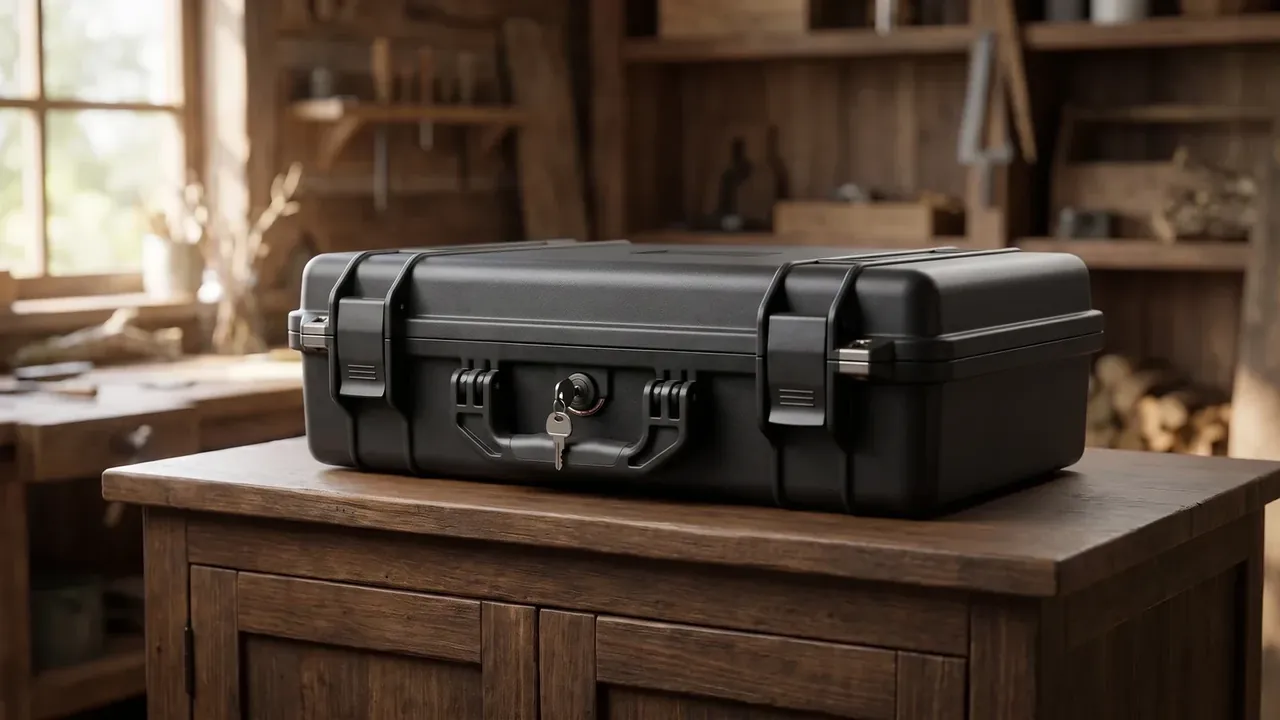
Quick answer: A Missile Box is three groups of shell parts — base, lid and fittings — formed by injection moulding or rotomoulding. Its behaviour is set in 3 places: cavity size, wall distribution, and the latch-to-gasket fit. Read those 3 and the cost and performance of the whole body become readable.
Table of contents
- Three shell parts, one assembly
- From sheet to shell: two forming routes
- Where the numbers land
- Lid and gasket interface
- Six checks before shipment
- FAQ
1. Three shell parts, one assembly
Strip a Missile Box to part level and 3 groups remain: base, lid, fittings. The base carries load and locates, the lid clamps and shields, the fittings tie the two together.
Modified PP or PE dominates, not for stiffness but for cold resistance: held at -40°C for 24 hours and dropped, modified PP keeps better than 60% of its notched impact strength while plain PP falls to about 30%.
| Part | Material | Job |
|---|---|---|
| Base | Modified PP, 6 mm wall | Load, location, stacking pressure |
| Lid | Modified PP, 5 mm wall | Compress the gasket, absorb impact |
| Latches | Glass-filled PA66, 4 off | Generate clamping force |
| Gasket | Hollow silicone, 25% compression | Keep water and dust out |
Four latches and 2 hinges take 18% of the material bill, and they decide whether the lid seats. One failed latch retires the sealing of the whole Missile Box.
2. From sheet to shell: two forming routes
There are 2 forming routes. Injection suits runs above 500 units: a 2500 t machine, a 2-cavity mould and a 320 second cycle, 90 of them cooling. Rotomoulding suits large parts under 100 units: a mould welded from 6 mm steel plate and 12 minutes of sintering.
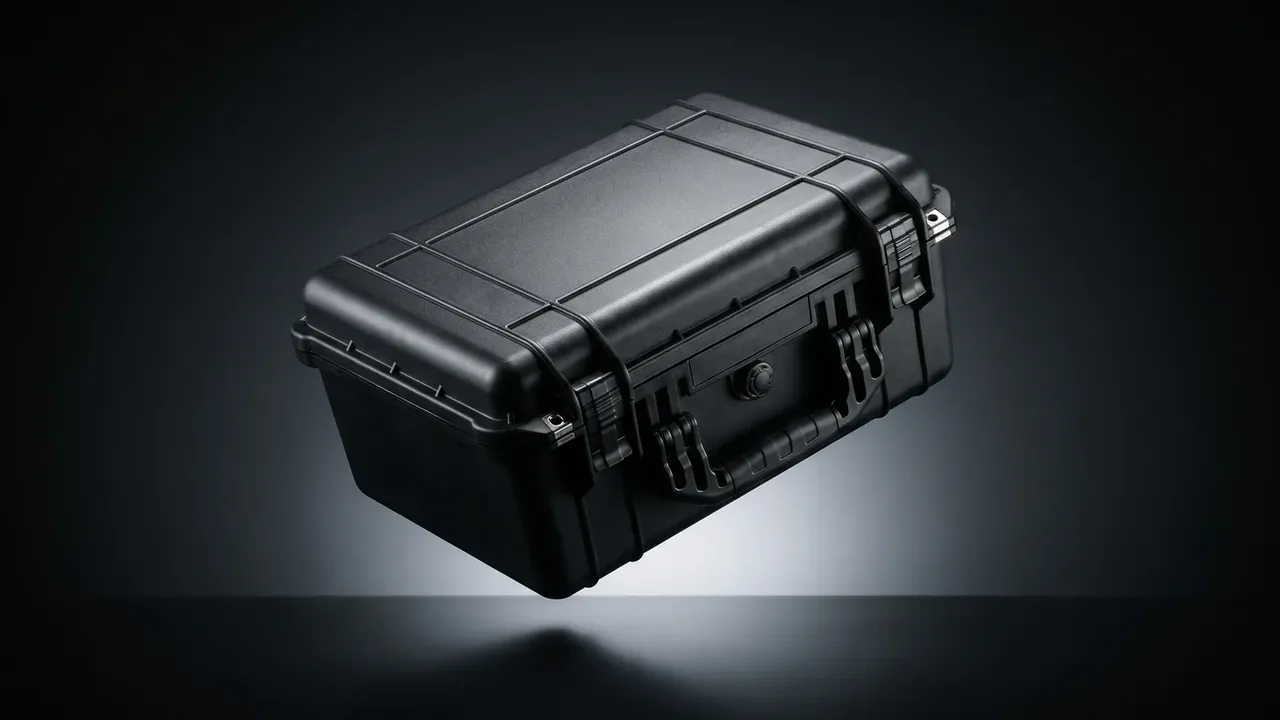
Injection holds a 1450 mm long edge of a Missile Box inside plus or minus 0.5 mm, while rotomoulding drifts to plus or minus 2 mm and relies on gasket compression to absorb it.
A tapped insert off by 0.3 mm stops the latch closing, so every unit passes an open-close test, with force accepted between 80 N and 120 N. The stage is labour heavy, so repeat-order prices rarely move.
3. Where the numbers land
The figures are not scattered across the drawing. They sit in 3 places, each tied to one failure mode. The first is the cavity: length, width and depth decide what fits and how much steel the mould needs. The second is wall distribution: 6 mm at the base, 5 mm at the side, 7 mm at the corner. The third is the latch-to-gasket fit, where travel, compression ratio and groove width are fixed together. A 3 mm travel with a 25% compression gasket seals to 25 kPa for 60 seconds; at 20% compression the same structure holds 15 kPa.
| Parameter | Typical value | Where it lands | Failure if missed |
|---|---|---|---|
| Cavity size | 1450 x 380 x 420 mm | Mould core | Will not fit, rattles |
| Base wall | 6 mm | Gate and cooling | Stacking collapse |
| Corner wall | 7 mm | Mould insert | Cracking on drop |
| Latch travel | 3 mm | Latch seat position | Lid not sealed |
| Gasket compression | 25% | Groove depth and width | Water and dust ingress |
A claim of "1 mm thicker" becomes a question: base or corner? The cost gap is 9%.
Because a cavity change drags the core, gasket perimeter and latch seats with it, most Missile Box revisions start at the insert.
4. Lid and gasket interface
The lid of a Missile Box is not a flat plate. A pressure ring runs inside, facing the gasket, and ribs outside spread impact toward the 4 corners. Ring flatness stays within 0.4 mm; past it one section stops compressing and water enters exactly there.
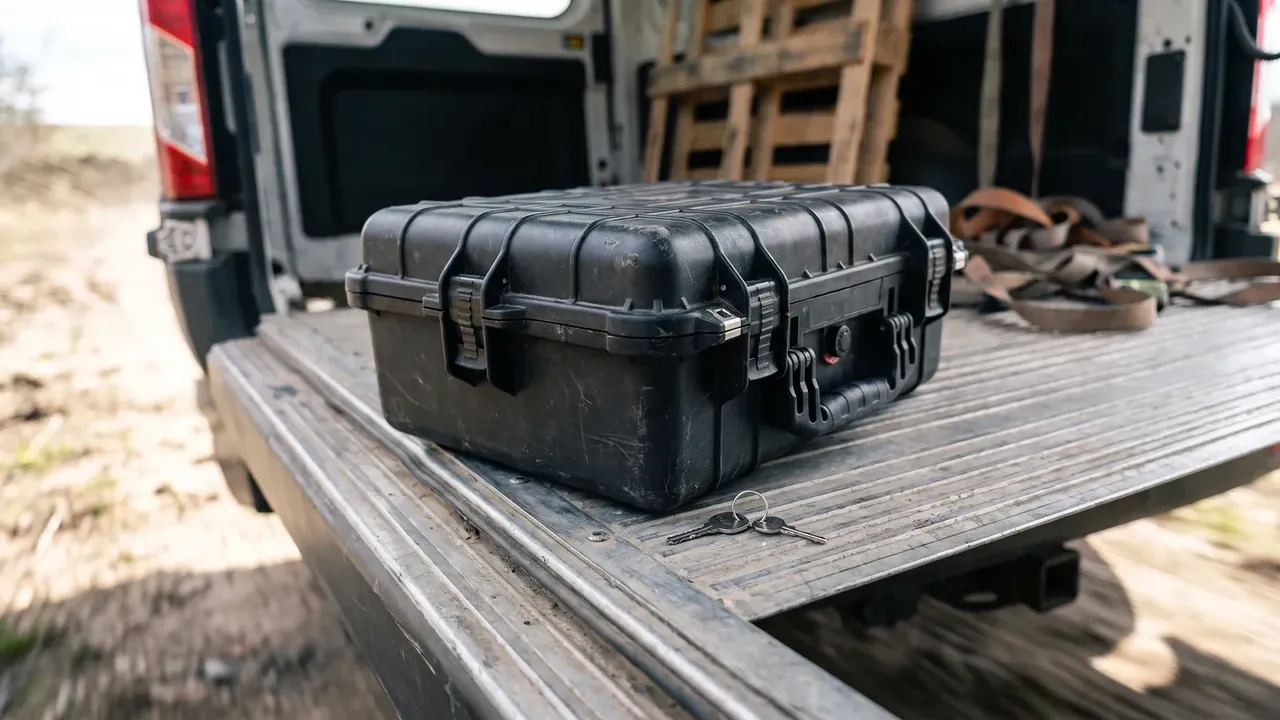
The gasket sits in a groove 0.5 mm narrower than the cord, and that interference holds it during assembly. Hollow silicone still recovers 70% at -40°C, at a 40% premium, which cold-region work cannot skip.
Two hinges sit at the quarter and three-quarter points of the long side. Move them and the lid twists, loading one latch harder. Screws go in at 12 N·m; under-torque shows as looseness by the third cycle.
5. Six checks before shipment
Final inspection need not cover everything. Six checks carry the risk: cavity size, wall thickness, latch force, leak tightness, drop and marking. Pass all 6 and the Missile Box is documented; skip one and the problem surfaces at the customer.
| Check | Method | Pass line |
|---|---|---|
| Cavity size | Tape measure, L W D | Plus or minus 0.5 mm |
| Wall thickness | Ultrasonic gauge, 5 points | Not below 5 mm |
| Latch force | Push-pull gauge | 80 N to 120 N |
| Leak tightness | Charge to 25 kPa | Under 1 kPa loss in 60 s |
| Drop | 1.5 m, 6 faces | No crack, no latch release |
| Marking | Visual | Model, lot, date present |
The drop check is often reduced to "drop it and see". The proper wording is 1.5 m, 6 faces, once each, on concrete, still latching after 3 further cycles.
Conclusion
A Missile Box can be described in 3 layers: three shell parts, 2 forming routes, 3 places where the numbers land. Parts decide assembly, forming decides tolerance, numbers decide how it fails. What separates one Missile Box from another is never the surface, but the wall, the compression ratio and the torque you have to measure.
This article discusses only the container (case body) side of specifications and design intent, and does not cover any handling, loading or use of the contents.
Related Reading
- How a military case is built and graded
- Where this body goes in handling and transport
- Ribs and pressure rings on a tool case lid
Related Products
- 8 Series — Gun Cases; Military Equipment Cases; Camera Equipment Cases; Drone Cases; Watch Cases; Knife Cases; First Aid Cases; Electronics Equipment Cases
- WL8-2812 PP Gun Case — model WL8-2812
- All protective cases and toolboxes: 7 series, 158 models