

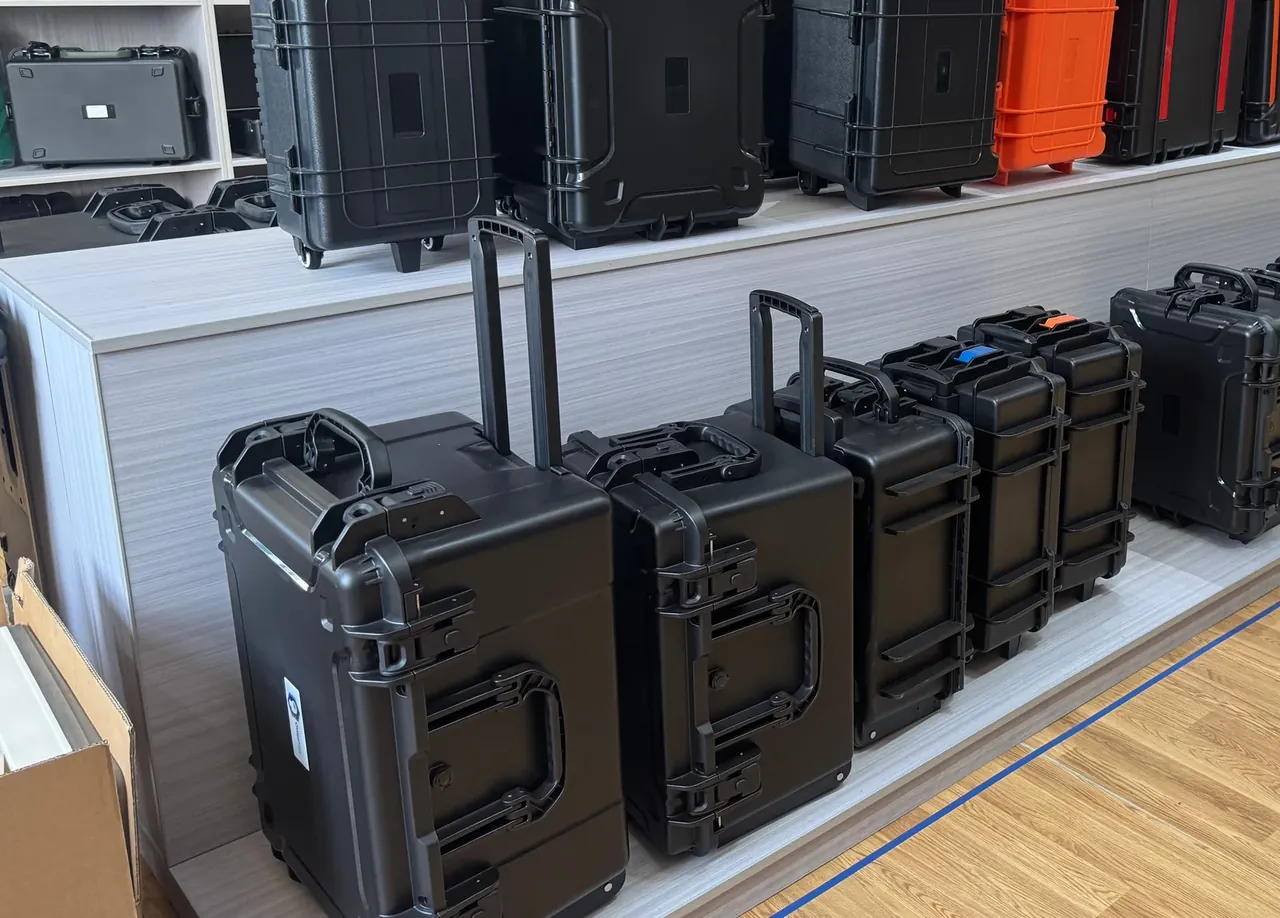
Quick answer: A mobile industrial field tool case earns its keep on four figures: 75 mm castors over a 20 mm curb, a 3-section handle at 900 mm, and 35 kg dragged 3 km.
This article discusses only the container (case body) side of specifications and design intent.
Table of contents
- Castor diameter against the ground
- Handle travel and the load path
- Curb height and ground clearance
- The fatigue edge of a loaded pull
- Dust when the lid opens on site
- FAQ
1. Castor diameter against the ground
A case sworn at on site usually tips at a curb. Wheel diameter sets rolling resistance and the step it can take: practice puts the passable step at a quarter to a third of the diameter, so a 75 mm castor clears 19 to 25 mm, and a 20 mm curb sits on that line.
Dynamic load per wheel scales with diameter: 60 kg at 75 mm, 25 kg at 50 mm. A four-wheel mobile industrial field tool case stands on three points, so the whole-case limit is single load times 3 over 1.5, or 120 kg at 75 mm. A 35 kg load uses 29% of it; the rest covers off-centre weight and impact.
| Wheel | Load per wheel | Step it clears | Ground it suits |
|---|---|---|---|
| 50 mm | 25 kg | 12 to 16 mm | Indoor epoxy floor, tile |
| 63 mm | 40 kg | 15 to 20 mm | Aisles, tile trims |
| 75 mm | 60 kg | 20 to 25 mm | Stone thresholds, concrete |
| 100 mm | 90 kg | 30 to 40 mm | Gravel, tactile paving, verge |
Material is easier to get wrong than size. TPE at 65A to 75A runs quiet and protects epoxy floors but lasts about 300 km under 80 kg; nylon wears better on concrete at the cost of noise.
The castor plate is forgotten most often: on a mobile industrial field tool case it needs a rib into the side wall, not four screws into a flat base, which cracks at the first curb.
2. Handle travel and the load path
Three sections to 900 mm is a compromise between case height and human height. The handle should sit 950 to 1050 mm off the floor, so someone 165 to 180 cm tall drags it with the wrist hanging. More sections give travel, but joint clearance accumulates and stiffness falls.
On a mobile industrial field tool case the load passes through the handle socket, not the grip. With the case tilted 15 degrees, 35 kg resolves into about 9 kgf along the handle, all of it on the joint between socket and shell. Wall thickness, inserts and screw count decide whether that joint survives 3 km.
Wobble reads stiffness directly. Pushed empty, 2 mm at the handle top is normal; at 35 kg over a 20 mm curb, 4 mm is the ceiling. Past that, the tube is bent or the socket root has cracked.
Locks are separate: button return force under 30 N, or a day of dragging wears the fingers out; 2 mm of sink under a hard press means the teeth are not holding.
3. Curb height and ground clearance
20 mm is a specific line: stair nosings, thresholds and pavement joints cluster around it. A 75 mm castor facing a 20 mm curb has 5 mm of margin, and whether it climbs depends on push angle and where the mass sits.
Clearance is the second figure on a mobile industrial field tool case. With a 75 mm wheel the axle sits 37.5 mm up, so 45 mm of clearance leaves 25 mm under the shell at a 20 mm curb and the base does not scrape. At 25 mm the base becomes a sledge, polishing itself white on gravel.
Higher is not better: 15 mm more clearance raises the centre of gravity and the handle needs another section. The compromise on a mobile industrial field tool case is loading heavy items near the axle.
Track matters too: keep it under 450 mm for a 1.2 m aisle, since a wider track grows the turning circle.
4. The fatigue edge of a loaded pull
A 35 kg load dragged 3 km is the first fatigue point; feel the hub afterwards, and hot means an undersized bearing.
| Part | Load path | First failure | Limit |
|---|---|---|---|
| Castor | Radial load, rolling friction | Flat spot, tread peel | 1.5 mm of uneven wear |
| Castor plate | Vertical load plus bending | Cracks around the holes | Hairline at the root |
| Handle tube | Bending and compression | Dent, lost straightness | 3 mm of bow |
| Handle lock | Shear and abrasion | Rounded teeth, collapse | 2 mm of sink |
| Base corner | Impact and rubbing | Cap worn through | Under 1.5 mm left |
Uneven wear is rarely the wheel's fault: 1 mm of parallelism error between axle and base gives 1.5 mm of one-sided wear over 3 km, and a crossfall makes the operator pull low. JUNZHIJIA builds a replaceable wheel set into a mobile industrial field tool case, so a wheel at the limit is swapped rather than the shell.
Whole-case fatigue adds 5,000 tumbles: handling, drops and rolls count, and the castor plate and base corner fail first, which points to corner thickness rather than the wheels.
The rule: 4 mm of handle wobble at 35 kg over a 20 mm curb, or 1.5 mm of uneven castor wear, condemns the wheel set on any mobile industrial field tool case.
5. Dust when the lid opens on site
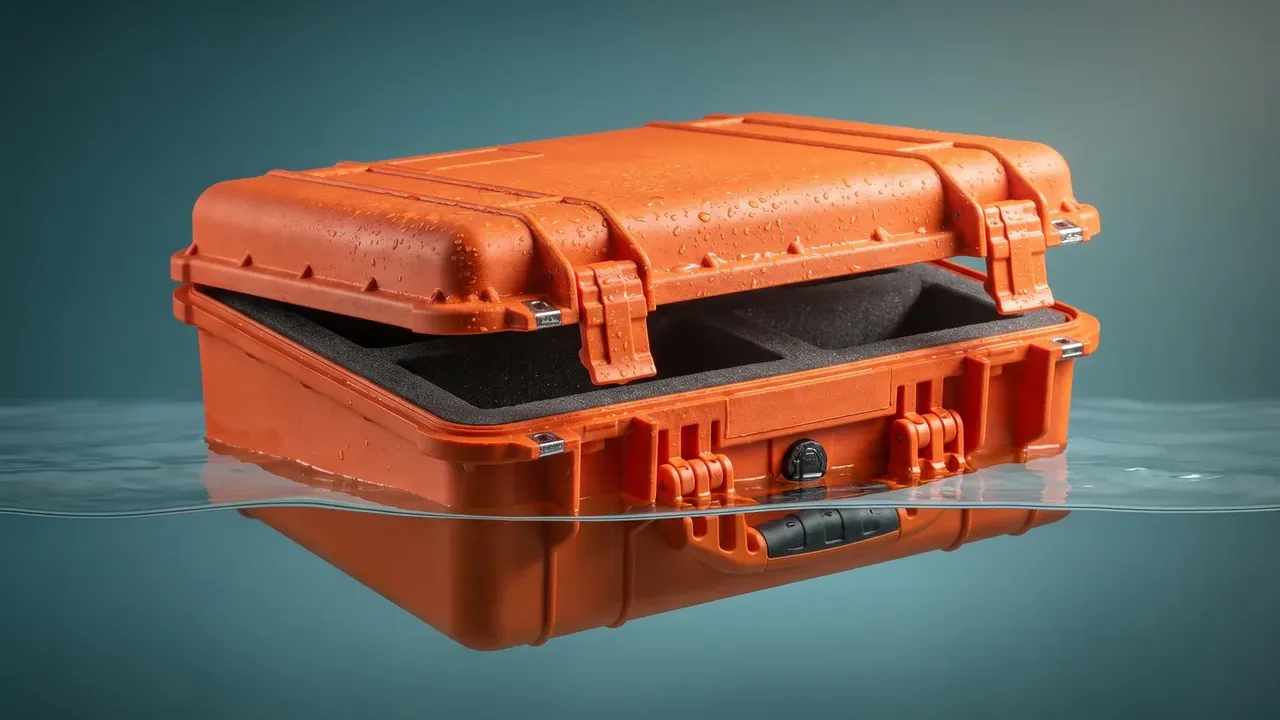
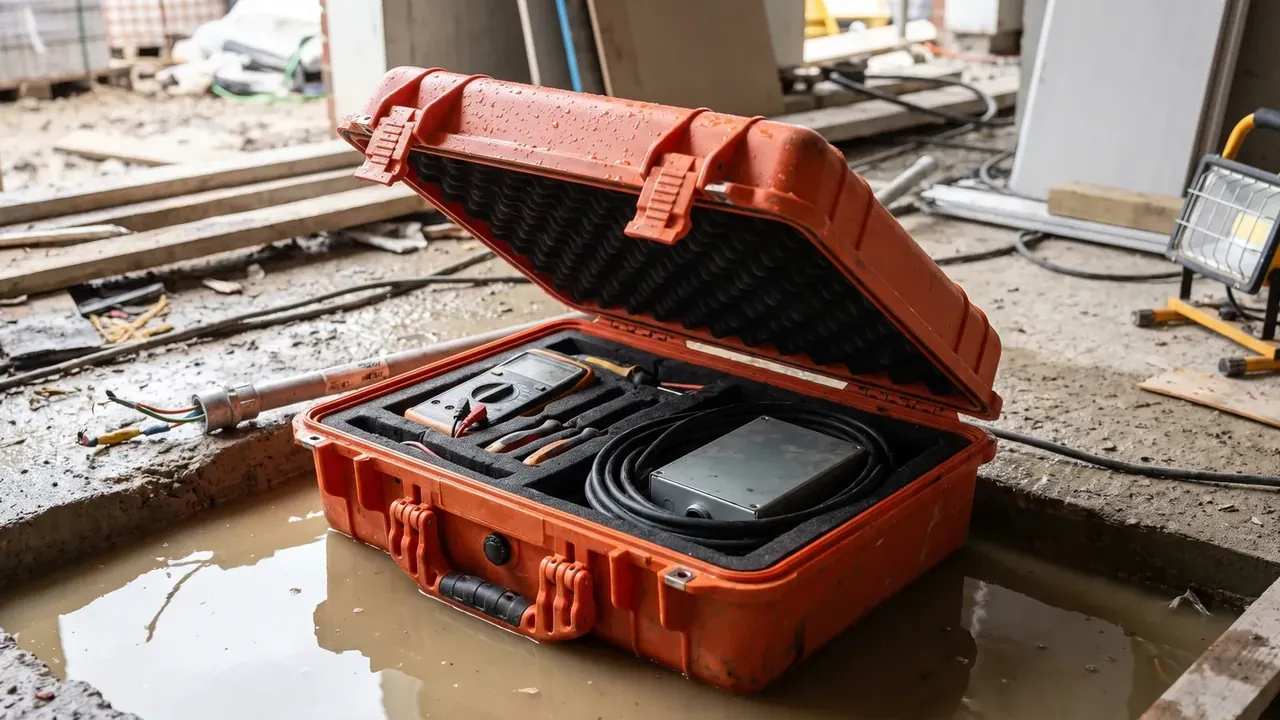
IP67 means 1 m of water for 30 min. It excludes jets and covers the closed state only; once the lid opens, protection is zero. The complaint on site is rarely water, it is the dust.
Two gaps cause it: the rim sits 45 mm off the ground, so wind lifts grit into the opening while the operator crouches, and the step between lid interior and rim collects dust pressed into the gasket at closing.
Stand the lid up as a windbreak, keep a mobile industrial field tool case open under 2 min, and hold foam gaps under 2 mm. Wipe the groove before closing: a TPE gasket at Shore A 50 to 60 with 25% to 30% compression seals because the groove is clean.
A soaked case drips from the lid into the cavities when opened; a removable liner dries faster than the shell.
Conclusion
The value of a mobile industrial field tool case shows in the last few metres of bad road. A wheel that matches the curb, a handle that fits the operator and clearance that clears gravel keep it rolling; miss one and the crew leaves it in the van.
This article discusses only the container (case body) side of specifications and design intent, and does not cover any handling, loading or use of the contents.
Related Reading
- Industrial cases with wheels
- Choosing a wheeled plastic transport case
- Case wheels and trolley handles
- Tool cases for assembly lines
Related Products
- 8 Series — Gun Cases; Military Equipment Cases; Camera Equipment Cases; Drone Cases; Watch Cases; Knife Cases; First Aid Cases; Electronics Equipment Cases
- WL8-2812 PP Gun Case — model WL8-2812
- All protective cases and toolboxes: 7 series, 158 models