

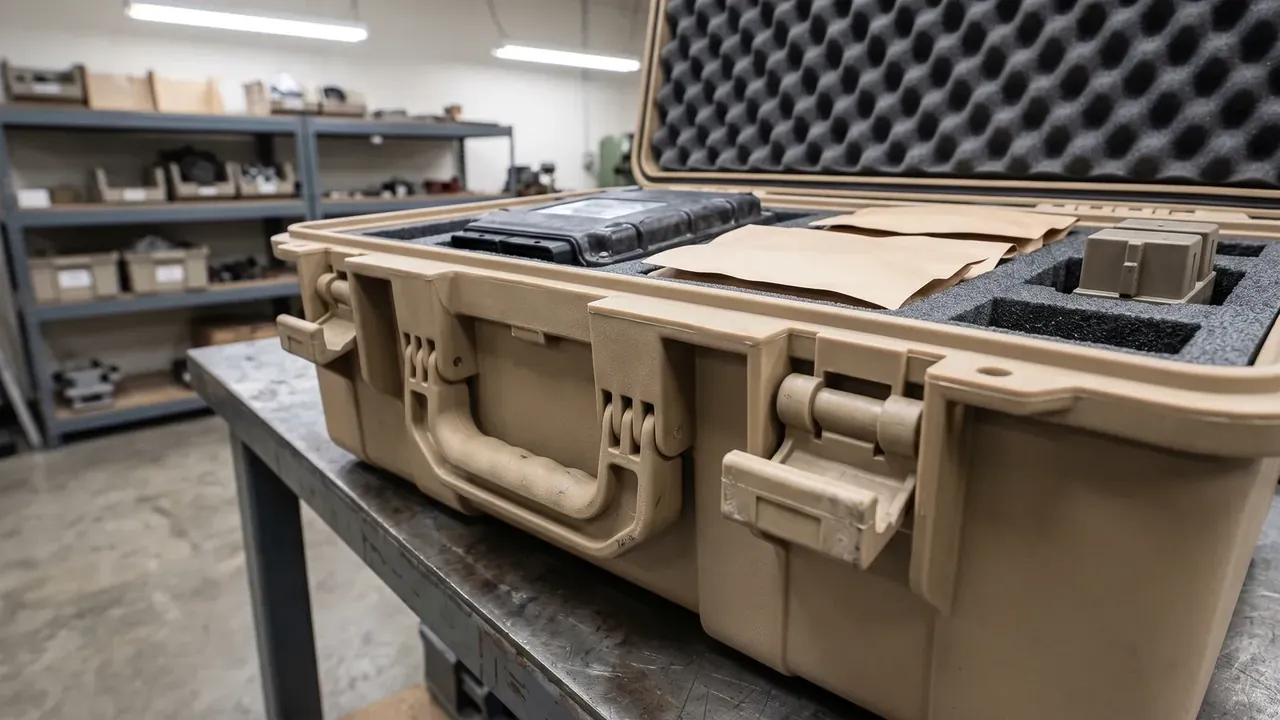
Quick answer: Modular Inserts for Military Cases keep gap growth under 0.18 mm after 200 insertions on a 9.5 mm tenon, with divider squareness within 0.6 degree.
Table of contents
- Tenon width of Modular Inserts for Military Cases
- Slot fit clearance
- Gap growth after two hundred insertions
- Divider squareness on reassembly
- Tenon width setpoint for insert batches
- FAQ
1. Tenon width of Modular Inserts for Military Cases
Dividers are pulled out and pushed back in, and whether the tenon wears first or the slot loosens first shows up once a feeler gauge is slid into the joint after two hundred cycles. Modular Inserts for Military Cases mill a short tenon on the end of each divider at a nominal 9.5 mm, and that tongue drops into a slot in the case floor. Between a 650 x 455 x 255 mm outer envelope and a 580 x 390 x 190 mm cavity the shell keeps a 4.8 mm wall, and the slot is cut into that base material. Below 9.0 mm the panel rocks sideways; past 10.0 mm the tongue has to be forced in, leaving scuffs on the slot wall. JUNZHIJIA books 9.5 mm as the nominal tier, with narrow and wide tiers from one sheet and one cutter.
A calliper takes four stations along the tenon, each within 0.08 mm of nominal. The process card for Modular Inserts for Military Cases puts tenon width and slot clearance on one line: one governs wear stock at the panel root, the other how loosely the body sits.
| Tenon tier | Measured width | Gap growth at 200 cycles |
|---|---|---|
| Narrow | 9.0 mm | 0.24 mm, reject |
| Nominal | 9.5 mm | 0.13 mm |
| Wide | 10.0 mm | 0.09 mm |
2. Slot fit clearance
The slot is cut 0.25 mm wider than the tenon, an allowance that lets the divider seat by hand without rattling against the floor. Close the clearance to 0.15 mm and seating needs outside help while removal raises burrs; open it to 0.35 mm and the panel drifts under side load, so squareness is the first limit to go.
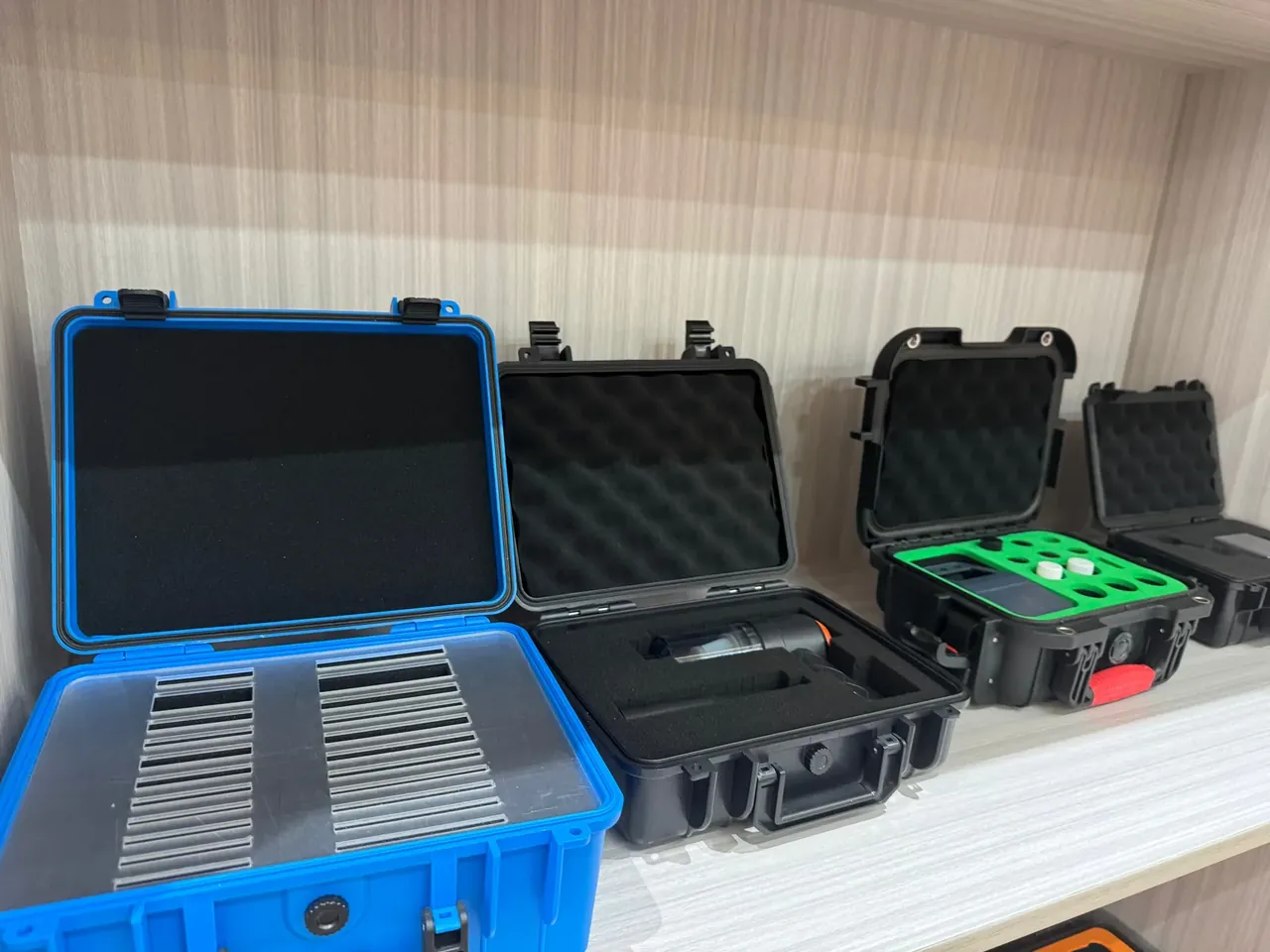
Empty cycling comes before the fit bench for Modular Inserts for Military Cases: the case finishes 3800 open-close cycles, then the 200-insertion run starts. Four latches are checked at 425 N each, and any cycle with the lid not fully seated is dropped. The 7.2 kg empty and 18 kg loaded states are each run once, and the larger growth is kept.
Two gaskets at 21 percent compression are rechecked against an IP67 spray that only judges the mouth; seepage at the rim is read against the feeler-gauge log and filed apart from the joint.
3. Gap growth after two hundred insertions
The 200 insertions are split at the 50th, 100th and 200th cycle for Modular Inserts for Military Cases, and at each stop a feeler gauge measures the seam between tenon face and slot wall. The starting 0.25 mm clearance is logged first, and every later reading has that baseline subtracted to give the growth, capped at 0.18 mm. A feeler blade carries a 0.01 mm thickness tolerance that is taken off first. Slots near the lid wear more than those near the floor, so the widest seam over the field is logged.
| Insertion count | Feeler seam | Stage |
|---|---|---|
| 50th | 0.31 mm | bedding in |
| 100th | 0.37 mm | rising |
| 200th | 0.43 mm | closing |
0.43 mm less the 0.25 mm baseline is 0.18 mm, right on the line, and as long as growth between the 100th and 200th stop has not climbed another 0.08 mm the pair passes. The fit bench covers seam width only; whether the panel stands straight waits for reassembly.
4. Divider squareness on reassembly
A divider is left to settle 3 min in the slot after reassembly of Modular Inserts for Military Cases, and only then is its face read against the case-floor datum, with squareness held at no more than 0.6 degree. If clearance has loosened the panel root, the face leans, and 0.6 degree bounds that lean. Gap growth records wear while squareness records panel position; either crossing its line holds the batch.

Each divider of Modular Inserts for Military Cases carries its own number, with starting clearance, 200th-cycle growth and reassembly angle filed under it, so the face batch code maps only to that panel's record. The IP67 spray follows the angle. The panel that finished 3800 cycles takes one more 200-insertion run, to confirm latching did not wear the fit loose early.
5. Tenon width setpoint for insert batches
Before release, eight panels are pulled and their tenons remeasured for Modular Inserts for Military Cases: one reading more than 0.5 mm off the 9.5 mm nominal is scrapped, and two such panels send the whole batch back for remilling.
Tenon width setpoint is fixed at the narrowest tier whose gap growth at the 200th insertion is still under 0.18 mm; any narrower tongue is kept as a sample only. That line follows the 200th stop: the thinnest tenon without crossing 0.18 mm becomes the toolpath baseline for the next batch. JUNZHIJIA files cutter offset, sheet lot number and this baseline; a tool or material change adds one more full 200-insertion run.
Modular Inserts for Military Cases are released panel by panel, and the three growth bands below each carry a separate routing so the wide tier's spare margin is not mistaken for a batch-wide concession. Kexin New Materials (Guangdong) Co., Ltd. files by panel number.
| Gap reading | Divider squareness | Disposition |
|---|---|---|
| within 0.18 mm | within 0.6 degree | release |
| 0.18 to 0.24 mm | 0.6 to 0.9 degree | hold for remeasure |
| above 0.24 mm | above 0.9 degree | whole batch remill |
Conclusion
Specifying Modular Inserts for Military Cases starts with recheckable tenon width and slot clearance figures, then with how the 200th-cycle growth and reassembly angle are logged. Only when 9.5 mm and 0.25 mm are balanced do the 0.18 mm growth bound and 0.6 degree squareness bound have a basis. The fit bench owns wear, the protractor recheck owns panel position, and JUNZHIJIA files the setpoint and the reject line together.
Related Reading
- EPE Foam vs EVA Foam in a Tool Box: What Is the Difference?
- Replacing and Re-Cutting Case Foam: When to Repair and When to Start Over
- Should a Protective Case Use Dividers or Foam Liner? Divider vs. Foam Comparison Table and Selection Advice
- Case Corner Radius: R10 vs R25
Related Products
- 8 Series — Gun Cases; Military Equipment Cases; Camera Equipment Cases; Drone Cases; Watch Cases; Knife Cases; First Aid Cases; Electronics Equipment Cases
- WL8-2812 PP Gun Case — model WL8-2812
- All protective cases and toolboxes: 7 series, 158 models