

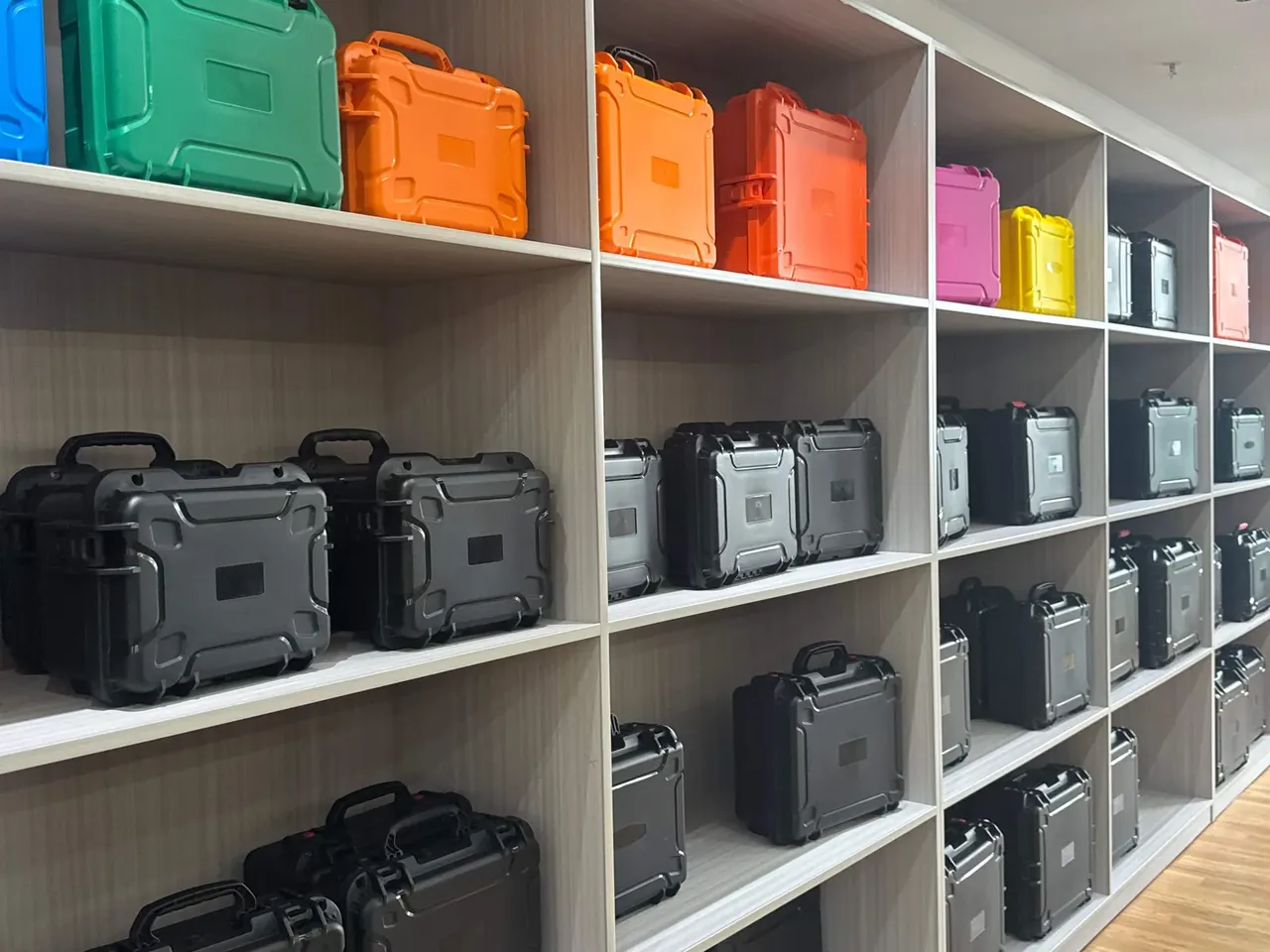
Quick answer: A multi-purpose outdoor case covers several jobs through four interfaces in the shell: a liner that lifts out in one piece, divider slots moulded with the wall, latches and gasket shared across sizes, and seats for wheels and straps. Miss one and it serves a single load.
Table of contents
- Four Prerequisites Behind a Multi-purpose Outdoor Case
- Swappable Inserts: One Shell, Four Linings
- Removable Dividers: Slot Pitch and Panel
- Latches and Seal: Commonality Across Sizes
- Shell Features: Wheels, Straps and Tie-Down Slots
- FAQ
1. Four Prerequisites Behind a Multi-purpose Outdoor Case
Versatility is sold as accessories, yet the number of loads is set earlier, in the interfaces moulded into the shell.
Four must coexist on a multi-purpose outdoor case: a liner that lifts out as one panel, divider slots moulded with the wall, latches and gasket shared across sizes, and seats for wheels and straps. With all four, one shell goes from equipment to cookware to spares; without one, changing the load means glue or a second case.
Check a multi-purpose outdoor case without tools: liner catches, vertical slots, M6 nuts, lid grooves.
| Prerequisite | Where it sits | Cost when missing |
|---|---|---|
| Liner lifts out | Inner catches | Forty minutes of glue |
| Dividers removable | Vertical slots | Foam cut as one block |
| Latches shared | Front and rear seats | Spares per size |
| Accessory seats | M6 nuts, wheel pads | Wheels strapped outside |
2. Swappable Inserts: One Shell, Four Linings
Die-cut EVA at 30 mm is the default: firm, slow to recover, for fixed outlines. Flocked PU at 20 mm takes parts that mark; laminated XPE at 40 mm resists compression; EPE at 25 mm covers short transfer.
Replaceability is the fixing, not the foam. Four catches or hook-and-loop tape release a panel in thirty seconds with the wall intact; a glued panel takes forty minutes to scrape.
Cavities run 1 to 2 mm over the part and need a 25 mm finger relief past 80 mm deep. A swap lifts volume use from 55 to 80 percent.
| Lining | Thickness | Change-over | Load shape |
|---|---|---|---|
| Die-cut EVA | 30 mm | Four catches, 30 seconds | Rigid equipment |
| Flocked PU | 20 mm | Hook-and-loop | Parts that mark |
| Laminated XPE | 40 mm | Edge-trimmed | Heavy or mixed loads |
3. Removable Dividers: Slot Pitch and Panel
Slots are moulded with the wall at 25 or 50 mm pitch. Fine pitch splits small parts; 50 mm keeps more section. They run 8 mm deep for a 4 mm PP hollow panel, and a 120 mm panel resists about 300 N sideways.
Round the slot base at R1; a square base chips at ejection and holds nothing.
A 3 mm wall at 25 mm pitch leaves about 2.4 mm at the root, where a drop crack starts. Divider and liner are one or the other on a multi-purpose outdoor case: fit both and the panel tops hold the lid off, so gasket compression falls from 40 to under 20 percent.
4. Latches and Seal: Commonality Across Sizes
Latch count follows lid span, not size. Two latches more than 300 mm apart let the lid arch, and a 1.5 mm gap tracks water.
The EPDM gasket runs 8 mm and compresses 30 to 50 percent. Below 25 percent, IP67 immersion at one metre for thirty minutes leaks furthest from a latch; above 55 percent it takes a set and cracks within two years.
One latch across 25 to 95 litre shells means one spare: 250 N pull, a 5 mm 304 hinge pin, a lid within 0.3 mm after 5,000 cycles.
| Item | Typical value | Beyond it |
|---|---|---|
| Latch spacing | 300 mm maximum | Lid arches, water tracks |
| Gasket compression | 30%–50% | Leaks below, ages above |
| Latch pull | 250 N | Latch releases in a drop |
5. Shell Features: Wheels, Straps and Tie-Down Slots
Feet and lid grooves locate a stack; out by 5 mm, three high leans.
Four M6 nuts take a wheel frame or strap eyes at 40 kg and 15 kg static. The 25 mm tie-down slot matches standard webbing, with roof loads figured at twice static for 80 km/h. None of it shows on a normal day, yet it decides whether a multi-purpose outdoor case moves between camp, vehicle and trail.
Conclusion
Versatility is four interfaces: a liner that lifts out, slots costed against wall thickness, latches shared, seats for wheels and webbing. Accessories can be reordered; interfaces are set when the tool is cut. Check those four and the multi-purpose outdoor case has a countable number of jobs.
This article discusses only the container (case body) side of specifications and design intent, and does not cover any handling, loading or use of the contents.
Related Reading
- Rotomolded Cases: Rotational-Moulded Shell Structure & Pro…
- What wall thickness does to case strength and weight
- Rib layout that avoids sink marks
- IP65 field immersion test on a waterproof toolbox
Related Products
- 8 Series — Gun Cases; Military Equipment Cases; Camera Equipment Cases; Drone Cases; Watch Cases; Knife Cases; First Aid Cases; Electronics Equipment Cases
- WL8-2812 PP Gun Case — model WL8-2812
- All protective cases and toolboxes: 7 series, 158 models