

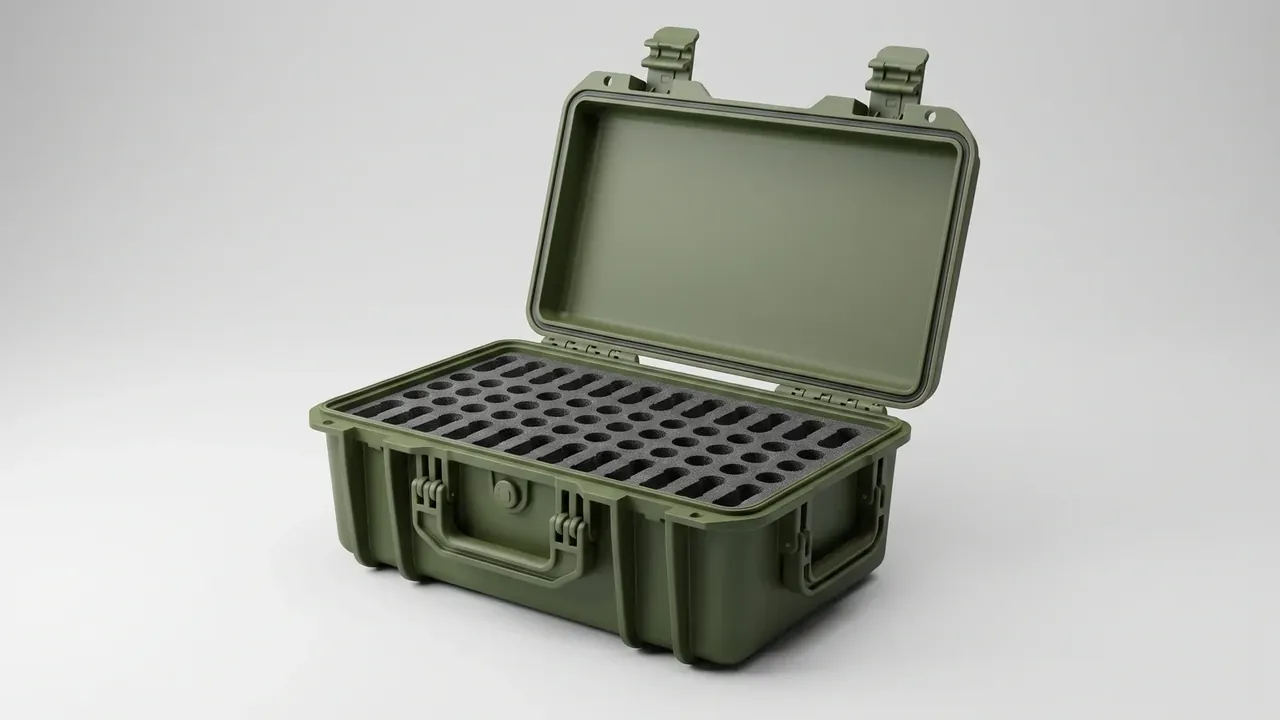
Quick answer: A Munitions Shipping and Storage Container is a rotomolded double-wall case whose body, lid, gasket line, four latches and drilled sheet are fixed in one mold cycle. Thickness distribution, gasket compression and latch preload are the three readings that decide if it was built right.
Table of contents
- What the Case Looks Like on the Loading Bay
- From Powder to Shell in One Cycle
- Where the Three Key Numbers Sit
- How Latches, Gasket and Wall Share the Load
- Five Steps That Separate It From a Tote
- FAQ
1. What the Case Looks Like on the Loading Bay
Minus eighteen on the dock, tail lift 1.1 m up, two people lifting a 32 kg Munitions Shipping and Storage Container; the lid came down in four latch clicks that rang sharp in the cold.
Strip one back and five parts remain: body, lid, gasket line, latches, locating sheet.
| Part | How it is made | What you can measure | What goes wrong |
|---|---|---|---|
| Body | One rotomolding cycle, vertical ribs | Side-wall thickness, rib height | Bulging, latches out of line |
| Lid | Matched pair with the body | Flatness, edge flange | Center sags, gasket never seats |
| Gasket line | Groove molded into the rim | Section height, continuity | Light gaps, water ingress |
| Latches | Hardware fitted after molding | Throw length, preload | One lets go, the rim lifts |
| Sheet | Drilled and dropped in | Hole squareness, thickness | Loose pockets, movement |
2. From Powder to Shell in One Cycle
Rotomolding is slower than injection molding, but tooling is cheap and thickness is easy to steer. Pellets ground to about 35 mesh are charged into the mold, and the closed tool enters a 285 °C oven. Two axes turn at once, eight rpm primary and two secondary. Fourteen minutes later it air-cools for four, water-cools for six, and the shell is demolded, trimmed and fitted.
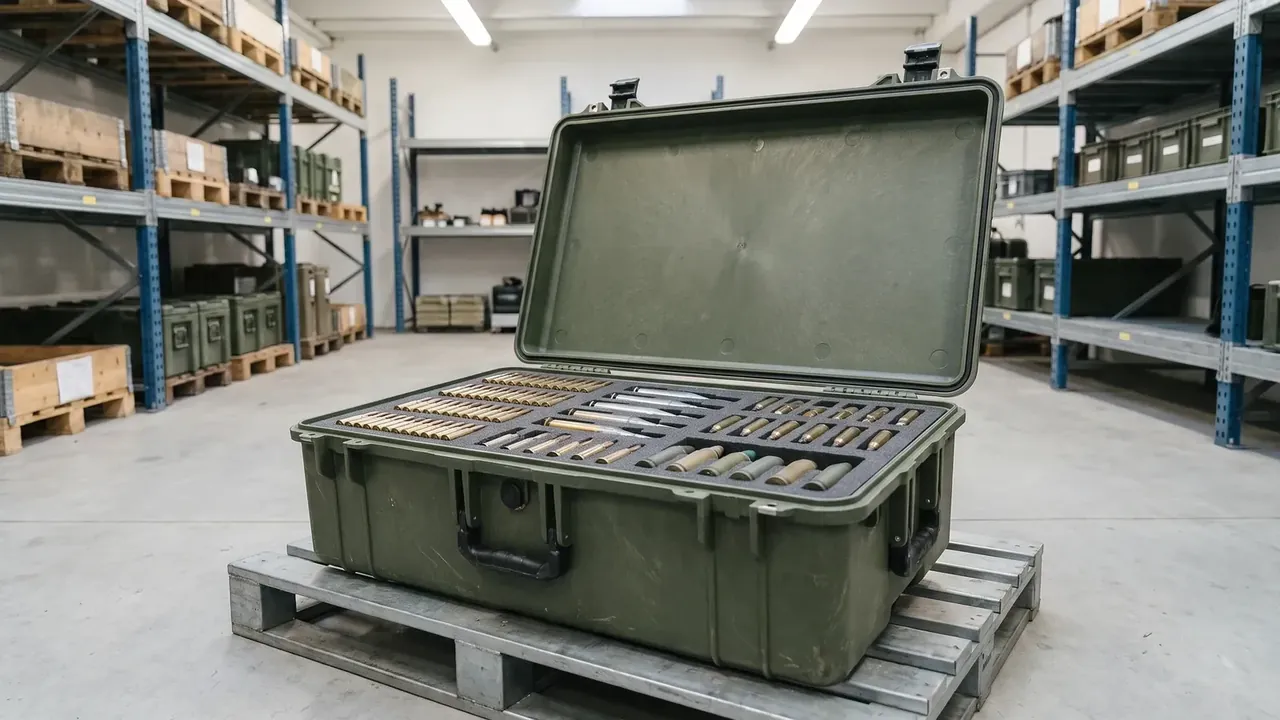
Thickness is distributed by charge weight against rotation speed, not guaranteed by mold size. Corners collect material and run two to three millimeters thicker than the sides; the lid center is thinnest because it sits closest to the axis. A case charged for 8 mm can measure 10 mm at the corners, 5.2 mm on the sides, 5 mm across the lid. Cut one or two trial shells, measure nine points across the section, then adjust charge against speed; once set, batch variation stays inside 0.6 mm.
3. Where the Three Key Numbers Sit
Three readings decide fitness for a Munitions Shipping and Storage Container: thickness distribution, gasket compression, latch preload. The first two are frozen in the tool and the rubber profile; the third is given again every time the lid closes.
A 5.2 mm side against a 5 mm lid and 8 to 10 mm corners suits a case rated at 40 kg. Let the spread pass 2 mm and a stack rests on one edge, so the bottom case dishes.
Gasket compression runs two and a half to three tenths of section height. Under-compress and vibration grinds the rim; over-compress and the rubber takes a permanent set.
Latch preload is a number, not a feel. One latch past center pulls 60 to 80 N, and four together flatten a 1.2 m rim. Judging by sound fails in cold: the click arrives half a millimeter short.
| Parameter | Where it lives | How to measure | Out of range |
|---|---|---|---|
| Wall thickness | Sides, lid center, corners | Ultrasonic gauge, three points | Sides bulge, lid dishes |
| Gasket compression | Whole gasket line | Exposed height after closing | Light gaps, rolled lip |
| Latch preload | Four or six points | Tension gauge, one at a time | A corner lifts, rim dust |
4. How Latches, Gasket and Wall Share the Load
Latches compress, the gasket blocks, the wall carries. On a Munitions Shipping and Storage Container none covers for another.
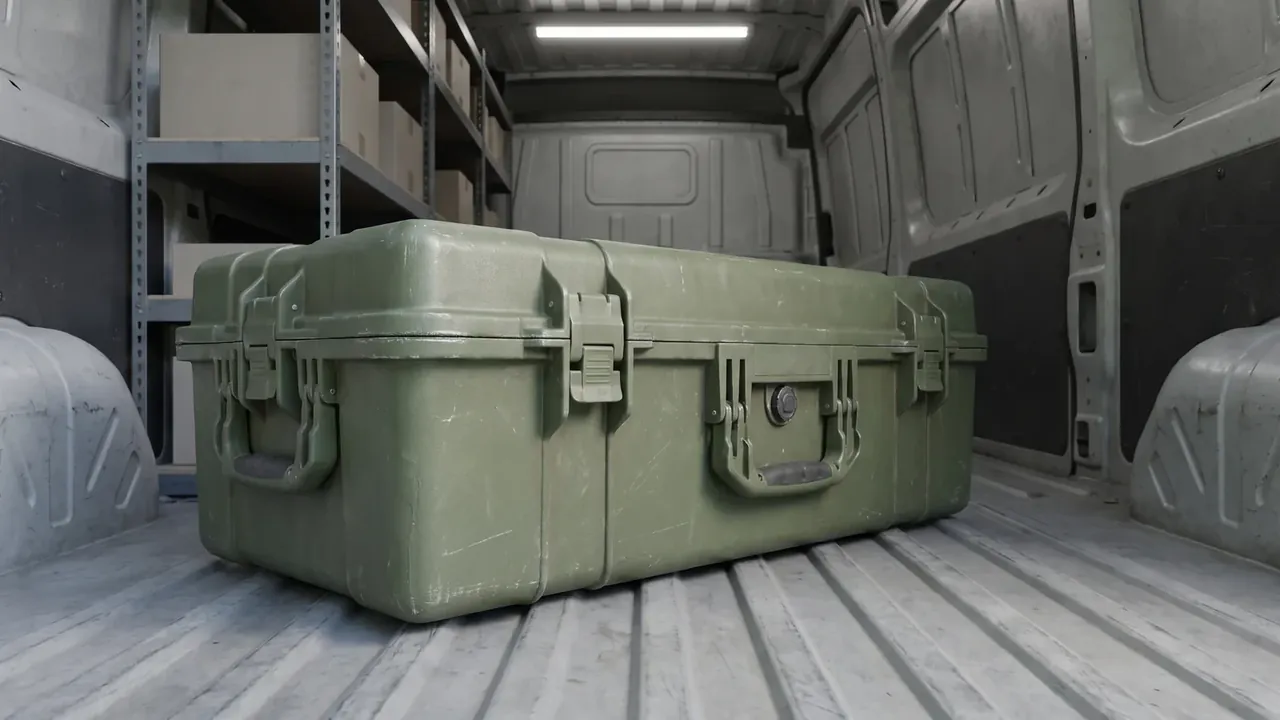
Latch throw must leave room for the gasket to age. A fresh gasket compresses three tenths with the latch at center; two years on, two millimeters of throw remain and the seal still holds.
5. Five Steps That Separate It From a Tote
A Munitions Shipping and Storage Container and a shop tote are not the same object:
- Wall. A tote runs 2.5 to 3 mm on the sides; a Munitions Shipping and Storage Container starts at 5 mm.
- Seal. Totes drain through a bottom gap; this one closes all the way round.
- Hardware. Totes use molded-in clips; this one uses replaceable latches.
- Interior. Totes rely on stacking pressure; this one uses a drilled sheet.
- Marking. Totes are stenciled; this one carries raised molded characters.
Sealing is the hardest to retrofit. A tote mold has no groove, and cutting one severs stress lines, so the lid warps and the leak worsens.
Conclusion
The Munitions Shipping and Storage Container looks like a thick plastic box, and its real cost sits where nobody photographs it: thickness set by charge weight, compression margin set by the gasket section, ageing room in the latch throw. Skip one and the case looks right on delivery, then fails within six months.
This article discusses only the container (case body) side of specifications and design intent, and does not cover any handling, loading or use of the contents.
Related Reading
- Inspection items and pass criteria for munitions containers
- Load, sealing and cushioning design of munitions cases
- How to read the structure of a transport and storage case
- Inspection and replacement lines for reusable cases
Related Products
- 8 Series — Gun Cases; Military Equipment Cases; Camera Equipment Cases; Drone Cases; Watch Cases; Knife Cases; First Aid Cases; Electronics Equipment Cases
- WL8-2812 PP Gun Case — model WL8-2812
- All protective cases and toolboxes: 7 series, 158 models