

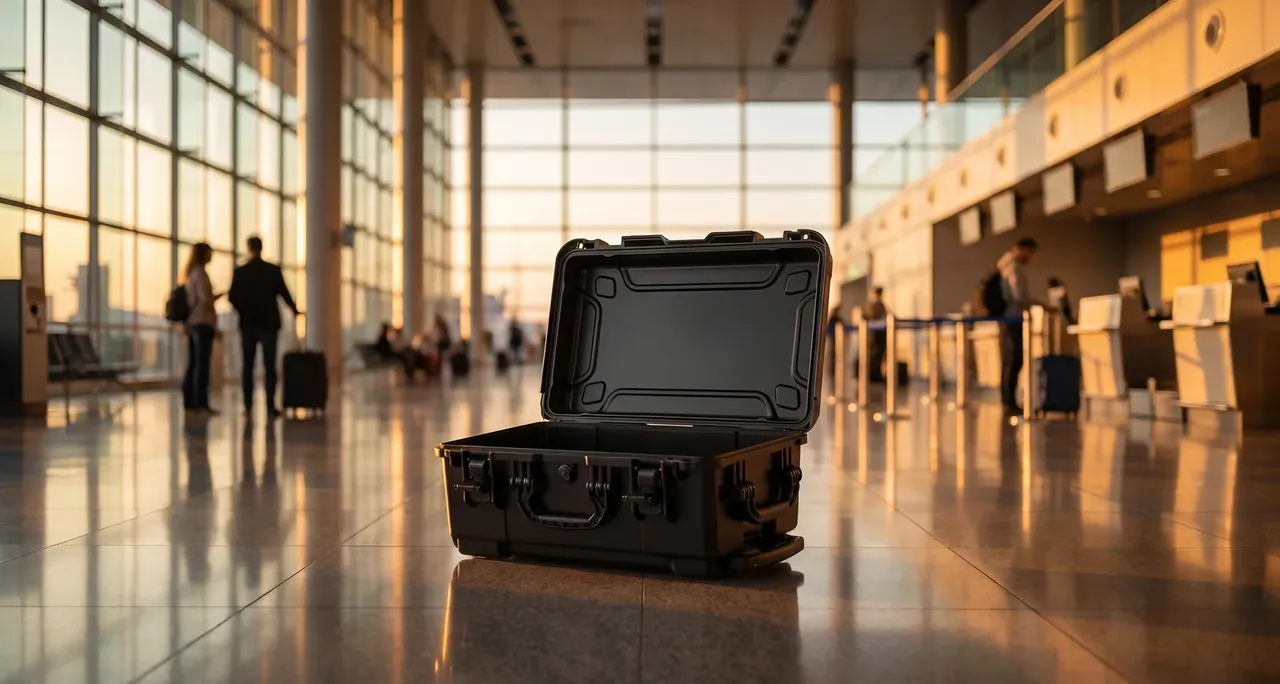
Quick answer: Network tester trolley protective case pairs a 1.4 mm tube wall with 0.22 mm lock clearance after 1,500 lifts and 0.40 mm handle sag at 60 kg.
Table of contents
- Network tester trolley protective case telescopic tube wall
- Locking tongue fit clearance
- Lock clearance after 1,500 lift cycles
- Handle deformation in the static load retest
- Tube wall setting for the handle batch
- FAQ
1. Network tester trolley protective case telescopic tube wall
A telescopic handle rises and drops a thousand times a day; the clearance worn into the locking tongue, and how the grip behaves under a hung weight, both show on the gauge. The Network tester trolley protective case splits this into two readings on one lift rig: the tube wall, and the fit left once the tongue seats in its hole. A 560×370×250 mm shell with a 495×310×185 mm cavity fixes the socket, a 4.3 mm case wall carries the ribs, and the tube opens at 1.4 mm with a 0.15 mm tongue gap; these stay fixed across batches.
Go thinner and the tube sways at full reach, pulling the tongue off its landing point; go thicker and the 6.8 kg empty case plus 17 kg payload adds a tip moment at the socket. JUNZHIJIA runs wall samples around 1.4 mm on the rig rather than judging one by feel.
| Wall grade | Tube wall | Tongue gap | Rig note |
|---|---|---|---|
| Thin A | 1.2 mm | 0.15 mm | Sways; tongue lands off to one side |
| Base B | 1.4 mm | 0.15 mm | Seats first time, no tip moment |
| Heavy C | 1.6 mm | 0.15 mm | Weighty; a print near the socket |
| Sample D | 1.0 mm | 0.15 mm | Fuzzes; reference only |
Each grade runs against the same tongue, so the wall is the only variable. The Network tester trolley protective case keeps the grade still holding clearance through later cycles, a choice settled in Section 5.
2. Locking tongue fit clearance
The tongue drops into its locating hole once the tube stops; fit clearance is the space between its flank and the hole wall. The Network tester trolley protective case sets it at 0.15 mm: below that a burred tab binds and one lift takes two presses, above it the stopped tube rocks into the shell.

Two castors at 55 kg each, two latches at 360 N each, 1 seal at 18% compression and a shell checked against IP65 are fixed case-side items, booked apart from the tongue gap. The Network tester trolley protective case files these under moulding checks, and keeps tongue and tube wall on the lift rig.
3. Lock clearance after 1,500 lift cycles
The rig drives the tube to full reach and back at a fixed stroke; once 1,500 cycles are done, lock clearance is read again. The Network tester trolley protective case caps it at 0.22 mm: inside that line the tongue stays in service, past it the grip socket loosens first.
| Lift index | Lock clearance | Rig note |
|---|---|---|
| Cycle 1 | 0.15 mm | Seats first time, hole unmarked |
| Cycle 500 | 0.17 mm | Faint wear band, landing true |
| Cycle 1,000 | 0.20 mm | Loose at full reach, still inside |
| Cycle 1,500 | 0.21 mm | Widest reading, short of 0.22 mm |
Those rows come from one tongue read all the way through, not four samples run once each. The thinner tube hit 0.22 mm near cycle 1,200; the base held 0.21 mm through 1,500. The Network tester trolley protective case picks its wall from that curve, not a single end-point.
4. Handle deformation in the static load retest
The case is not packed away when cycling ends. A 60 kg static load hangs from the grip for 30 min, then socket-to-lid shift is read against a 0.40 mm ceiling. The Network tester trolley protective case runs this after the lifts to see whether a worn tongue lets the loaded grip tilt the lid.
| Clearance reading | Grip deformation | Retest note |
|---|---|---|
| 0.15 mm | 0.24 mm | Fresh tongue; returns unloaded |
| 0.20 mm | 0.33 mm | Past a thousand cycles; slower rebound |
| 0.21 mm | 0.38 mm | The 1,500 set, near 0.40 mm |
| 0.23 mm | 0.44 mm | Crossed early; a step at the socket |
Wider clearance lifts deformation a little further when read against Section 3; shell, grip socket and tube are logged as one load path here.
5. Tube wall setting for the handle batch
Only here is the wall fixed. The Network tester trolley protective case orders neither from the prettiest single reading nor the least material; the 1,500-cycle lift, the 60 kg static load and the tongue wear are stacked on one tube, and the surviving grade goes into the batch drawing.
The batch card states the setting is the thinnest grade whose lock clearance stays below 0.22 mm after the fifteen-hundredth lift, with thinner tubes kept only as samples. The base ended 1,500 cycles at 0.21 mm with 0.38 mm of grip deformation, both inside bounds, while thin grade A and sample D crossed early. Custom New Material (Guangdong) Co., Ltd. verifies the batch by this method, and JUNZHIJIA locks the 4.3 mm case wall, 1.4 mm tube and 0.15 mm gap as fixed values.
Conclusion
The Network tester trolley protective case reads tube wall, tongue and grip on one lift rig, where 0.21 mm of clearance after 1,500 cycles and 0.38 mm of deformation under 60 kg pull one number with the next. A 1.4 mm wall, a 0.15 mm tongue gap and a 0.22 mm bound are interlocking settings on one batch drawing. JUNZHIJIA verifies case-side locking and static behaviour this way; the 560×370×250 mm shell only carries the load path, and the choice rests on the wall grade still standing.
Related Reading
- Can a Protective Case Be Fitted with Wheels? Matching Trolley Handle and Castor Load Capacity
- Custom EVA foam lined precision instrument case
- Custom Foam Instrument Case Specifications: Sizes, Walls, Load
- Case Handle Load Testing: Static vs Dynamic Verification
Related Products
- 8 Series — Gun Cases; Military Equipment Cases; Camera Equipment Cases; Drone Cases; Watch Cases; Knife Cases; First Aid Cases; Electronics Equipment Cases
- WL8-2812 PP Gun Case — model WL8-2812
- All protective cases and toolboxes: 7 series, 158 models