

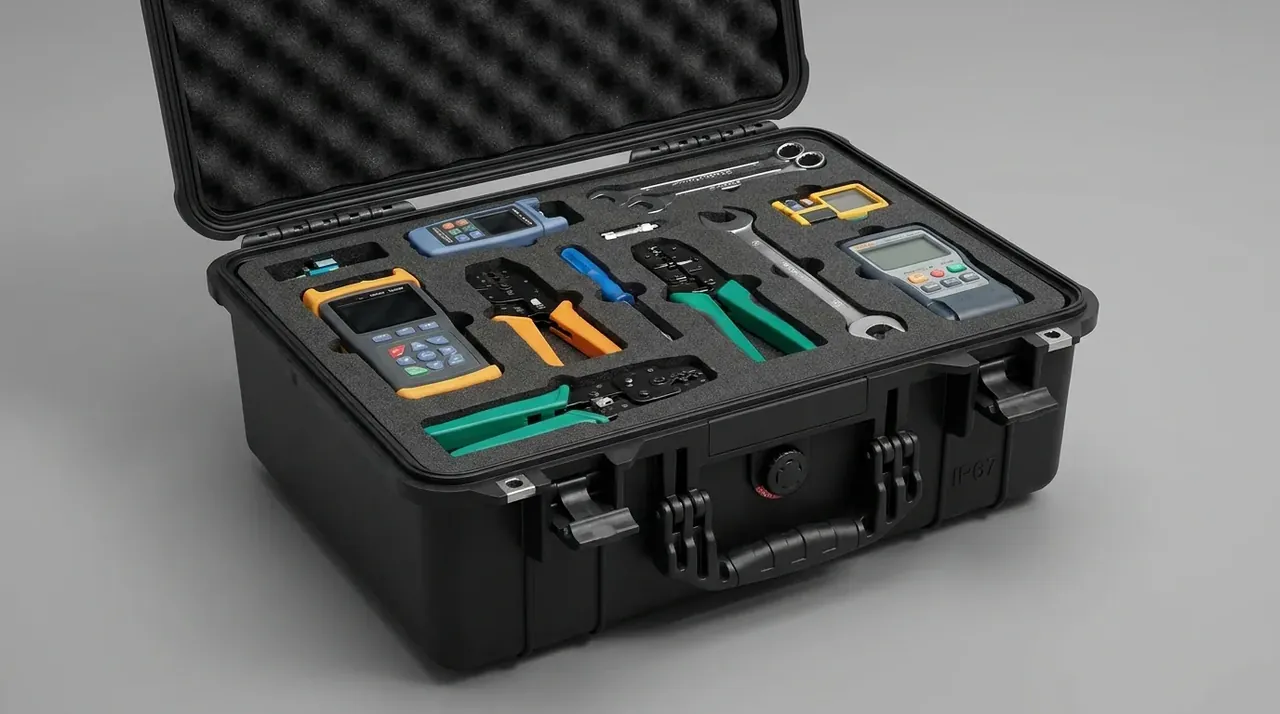
Quick answer: NFPA case labelling commonly uses a 150–200 mm diamond, 50 mm digits, a 1.2 m mounting height and 40% clear space, sized to the reading distance.
Table of contents
- What the Four-Colour Diamond Encodes
- Sizing the Mark: Reading Distance Drives Everything
- Placement, Orientation and the Bilingual Strip
- Weathering: Making the Label Outlast the Trip
- FAQ
1. What the Four-Colour Diamond Encodes
A case in a plant room is read from ten metres away, at an angle, often through dust. NFPA 704 compresses that reading into four blocks: blue on the left for health, red on top for flammability, yellow on the right for instability, white at the bottom for special hazards. Each block carries one digit from 0 to 4. The standard fixes the diamond, the four colours and that 0–4 scale; it says nothing about millimetre sizes, so the figures below are engineering practice.
The shell is not asked to explain chemistry, only to keep four colours distinct, one digit legible at the viewing distance, and both intact until arrival.
| Marking element | Engineering acceptance value | Where it fails |
|---|---|---|
| Colour | Four blocks matched to a card, ΔE ≤2 | Blue drifts purple and merges with a black shell |
| Digit | One digit per block, values 0–4 | Two digits in one block, unreadable at 15 m |
| Height | 50 mm minimum, 8 mm stroke | Right height, thin stroke, strokes break |
| Position | Front face, centre at 1.2–1.5 m | Covered by a latch, one corner lost |
| Durability | No lift after 10 cycles, -30 ℃ to 70 ℃ | Bench-tested only, fades in one sea leg |
The durability row is the one that gets skipped: a label tested at 23 ℃ looks perfect on the day it ships.
2. Sizing the Mark: Reading Distance Drives Everything
Digit height is a function of distance, not a preference. This workshop works to a 1 : 300 ratio, so a 50 mm digit is specified for 15 m, and a 150 mm diamond is the smallest square holding it with a 25 mm border each side.
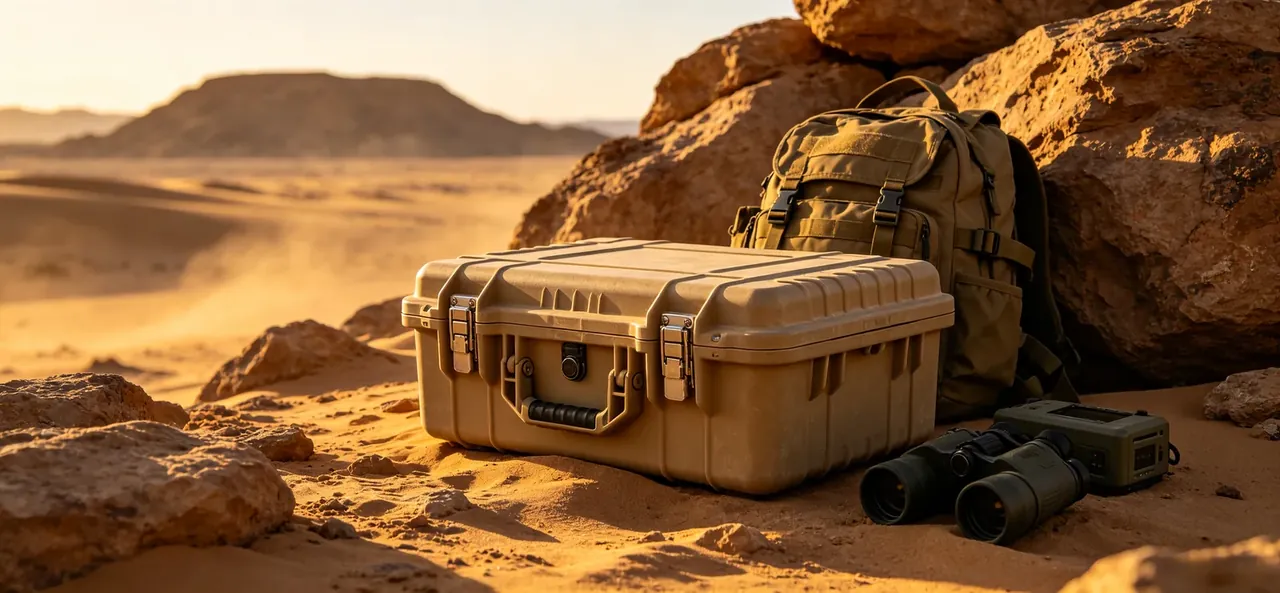
Whitespace is the second constraint and the first thing buyers cut. The diamond needs 40% of the face width left clear around it, because site light is oblique and a mark pushed to the edge loses a corner to its shadow. Where crews include Spanish speakers, a bilingual strip commonly sits 20 mm down at a 1 : 0.8 ratio, capped at 40 mm overall. Drop the type under 25 mm and the Spanish accents fill in, which sends the reader back to English.
One constraint never appears on a spec sheet: the parting line between lid and base. A label crossing it lifts along that line after roughly 2000 closures. On a wall tighter than a 300 mm radius, a 1.5 mm flat adapter plate is bonded first, so the film is never bent around compound curvature.
| Viewing distance | Diamond edge | Digit height | Typical face |
|---|---|---|---|
| 3 m | 60 mm | 20 mm | Side label on a carry case |
| 6 m | 90 mm | 30 mm | Inside a cabinet door |
| 10 m | 120 mm | 40 mm | Workshop aisle |
| 15 m | 150 mm | 50 mm | Main face in a storeroom |
| 20 m | 210 mm | 70 mm | Outdoor staging area |
The steps are not linear: under 10 m the ratio is about 3.5 mm of digit per metre, and beyond that sizes round up to the next 5 mm step.
3. Placement, Orientation and the Bilingual Strip
A correct label in the wrong place reads as no label. On an upright case the diamond goes in the upper right quadrant of the front face, fully visible with the lid closed, centred between 1.2 m and 1.5 m above the floor.

Three features get a 30 mm clearance: latches, handle and relief valve. A label over a latch is polished white within a few dozen closures; one over a valve blisters the first time it vents. A second copy goes on the side at 90°, with both centres held within 20 mm of each other.
Reflective film is commonly specified in three grades, and the grade should follow mounting position rather than budget. Engineering grade suits an indoor aisle within 10 m, high-intensity grade holds to 15 m, and diamond grade is reserved for outdoor staging where headlights sweep the face at night.
4. Weathering: Making the Label Outlast the Trip
A label should not be the shortest-lived part of a case built for 8 to 10 years. The working target is five years without lost characters, colour shift or edge lift, written as an acceptance item rather than a promise.
| Ageing test | Condition | Engineering acceptance value |
|---|---|---|
| Cold | 24 h at -30 ℃ | No lift, no cracking |
| Heat | 72 h at 70 ℃ | ΔE ≤3 |
| Cycling | 10 cycles, -30 ℃ to 70 ℃ | Flat edges, no loss |
| UV | 1000 h | ΔE ≤3 |
| Adhesion | Cross-cut, 1 mm, 6 × 6 | Loss ≤5%, grade 3 |
Adhesion separates good batches from bad ones. The film that scores grade 4 on a smooth plaque often drops to grade 1 on a pebbled wall, so the coupon must be cut from the same batch and texture as the shell.
Any batch above ΔE 3 after 1000 h of UV is rejected rather than reworked. A clear coat pulls the number back under 2, but that coat cracks first at -30 ℃ and moves the failure to a colder customer.
Conclusion
NFPA case labelling is a reading system held up by five parts: colour, digit, height, position and durability. Shift one colour and the hazard class moves a step; lose 10 mm of digit height and the stroke breaks at 15 m; skip one ageing test and the mark is dead after a single sea leg. Write all five into the drawing and the inspection sheet, and nobody at the site has to guess.
This article covers case-side specifications only and does not address any handling, loading or use of the contents.
Related Reading
- Label elements for export packaging
- Label area and nameplate layout
- English label wording and type size
- Layout inside a fire equipment case
- Marking size and position for shipments
Related Products
- 8 Series — Gun Cases; Military Equipment Cases; Camera Equipment Cases; Drone Cases; Watch Cases; Knife Cases; First Aid Cases; Electronics Equipment Cases
- WL8-2812 PP Gun Case — model WL8-2812
- All protective cases and toolboxes: 7 series, 158 models