

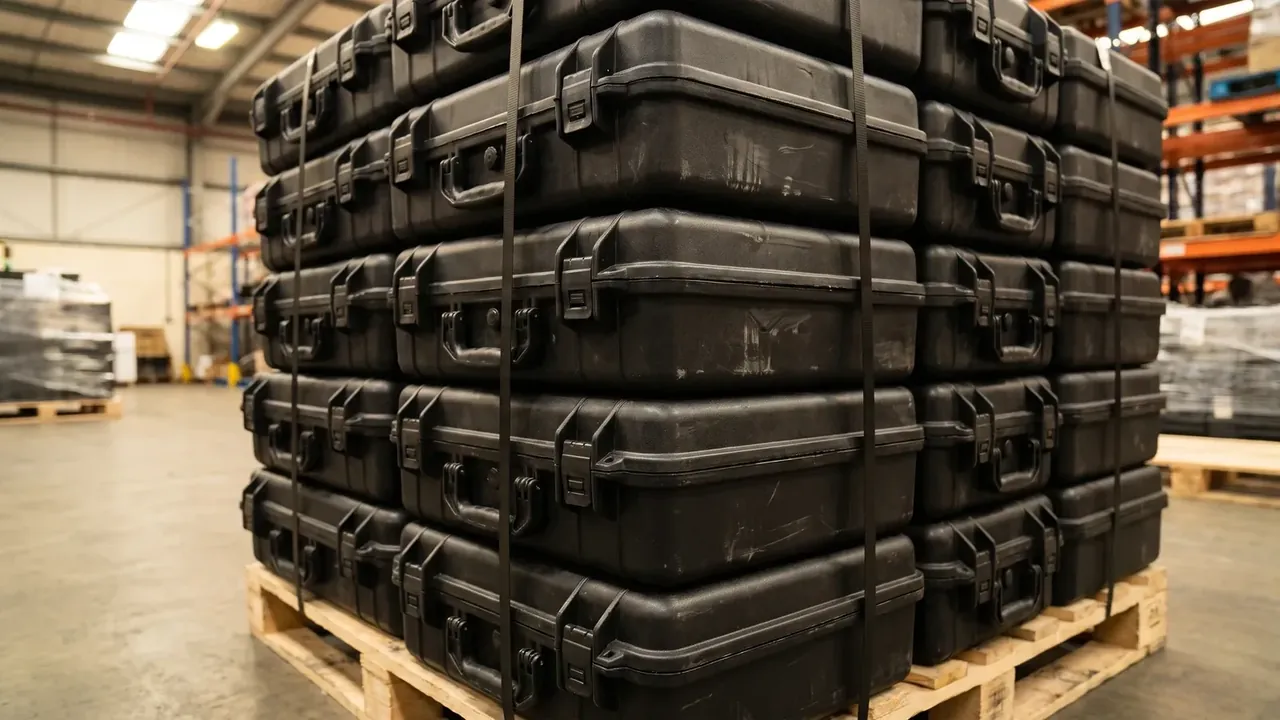
Quick answer: An Optical Instrument Transport Case keeps lens acceleration under 15 g with 60 to 90 kg/m³ closed-cell EVA and holds humidity below 50 percent RH.
Table of contents
- Vibration allowance through the insert stack
- Cleanliness of the cavity and insert outgassing
- Humidity inside the closed shell
- Condensation across a temperature step
- Cross-checking the four sensitive factors
- FAQ
1. Vibration allowance through the insert stack
A 200 mm aperture interferometer head weighs 12 kg and its lens group rides on three sprung retainers, with resonance usually near 38 Hz. Road vibration spans 5 to 500 Hz at 1 g of sine sweep, and displacement reaching the glass has to stay under 0.05 mm. What matters is amplification at resonance, not peak acceleration.
An Optical Instrument Transport Case damps in two stages: a 15 mm closed-cell EVA outer layer takes the low frequencies, an 8 mm soft foam inner layer touches the barrel, and no void sits between them. Leave a void and the barrel swings freely, however thick the foam.
| Factor | Level | Effect on the light path |
|---|---|---|
| Sine sweep | 5–500 Hz at 1 g | locates resonance and amplification |
| Shock | 15 g / 6 ms | relative shift of ring and seat |
| Insert density | 60–90 kg/m³ | sets the low-frequency floor |
The sweep starts at 5 Hz and climbs one octave per minute to 500 Hz, once per axis, with amplification held to Q of 5 or less. A high Q means the insert is too stiff and shock energy magnifies into the retaining ring; a Q under 2 means it is too soft, so the barrel creeps on a long haul. An Optical Instrument Transport Case is swept in-house, moving resonance below 30 Hz or above 60 Hz to clear the 40 to 55 Hz band of a truck chassis.
2. Cleanliness of the cavity and insert outgassing
Two things attack a coated lens: hard particles above 50 μm, which grind across the coating under vibration, and unreacted vinyl acetate in the EVA, which volatilises above 40 °C and settles as a haze. The insert is therefore hot-formed from closed-cell sheet with sealed cut faces instead of being die-cut, so crumbs stay locked in.
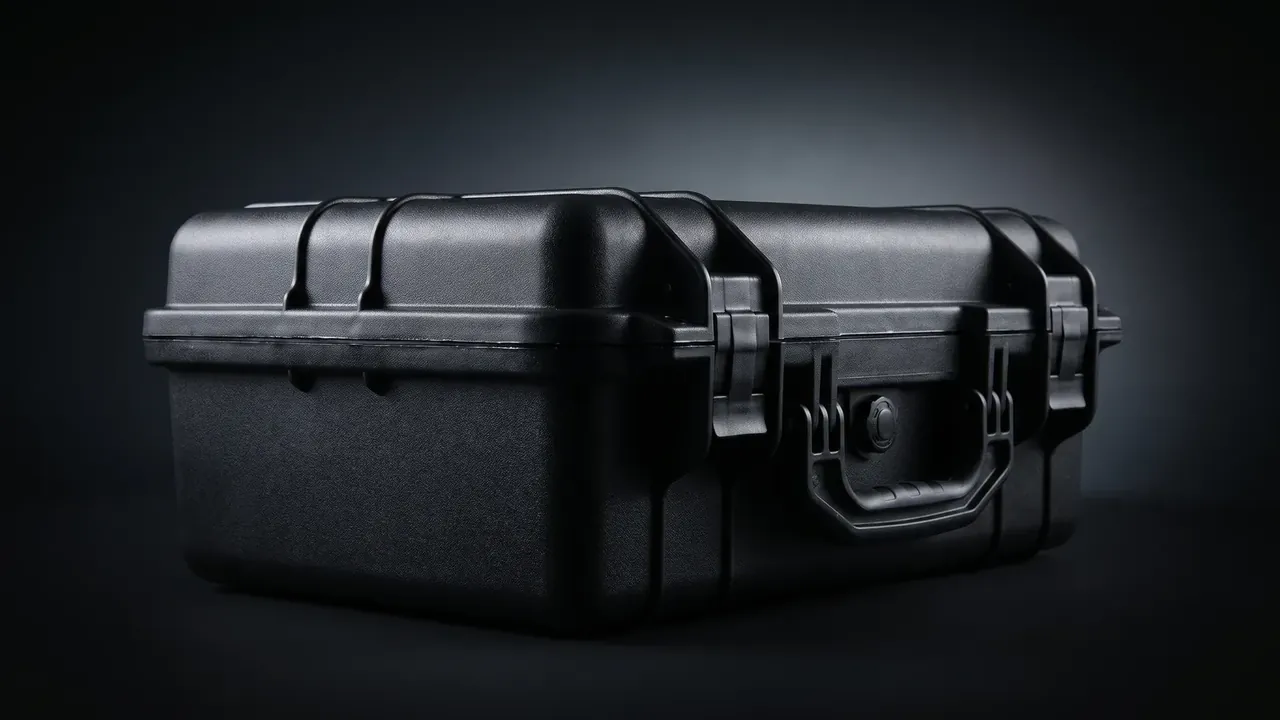
Cleanliness inside the cavity comes from three layers of isolation: a non-woven sleeve over the barrel, a PE wrap over that, then the cutout itself. Cavity tolerance is set at plus 0.5 mm, deliberately loose, so the foam never rubs the barrel's outer diameter. A dry nitrogen purge before closing carries most debris out.
Outgassing can be screened cheaply. Seal a scrap of EVA and a coated test slide in a 1 L glass jar, hold it at 60 °C for 24 hours, then look for haze on the slide. The result is comparative, but it ranks one sheet against another, and an Optical Instrument Transport Case uses it at goods-in.
3. Humidity inside the closed shell
Above 60 percent relative humidity, mould starts on the coating and hyphae work into its micropores where no cloth can reach. An Optical Instrument Transport Case holds the interior below 50 percent RH with two things: a sealed mouth and a desiccant charge sized to the internal volume.
| Relative humidity | Storage duration | Surface state |
|---|---|---|
| above 70 percent | 30 days | mould spots at the edge, re-coating needed |
| 55 to 65 percent | 90 days | local haze, polishable |
| below 50 percent | 12 months | no visible change |
The charge follows net volume: 20 g of silica gel per 10 L pulls 80 percent starting humidity down to 45 percent within 6 hours at 25 °C. A three-colour indicator card inside the lid shows whether the seal survived the journey.
Most seal failures trace to the mouth: gasket compression under 20 percent, or a shell shrunk in the cold that lifts the lid rim. Immersion to IP67 at 1 m for 30 minutes, wiped and opened, settles it. An Optical Instrument Transport Case runs that check on every shipment.
4. Condensation across a temperature step
Bring a case from a -10 °C truck into a 22 °C laboratory and the dew point inside is pinned by shell temperature, so moisture forms on the barrel's outside rather than the glass, provided nobody opens the lid. Do not unpack on arrival; let it stand 4 hours.
At a 30 °C step with 50 percent internal humidity the dew point sits near 9 °C, and any wall below that fogs. A 4 mm PP wall conducts slowly, so the inner face warms least in the first hour, and settling time cannot be judged by touch.
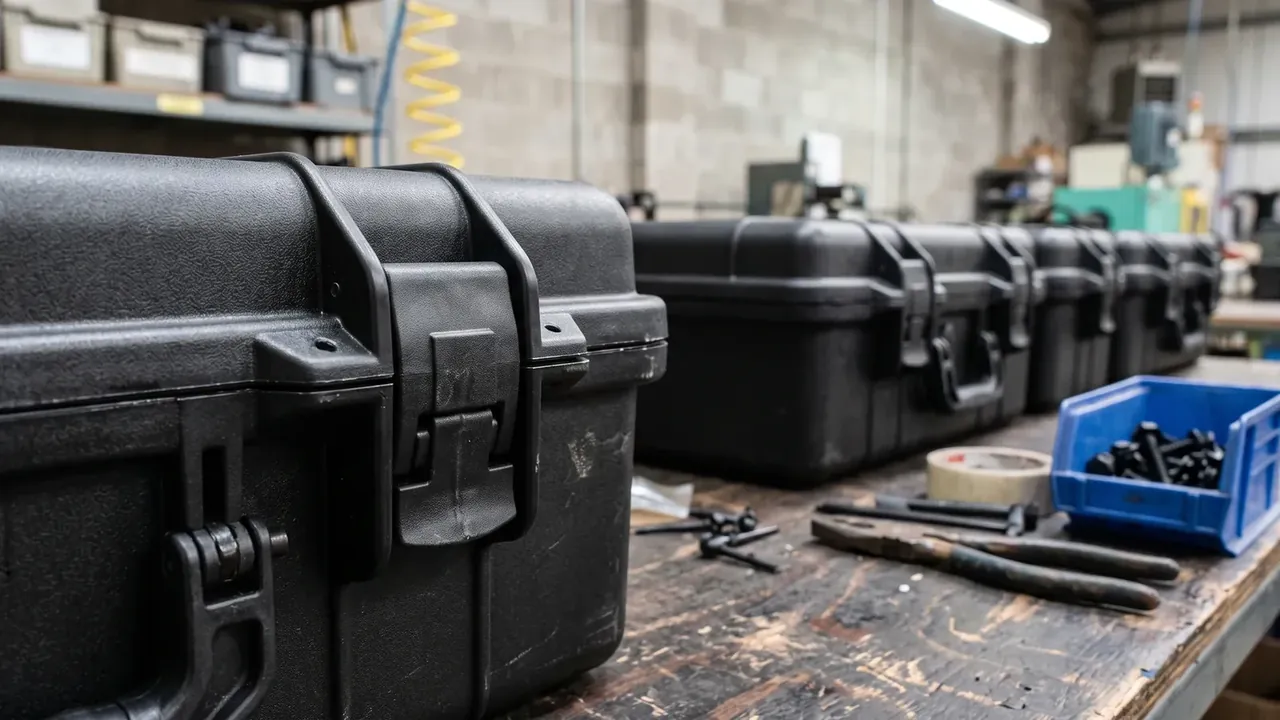
The reverse case exists too: 35 °C outdoors into a 5 °C cold store. Condensation lands on the outside of the shell and the interior is untouched, but wet air rushes in the moment the lid opens and the glass fogs at once. An Optical Instrument Transport Case waits 30 minutes in an ante-room first.
5. Cross-checking the four sensitive factors
Vibration, cleanliness, humidity and temperature cannot be judged one at a time. A softer insert buys vibration margin but loosens the cutout, so particles collect in the gaps; more desiccant drives humidity down but the powder from spent gel becomes a contaminant itself.
| Duty | Governing factor | Item rechecked |
|---|---|---|
| 8 h road leg | vibration | Q at resonance, ring shift |
| 30 days by sea | humidity | indicator colour, water traces |
| winter arrival | temperature | fogging after a 4 h stand |
The method is to set a hard line for each factor, then read them together: 15 g and Q of 5 or less, 50 μm particles and no outgassing haze, 50 percent RH with 20 g of gel, a 4-hour stand. An Optical Instrument Transport Case prints all four on one acceptance sheet, and any single breach sends the unit back.
Cleanliness is usually sacrificed: thickening the insert to gain vibration margin relaxes the cutout, and every extra gap is somewhere for grit to sit. An Optical Instrument Transport Case ties cavity tolerance to insert thickness: plus 0.5 mm at 15 mm of foam, tightened to plus 0.3 mm once the foam reaches 20 mm.
Conclusion
Fifteen g with a Q of 5, 50 μm particles, 50 percent RH against 20 g of gel, a 4-hour stand after a 30 °C step: each line is easy alone and hard together. The two-stage foam, hot-formed sheet and sealed mouth in an Optical Instrument Transport Case serve those four at once, and any one conceded for another shows up on the glass. Before ordering, ask for a sweep curve and a sample indicator card.
Related Reading
- Volume, cavity and usable corner ratio
- Calibration equipment transport case
- Foam thickness 5, 10 and 15 mm
- Plastic case versus wooden crate
Related Products
- 8 Series — Gun Cases; Military Equipment Cases; Camera Equipment Cases; Drone Cases; Watch Cases; Knife Cases; First Aid Cases; Electronics Equipment Cases
- WL8-2812 PP Gun Case — model WL8-2812
- All protective cases and toolboxes: 7 series, 158 models