

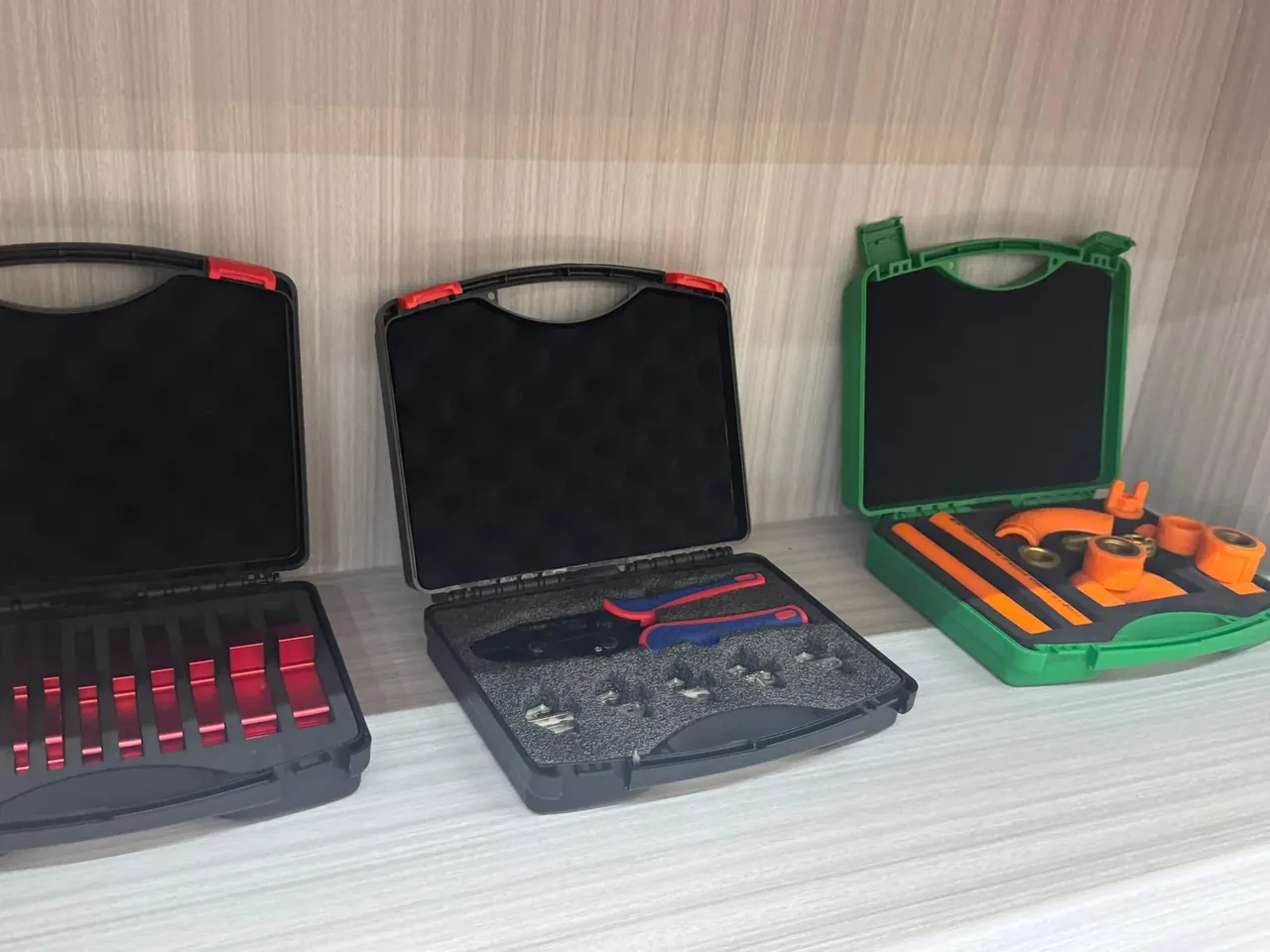
Quick answer: An outdoor camping tableware anti-collision storage box uses a 4.5 mm rotomoulded wall with ribs at 70 mm pitch, six compartments with 35 mm lips, and holds a 60 kg top load over four tiers with no more than 2 mm of residual set in the lid.
Table of contents
- Side ribs and dent recovery of the outdoor camping tableware anti-collision storage box
- Divider slot width and lip height
- Lid load sharing across a four-tier stack
- Corner radius rebound after a 1 m drop
- Drain holes and the slope that clears condensate
- FAQ
1. Side ribs and dent recovery of the outdoor camping tableware anti-collision storage box
The outdoor camping tableware anti-collision storage box is rotomoulded at a 4.5 mm wall, 560×400×290 mm outside, 4.2 kg empty and rated for 12 kg. Three horizontal ribs are pressed into each side, 5 mm tall at 70 mm pitch, starting 25 mm below the rim and running down to the base fold. The ribs do not flatter a stiffness number; they keep a dent local. Without them a single side knock pushes a 300 mm wall in by 15 mm or more, and with them the same blow stops near 6 mm.
Whether a dent comes back depends on temperature and time. Pressed 12 mm at 20°C, the wall of an outdoor camping tableware anti-collision storage box recovers to within 1.5 mm of flat after 24 h; below 0°C that figure doubles, because HDPE creeps back far more slowly when cold. Acceptance therefore states the temperature; a rebound figure without one compares with nothing.
| Structural item | Value | Reading use |
|---|---|---|
| Wall | 4.5 mm | Dent resistance and rotomoulding allowance |
| Rib height | 5 mm | Deduction from internal width |
| Rib pitch | 70 mm | How far a dent spreads |
| Residual dent | ≤1.5 mm after 24 h | Pass line at 20°C |
Ribs cost internal space: 5 mm a side, 10 mm across, which pulls usable width from 515 mm down to 505 mm. A quote built on external dimensions alone lands about 3% short of the real volume. Ten units per lot are checked with calipers at rib root and rib crown, and anything under 4.0 mm at the root goes back.
2. Divider slot width and lip height
Inside, six compartments sit on a 3×2 grid, with 8 mm dividers in 9 mm slots and a 35 mm lip per cell. The lip takes the first hit: when the case tips onto its side, the lip stops lateral travel before the divider sees any shear. Drop the lip to 20 mm and each cell is walled by a low curb that a side impact pushes straight out of its slot; raise it to 50 mm and fingers no longer reach the bottom of a cell.
A 9 mm slot leaves 1 mm of assembly clearance on an 8 mm divider, with insertion force around 60 N. Under 0.5 mm the divider swells in damp air and jams; over 1.5 mm it rattles as the box is carried and polishes white marks into the slot mouth. Slots are moulded with the base, with a 2 mm radius at the bottom so stress avoids a square corner.
Dividers can be taken out but not added. Pulling two out merges cells without touching lip height or stiffness; forcing in a longer divider spreads the slot, where the moulding is only 3.2 mm thick and cracks beyond repair.
3. Lid load sharing across a four-tier stack
The stack is designed for four tiers at 12 kg each, with 60 kg of equivalent load on the top lid. Four pads sit on the lid face, 22×22 mm each, directly over the rib crowns below, so load travels down the walls rather than through the thin lid middle. Move them inward and the lid sags past 4 mm after 72 h, rubbing audibly at the rim.
The reading is residual set in the lid, capped at 2 mm, measured at the centre and at four points between the pads. Run it at 40°C and the figure climbs toward 2.8 mm, since HDPE loses modulus near 50°C, which is why three tiers suit summer.
| Stack condition | Load and temperature | Residual set |
|---|---|---|
| Four tiers, normal | 60 kg top, 20°C | ≤2 mm |
| Four tiers, hot | 60 kg top, 40°C | ≤3 mm |
| Three tiers, normal | 45 kg top, 20°C | ≤1.2 mm |
4. Corner radius rebound after a 1 m drop
The box is dropped from 1 m onto all six faces with 10 kg of ballast, after 4 h at -15°C. Corners carry an R8 radius: below R5 the energy lands on a point and splits the corner, above R12 the wall thins through the curve. R8 is the usual compromise on a rotomoulding tool, and the wall still measures over 4.2 mm through the curve.
Three readings follow the drop. Corner shape first, with collapse held to 3 mm. Then the six divider slots, none of which may show a through crack. Last is lid flatness, with the gap at the rim kept under 1.5 mm once closed. A failure in either of the first two retires the box; the third alone calls for a new gasket and a re-check.
5. Drain holes and the slope that clears condensate
Two 6 mm drain holes sit at the lowest corner of the base, which is sloped 3° toward them from the opposite corner. Day-night swings leave condensation inside, and 200 mL clears in 20 min at that slope; at 1° the same volume needs 50 min, long enough for a second round to pool.
More holes are not better. A four-hole base gathers material at each opening during rotomoulding, and the uneven wall becomes the leak path. Two holes at 3° already cover 200 mL, each offset 15 mm from the base ribs.
Each hole takes a flush silicone plug with 0.2 mm interference. The plug must survive 24 h at 55°C and 24 h at -15°C without loosening or splitting. Hole edges take a 0.5 mm chamfer; a sharper edge cuts a notch as the plug seats, and water starts there.
Conclusion
The figures on an outdoor camping tableware anti-collision storage box hold each other in place: a 4.5 mm wall with 5 mm ribs at 70 mm pitch, six cells on 8 mm dividers with 35 mm lips, 2 mm residual set at 20°C rising to 2.8 mm at 40°C, corner collapse under 3 mm after a 1 m drop, and a 3° base slope feeding two 6 mm drains. Change one and the rest need re-checking. How tableware is arranged or lifted out of the box falls outside this page.
Related Reading
- Choosing between dividers and foam
- Materials and mounting faces for anti-slip feet
- Layering and bonding of foam linings
- Matching case depth to centre of gravity
Related Products
- 8 Series — Gun Cases; Military Equipment Cases; Camera Equipment Cases; Drone Cases; Watch Cases; Knife Cases; First Aid Cases; Electronics Equipment Cases
- WL8-2812 PP Gun Case — model WL8-2812
- All protective cases and toolboxes: 7 series, 158 models