

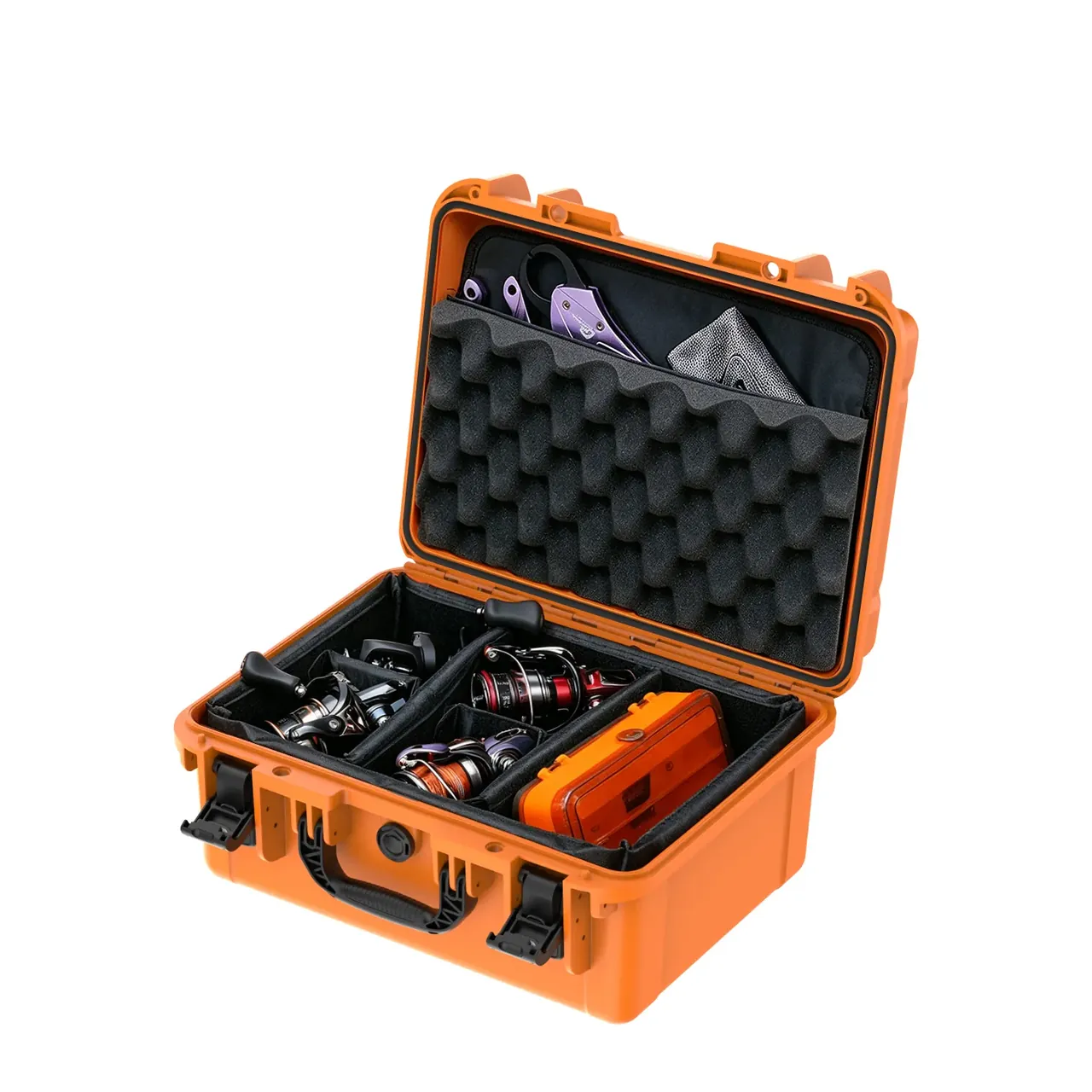
Quick answer: Case outdoor storage for three years ends in a brittle latch snap, with gloss down from 12 GU to 3 GU and tensile retention at 63%.
Table of contents
- A three-year order: whitening, embrittlement, crushing
- UV dose accounting: 70% tensile at month 26
- What ΔE 4 looks like at what distance
- Thermal cycling and four-high stacks
- Year 1, 2, 3 checks and when to move inside
- FAQ
1. A three-year order: whitening, embrittlement, crushing
Year one only whitens. At month 12 the 60° gloss on the lid had fallen from 12 GU to 7 GU, a finger left fine powder and a damp cloth left a pale smear. Latch force rose from 42 N to 46 N and the gasket still recovered 88%.
Year two splits the colours. By month 18 the gap between lid and base crossed ΔE 4 while control cases kept indoors sat at ΔE 1.6. By month 26 tensile retention hit 70%, the specimen falling from 28 MPa to 19.6 MPa as the break turned brittle.
Year three belongs to the latch. At month 36 it snaps audibly, a −5 ℃ drop test cracks it outright and the crack runs 18 mm along the latch seat root. The case still holds gear, but it can no longer carry the original stack height.
| Month | Gloss GU | ΔE | Tensile | Latch N | Action |
|---|---|---|---|---|---|
| 6 | 10 | 1.2 | 96% | 43 | Normal use |
| 12 | 7 | 2.4 | 91% | 46 | Log |
| 18 | 5 | 4.0 | 84% | 49 | Half shade |
| 26 | 4 | 5.1 | 70% | 54 | 2 high |
| 36 | 3 | 6.3 | 63% | 62 | Indoors |
The order cannot be reversed: whitening does not touch sealing, embrittlement decides whether the latch carries load, and colour is only the early warning.
Placement rewrites the timeline inside one yard. A 30° south slope collects 22% more annual dose than an upright case in shade, and turning a case so the latch faces north pulls month-18 colour from ΔE 4.0 to 3.1.
2. UV dose accounting: 70% tensile at month 26
340 nm penetrates a case wall deeper than any other UVA band, and the tertiary carbon bond in polypropylene absorbs exactly there. 0.76 W/m² is the standard UVA-340 setpoint: 1000 h in the chamber equals roughly 14 months of single-face exposure in southern China.
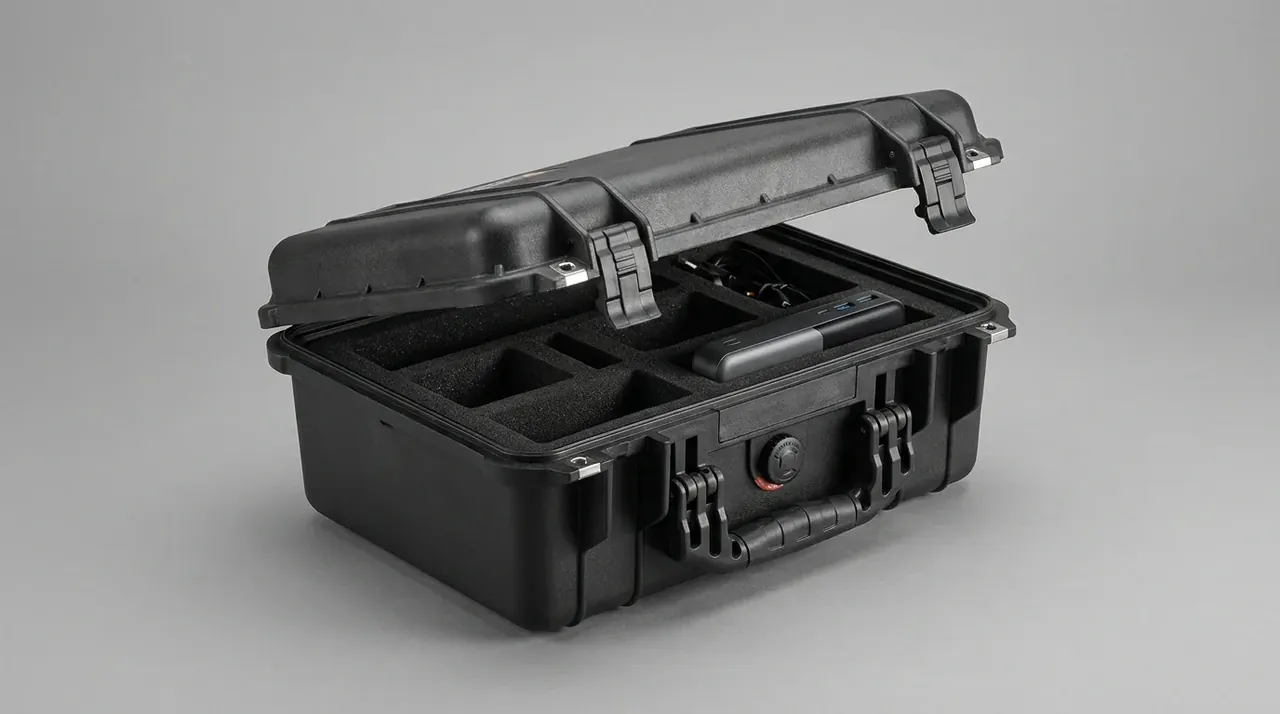
Counting half the days as sun, 0.76 W/m² gives about 12 MJ/m² a year per face. Month 26 lands at 26 MJ/m² with tensile retention at exactly 70%, within 4% of the 1900 h chamber result. The early curve is nearly straight, losing 11 points per 10 MJ/m².
Heat pushes that curve left. A lid measured 62 ℃ at noon in summer, 18 K above air, and every 10 K of surface temperature multiplies chain scission by about 1.8, so a case leaning south crosses the line 6 months before an identical case in shade.
Past 70% the slope steepens. Month 36 reads 63%, and the same gradient puts month 48 near 42%, where a 1.2 m drop already cracks a corner.
3. What ΔE 4 looks like at what distance
ΔE 4 is visible at 0.5 m; ΔE 2 needs two cases side by side before anyone can split them. Measurement runs an 8 mm aperture spectrophotometer, D65 light and 45/0 geometry, averaging 3 points on the lid centre where single readings scatter within 0.3.
On white cases ΔE 4 reads as yellowing, b* climbing from 1.8 to 6.2. On dark cases the same number reads as greying, L* rising 3.5.
Colour does not affect sealing, but it is the best proxy available. By the time ΔE reaches 4 the gasket has hardened 8 Shore A and taken 31% permanent set, the edge of leaking.
4. Thermal cycling and four-high stacks
The daily cycle outdoors runs −15 to 55 ℃, 365 times a year. Case and lid shrink 0.8 mm apart, widening the gasket groove fit from 0.4 mm to 0.9 mm. That gap does not leak at once, but it lets the lid chatter in wind and adds one micro impact per day at the latch.
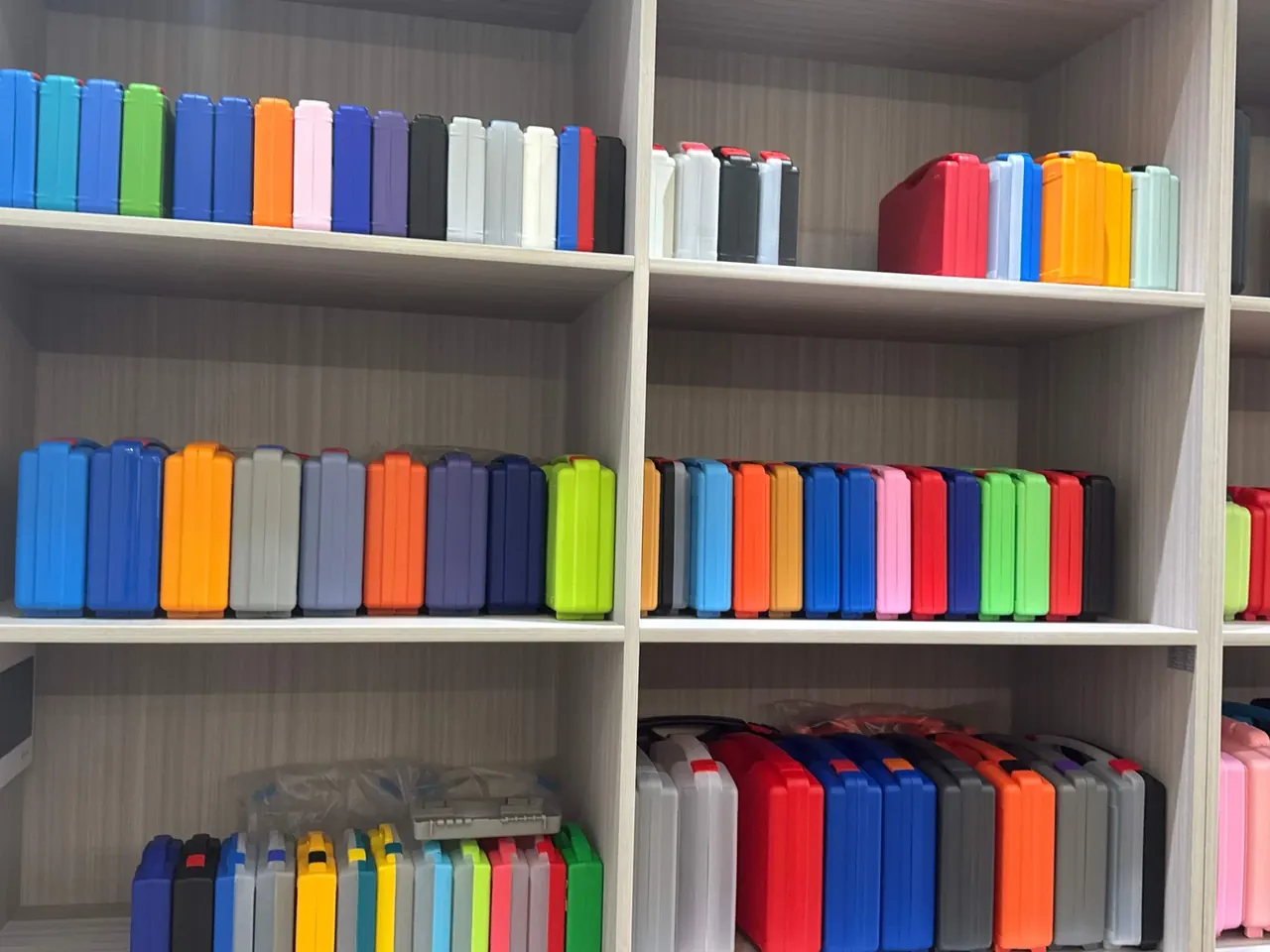
Stacked four high, the bottom case carries three cases: 36 kg of static load over 4 feet, about 90 N per corner. Crushing runs 0.6 mm a year, 1.8 mm by year three, and the body diagonal grows from 512 mm to 514 mm.
Load and temperature compound. At 55 ℃ the flexural modulus of PP drops about 40%, so the same 36 kg presses twice as deep on a July afternoon.
| Stack | Load per corner N | Crush mm/yr | 3-year mm | Guidance |
|---|---|---|---|---|
| 2 high | 30 | 0.2 | 0.6 | Long term |
| 3 high | 60 | 0.4 | 1.2 | Retest yearly |
| 4 high | 90 | 0.6 | 1.8 | Drop a tier in year 3 |
| 5 high | 120 | 0.9 | 2.7 | Not advised |
The bottom crushes three times faster than the top because it also carries wind load and vibration.
5. Year 1, 2, 3 checks and when to move inside
Year one covers 4 items: lid gloss, colour between lid and base, latch force and gasket recovery. All four fit in 30 min without opening the case, using a gloss meter and a force gauge.
Year two adds 2 more: corner cracks and rib whitening. Ribs are the thinnest section at 3.0 mm walls, so whitening means local yielding, and a fingernail dragged across it catches a step.
Year three adds 4: body diagonal, lid-to-base fit gap, purge valve operation and a stack height review, measured with every case empty.
Three verdict lines trigger a move indoors, any one sufficient: tensile retention below 70%, colour past ΔE 4 together with latch force above 60 N, or corner crush beyond 1.5 mm. A case passing all three still works, but only at two high.
Mitigation is three moves: a canopy to block direct sun, pallets lifting the base 100 mm, and turning cases from a south slope to upright in shade. They delay the crossing by 8 to 10 months, and only delay.
Conclusion
Case outdoor storage is settled by three numbers logged over three years, not by how a lid feels: gloss, ΔE and tensile retention. Log for 12 months, shade from month 18, cut the stack to two high at month 26, and move the case indoors at month 36. The schedule follows the 340 nm, 0.76 W/m² dose curve, which costs 11 points per 10 MJ/m² before 70% and 15 points after, so delay gets dearer every month. The operational step is one sheet at the yard gate: work down the row matching the year, tick each item, and treat a missing entry as a failed check. If ΔE 4 and a 60 N latch arrive together in year two, jump to the year-three action instead of waiting for the anniversary.
| Year | Checks | Verdict line | Action |
|---|---|---|---|
| Year 1 | Gloss, colour, latch force, gasket recovery | ΔE ≤2.4, latch ≤46 N | Log, keep 4 high |
| Year 2 | Add corner cracks and rib whitening | ΔE ≤4.0, tensile ≥84% | Half shade, 3 high |
| Year 3 | Add diagonal, fit gap, valve, stack review | Tensile ≥70%, crush ≤1.5 mm | Move indoors or 2 high |
This article discusses container-side specifications and design implications only, and does not cover any handling, loading or use of the contents.
Related Reading
- Base conditions for long-term outdoor case storage
- Converting UV chamber hours into outdoor exposure
- Metal ammunition boxes used as outdoor storage
- How outdoor case surfaces age after three years of sun
Related Products
- 8 Series — Gun Cases; Military Equipment Cases; Camera Equipment Cases; Drone Cases; Watch Cases; Knife Cases; First Aid Cases; Electronics Equipment Cases
- WL8-2812 PP Gun Case — model WL8-2812
- All protective cases and toolboxes: 7 series, 158 models