

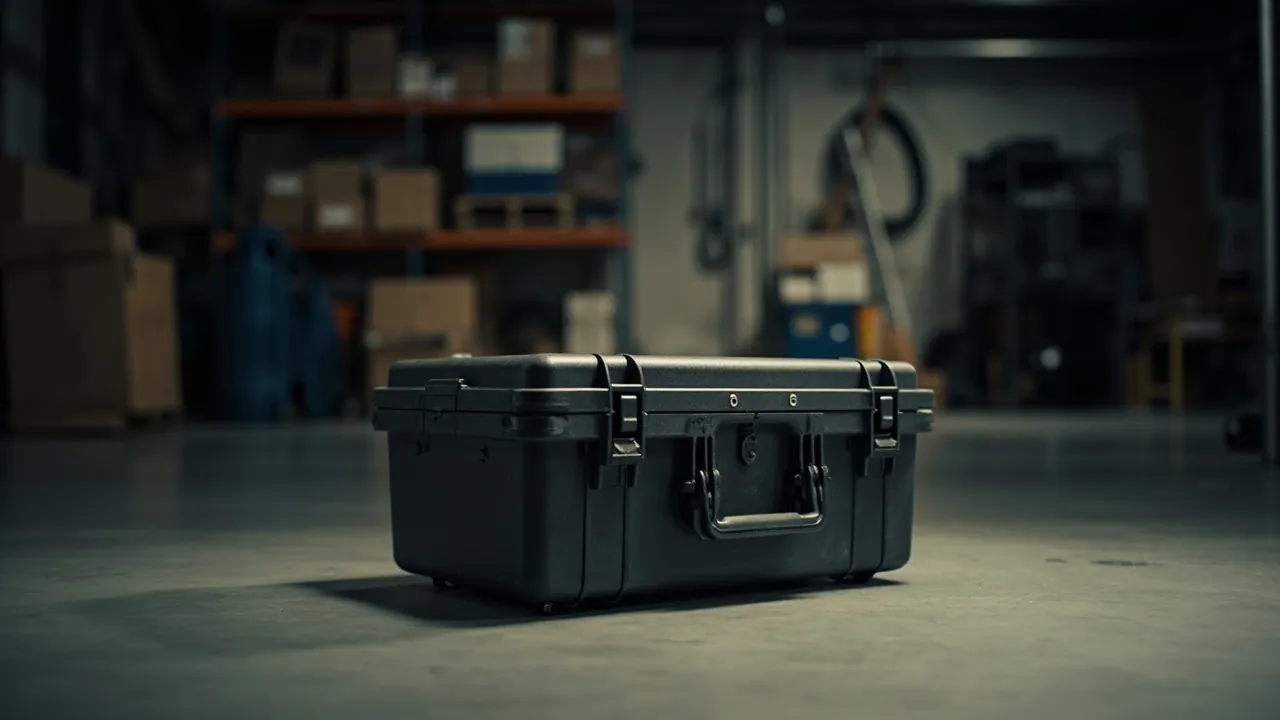
Short answer: yes, and this is one of the fastest-growing civilian applications for hard-sided protective packaging — but only when three conditions are met at the same time: the right material, a verified ingress protection rating, and the right internal liner. A case built to industrial packaging specifications is, at its core, a rigid container with a controlled seal and a locking mechanism. Its original design goals were resistance to stacking loads, protection from moisture and dust, and repeatable handling and transport. Those same capabilities are exactly what patios, garages, campsites, vehicle trunks and emergency storage rooms demand. The real distinction is this: a case intended for outdoor use must be selected on IP rating and material system, not on how sturdy it looks. A high-density polyethylene (HDPE) case marked IP67 and one ordinary plastic storage tote with no ingress testing at all can differ by an order of magnitude once continuous rain, day-night temperature swings and ground moisture come into play.
This article is written for both individual buyers and B2B channel partners. It first reduces the product category back to what it actually is — a measurable piece of industrial packaging — then works through five representative civilian scenarios, provides selection parameter tables and a pitfall checklist, and closes with the clauses that should appear in a wholesale, agency or OEM/ODM agreement. All specific figures are given as typical or empirical values; actual projects should be based on the drawings and third-party test reports issued by the supplier.
Table of Contents
- The direct answer: yes, but three conditions come first
- Setting the terms: this is industrial packaging, not a military-exclusive product
- Scenario one: patio and balcony storage
- Scenario two: vehicle and trunk gear storage
- Scenario three: camping and fieldwork moisture protection
- Scenario four: garage, warehouse and workshop tool and part storage
- Scenario five: emergency supplies and long-term household reserves
- The six parameters that drive a civilian selection
- Ingress protection: choosing between IP65 and IP67 outdoors
- Material choice: weighing HDPE, copolymer PP, steel and aluminium
- Liners and dividers: making the case actually fit your contents
- Common mistakes and a pitfall checklist
- Sourcing and channels: what wholesale, agency and OEM/ODM buyers should watch
- FAQ
- Conclusion and further reading
The direct answer: yes, but three conditions come first
Using this type of case outdoors is not a question of whether things fit inside. It is a question of whether the case can protect them over time. Three conditions must all be satisfied.
- The material must survive the outdoor environment. The real enemies outdoors are UV degradation, low-temperature embrittlement and long-term moisture absorption — not weight. Thin-wall homopolymer polypropylene (PP) chalks and fades under prolonged sunlight and becomes brittle in the cold; recycled-blend compounds crack after enough thermal cycling. A sensible starting point for outdoor use is a copolymer PP compound or high-density polyethylene (HDPE), which retains toughness down to roughly -20 °C to -30 °C in common grades, stabilized with a UV package. For the underlying logic of plastic selection, see protective case plastic materials.
- The ingress protection rating must appear on the data sheet. Outdoors, a case meets rain, splash, brief standing water and high humidity. A tote that has never been ingress-tested relies entirely on the lid "closing tightly", and it fails as soon as wind drives rain sideways. The sensible minimum is IP65 (dust-tight plus water jets), while scenarios with standing water or washdown demand IP67 (temporary immersion, commonly 1 m for 30 minutes). For a full reading of the rating system, see what is an IP67 rating.
- The liner must match the contents. The shell decides whether the case survives the environment; the liner decides whether the contents survive each other. For anything mobile — vehicle-mounted, carried by hand — use closed-cell EVA or PE foam or rigid dividers. Never use open-cell polyurethane sponge, which absorbs water. A full comparison appears in case internal foam types.
These three points look simple, yet they explain the majority of "I bought a case and my gear still got wet" stories. The buyer purchased a container shaped like a case without purchasing a case that actually protects.
Setting the terms: this is industrial packaging, not a military-exclusive product
In industrial packaging language, the products often called ammo boxes or ammo cans are rigid containers designed to a high protection specification for the storage and transport of equipment and supplies. Every meaningful property is a measurable physical quantity, independent of any particular use:
- External dimensions and stacking footprint: whether the case matches standard pallet modules such as 1200 mm × 1000 mm and 1200 mm × 800 mm;
- Internal volume: expressed in litres, which sets loading density;
- Tare weight and gross weight: which set the limits for manual handling and lifting;
- Ingress protection rating: the two digits of the IP code;
- Stacking strength: the static load the bottom case can carry long term;
- Seal service life: measured in open-close cycles or years.
It is therefore correct and professional to read a term such as "50 cal box" as a capacity designation — much like "20 ft container" or "IBC tote" is a packaging format name. A civilian buyer should be negotiating internal dimensions, wall thickness, seal architecture and stacking height, not the words printed on the label. The full contrast between these categories is covered in military ammo case versus storage box.
One point is worth stating up front: these cases suit civilian use precisely because they were over-designed for it. Industrial packaging must guarantee contents survive unattended in the open, while civilian scenarios — a covered patio, a trunk, a garage — are usually less severe. Using a high-specification product to meet a moderate requirement leaves a healthy safety margin. That is exactly why the civilian migration of rugged cases into storage, camping and tool organization keeps accelerating.
Scenario one: patio and balcony storage
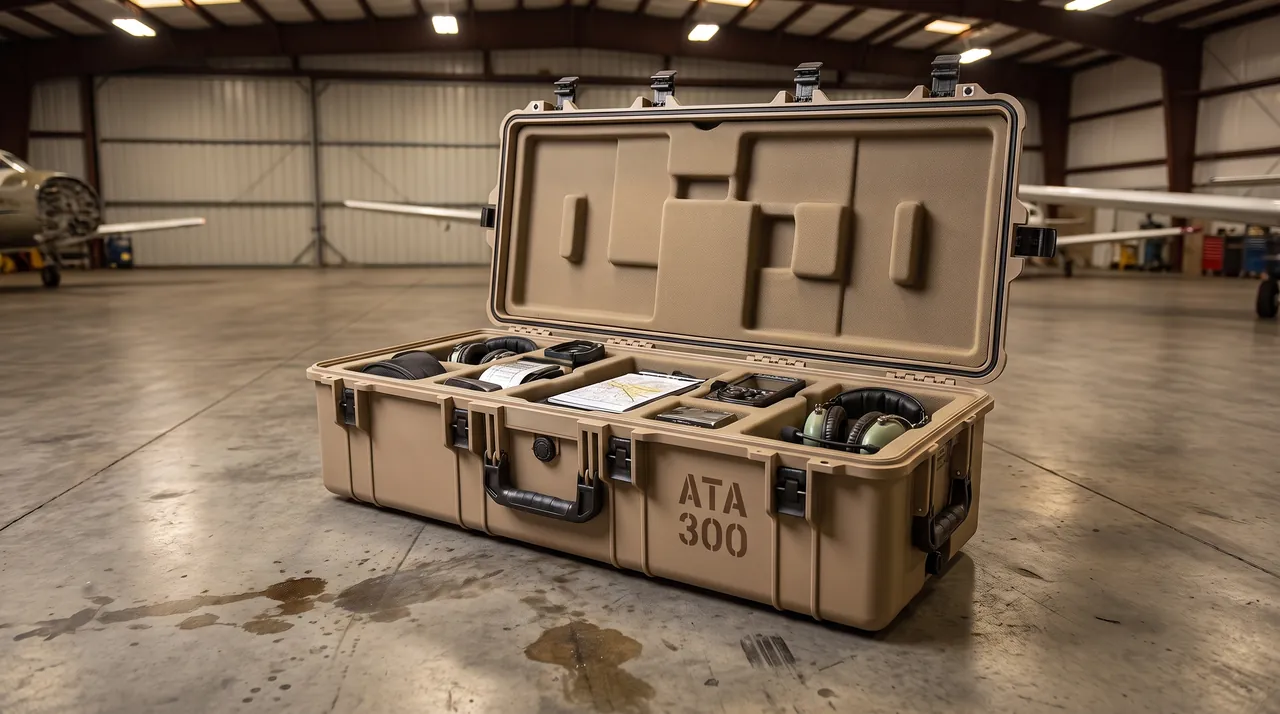
Core requirements: rain resistance, moisture resistance, UV resistance, protection from rodents and insects, plus appearance and the ability to be sat on.
A patio is a classic semi-outdoor environment: strong UV by day, condensation at night, sustained rain in the wet season, low temperatures in winter. The typical failure of wooden or resin deck boxes is a water-absorbing base that mildews, a leaking lid seam, and rodent damage.
Selection points:
- Ingress protection: start at IP65 for an ordinary patio; in coastal areas, permanently humid regions, or where typhoon flooding is possible, move to IP67. Require IP6X (dust-tight) as well, so sand and dust cannot enter.
- Material: prefer HDPE or copolymer PP with a UV stabilizer package. Dark cases absorb heat quickly; lighter or mid-tone colours help limit internal temperature rise.
- Stacking and load: many users want the case to double as a side table or a seat. Distinguish between the lid's local load capacity and the case's long-term stacking strength. Sitting or leaning briefly is governed by instantaneous lid load; using a case as a permanent step stresses creep in the walls. A practical rule is to apply no more than 30%-50% of the static load rating for occasional seating, and never for continuous load.
- Keep the base off the ground: a base laid flat on the slab accelerates moisture wicking. Add runners or place the case on a grate so air can circulate underneath.
- Internal organization: patio contents rotate seasonally — garden tools, barbecue accessories, pool parts — so removable dividers suit better than fixed foam. The trade-off is discussed in case divider versus foam.
A frequently overlooked detail on patios is condensation. Air inside the case warms and holds more moisture by day; as temperature falls at night, that air can carry less water and the surplus condenses on the inner walls. The tighter the seal, the less external moisture enters — but the case still generates its own internal moisture. The answer is to put items in dry and to use a replaceable desiccant pack, rather than leaving the lid open to "ventilate", which forfeits the rating. Pressure equalization is covered in outdoor case pressure valve.
Scenario two: vehicle and trunk gear storage
Core requirements: vibration resistance, heat tolerance, protection from water crossings, and latches that stay locked.
A vehicle is a very different test from a patio: continuous road vibration, high temperatures inside a closed cabin in summer (empirical values readily exceed 60 °C), occasional fording, and inertial shock under hard braking.
Selection points:
- Temperature range: cabin heat accelerates both plastic creep and seal ageing. Confirm the material's upper service temperature (HDPE commonly around +60 °C to +80 °C depending on grade) and the seal compound. Silicone (VMQ) has the widest temperature window; EPDM offers the best weather, water and ozone resistance and is the mainstream vehicle-grade choice.
- Latch security: vibration gradually loosens ordinary plastic catches or pops them open. Choose metal cam latches with an over-centre self-locking action, or a design with a secondary safety catch. Details appear in case latch selection.
- Water crossing: a vehicle may take on water in flooded streets or at a car wash. If fording is routine, specify IP67; IP65 is adequate for rain alone.
- Restraint: cases slide inside a trunk. Pair them with straps, hook-and-loop base pads or rails so they cannot move freely and strike the bodywork.
- Pressure equalization: rapid altitude change, or sharp cabin temperature swings, can make a case hard to open or can push against the seal. A pressure equalization valve, which passes air but not water, handles this more gracefully.
It is worth stressing that a vehicle is not only a transport environment; it is also mobile storage. Tools, a jump-starter, ropes and spare clothing may live in a trunk for months. The case's role shifts from transit container to small storage unit, and the demand on long-term seal stability actually rises, because the case is opened rarely and exposed for a long time.
Scenario three: camping and fieldwork moisture protection
Core requirements: high-integrity sealing, dust exclusion, manageable manual carry, and resilience to overnight condensation and sudden storms.
Camping and fieldwork — surveying, inspection tours, utility construction, geological exploration — share a common trait: equipment stays outdoors for long periods, and once it is wet there is often no way to recover on site. Electronics, spare batteries, optical instruments, documents, dry food and medication all belong to the "hates moisture" category.
Selection points:
- Seal class: go straight to IP67. The reasoning is simple: a tent edge, a truck bed and a creek bank can all see brief standing water, and the IPX5 jet test does not cover immersion — the failure modes differ, so the two are not a simple progression.
- Liner: closed-cell EVA pre-cut foam is the first choice. EVA does not absorb water, recovers consistently, and can be CNC-cut into snug pockets; common densities run 30-80 kg/m³. Laminating layers produces a gradient — a soft outer layer to absorb large deflections and a firmer inner layer to provide support. Design variables are covered in custom foam factors.
- Carry design: the combined weight of case and contents decides whether you actually take it along. A practical manual-carry ceiling is about 20-25 kg; above that, consider a wheeled case or a two-person lift. Handle-to-wall joints are the most common cracking site, so confirm there is local reinforcement.
- Moisture management: include a replaceable humidity indicator card and desiccant. After every trip, check that items are dry before they go back in.
Fieldwork adds one more requirement that is easy to miss: the case must be usable as a temporary work surface or step. This "second use" places heavy demands on rigidity and directly tests rib layout and rim geometry. How to judge structure is described in high-strength case structure.
Scenario four: garage, warehouse and workshop tool and part storage
Core requirements: resistance to oil, rust prevention, compartmentalization, stacking and fast access.
A garage or workshop is a semi-industrial environment where oils, cutting fluids, metal chips and dust coexist, and where steel tools and parts rust over time. Traditional sheet-metal toolboxes suffer from poor sealing, corrosion and unstable stacking.
Selection points:
- Rust-prevention liner: for long-term storage of steel parts, add VCI (vapour corrosion inhibitor) film, paper or bags alongside the foam to maintain a corrosion-inhibiting atmosphere inside a closed space. The long-term storage logic is discussed in military steel ammo can long-term storage.
- Dividers beat foam: when tool types are many, shapes are irregular and access is frequent, rigid divider grids or pull-out trays are more practical than fixed foam. Foam suits single fixed items; dividers suit many small mixed items.
- Stacking stability: garages are space-constrained, so vertical stacking is common. Confirm the case has a stacking location feature — interlocking bosses and recesses between the top of one case and the base of the next — rather than relying on flat surfaces. Design details appear in case stacking structure.
- Identification: in batch use, the case should have a proper writable label area or a card slot so contents can be sorted by model, process or project. In a high-frequency workshop this visibly cuts search time.
- Base strength: heavy tools demand ribs in the load-bearing area of the base, otherwise the bottom bows over time and stacking flatness suffers.
Scenario five: emergency supplies and long-term household reserves
Core requirements: contents still usable after long unattended storage, efficient stacking, and fast identification.
The central tension in household emergency reserves — water purification supplies, lighting, backup power, medical consumables, copies of important documents — is that storage time is long and inspection frequency is low. When the moment comes, everything must work. That pushes the case's long-term seal stability close to an industrial warehousing requirement.
Selection points:
- Seal service life: this is the key metric for long-term reserves. O-rings or profile extrusion seals hold their elasticity within the compression set range for years, whereas flat self-adhesive foam ages and loses rebound. Ask the supplier for the seal compound, hardness and compression set requirement.
- Stacking strength: reserves tend to accumulate in storerooms or on balconies, where vertical stacking is unavoidable. Plastic creeps under sustained load, and surviving a short-term load does not mean standing up to a long-term one. A practical estimate takes long-term stacking strength as 30%-50% of short-term compressive strength.
- Temperature and humidity: a hot balcony accelerates both plastic and seal ageing. Keep reserves out of direct sun and in a place with small temperature swings.
- Fast identification: the worst outcome in an emergency is rummaging through boxes. Sort by purpose, label consistently, and keep a contents list plus an inspection interval — for example, check seals and desiccant every six months.
- Documents and valuables: paper copies and electronic media need particular moisture protection. Use double protection — a sealed bag inside a sealed case — with desiccant.
The six parameters that drive a civilian selection
Consolidating the requirements of all five scenarios yields six parameters that belong on any purchase list.
| Parameter | What it means | Recommended civilian value (empirical) |
|---|---|---|
| --- | --- | --- |
| Material system | Determines low-temperature toughness, weathering and rigidity | Outdoors, prefer HDPE or copolymer PP with UV package |
| Ingress protection | Dust and water protection class | IP65 minimum semi-outdoors; IP67 where immersion is possible |
| Seal architecture | Flat contact versus gasketed groove compression | Outdoors, always a groove plus replaceable seal |
| Internal volume | Theoretical loading space in litres | Estimate usable volume as theoretical × 0.7-0.8 |
| Stacking strength | Creep resistance under long-term static load | State the layer count and storage period; "stackable shape" is not enough |
| Liner and dividers | Protection and access efficiency | Closed-cell foam for mobile use; dividers for many small items |
Beyond these six, two softer criteria deserve attention: spare parts availability — whether seals, latches and hinges can be ordered separately — and test documentation — third-party ingress protection and transport test reports. For an individual buyer the first determines service life; for a B2B channel the second determines whether the product can enter corporate procurement and tender systems.
Ingress protection: choosing between IP65 and IP67 outdoors
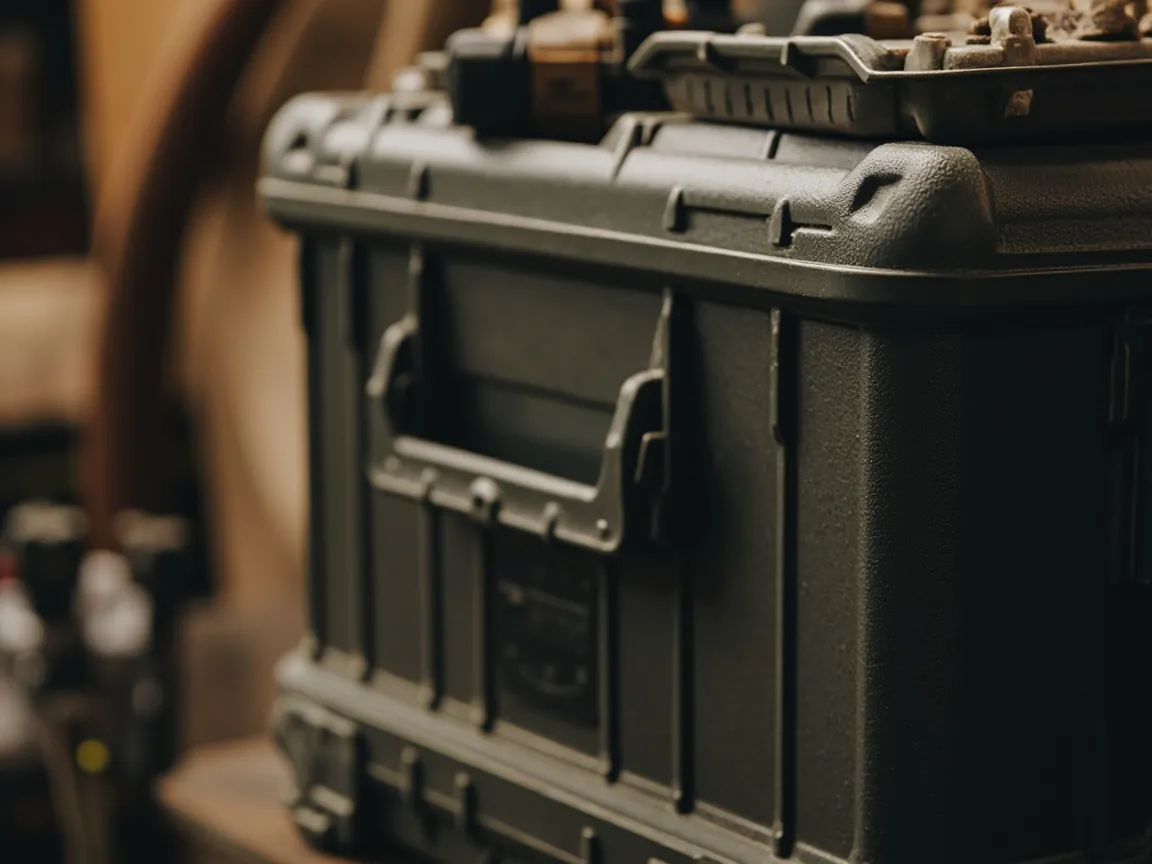
Ingress protection follows IEC 60529 (with the Chinese national equivalent GB/T 4208-2017) and is written as IP plus two characteristic digits.
- First digit (0-6): protection against solid foreign objects and dust. Level 5 is "dust protected" (limited ingress that does not impair operation); level 6 is "dust-tight" (no dust ingress).
- Second digit (0-9): water protection. Level 4 is splash, 5 is water jets, 6 is powerful water jets, 7 is temporary immersion (commonly 1 m for 30 minutes) and 8 is continuous immersion (conditions agreed between buyer and supplier).
The key point: IPX5 and IPX7 test two different failure modes. IPX5 uses a dynamic jet to assess seal integrity under water impact; IPX7 uses static water pressure to assess seal integrity under immersion. The standard is explicit that they are not a simple progression — a sample that passes immersion does not automatically pass the jet test. Technical agreements and data sheets should state each digit, for example "IP6X + IPX5 + IPX7", and should explicitly reject substituting X.
The outdoor civilian rule of thumb compresses to one question: will water ever stand around this case? If yes, specify IP67; if no, IP65 is enough. If both are possible — a vehicle case that sees both rain and fording — require both. Structural design points are covered in outdoor case waterproof design, and test methods in IP67 submersion test.
Material choice: weighing HDPE, copolymer PP, steel and aluminium
Each material maps to a different outdoor profile and a different feel in the hand.
| Material | Low-temperature toughness | Rigidity | Weather and water resistance | Weight | Relative cost | Suited civilian scenarios |
|---|---|---|---|---|---|---|
| --- | --- | --- | --- | --- | --- | --- |
| Copolymer PP | Good | Higher | Good, with UV package | Low | Low | Patio and garage general storage |
| HDPE | Excellent | Lower, needs ribs | Excellent | Medium | Medium | Outdoors, vehicle, camping |
| Cold-rolled steel | Excellent | Excellent | Excellent, needs coating | High | Medium-high | Long-term warehousing, heavy tools |
| Stainless 304/316 | Excellent | Excellent | Excellent | Highest | High | Coastal, humid, long-term reserves |
| Aluminium 5052/6061 | Good | Medium-high | Excellent | Low | High | Instruments, equipment, portable transit |
The decision logic is straightforward: first fix the low-temperature limit and the form water takes, then decide whether rust is acceptable, and finally weigh weight against budget. For humid coastal sites, prefer HDPE or stainless steel. For portability, prefer HDPE and aluminium. When maximum stacking strength matters most, a steel structure remains the safest answer. For the differences among plastics, see PP, ABS and PC case difference.
Liners and dividers: making the case actually fit your contents
The same shell with different liners can differ by more than thirty percent in usable volume and protection.
- Open-cell polyurethane sponge (PU): lowest cost, fine for dry indoor use. Its open structure absorbs water and oil and degrades into crumbs, so it is not recommended outdoors.
- Closed-cell EVA or PE foam: does not absorb water, recovers reliably and can be pre-cut. The outdoor default. Common EVA densities run 30-80 kg/m³.
- Pre-cut foam: CNC-cut to the outline of the contents, forming snug pockets. Suits a single fixed item.
- Grid and pull-apart foam: users tear out blocks to form pockets. Suits many small mixed items whose shapes change.
- Rigid dividers and trays: suit frequent-access tools or applications needing load-bearing compartmentalization.
The governing parameter is the cushion curve, which sets the required foam thickness and density combination from item weight and expected drop height. Empirically, heavier and more shock-sensitive items need thicker, lower-density foam within a sensible range, to lengthen the deceleration distance. Practical guidance appears in pre-cut foam design tips.
Common mistakes and a pitfall checklist
Mistake one: treating "the lid shuts" as "the case is waterproof". Many so-called waterproof boxes simply overlap at the rim, with no gasket and no control of compression. A quick test: close the lid without latching and slide a thin strip of paper around the perimeter. If resistance varies sharply and some sections have none at all, the sealing face is not flat.
Mistake two: buying the case and skipping the liner. In transit, contents rattle freely and shock transfers directly between the item and the wall. A "waterproof case" with no liner solves moisture but not impact.
Mistake three: using open-cell sponge outdoors. Once saturated, open-cell sponge becomes an internal moisture source. The better the seal, the less able that water is to escape, and the faster corrosion proceeds.
Mistake four: leaving the case on sunlit ground. Heat accelerates plastic creep and seal ageing, and worsens internal condensation. Shade, elevation and airflow are the three most effective countermeasures.
Mistake five: ignoring that seals are consumables. Gaskets, latches and hinges all age. Confirm that spares can be ordered separately and that replacement instructions are supplied — this often doubles the service life of the case.
Mistake six: judging from photos rather than data. Outdoor purchasing must rest on parameters: material system, ingress rating digit by digit, seal architecture, wall thickness, stacking strength and service temperature range. A product missing this information should not be used outdoors, however professional it looks.
Sourcing and channels: what wholesale, agency and OEM/ODM buyers should watch
For distributors and brand owners, the civilian migration of rugged cases is a product definition problem, not a simple category transfer.
Wholesale and agency buyers should focus on three things. First, product line completeness — whether one platform spans multiple volumes, ingress ratings and liner configurations so a full range can be sourced from a single partner. Second, spares and after-sales — whether gaskets, latches and hinges have a stable supply, which directly affects return rates and reputation. Third, test documentation — whether third-party ingress, drop, vibration and salt-spray reports are available, which determines access to corporate procurement.
OEM/ODM projects should convert requirements into acceptance clauses covering six blocks:
- Material: base polymer system (HDPE or copolymer PP), whether recycled content is permitted and the upper limit, colour and colour-tolerance requirements, UV additive requirements.
- Structure: wall thickness, rib pattern, rim geometry, hinge and latch type, padlock hole position.
- Seal: groove geometry, seal compound (NBR/EPDM/VMQ/FKM), hardness (commonly 50-70 Shore A), compression set and replaceability.
- Ingress rating: state each digit, for example IP6X + IPX5 + IPX7, and do not accept X as a substitute.
- Liner: foam material, density, thickness, cutting method and tolerances.
- Documentation and spares: type test reports, material certificates, spare parts list and lead time, packaging and marking requirements.
JUNZHJIA is manufactured by KeXin New Materials (Guangdong) Co., Ltd. and covers protective cases, toolboxes, rugged storage cases and waterproof junction boxes, serving wholesale, agency, OEM/ODM and global supply. Within the clause framework above, configurations can be tailored to the customer's operating conditions — material system, sealing solution, latch type and custom liner — with the corresponding test documentation and spare parts support.
FAQ
Q: Can an ordinary plastic storage tote reach outdoor-case protection levels by adding a strip of weather seal?
A: In the vast majority of cases it is neither worthwhile nor reliable. Four conditions would have to be met at once. First, the rim needs a continuous sealing groove; an ordinary tote usually has a flat or stepped rim with no machining allowance, so an added strip can only form flat contact with no control of compression. Second, the latch must apply stable clamping force; plastic catches exhibit stress relaxation, so clamping force declines month by month while closed. Third, the walls need ribs to resist bulging; injection-moulded parts cannot have ribs added later, so an external metal frame would be required, and the weight and cost would exceed buying a proper case outright. Fourth, the modified product would need to be re-tested for ingress protection; without testing there is no evidence of IP65 or IP67. Added together, the cost usually exceeds buying a compliant case directly. For a semi-outdoor, dust-only situation, limited modification is reasonable: fit a closed-cell EPDM gasket, add corner bumpers, replace open-cell sponge with closed-cell foam and use desiccant — but do not claim immersion protection on that basis.
Q: Should I choose IP65 or IP67?
A: The difference lies in the form the water takes. IPX5 tests water jets, applied through a 6.3 mm nozzle at a defined distance and flow rate from all directions, assessing seal integrity under dynamic impact. IPX7 tests temporary immersion, commonly 1 m for 30 minutes, assessing seal integrity under static pressure. Because the failure modes differ, the standard is explicit that the two are not a simple progression. Ask two questions: is the site a place of washdown and storms, or a place where water may pool? The former calls for IPX5, the latter for IPX7. A covered patio or carport is usually fine at IP65; campsites, boat decks, flood-prone ground and washdown areas should specify IP67. If both conditions are possible, require IP6X + IPX5 + IPX7 together and ask the supplier for evidence digit by digit. Remember that a higher immersion rating does not automatically improve jet performance — each must be tested and accepted separately.
Q: Why does condensation form inside an outdoor case? Is it worse with a better seal?
A: Condensation originates from the moisture carried by the air inside the case, not from water leaking in. By day the case warms, the internal air expands and holds more water vapour; at night the temperature falls, the air can hold less, and the surplus condenses on the inner walls and on the contents. This is not caused by seal quality — the seal only governs whether external moisture can enter. The correct response is therefore not to "ventilate" by leaving the lid open, which forfeits the rating, but to do three things. First, put items in dry; never place a wet raincoat or towel inside a sealed case. Second, use a replaceable desiccant pack with a humidity indicator card to absorb internal moisture. Third, limit temperature swings by keeping the case out of direct sun. A pressure equalization valve, which passes air but not water, reduces the pressure differential and helps with rapid temperature changes, but it cannot replace desiccant.
Q: Will summer heat in a car trunk damage the case?
A: Assess it item by item. Inside a closed vehicle under summer sun, temperatures readily exceed 60 °C according to empirical values, which approaches the long-term service limit of some plastics. The risk comes from three directions. First, rigidity falls as the plastic approaches its softening region, so a sustained load causes creep and gradual deformation. Second, seals age faster, compression set increases and sealing capability declines. Third, the contents — especially batteries, medication and electronics — are more heat-sensitive than the case itself. Countermeasures include choosing a lighter colour to reduce heat absorption, confirming the material's long-term service temperature range and the seal's temperature rating, avoiding long-term storage of heat-sensitive items in the trunk, and moving the case into the shade when it is not in use. If vehicle-mounted use is essential, describe the "vehicle plus high temperature" duty cycle to the supplier and ask for a recommended material and seal combination.
Q: What volume should I choose for a camping case?
A: Work out usable volume first, then item count, then check the carry weight. Step one is to separate three concepts: external dimensions govern footprint; internal volume is the theoretical loading space (internal length × width × height ÷ 1,000,000 gives litres); usable volume deducts liner thickness, rib protrusions and handle recesses. Empirically, with 20 mm pre-cut foam the usable volume is about 70%-80% of theoretical; with 40 mm foam it may fall to 55%-65%. Step two divides usable volume by the actual outline volume of the items to get a count, leaving access clearance for irregular shapes. Step three checks total weight: case tare plus contents. Manual handling has a practical ceiling around 20-25 kg; above that, consider a wheeled case or split the load across two cases. The right approach is to list the items and their dimensions first and work back to a case size, rather than buying a case and trying to make things fit.
Q: If the gasket ages, can I replace it myself?
A: Most cases with a grooved seal design allow the seal to be replaced, and this is one of the real advantages over flat sealed designs. Note four points when replacing. First, match the specification: groove cross-section, seal profile and Shore hardness must match the original, with a common hardness range of 50-70 Shore A. Substituting a harder or softer seal breaks the compression design. Second, match the compound: EPDM is the default outdoors for weather, water and ozone resistance; silicone VMQ suits extreme cold; nitrile NBR suits contact with oils; fluoroelastomer FKM suits aggressive chemicals. Third, handle the joint: a continuously moulded ring is most reliable; if a strip must be joined, the joint must be flush and must sit away from a corner. Fourth, inspect on assembly: close the lid without latching and slide thin paper around the perimeter to check for even resistance, then close each latch and confirm a consistent engagement feel. It is best to confirm at the procurement stage that spares can be ordered separately, and to keep the replacement instructions. This often doubles the life of the case.
Q: As a channel partner, how do I verify a supplier's ingress protection claims?
A: Verify in three tiers. Tier one is visual and tactile inspection on receipt, done for every batch: check that the gasket is continuous with no cuts or flash; check that it rebounds promptly when pressed; close the lid without latching and use a feeler gauge or paper strip around the perimeter to check gap evenness; close each latch and confirm consistent force with a definite engagement; and check that hinges, handles, pressure valves and nameplates all have independent sealing measures at their penetrations. Tier two is a simple spray screen, suitable for first articles and periodic sampling: use an ordinary spray gun at 2-3 m, spraying each face for at least one minute from all directions and concentrating on latches, hinges, handle roots and corners. Place dry paper tissue and a humidity indicator card inside and inspect immediately after the test. Tier three is third-party re-testing to IEC 60529 / GB/T 4208-2017, appropriate for first shipments, major projects and disputes; IK impact, salt spray and flammability can be commissioned at the same time. In every tier, check that the model designation and photographs on the report match the actual product, and be wary of wording that refers to a "similar reference model".
Q: How does a civilian version differ from a true military-specification case?
A: A civilian version usually adjusts appearance, accessories and packaging for the market, but the core protection capability should remain identical. Differences typically fall into three groups. First, structure and material: the proper approach is not to reduce wall thickness or seal specification, but to differentiate only in colour, marking and liner configuration. Second, accessories and appearance: soft-grip handles, nameplate design and writable label areas do not affect protection. Third, documentation and verification: military programmes often carry more complete standards-compliance files, while civilian versions provide them according to customer requirements. Three red lines should be held during procurement: the material system must not be downgraded, the seal must not revert to a flat design, and the ingress rating must be tested to the same standard. As long as those three hold, a civilian version and an industrial version share the same performance lineage. If a supplier cuts cost by switching to thin-wall recycled material, removing the grooved seal, or failing to produce test evidence, then the product only looks the part rather than performing it, and it should not be used for long-cycle outdoor duty.
Conclusion and further reading
Back to the title question: an ammo box can serve as an outdoor storage box, provided it is selected as industrial packaging rather than bought as a household organizer. A case that suits the outdoors must resist UV and cold in its material, use a groove-compressed seal, withstand stacking and torsion in its structure, and match its liner to the contents. Together these four define protection capability — not the shape of the shell. The five civilian scenarios each emphasize different points: a patio cares about rain and weathering, a vehicle about heat and latch security, camping about sealing and portability, a garage about compartments and stacking, and emergency reserves about long-term seal stability and stacking strength.
Three actionable recommendations. First, define the duty cycle before the case — establish the low-temperature limit, the form water takes (splash, jet, immersion), whether the case sits in the open, the stacking height and the storage period, and select material, seal and structure accordingly. Second, decide on data rather than appearance — material system, ingress rating digit by digit, seal architecture, wall thickness, stacking strength and service temperature range; all six are required. Third, manage the gasket as a consumable — buy spares alongside the case and set an inspection interval; for a modest cost, the life of the case can be doubled.
JUNZHJIA is manufactured by KeXin New Materials (Guangdong) Co., Ltd., covering protective cases, toolboxes, rugged storage cases and waterproof junction boxes, serving wholesale, agency, OEM/ODM and global supply. Material systems, sealing solutions, latch types and custom liners can be configured to the customer's operating conditions, with corresponding test documentation and spare parts support.
Further reading