

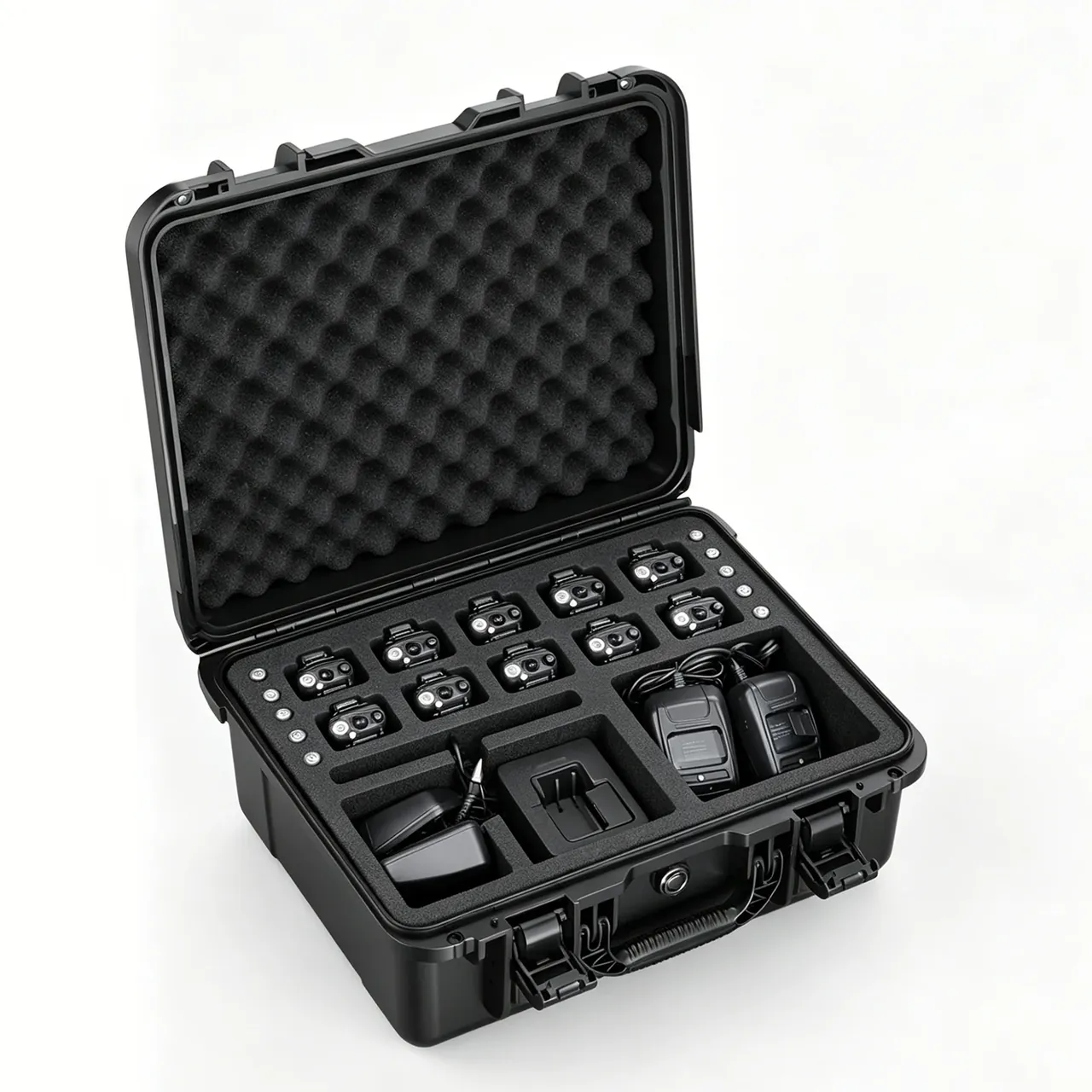
Quick answer: The Outdoor Communication Equipment Case zones kit by deployment order: one antenna channel, four handset bays and a 90-second pick loop.
Table of contents
- Antenna and handset zones
- Battery and charging bays
- Pick order during deployment
- Zone labels and shift handover
- ESD and shielding for RF kit
- FAQ
1. Antenna and handset zones
A 400 mm whip sets the longest straight line inside the Outdoor Communication Equipment Case. It cannot be folded, since every fold leaves a bend at the base and range drops the next morning, so zoning starts at the antenna channel rather than at the handset.
That channel runs unbroken in the Outdoor Communication Equipment Case, rounded at the floor, its mouth slightly narrower than the whip so foam grips it instead of the lid. A solid wall separates it from the handset bays, thick enough to hold shape after compression, or the whip shifts on rough ground and works its mount loose.
Handset bays step by body thickness. Two models often share one box, so depth is cut for the thicker body and shims take up the rest; shallow extra bays thin the walls, and thin walls crack first in cold. Working range is −20 to 55 °C, where foam hardens and wall sections are checked at that end instead of by feel at room temperature.
A box claiming 6–10 compartments yields about seven usable bays: one channel, one dock, the rest handsets. Claim those three first, or one bay always comes up short.
| Zone | What sits there | Bays used | Pick action |
|---|---|---|---|
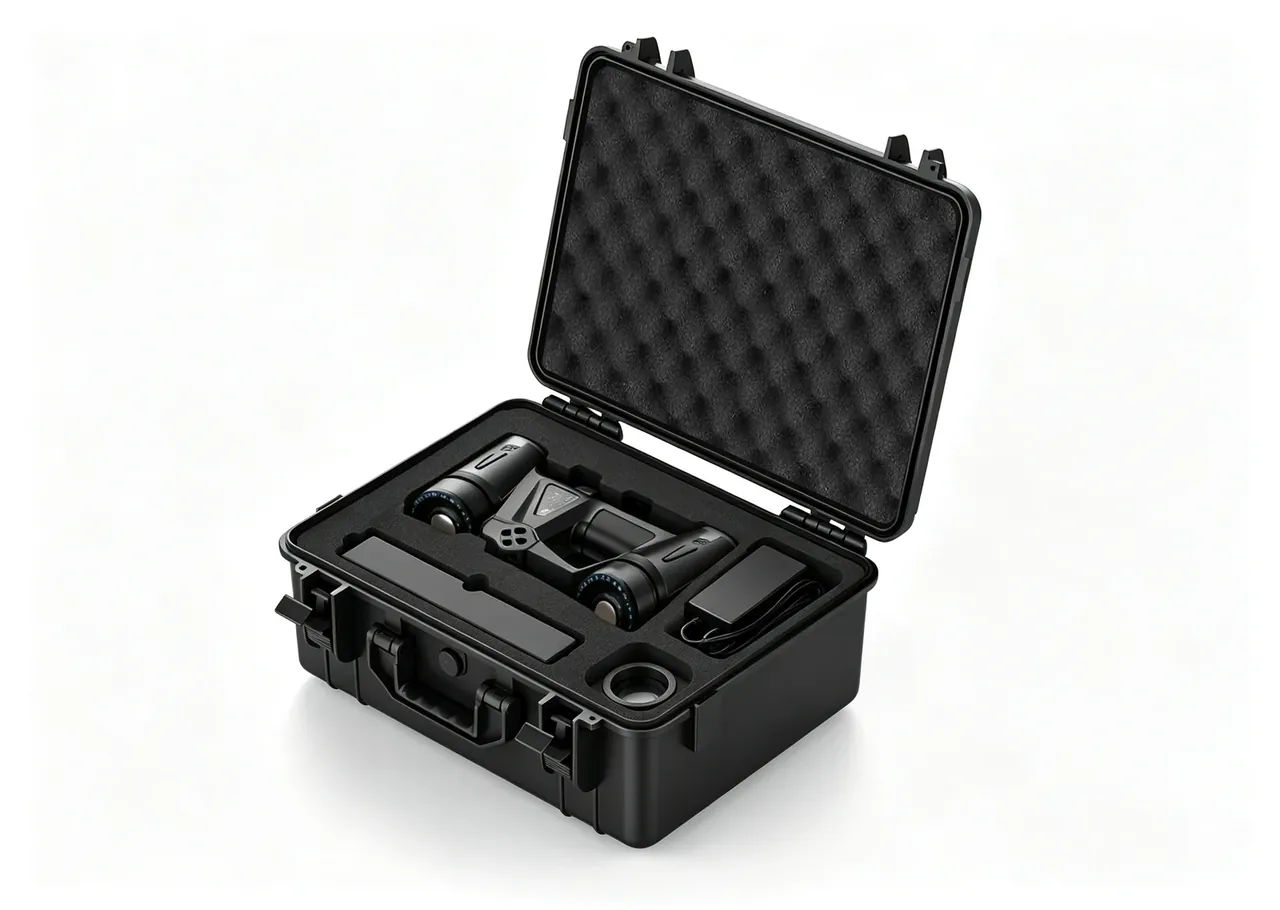
| Long channel | Two 400 mm whips | 1 | Pull halfway, then lift |
| Handset bays | Four handheld radios | 4 | Grip the body upright |
| Battery bay | Four spare packs | 1 | Thumb-push out of the mouth |
| Accessory bay | Headsets and a message pad | 1 | Lift the retainer strip |
2. Battery and charging bays
A 2000–3000 mAh pack is a small share of total weight and still the first thing to shift in a drop. With little footprint to hold it, the pack slides half a bay on landing and the contacts take the hit.
The pack gets its own bay in the Outdoor Communication Equipment Case, never shared with a handset. Foam at the top of the 25–45 kg/m³ band sits underneath, slow to rebound, and a narrow strip presses only the two ends, leaving a finger gap between them.
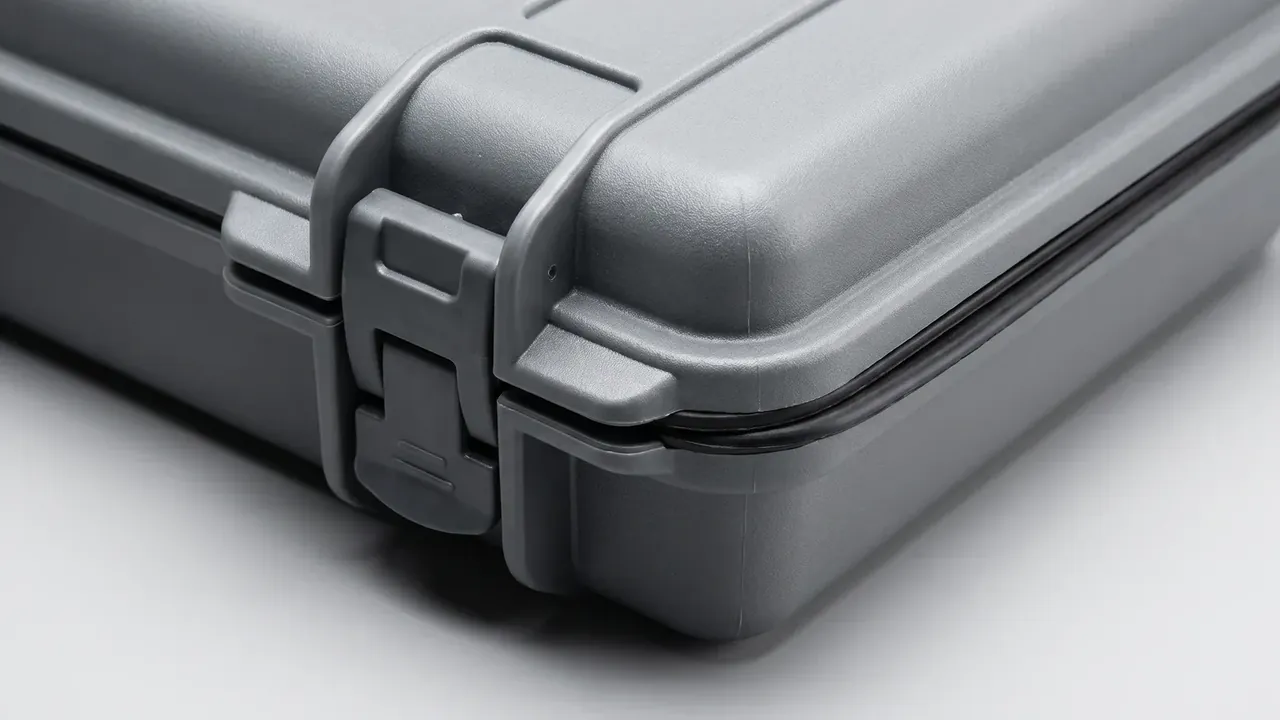
The dock is bolted from inside to one side of the body, its nut sunk into a recess so nothing protrudes outside. Cables run into a lid pocket opening toward the handle, clear of the seal line; a cable trapped under the gasket leaves a channel that no IP67 rating of 1 m for 30 min will survive.
An empty bay sits between dock and battery bay, because charging warms the pack and heat needs a route out. Cold-end derating belongs in the same sum: at −20 °C usable capacity falls, so packs are counted from the derated figure, not from the 2000–3000 mAh on the label.
3. Pick order during deployment
Ninety seconds for a full pick is a routing figure, not a dexterity one. Lid open, antenna out, handset out, battery out — each step takes what it takes depending on how far a bay sits from the opening and whether a finger fits in.
Sequence follows the action chain. The Outdoor Communication Equipment Case puts the antenna channel against the lid side because erecting a whip precedes powering up, handsets in the middle so the hand crosses nothing, packs deepest where they are taken last or not at all.
Finger gaps sit between bays, wide enough for one finger sliding in sideways. Without them a pick turns into a pinch-and-pull on the equipment edge that loads the antenna base and marks the body, and the 90-second target dies there.
Deployment rule: a single pick past 90 seconds, or a crushed antenna channel, fails the zoning of that case. Test it by handing an Outdoor Communication Equipment Case to someone who has never opened one, timing three runs from lid to last item and averaging them; over the limit, move bays before changing foam.
4. Zone labels and shift handover
Zone labels exist so the next shift finds things without asking. In the Outdoor Communication Equipment Case they sit in shallow recesses on the bay walls, not on the lid where foam hides them at the moment of opening.
Each label carries three lines: bay number, item name, quantity due. One type size throughout, the number largest, the quantity last in Arabic numerals, so a change swaps one strip instead of the whole label.
Handover runs bay by bay. Two people face the Outdoor Communication Equipment Case and count from bay one to the last, calling number and quantity at each stop and writing shortages down on the spot; working down a checklist and then hunting the box costs more time than packing did. The sheet keeps an empty-bay column, since an empty bay is normal: one radio left behind, one away for repair, recess empty while the label stays.
| Handover point | How it is checked | Where it is written | If an item is missing |
|---|---|---|---|
| Before departure | Bay-by-bay call-out | Front of the handover sheet | Make it good, then sign |
| Field transfer | Two people count together | Lid pocket | Mark the empty bay at once |
| Return to store | Reset by bay | Back of the sheet | Trace the previous step |
| Monthly count | Bays opened and checked | Stocktake sheet | Repair or reorder |
5. ESD and shielding for RF kit
The Outdoor Communication Equipment Case body does not conduct, a property of the material rather than a fault. Radio gear suffers static build-up and external field coupling, and both are answered inside the box without turning the shell into metal.
Static control works through surface resistance in the 10⁶–10⁹ Ω band. Below it, charge drains so fast that the discharge at first touch damages parts; above it, charge sits on the surface and never leaves. A conductive liner in the Outdoor Communication Equipment Case bleeds charge to a bleed point rather than holding it.
Shielding is a separate layer: the shell carries strength and sealing, a liner or standalone bag does the electrical work, and the wall keeps its 2.0–3.5 mm section for compression load. Sealing and shielding then compete at one interface, a gasket working when pressed and a seal when compressed. Latches and hinges break that continuity twice: a latch at 200–400 N flattens the rim, and the bridge at the hinge keeps enough travel to stay in touch through 20,000 cycles on spring preload.
Related Reading
- How to choose a communication equipment case
- Outdoor two-way radio protective hard box
- Multi-bay walkie-talkie charging case
- Railway signal equipment case
JUNZHIJIA
Related Products
- 8 Series — Gun Cases; Military Equipment Cases; Camera Equipment Cases; Drone Cases; Watch Cases; Knife Cases; First Aid Cases; Electronics Equipment Cases
- WL8-2812 PP Gun Case — model WL8-2812
- All protective cases and toolboxes: 7 series, 158 models