

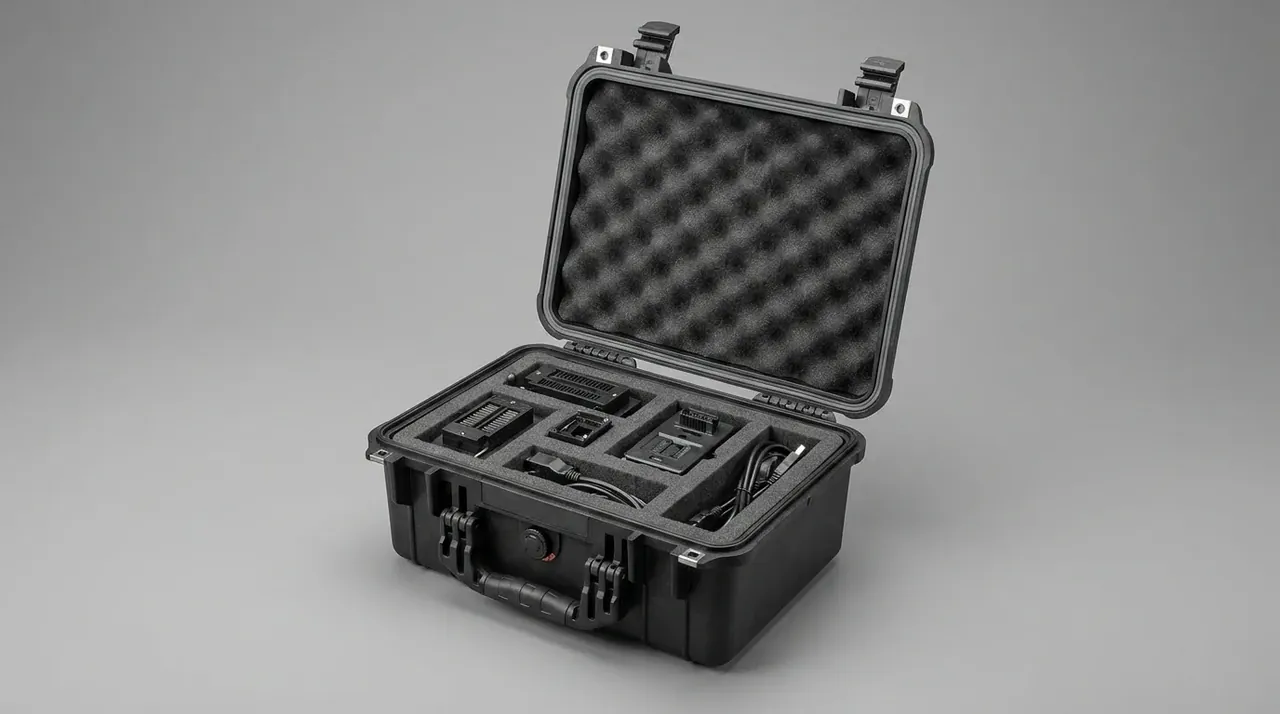
Quick answer:Outdoor walkie-talkie multi-charging station case sets six 65 mm bays on a 12 mm pitch, pulls 48 W and holds a 12 °C rise.
Table of contents
- Charging bay layout of the outdoor walkie-talkie multi-charging station case
- Foam fitment and body retention across six bays
- How charging heat leaves the case
- Cable routing and the lid-side cable pouch
- Shift handover counting and bay numbering
- FAQ
Charging bay layout of the outdoor walkie-talkie multi-charging station case
A shift change puts six radios on charge at once and the duty desk strip has two free sockets. The outdoor walkie-talkie multi-charging station case turns that scrum into a grid: six bays, 65 mm across, on a 12 mm pitch, two rows of three over a 450 x 300 mm cavity.
A handheld with battery and clip runs 52 to 60 mm thick, so 65 mm lets a gloved hand seat it first time. Narrow the bay and every insertion scrapes the foam; widen it and the unit rattles, putting the transit load on the side walls. The 12 mm pitch is about grip: below 10 mm the only handle left is the antenna.
Docks sit hard against one wall, opening an 8 mm service gutter between foam and shell so six leads collect on one side. The outdoor walkie-talkie multi-charging station case moulds at 3.8 mm nominal wall, 520 x 400 x 230 mm outside, 4.6 kg empty.
| Bay item | Value | What it settles |
|---|---|---|
| Bay count | 6 | Radios swapped as one shift set |
| Bay width | 65 mm | First-try seating, no scraping |
| Bay pitch | 12 mm | Finger clearance for pull-out |
Foam fitment and body retention across six bays
The outdoor walkie-talkie multi-charging station case cuts its bays from one 50 kg/m³ closed-cell EVA billet, 30 mm thick, 22 mm pocket, 8 mm of solid material underneath. No splices: a spliced base opens at the seam on the first corner drop.
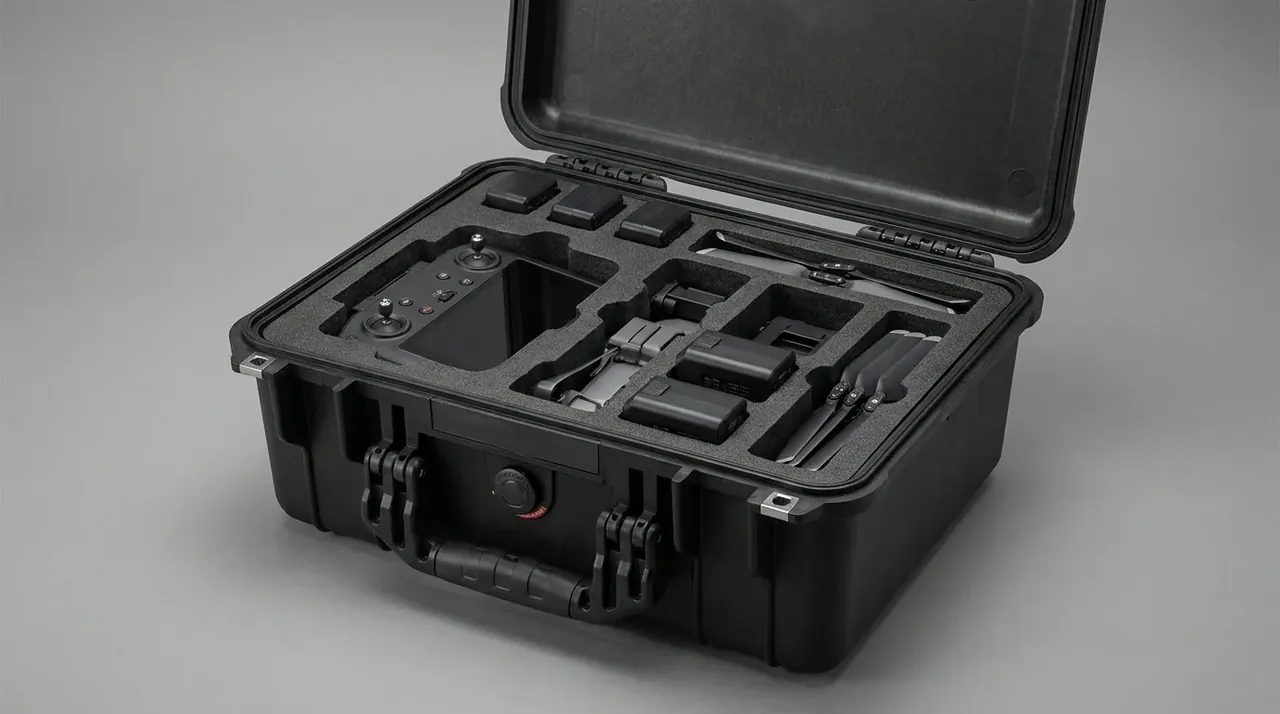
Retention on the outdoor walkie-talkie multi-charging station case comes from the side walls, not lid pressure. A 65 mm bay around a 62 mm body leaves 1.5 mm per side; at 20 % compression the EVA stands the radio upright. Lid foam is 15 mm egg-crate and only brushes the top edge, since load on the antenna boss whitens the plastic at its root.
Copolymer PP shows notched impact of 10 to 20 kJ/m² at 23 °C with 1.0 % to 2.5 % shrinkage; ABS lands at 20 to 35 kJ/m² and 0.4 % to 0.7 %. A 12 mm pitch is a tight feature, so PP pushes the tool allowance to about 1.8 % while ABS runs near 0.5 %.
| Liner item | Value | How it is judged |
|---|---|---|
| EVA density | 50 kg/m³ | Low density crushes the wall |
| Pocket depth | 22 mm | Aligned to body height |
| Solid base | 8 mm | Does not tear out on drop |
How charging heat leaves the case
In the outdoor walkie-talkie multi-charging station case, six docks at full load draw 48 W, of which roughly 30 % becomes heat inside. Spread over about 0.9 m² of shell, the surface sits some 7 K above ambient and the air-to-wall term adds the rest, so the measured rise lands at 12 °C at 25 °C ambient, lid open.
A 2 mm aluminium plate in the base carries that heat. Docks bolt to it and a 1 mm thermal pad bridges plate and shell; the plate has no holes, so the relief valve stays the only gas path. Contact matters: four M3 screws at 0.6 N·m, because a soft joint lifts the rise.
With the lid shut the air stops moving, 48 W can only creep through the walls, the rise passes 20 °C, the dock's cutback halves the current and a 3.5 h charge stretches past 6 h. Closed-lid input is therefore capped at 20 W, three bays at a time. The -20 °C to 55 °C envelope closes the loop: 43 °C ambient plus 12 °C lands on the ceiling.
| Thermal item | Value | Reading |
|---|---|---|
| Full-load input | 48 W | Six bays running together |
| Internal rise | 12 °C | 25 °C ambient, lid open |
| Closed-lid cap | 20 W | Three bays at a time |
Cable routing and the lid-side cable pouch
On the outdoor walkie-talkie multi-charging station case a 1.5 m main lead enters through a rear gland with 5 mm of strain-relief slack at 0.75 mm². It follows the 8 mm gutter, then splits into six 0.4 m branches, one per dock, with connectors staggered 20 mm apart.
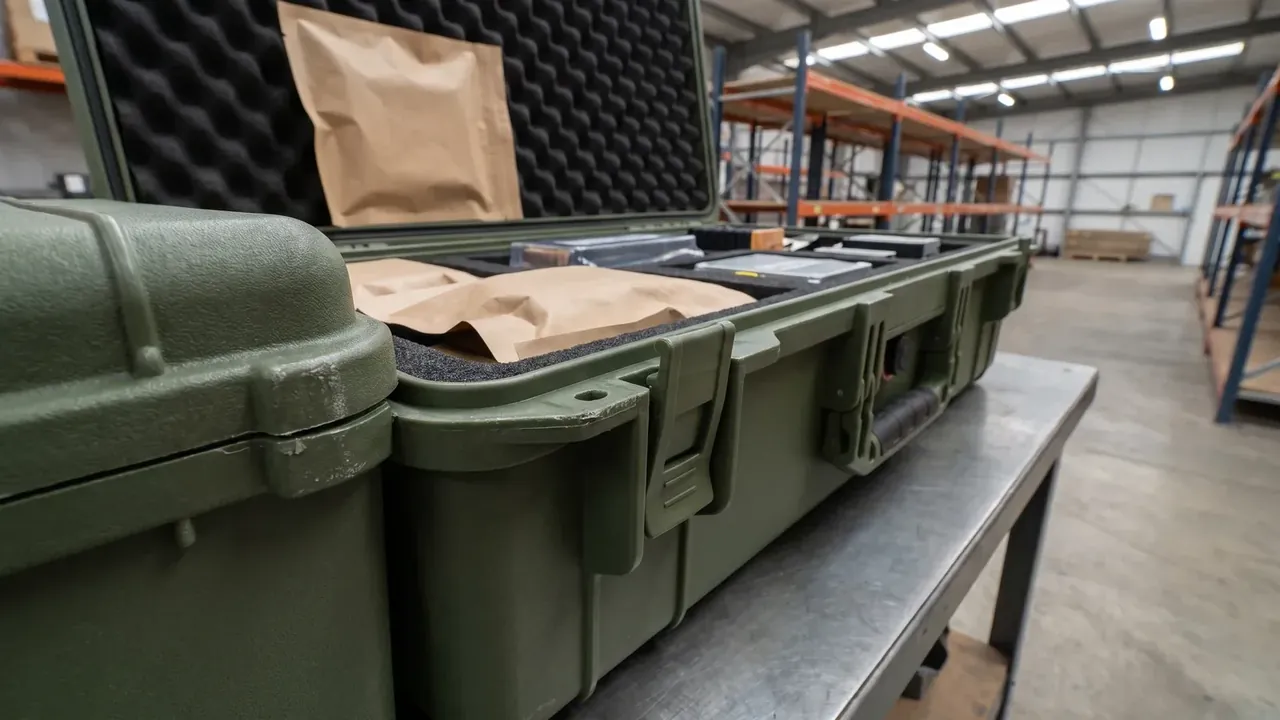
The lid pouch is 0.6 mm clear TPU, 25 mm deep, hinge-side opening. Spare leads coil into it so the lid closes on foam, not cable. At 200 mm clear width and roughly 180 mm per coil, six branches fit without bulging.
Plug orientation matters on the outdoor walkie-talkie multi-charging station case: all six point up, so each lead hangs instead of crossing a bay mouth. A crossing lead gets bumped on every insertion, the jacket wears through and the short lands at the bay edge. The 8 mm gutter fits a 5.2 mm cable plus 2.8 mm clearance.
Shift handover counting and bay numbering
Bays on the outdoor walkie-talkie multi-charging station case run 01 to 06, laser-marked on a 1.0 mm rigid tag strip along the liner front edge, not on the EVA. Marking foam shallows out under compression. Left column 01 to 03, right column 04 to 06.
Counting follows the numbers, not a body tally: six radios, six numbers, a gap shows at a glance. The pass stays under 60 s; both sides sign against a bay.
The reject line sits on three readings: if rise, pitch or charge time crosses its limit the lot is scrapped, not sorted for rework. Rise is judged at 12 °C, pitch at 12 mm ±0.3 mm, charge time at 3.5 h. Rise wanders because it tracks ambient, so ambient gets logged beside it.
| Verdict item | Limit | Check first on overrun |
|---|---|---|
| Internal rise | 12 °C | Plate contact, M3 torque |
| Bay pitch | 12 mm ±0.3 mm | Shrink allowance, mould temperature |
Conclusion
The outdoor walkie-talkie multi-charging station case ties six bays, 65 mm of width, a 12 mm pitch, 48 W, a 12 °C rise, a 1.5 m lead and a 3.5 h charge into one shop-floor chain, the numbers spread across layout, liner, heat path, routing and counting. The 3.8 mm wall and the -20 °C to 55 °C envelope bound that chain; step outside either and rise and pitch drift together.
Case-side specification only; handling and operation of carried items are out of scope.
Related Reading
- Antenna groove and lid press-frame on a radio case
- Moisture-proof liner for torches and spare cells
- Usable ratio of case volume at cavity corners
- Structural items for a tracker safety case
Related Products
- 8 Series — Gun Cases; Military Equipment Cases; Camera Equipment Cases; Drone Cases; Watch Cases; Knife Cases; First Aid Cases; Electronics Equipment Cases
- WL8-2812 PP Gun Case — model WL8-2812
- All protective cases and toolboxes: 7 series, 158 models