

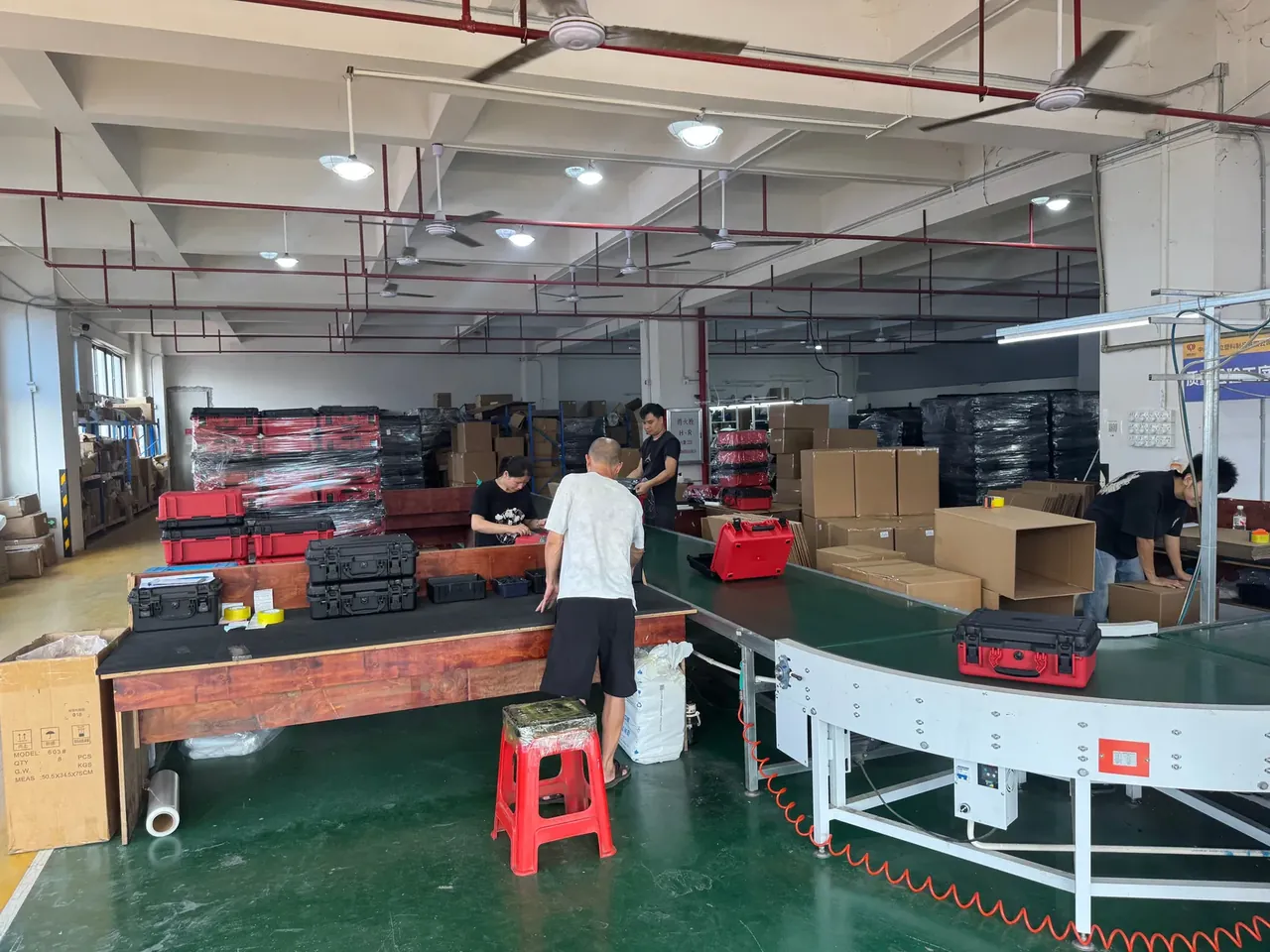
Quick answer: An outdoor diving flashlight shockproof safety box keeps foam rebound above 92% after a 1.2 m six-face drop, with liner shift under 0.7 mm.
Table of contents
- Foam density in the outdoor diving flashlight shockproof safety box
- Reserved clearance of the lid press frame
- Rebound readings across successive drops
- Liner shift on the immersion retest
- Density reject line for diving batches
- FAQ
1. Foam density in the outdoor diving flashlight shockproof safety box
The shell of this outdoor diving flashlight shockproof safety box measures 420×310×160 mm outside, 365×255×110 mm inside, with a 3.2 mm wall, and the base foam is held at 45 kg/m³. Denser foam is not automatically better: a higher grade rebounds faster and leaves less set after a six-face drop, but hard foam passes impact straight to the shell and dents the liner contact face. The 45 kg/m³ grade is the measured balance between rebound and cushioning.
Too low a grade and permanent compression grows after a 1.2 m six-face drop, rebound misses ≥92% and the liner starts to loosen in the base; too high and the impact peak travels along hard foam to a shell corner. Both failures trace to density, not the latches. At 2.9 kg empty and 5.5 kg loaded, cushioning returns to this grade rather than to a thicker pad.
| Density grade | Rebound after six-face drop | Verdict |
|---|---|---|
| 35 kg/m³ | 88% | Reject |
| 45 kg/m³ | ≥92% | Threshold |
| 55 kg/m³ | 94%, too hard | Reject |
2. Reserved clearance of the lid press frame
A 0.5 mm gap between the lid press frame and the base foam closes the lid without crushing the pad or letting the liner float. In the outdoor diving flashlight shockproof safety box the frame is moulded into the lid and descends to pre-load the foam a little, then stops; a wider gap lets liner shift pass ≤0.7 mm on a 1.2 m drop, while a tighter one keeps foam compressed and ages rebound early.
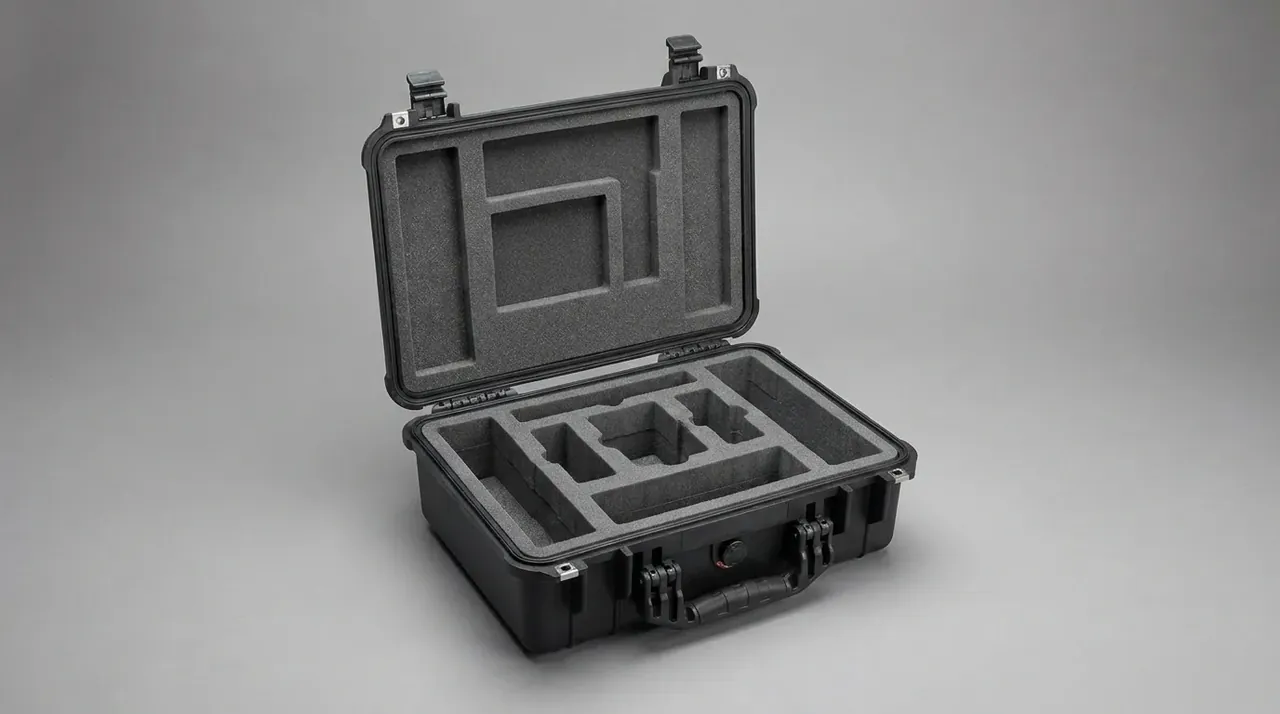
The gap carries allowance for wear over 3600 open-close cycles: as the frame edge wears the gap grows, so the initial 0.5 mm is set tight rather than loose. Corner stops line up with relief slots in the base foam, and two latches at 300 N each seat without lid spring-back. This detail is independent of foam density, yet the two together decide the liner rebound of the outdoor diving flashlight shockproof safety box after repeated drops.
3. Rebound readings across successive drops
Drops run 1.2 m across six faces in sequence, with rebound logged after every face rather than only the sixth. The outdoor diving flashlight shockproof safety box rests briefly after each impact, a thickness gauge reads the recovered foam height against the start, and liner shift from a base datum is logged too. After six faces, rebound must hold ≥92% and shift stay within ≤0.7 mm; an early crossing ends the run.
| Drop sequence | Foam rebound | Liner shift |
|---|---|---|
| 1st face | 98% | 0.1 mm |
| 3rd face | 95% | 0.4 mm |
| 6th face | ≥92% | ≤0.7 mm |
The sixth-face row at ≥92% and ≤0.7 mm is the line. Rebound read as density fade plus a widening frame gap beats watching thickness alone. A spread above 2 points across three cases means uneven foam density, so the batch is checked before the criterion. Drop order, specimen attitude and floor flatness all go into the record, or the six readings have no comparison.
4. Liner shift on the immersion retest
Liner shift is remeasured after a 0.5 m immersion for 1 h, a seal-and-liner retest beyond the drops. The outdoor diving flashlight shockproof safety box has already taken six impacts, and immersion checks whether the mouth seal edge and the frame let hydrostatic pressure nudge the liner loose; the box is opened, the mouth checked for water, then shift measured again, still held within ≤0.7 mm.
The single gasket groove at 18% compression is dried before reading, since trapped water inflates the figure; if the two 300 N latches show give first, the fault is latch preload, not the liner. Re-measured after immersion, a frame gap widened by moisture lets shift accumulate along it, and IP67 is written as a benchmark method only. Read together, these confirm the base foam of the outdoor diving flashlight shockproof safety box still holds the liner in place after drop and immersion.
5. Density reject line for diving batches
The reject line lands on the measured lower deviation of 45 kg/m³ foam and the rebound after six faces. Every outdoor diving flashlight shockproof safety box batch is sampled for density, then drop rebound backs out foam fatigue; both must clear before sign-off. Density is listed apart because it sets the initial cushion and decides the rebound margin left after six faces, exposing incoming drift earlier than an end reading.
| Rebound reading | Matching density | Batch verdict |
|---|---|---|
| 90% | 40 kg/m³ | Reject |
| 92% | 45 kg/m³ | Threshold |
| 94% | 55 kg/m³ | Too hard |
The 90% row paired with 40 kg/m³ misses ≥92% and is rejected; 94% with 55 kg/m³ rebounds well but hard foam passes impact to the shell, so it is not taken. JUNZHIJIA centres shock batches on 45 kg/m³ and ≥92% rebound, with density, initial thickness and six-face end rebound on one line; a batch missing one figure leaves the pass count.
Conclusion
The shock verdict for the outdoor diving flashlight shockproof safety box is whether base foam density and frame gap still hold the liner in place after repeated drops. 45 kg/m³, a 0.5 mm gap, ≥92% rebound over six 1.2 m faces and ≤0.7 mm liner shift must be read on one batch; separating any one destroys comparison. Measure density and initial thickness first, run six-face readings, then the immersion retest, because reversing it scores frame give as rebound fade.
Related Reading
- Diving equipment case pressure and corrosion protection
- Diving and snorkeling equipment case protection
- Diving waterproof dry box plastic hard shell
- Marine protective case hardware in salt spray
Related Products
- 8 Series — Gun Cases; Military Equipment Cases; Camera Equipment Cases; Drone Cases; Watch Cases; Knife Cases; First Aid Cases; Electronics Equipment Cases
- WL8-2812 PP Gun Case — model WL8-2812
- All protective cases and toolboxes: 7 series, 158 models