


A diving equipment case is a specialized protective container engineered for regulators, masks, fins, buoyancy compensators, dive computers, underwater lights and underwater imaging rigs. Unlike an ordinary storage box, a diving equipment case has to solve four problems at once in a combined environment of moisture, salt spray, pressure differential and sharp temperature swings: structural pressure resistance, corrosion-protected lining, whole-case sealing and reliable content retention. For naval dive units, underwater engineering teams and rescue diving organizations, a set of gear that takes on moisture, absorbs a knock or sits in salt for weeks will fog its optics, pit its metal parts and short its electronics, and the mission stops on the dock. Choosing a diving equipment case that is structurally sound, reliably sealed, salt-fog resistant and stackable is therefore the first line of defense for underwater operations. This article explains how such a case is specified across shell materials, zoned liners, sealing, shock isolation, corrosion treatment and certification, and links that thinking to Diving & Snorkeling Equipment Cases: Regulator, Mask & BCD Protection, Equipment Cases: General Instrument & Gear Transport Protection and Case Shell: Structural Materials and Molding Process of Protective Cases so that operators can build a complete storage-and-transport framework.
Application Scenarios and Protected Objects
The diving equipment case serves a broad family of gear. Recreational and training lines include regulator assemblies, masks, snorkels, fins, wetsuits and drysuits, weight belts and buoyancy compensators. Professional and working lines add dive computers, underwater acoustic communication terminals, underwater light heads, imaging and lighting gimbals, surface-supply control units and various instrumented items used for underwater survey and observation. What ties them together is high value, fine structure, sensitivity to moisture and salt, and the need for fast retrieval and fast stowage at the dive site. For a naval dive unit, the case must also survive multimodal transfer by boat, ship and vehicle, then be hoisted, stacked and lashed inside a narrow compartment without losing shape.
Planning the case by mission layer is the key to support efficiency. Split the gear into a carry layer, a working layer and a spares layer. The carry layer holds high-frequency small items such as masks, dive computers and hand lights, each in its own pocket placed in the lid area for quick access. The working layer holds larger items such as regulators, imaging heads and light assemblies, fixed one-to-one by molded inserts. The spares layer holds gaskets, spare batteries, desiccant and tools, stored by a numbered checklist. Once this structure exists, every issue and recovery can be counted against fixed positions, reducing omissions and misplacement. Units that stay at sea for long periods should also define a consumables baseline inside the case so that gasket and desiccant replacement cycles are visible, preventing a single small part from breaking a full underwater operation. The value of a diving equipment case is not how much it holds, but whether every piece of underwater gear is ready before launch.
Beyond the classic users, diving equipment cases also serve commercial diving contractors inspecting harbor structures, research teams deploying underwater sensors for environmental monitoring, and film crews shooting underwater sequences. In each setting the container has to move a mixed load of wet and dry items, delicate electronics and heavy mechanical parts through docks, boats and vehicles without letting salt or vibration degrade any of them. A useful habit is to photograph the loaded case once it is configured correctly, then keep that image taped inside the lid under a clear cover. When a new team member packs the case, the photograph removes guesswork and keeps the layering stable across missions. Photographs also help when the case is rotated between crews, because the expected configuration is documented rather than remembered.
Pressure Resistance, Corrosion Protection and Design Goals
The pressure requirement for a diving equipment case comes from two directions. The first is the case as a structural member: under stacking loads, transit squeezing and lashing tension, the walls, ribs and corners must carry static and concentrated loads without permanent deformation. The second is the cavity's response to water pressure and external pressure change. On deep dives or high-altitude transfers, a pressure differential can bulge or suck the lid and stress the sealing structure, so a pressure equalization valve with a waterproof breathable membrane is needed to bleed pressure slowly. Pressure resistance, therefore, is not simply thicker walls; it is the coordination of shell material, rib layout, latch compression and the equalization valve so the case stays geometrically stable under load.
Corrosion protection is the metric that sets a diving equipment case apart from other equipment cases. Chloride ions in seawater break down the passive film on metal surfaces and trigger pitting and crevice corrosion. Salt left on latches, hinges and screws can produce rust within weeks and then seize the moving parts. The case should therefore favor salt-fog-resistant polypropylene copolymer or modified engineering plastics, hardware in stainless steel or anodized corrosion-resistant aluminum, and gaskets in EPDM or silicone that resist ozone, UV and salt water. Beyond materials, the geometry should avoid deep grooves and blind holes that trap water, so rinse water can drain away and the probability of pooling corrosion falls at the source. A qualified diving equipment case earns its corrosion performance from materials, structure and maintenance habits together, and no single element can carry the result alone.
Shell Materials and Structural Selection
Common shell materials for a diving equipment case include polypropylene copolymer, modified engineering plastics, magnesium-aluminum alloy and composites. A polypropylene copolymer shell, formed by injection or blow molding, is light, tough and chemically resistant, making it the default for wet and marine conditions. Modified engineering plastics offer more rigidity and surface hardness for applications that also care about appearance. A magnesium-aluminum shell provides high rigidity and good thermal conduction for heavier working gear, but demands anodizing to resist salt-fog attack. Composite shells give the best weight reduction for carry-sensitive missions. The trade-offs among similar materials are discussed in What Common Plastic Materials Are Used in Protective Cases?.
In structural form, diving equipment cases usually adopt a clamshell with a large opening so wet gear can be loaded and unloaded as a set. Walls should carry crosswise ribs that route impact loads toward the edges and corners rather than the middle of a panel. Edges should be rounded to reduce stress concentration, and corners should take bumpers or Case Stacking Corner: Load-Bearing and Alignment Hardware for Stacked Cases to serve both stack alignment and drop resistance. Bulky towable models may take casters and an extending handle, though the caster mount requires reinforcement, otherwise repeated loading on sand and deck will crack it. Selection should also assess the operating temperature band: if the gear is used in cold seas, confirm the shell will not become brittle and the gasket will stay elastic, because no protection rating can be delivered by a case that fails at low temperature.
Liner Zoning and Content Retention
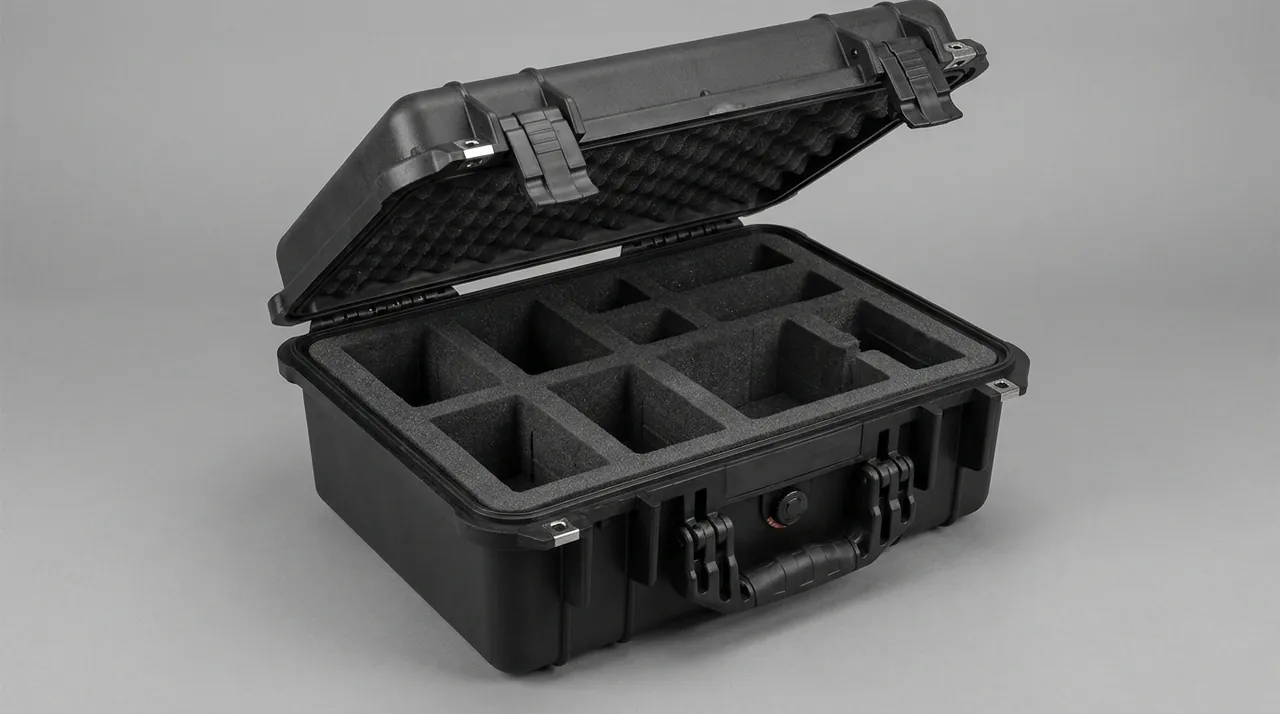
Inside a diving equipment case, the liner is what turns the hard contact between gear and shell into compliant restraint, and it anchors the whole zoned-protection concept. The usual choices are EVA foam, cross-linked polyethylene foam, polyurethane foam and adjustable dividers. EVA strikes a balance between hardness and toughness and is easy to mold, which makes it well suited to form-fitting hard inserts. Cross-linked polyethylene combines a high closed-cell ratio with minimal water uptake, so it performs well in wet or splash-prone situations. Polyurethane is soft and is the natural pick for wrapping delicate pieces such as masks and lenses. A side-by-side look at these foams appears in What Foam Should a Protective Case Insert Use? EVA vs EPE vs XPE vs PU Compared, and the tailoring side is treated in Case Foam Lining: Cushioning and Customization of Case Interiors.
Fixation should follow the principles of heavy low, light high, large low, small high, frequently used outboard, fragile centered. Place heavier items such as regulators at the bottom near the wheels to lower the center of gravity. Put fragile items such as masks and dive computers in the middle cushion layer, away from direct wall impact. Keep commonly used small parts such as spare batteries and gaskets in the lid mesh pocket for quick access. For cylindrical or blocky items, use a groove-plus-strap double constraint: cut a groove in the liner to support the body, then press a stretch webbing over the top to limit vertical bounce. For small instruments such as dive computers and lights, provide independent shallow pockets to prevent rubbing and collision. Cutouts should also leave a slight compression allowance matched to the contour so the item is firmly held without plastic deformation from an over-tight fit.
Sealing Structure and Waterproof Rating
Whether the contents of a diving equipment case come through splashes, rain and brief immersion depends on how well it seals. The seam between lid and body is shut off by a Case Seal Strip: The Key Waterproof and Dustproof Accessory for Protective Cases. Good gaskets are commonly made of EPDM or silicone; they resist ozone and UV while also standing up to salt water, and they stay flexible even in the cold. Profiles come as round, hollow rectangular or lip types, and the lip variant presses itself against the seam as the lid closes, giving the most dependable seal. Where brief immersion is possible, the case ought to be rated IP67 or higher, which means it blocks dust completely and can sit underwater at a given depth for a short time without leaking.
It is worth stressing that sealing is not decided by the gasket alone; even latch compression matters just as much. A single over-tight latch deforms the case and leaves a local gap, which breaks overall sealing, whereas multiple symmetrical latches distribute force around the lid. Routine maintenance should clean the gasket regularly to keep grit from forming leak-inducing dents, and every salt-water use should end with a fresh-water rinse and wipe. If the gasket hardens, cracks or stays flattened, replace it promptly; the handling steps are described in What to Do When a Protective-Case Gasket Ages. For deep dives or air transfers with a clear pressure differential, a breathable valve with a waterproof membrane should be fitted so gas moves slowly in and out to equalize pressure without admitting water.
Shock Isolation and Vibration Damping
Shock isolation forms the second pillar of protection in a diving equipment case. The idea is to swap the rigid connection between gear and shell for one that is elastic and damped, so that impact energy from outside gets soaked up in stages—through foam compression, elastomer deformation and damping loss—which brings down the peak acceleration arriving at the gear. Underwater imaging heads, dive computers and acoustic terminals usually carry sensors and circuit boards that cannot tolerate high-frequency vibration or drop shock; one cracked solder joint or shifted component is enough to knock out the entire unit. Damping design thus has to work across the shell, the liner and the retention system at the same time.
From a design standpoint, layering the damping generally beats relying on a single layer. The most familiar arrangement is a shell damping layer plus a liner cushion layer: a thin damping film glued to the inside of the shell soaks up high-frequency chatter, while the liner foam does the heavy cushioning. For highly sensitive instruments, a silicone pad or an elastic support can be slipped between the item and its insert, adding a third stage of protection. One caution: softer is not automatically better, because overly soft foam creeps under prolonged vibration, the gear settles and loses its constraint, and so foam density has to be chosen for the weight it carries. On receipt, high-value gear deserves a free-drop and simulated-transport vibration check, and the batch should only be released once transmissibility targets are met. For each batch of cases, the test conditions and outcomes should be logged so there is a traceable damping record.
Latches, Hinges and Load-Bearing Configuration
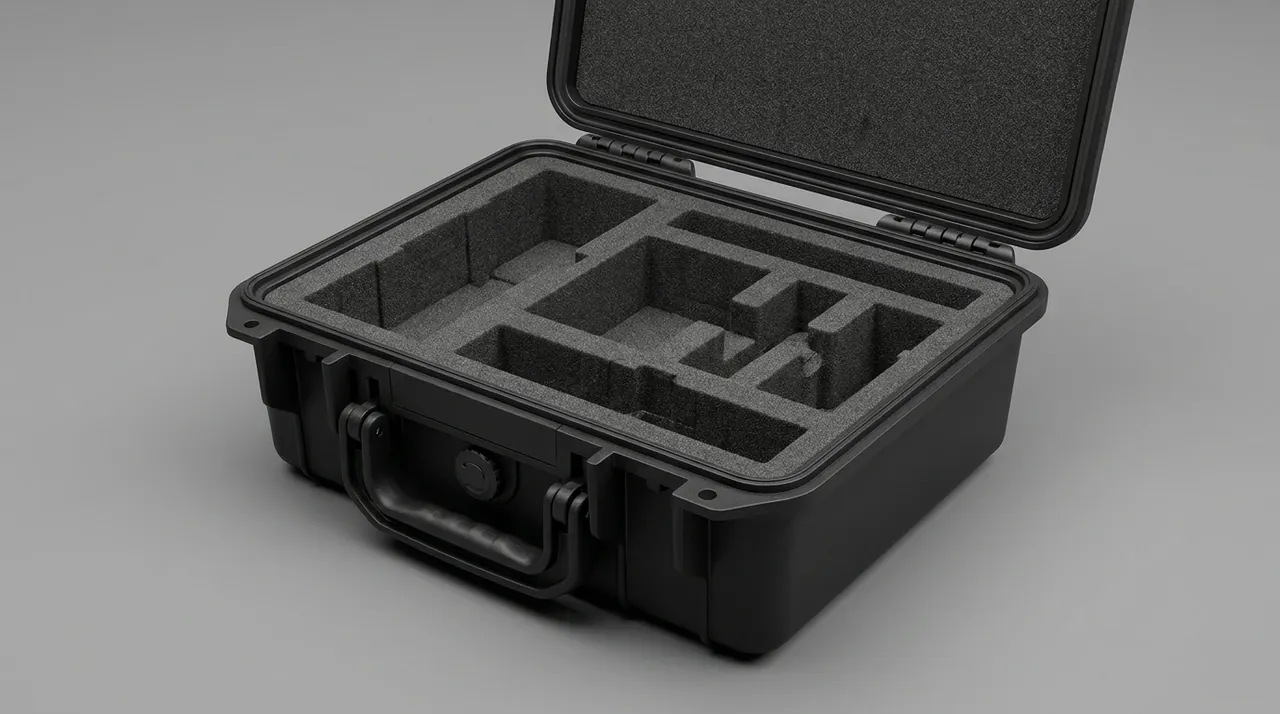
When a diving equipment case is transported, it routinely faces stacking pressure and impact, so the latch has to do more than deter theft—it must keep the lid shut under load. Draw latches, butterfly catches, push latches and recessed combination locks are the usual options. Draw latches are simple and stable under load, which is why heavy cases favor them; butterfly catches are quick to work for cases opened often; combination locks add a theft-resistance tier for transfers with no one watching. Material and corrosion resistance also deserve attention, with stainless steel or corrosion-treated hardware preferred so nothing rusts shut in salt fog. Latches should be spread symmetrically and in enough numbers to keep the lid load even and stop the middle from bulging; more selection guidance is in Case Latch: Pressure and Theft Resistance Hardware for Protective Cases.
Hinges and lid supports warrant the same care. Because a diving equipment case has a wide opening and a heavy lid, an under-strength hinge will loosen and drift out of alignment after many cycles and then fail to squeeze the gasket shut. A metal-pin hinge paired with a travel stop holds the opening angle in check and prevents the sealing zone from being over-stretched. Against theft, a steel cable seal, tamper-resistant screws or a numbered seal makes any unauthorized opening visible while the case is in transit. Bear in mind that latches and hinges are only supporting measures; the genuine safety of the gear still depends on disciplined procedure and continuous supervision, with the container serving merely as the last physical barrier. Units that fly frequently should also check how the latch behaves under low pressure, so seal suction never makes it impossible to open.
Corrosion Treatment and Salt-Residue Maintenance
Corrosion protection runs through the whole life of a diving equipment case and does not stop at material choice at the factory. The exterior should have a weather-resistant finish: engineering-plastic shells rely on the material itself, while metal parts rely on anodizing, passivation or coating. Hardware, screws and hinges should use metals from the same family to avoid galvanic corrosion from dissimilar contact. Inside, a vapor corrosion inhibitor can slowly release inhibiting molecules in the closed space to form a monomolecular protective film on metal surfaces and suppress pitting from residual salt. These measures align with the sealing and material-matching logic in What Does the Seal Ring of an Outdoor Protective Case Do, and How to Choose Its Material?.
Maintenance habits strongly affect corrosion outcomes. After every salt-water operation, rinse the shell and hardware with fresh water, clean the latch gaps, hinge pins and seal grooves, dry them, and only then close the case; never latch it shut with salt still on the surfaces. If water entered the case or wet gear was stored, remove the liner to dry and replace the desiccant as needed. For long storage, keep the case upright, avoid heavy loads, and open it periodically for ventilation to prevent mold in a sealed, humid environment. Avoid wiping engineering-plastic shells with organic solvents, which can swell and crack the surface. In the end, the salt-fog resistance of a diving equipment case is the sum of material, process and daily care, and dropping any one of them makes the protection rating meaningless.
Stacking, Handling and Whole-Case Securing
Boats, hangars and warehouses are short on space, so diving equipment cases are frequently stacked several layers high, which puts the burden on the case's stacking ability. Case Stacking Corner: Load-Bearing and Alignment Hardware for Stacked Cases makes upper and lower cases line up exactly and channels the upper weight down through ribs and corner posts instead of thin walls, so the static load is spread out; the underlying structural principle is explained in How Do Protective Cases Achieve Stable Stacking? Stacking Ribs, Locator Bosses, and Interlocking Principles. How high you can go is set by the rated stacking weight of one case, its footprint and the bearing strength of the bottom layer, and the usual rule is heavy below, light above and same size first, with a transition board when sizes are mixed. The stacking limit printed by the maker must never be exceeded.
Handling follows its own rules. A wheeled model is fine for towing on flat ground, but on sand, decks and stairs it should be lifted by its handles or lift points. Handles belong on both sides of the center of gravity, so a one-sided pull cannot twist the case. When a whole stack is in transit, straps and anti-slip mats should hold the column together so a hard stop cannot send it sliding forward or a ship's roll cannot topple it. Keep in mind that stacking only handles static bearing; the bumps of the road still have to be soaked up by the liner, and neither can stand in for the other. Careful planning of stacking and securing not only protects the gear but also speeds up loading and makes better use of compartment space.
Temperature and Humidity Management
However well the case is sealed, condensation can still form inside a diving equipment case when day-night temperature shifts or high humidity are in play. Vapor given off by wet gear trapped in a closed case meets the cooler walls and surfaces and turns into droplets, and over the long run that invites mold and corrosion of metal. This is why cases typically come with desiccant, humidity indicator cards or active dehumidification modules. Silica gel is cheap and can be regenerated by drying, which makes it the entry-level choice, and color-changing silica signals moisture uptake visually. When storage will be long or transport crosses climate zones, an electronic humidity readout plus a semiconductor dehumidifier can keep relative humidity inside a safe band.
Getting desiccant use right is a matter of quantity and timing. The dose has to suit both case volume and journey length: under-dose and dehumidification is incomplete, over-dose and moisture may be released again in bitter cold. After gear is removed, close and seal it again promptly so damp outside air cannot flood in. If the gear is moving straight from a cold place into a warm, damp one, let it temper inside the closed case before opening, so its temperature edges toward ambient and the odds of condensation drop. For underwater instruments with built-in electronics, moisture control matters as much as electrostatic protection—an approach that echoes the environmental management in Detection Instrument Case: Protective Storage for Field Test Equipment. Treating temperature and humidity as variables you can control is the most economical way to extend diving gear life.
Labeling, Inventory and Gear Traceability
When a unit looks after several diving equipment cases at the same time, labeling and inventory are what keep management efficient. The outside of the lid should be marked with gear category, assigned crew, gross weight, and this-way-up and fragile symbols so that handling and dispatch read at a glance. Inside goes a gear list, operating notes and stowage numbers so every item has a defined home. Instruments that carry verification or calibration status can take a validity label prompting a check before and after use. Today's management can also bring in QR codes or RFID tags to enable scan-based counting and full lifecycle traceability, which shifts stock-taking away from human memory and toward data comparison.
Traceability earns its keep especially in underwater work. A single mission usually mixes multiple gear groups, and without numbering and records it becomes very hard to say whether a failure originated with the gear itself or with the storage-and-transport stage. Building a file for the case and its key items—recording issue and return times, the crew assigned, and maintenance and replacement history—lets a fault review pin down the stage fast. Label stock should likewise be weather-resistant, and critical warnings are best laser-etched or carried on metal nameplates so sun, rain and salt water cannot make them peel or blur. That said, any labeling and traceability scheme has to serve compliance management, and cross-border transport must respect local regulations and export-control requirements.
Molding Process and Custom Tooling
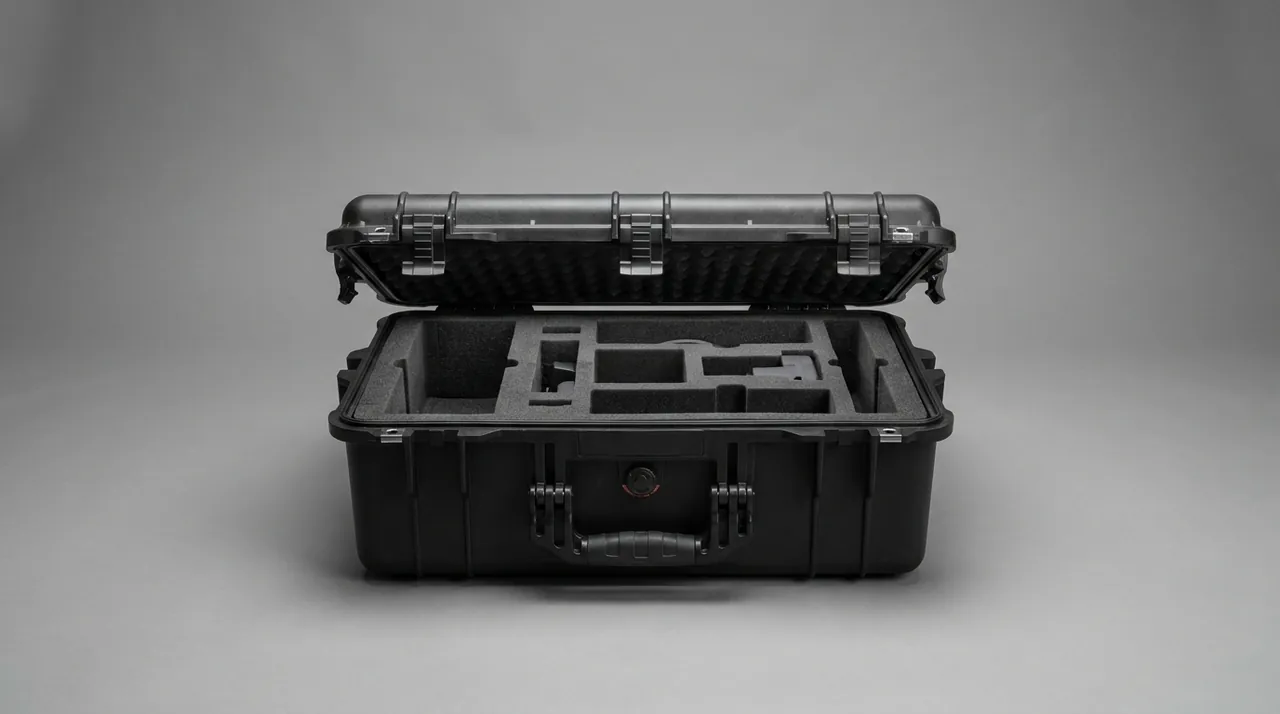
The way a diving equipment case is molded has a direct bearing on its strength, sealing and consistency from unit to unit. Engineering-plastic shells are produced mainly by injection molding or blow molding. Injection molding handles small and midsize cases with intricate, precise features, turning out ribs, latch seats and seal grooves in a single shot with even wall thickness and stable dimensions. Blow molding suits large hollow cases, offering good integrity and impact resistance but somewhat less detail precision. Metal shells are typically made by stamping, bending and welding, followed by a surface treatment for corrosion resistance. Before committing to custom tooling, settle the parting line, draft angle, shrinkage and gate location, then confirm dimensions and assembly through trial molding so mass production does not deliver uneven lid gaps or misaligned latches.
Custom production normally breaks into shell tooling first and liner processing second. While tooling the shell, the outer form, wall thickness, ribs and latch seats are drawn from the gear's 3D model. In the liner stage, zoned foam is CNC carved or thermoformed from the gear contour and its vulnerable points. Prior to tooling, settle foam density, color and flame rating, and lay out support zones around fragile points. Tooling costs more up front, yet it achieves the best positioning and damping and brings down long-term breakage costs. For small batches with frequent changes, a standard shell plus a custom liner can deliver near-custom protection at lower cost. For more on shell forming, see Case Shell: Structural Materials and Molding Process of Protective Cases to match material, structure and process.
Certification, Acceptance and Export Compliance
Although a diving equipment case is only a packaging container, its reliability is normally judged against general protective-case standards. The usual references are IP ratings, MIL-STD-810H environmental engineering and test methods, and the relevant domestic military and industry specifications, which span drop, vibration, rain, dust, salt fog and low pressure. For diving duty in particular, the salt-fog and immersion results carry the most weight, and suppliers should be asked for the matching test reports as objective proof. When the goods arrive, the user should follow a short inspection routine: look for cracks and deformation, check that latches work smoothly, confirm the gasket is whole and properly seated, verify the liner cavities match the gear, and measure lid-gap uniformity both empty and fully loaded.
A purchase spec should state, at minimum, shell material and wall thickness, sealing rating, liner density and material, stacking load, latch type, temperature range, certification basis and the liner zoning drawing; the acceptance checklist and critical-batch sampling rule should be written into the contract so quality decisions rest on documented grounds. For high-value gear, a first-article vibration-table and free-drop check is advised before the batch is released. One closing clarification: this article covers only the structure, materials and performance of the diving equipment case as a packaging container and says nothing about the properties of the protected items. Cross-border transport and export of related equipment must comply with local laws, regulations and export-control requirements and be evaluated separately by the user; nothing here is a compliance conclusion.
FAQ
Q: What is the essential difference between a diving equipment case and an ordinary plastic box? A: The essential difference lies in the protection goal and environmental adaptability. An ordinary plastic box mainly answers whether an item fits and can be carried, with little demand on sealing, salt-fog resistance or damping. A diving equipment case serves precision gear such as regulators, dive computers, underwater cameras and lights, so its core is a pressure-resistant structure, continuous sealing, salt-fog corrosion protection, zoned lining and shock isolation. It is stricter in shell material, hardware corrosion resistance, sealing rating, latch load-bearing and stacking design, and it is often carved one-to-one from gear 3D data so every item is constrained in six degrees of freedom and the peak acceleration in transit is reduced to what the gear can withstand. A diving equipment case is therefore not about fitting in, but about holding firm, cushioning well, isolating cleanly and surviving salt. Buyers should first define the mission environment and then set the rating and configuration accordingly. Documenting that environment profile at the start pays back on every later order, because the same assumptions are reused instead of debated again.
Q: Why is corrosion protection so important for a diving equipment case, and how is it achieved? A: Because diving gear is repeatedly exposed to seawater, salt fog and moisture, and chloride ions break the passive film on metal surfaces, causing pitting and crevice corrosion, with latches, hinges and screws suffering first. Corrosion protection is built from three ends: material, structure and maintenance. For material, prefer salt-fog-resistant polypropylene copolymer or modified engineering plastics for the shell, stainless steel or anodized aluminum for hardware, and EPDM or silicone that resists ozone, UV and salt water for the gasket. For structure, avoid blind holes and deep grooves that trap water so rinse water drains freely. For maintenance, rinse with fresh water and dry after every salt-water use, focusing on latch gaps and hinge pins. A vapor corrosion inhibitor can be added inside to form a monomolecular film on metal surfaces and suppress pitting from residual salt. Only the three together deliver the rated protection. A simple discipline is to rinse within the same day as the dive, because salt that dries overnight is harder to remove than salt that is still wet.
Q: How should the sealing rating be chosen, and is IP67 enough? A: Choose the sealing rating from the mission scenario rather than chasing the highest number. If the gear only needs splash and dust protection, a normal sealing structure with a quality gasket is enough. If it must resist rain, deck spray or a brief fall into water, choose a case with a quality gasket rated IP67 or better, meaning fully dust-tight and briefly immersible at a set depth without water ingress. If deep dives or prolonged immersion are involved, higher immersion and pressure verification is needed. Regardless of rating, ensure even latch compression and a gasket with no breaks, and fit a breathable valve with a waterproof membrane where deep dives or air transfers create a real pressure differential. The rating is only a design target; daily maintenance is what keeps sealing reliable, and a hardened or cracked gasket must be replaced or even a high nominal rating will fail. Keeping a spare gasket of the correct profile inside the case turns a repair into a few minutes of work instead of a lost mission.
Q: Should the liner use EVA or cross-linked polyethylene? A: There is a place for both, and the answer depends on the gear and the environment. EVA balances hardness and toughness and molds easily, so it suits form-fitting hard inserts that give even circumferential support and resist cracking when cold. Cross-linked polyethylene provides a high closed-cell ratio, minimal water absorption and good resilience, which fits wet or splash-exposed use and creeps only slightly under sustained load. When a delicate item needs a soft wrap, a layer of soft polyurethane can be laid at the contact surface. In real projects EVA usually does the main supporting while cross-linked polyethylene forms the environmental barrier, and the pairing delivers the best result. The choice should also factor in gear weight, transport duration, and ambient temperature and humidity, and foam density must not be too low, or steady vibration can cause creep and let the gear drift out of position. If unsure, order a sample of each candidate foam, load it as intended, and compare compression set after a week under load.
Q: Does a diving equipment case need to be fully waterproof? A: Full waterproofing is not needed in every scenario, but keeping moisture out and repelling splashes is a general requirement. If the gear goes to sea with a boat, or crosses a rainy deck or wet pier, pick a case with a quality gasket rated IP67 or better and inspect the gasket on a schedule. If it mainly stays indoors and makes short trips, dust and splash protection usually suffices, and chasing deep-immersion ratings just adds cost and weight. Whatever the rating, the inside should work with desiccant or a dehumidifier, since even without any water entering, vapor from wet gear can condense as temperatures swing and cause mold and corrosion. The point is to fix the rating from the mission checklist and fold maintenance into the routine: rinse and dry after every salt-water use and swap the desiccant on time. A humidity indicator card visible through the lid lets a handler confirm the interior state without opening the case.
Q: How should case labeling and traceability be designed for easy management? A: Labeling works best when the essentials are shown outside and the full list is kept inside. The lid exterior carries gear category, assigned crew, gross weight, and this-way-up and fragile marks so handling and dispatch are clear. Inside sits a gear list, operating notes and stowage numbers so each item has a fixed place. Instruments with calibration status get a validity label that prompts a check before and after use. Modern management can also use QR codes or RFID tags to support scanning-based inventory and full lifecycle traceability. External labels must be weather-resistant, and critical warnings should be laser-etched or on metal nameplates so sun, rain and salt water cannot make them peel and fade. Keeping a file for the case and its key items—with issue and return times, assigned crew, and maintenance history—lets fault reviews locate the stage quickly while sharply improving counting efficiency and cutting misplacement and collision risk. Numbering also supports rotation, because a case can be traced back to the crew that last used and returned it.
Q: Can diving equipment cases be stacked, and how high is appropriate? A: They can be stacked, as long as stacking corners are used and the rated load is respected. Stacking corners make upper and lower cases line up precisely and route the upper weight into ribs and corner posts instead of thin walls, spreading the static load. How high you go is set by the rated stacking weight of one case, its footprint and the bottom layer's bearing capacity, and the rule is heavy below, light above and same size first, with a transition board when sizes are mixed. Stacking covers static bearing only; the jolts of the road still need the liner to soak them up, and neither can take the other's place. Vehicles and vessels should strap and anti-slip the whole column so a hard stop cannot slide it forward or a roll cannot topple it. Never go past the maker's stacking limit, and for long storage rotate the stack periodically to check the bottom cases for creep. Marking the approved stack height on the case exterior helps new handlers comply without special training.
Q: What documents should a buyer request from a diving equipment case supplier? A: Three categories matter most. First, material and structure documentation, including shell material, liner scheme, latch and stacking-corner configuration, and hardware corrosion treatment, to judge whether they meet the weight and salt-fog environment. Second, protection performance test reports such as IP rating, MIL-STD-810H or corresponding military-standard drop, vibration, rain, dust, salt-fog and low-pressure results are the objective reliability evidence. Third, customization and upkeep details, such as whether the liner can be CNC-carved from the gear's 3D data, whether anti-static or vapor-inhibitor liners and humidity-management modules are supported, and the replacement cycle and supply channel for gaskets and consumable parts. After delivery, run a simple acceptance check for cracks, deformation, sealing integrity and cavity fit, and give high-value gear a first-article vibration and drop check before batch issue, keeping records in the gear file for long-term traceability. Comparing the delivered documentation against the specification line by line before payment is the cheapest way to catch a mismatch while the supplier still has every incentive to correct it.