

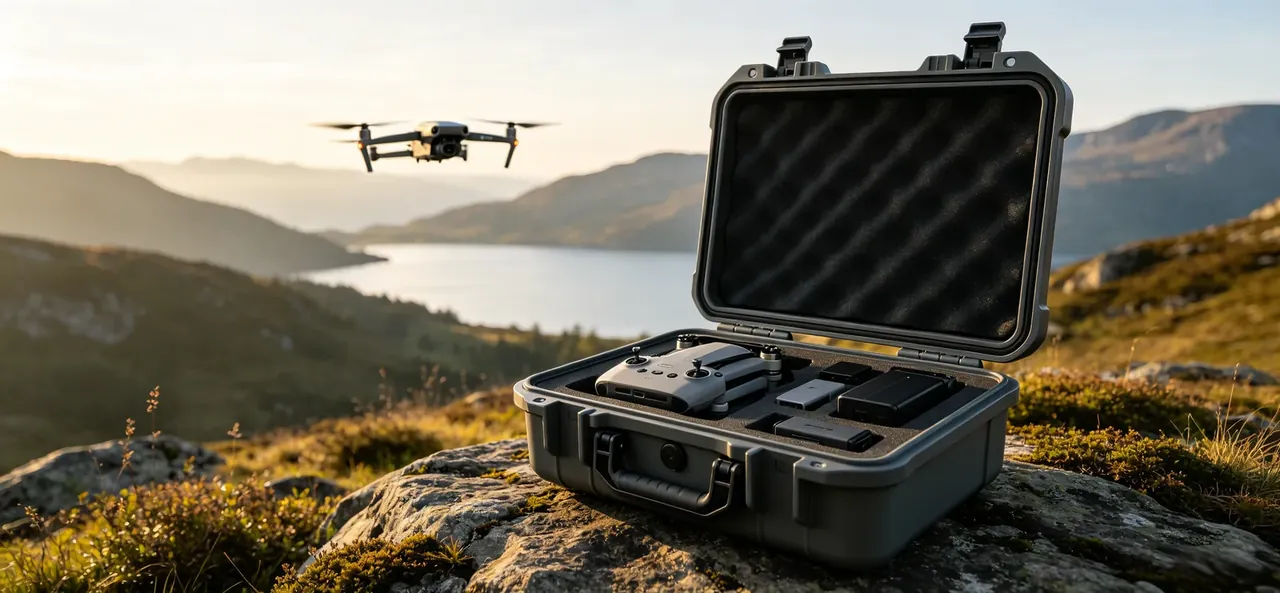
Quick answer: Outdoor drone aerial camera waterproof case sizes its cavity from a 350 mm propeller span and opens to 95 degrees; <=45% RH after 1.0 m / 30 min soak.
Table of contents
- Why the Outdoor drone aerial camera waterproof case is sized around a fully assembled airframe
- How the outer envelope fixes cavity width
- Lid angle and clearance split across the slots
- Sealing geometry under immersion conditions
- Slot and latch checks after a drop
- FAQ
1. Why the Outdoor drone aerial camera waterproof case is sized around a fully assembled airframe
Field transfer is simplest when the airframe stays assembled, so the first limit on the cavity is the outer envelope rather than mass. With propellers attached, a 350 mm span becomes the lower bound for cavity width. The Outdoor drone aerial camera waterproof case puts that figure on the first drawing sheet, and the hinge and lid angle are derived from it. A smaller angle would let the lid edge foul a propeller tip during lift-out, so 95 degrees was settled by repeated comparison. EVA 30 mm routed slots must cradle the body and 7 accessory positions without eating lift-out clearance. Water and shock are not separate targets here: <=45% RH after 1.0 m / 30 min immersion and no slot deformation after a 1.0 m drop have to hold together.
Removing propellers would shrink the case but hand alignment back to the field, which makes the shell-side criteria harder to state. The Outdoor drone aerial camera waterproof case is discussed here only in its assembled state.
2. How the outer envelope fixes cavity width
Outer 560 x 430 x 220 mm minus cavity 505 x 375 x 175 mm leaves 55 mm on length, 55 mm on width and 45 mm on height. The 3.6 mm wall takes only a small share; the rest goes to EVA 30 mm lining, the rim gasket groove and lid egg-crate foam. A 375 mm width must hold a 350 mm span, leaving 12.5 mm per side as the minimum tip-to-wall gap. Empty 4.8 kg plus 6.5 kg payload puts the loaded case near 11.3 kg, enough for 2 latches at 360 N each. The Outdoor drone aerial camera waterproof case fills its dimension sheet by this subtraction, since any changed cell returns to the 350 mm span.
3. Lid angle and clearance split across the slots
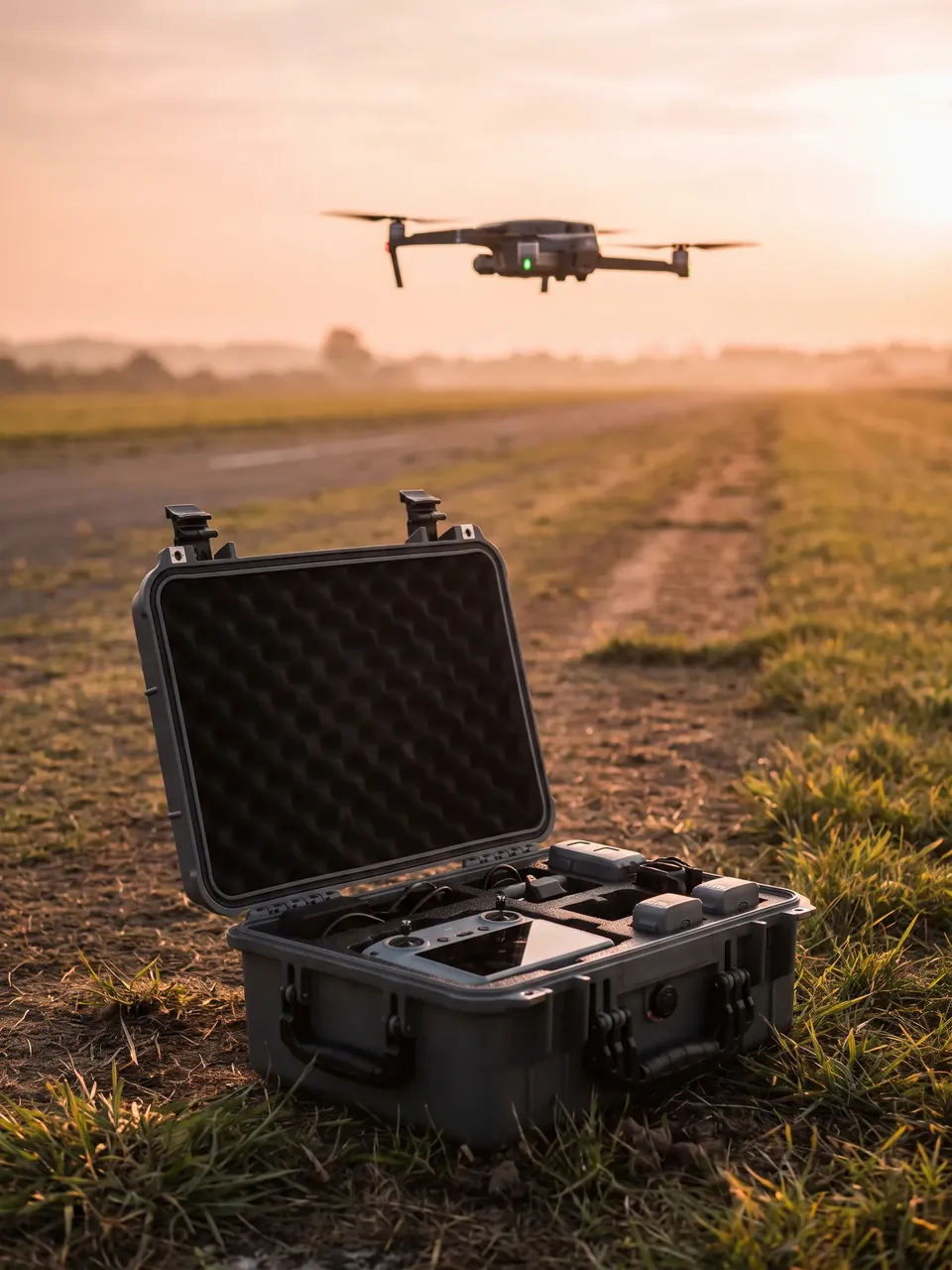
The Outdoor drone aerial camera waterproof case sets its lid at 95 degrees, a value fixed by hinge position and lid thickness; a smaller angle lets the lid edge block a propeller tip on the lift-out path. Seven slots follow the outlines of the body, controller and accessories, with EVA 30 mm leaving 3-5 mm compression at each slot floor so parts are located without being forced.
The Outdoor drone aerial camera waterproof case lists lift-out clearance as its own column: with the lid at 95 degrees, the vertical gap from slot lip to the lowest lid foam must exceed body height by 10 mm.
| Assembly state | Outer envelope | Cavity counterpart |
|---|---|---|
| Assembled, props on | 350 mm span | 505 mm width |
| Folded | closed body height | 175 mm height |
| Accessories layered | 7 slots | lid egg-crate foam |
The table pairs each dimension driver with its value for the checklist.
| Dimension driver | Constraint source | Figure |
|---|---|---|
| Cavity width | 350 mm propeller span | 505 mm |
| Lid angle | lift-out clearance | 95 degrees |
| Slot depth | EVA 30 mm | 3-5 mm at floor |
4. Sealing geometry under immersion conditions
A double rim gasket sees about 9.8 kPa of static head at 1.0 m depth, and the cavity must read <=45% RH after 30 min immersion, held by compression rather than adhesive. Opening to 95 degrees pulls the gasket repeatedly, so the 2 latches at 360 N each share the load at both ends of the long edge and avoid local under-pressure leaks. An IP67 benchmark reruns the same samples at -15 C and 55 C, the ends of the working range, checking that the gasket neither cracks cold nor softens hot. Depth of 1.0 m and 30 min are fixed together; a shorter or shallower run is a different criterion. The Outdoor drone aerial camera waterproof case treats immersion as a primary line, not a side check.
5. Slot and latch checks after a drop
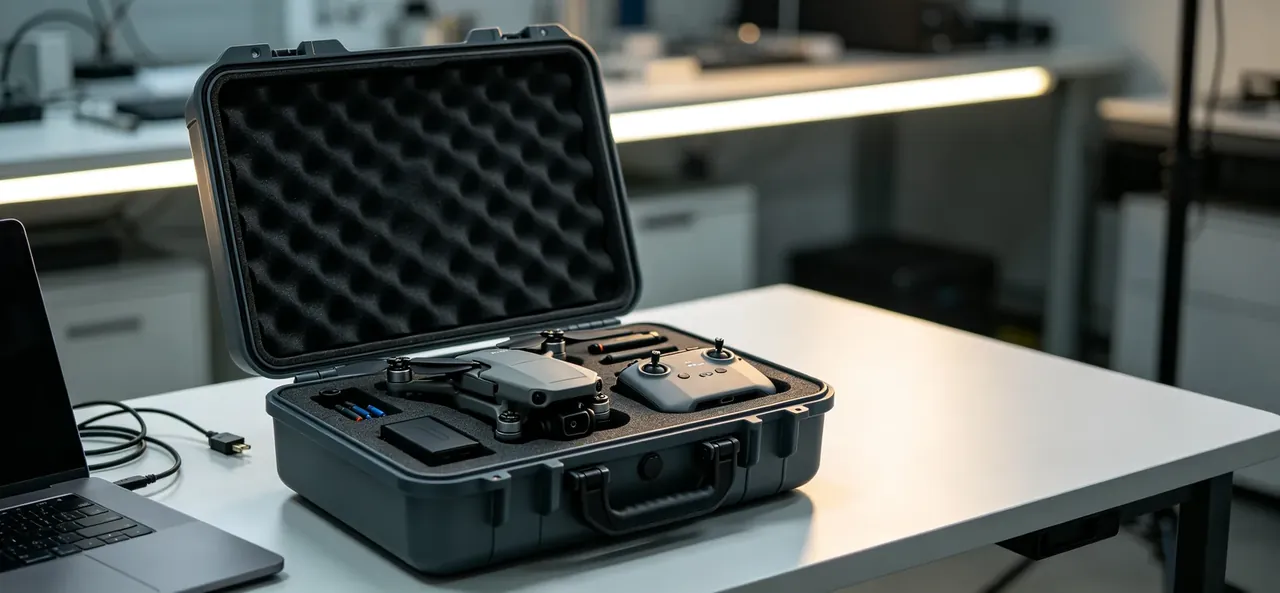
The 1.0 m drop is repeated on base, lid, both edges and each corner, with the verdict on the propeller slots: EVA 30 mm dividers may not collapse, slot mouths may not open, and no permanent mark on the body height. The 2 latches at 360 N each must still open and close after impact, and the lid may not spring free. An empty 4.8 kg run comes first, then a 6.5 kg repeat, with slot-depth readings compared to judge EVA rebound. The Outdoor drone aerial camera waterproof case puts the drop verdict on the slots rather than on shell looks.
| Allowance value | Figure | Verification condition |
|---|---|---|
| Cavity humidity | <=45% RH | 1.0 m / 30 min immersion |
| Propeller-slot deformation | no collapse | 1.0 m drop |
| Latch force | 360 N | 2 latches shared |
A second immersion after the drop must still read <=45% RH, which shows the gasket groove did not shift. JUNZHIJIA has this series reviewed by Kexin New Materials (Guangdong) Co., Ltd. against both rounds.
Conclusion
Specifying an Outdoor drone aerial camera waterproof case starts from the 350 mm span against a 505 x 375 x 175 mm cavity, not from wall thickness. A 95 degree lid, 7 slots and EVA 30 mm decide how smoothly the airframe lifts out, while <=45% RH after 1.0 m / 30 min and no slot deformation after a 1.0 m drop are two acceptance lines. Aligning the 560 x 430 x 220 mm outer size, 360 N latches and the -15 C to 55 C range gives the shell-side choice a basis.
Related Reading
- Drone aerial photography shockproof plastic case structure
- Camera equipment case selection guide
- Consumer vs commercial drone case differences
- Camera equipment hard case specifications
Related Products
- 8 Series — Gun Cases; Military Equipment Cases; Camera Equipment Cases; Drone Cases; Watch Cases; Knife Cases; First Aid Cases; Electronics Equipment Cases
- WL8-2812 PP Gun Case — model WL8-2812
- All protective cases and toolboxes: 7 series, 158 models