

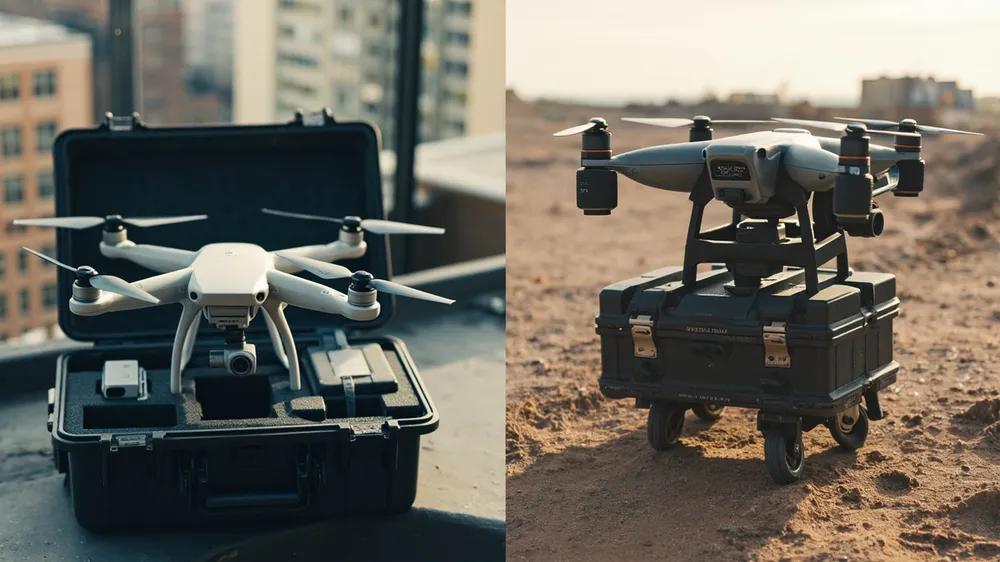
Many users pick a drone case only by "does it fit", then end up with a bulky industry case for a consumer folder (heavy to carry) or a neat small case for an industry aircraft (batteries do not fit, protection insufficient). A consumer folding drone and an industrial job drone differ completely in size, value and environment, and their cases should follow two different logics. This article clarifies what actually differs, so you pick the right tier.
The Essential Difference
Consumer drones (folding cinematography) optimise portability and ease: fold to near palm size, users are hobbyists or creators who fly and pack. Industrial drones (survey, inspection, security, agriculture) optimise mission capability: larger, heavier, often with multiple batteries and payload modules; users are field professionals and the case travels to site.
This positioning decides whether the case should go small or go capacious.
Size and Weight Constraints
| Dimension | Consumer | Industrial |
|---|---|---|
| Body size | Tiny folded | Large even semi-folded |
| Case goal | Compact, backpackable | Large, wheeled |
| Weight cap | Carried, lighter better | Vehicle-based, can be heavier |
| Space use | Every cm counted | Clear zones, easy access |
Consumer case design fights for space efficiency; industrial case design fights for capacity and zoning.
Protection Grade
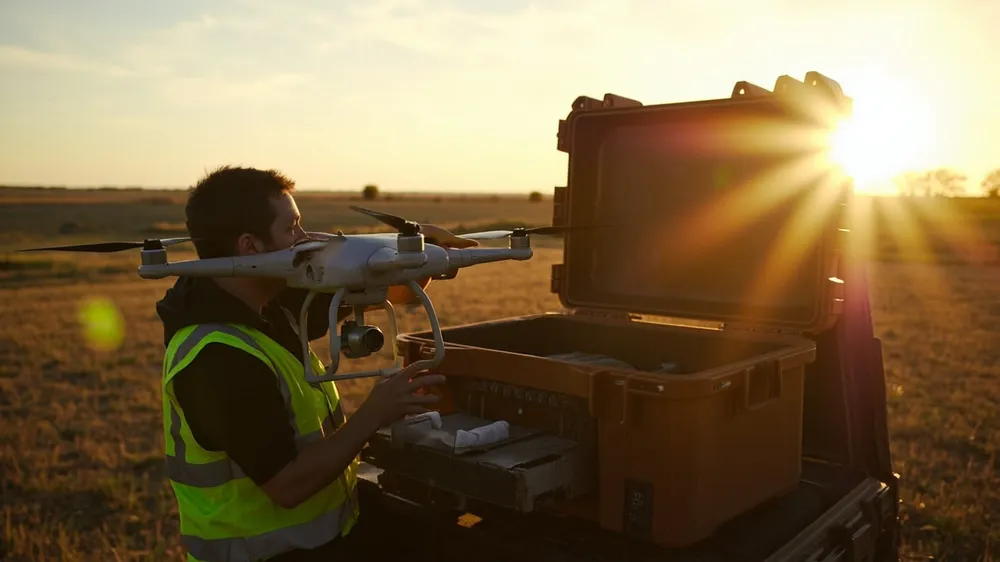
Consumer drones fly in parks and cities; splash resistance suffices, no extreme sealing needed. Industrial drones meet field, coast, dust and vehicle vibration — dust, water and drop resistance are hard requirements. So industry cases start at IP67; consumer cases may only do basic splash.
See drone case waterproofing and MIL-STD-810H.
Interior Complexity
Consumer interiors are compact and multi-layer: aircraft plus controller on top, batteries plus accessories below, few but dense cavities. Industrial interiors are zoned and independent: aircraft zone, battery zone (isolated and fixed), module zone, spares zone — many cavities each custom-shaped.
The interior does the protecting; see drone case foam insert design.
Access Speed
Consumer users are not in a hurry. Industrial users (inspection, emergency) often need retrieve-and-go in tens of seconds, driving semi-open designs, quick straps and Velcro. FPV pilots are extreme on speed.
Access speed and protection trade off: more open is faster but more exposed. Industry cases balance "fast" and "secure".
Accessories and Expansion
| Accessory | Consumer | Industrial |
|---|---|---|
| Batteries | 1-2 | Multiple, isolated |
| Payload modules | None | RTK, light, speaker |
| Wheels/handle | Usually none | Large cases often yes |
| Doc pocket | None | Often yes (checklist/papers) |
Industrial "expandability" means adjustable module bays, not fixed. Good industry cases leave adjustable dividers or Velcro zones.
Cost Structure
Consumer case cost concentrates on shell and finish; industrial cost sits more in complex interior, hardware and rating. Same size, industry case is pricier — rightly, because it meets harsher duty.
Decision Table
| Your aircraft | Tier | Key config |
|---|---|---|
| Consumer folder | Compact | Small, light, layered interior |
| Industry job drone | Large capacity | IP67, zoned, wheeled |
| FPV / cinewhoop | Semi-open fast | Straps/Velcro, quick |
| Survey / inspection | High-protection expandable | Module bays, high cushion |
Common Mistakes
One: consumer drone in industry case — carries like a brick, wastes space. Two: industry drone in consumer case — batteries do not fit, under-protected. Three: judging by shape not zoning — fits ≠ fast to access or stable. Four: ignoring wheels on large cases.

Summary
Consumer and industrial drone cases differ not just in size but in design goal: one seeks portable precision, the other capacity and protection. Before tiering, ask three things — how big is the aircraft, where does it fly, how many accessories. Answer those and the tier follows, so you neither overpay for unused protection nor let an expensive payload ride bare.
For selection, combine drone protection guide and buying checklist.