

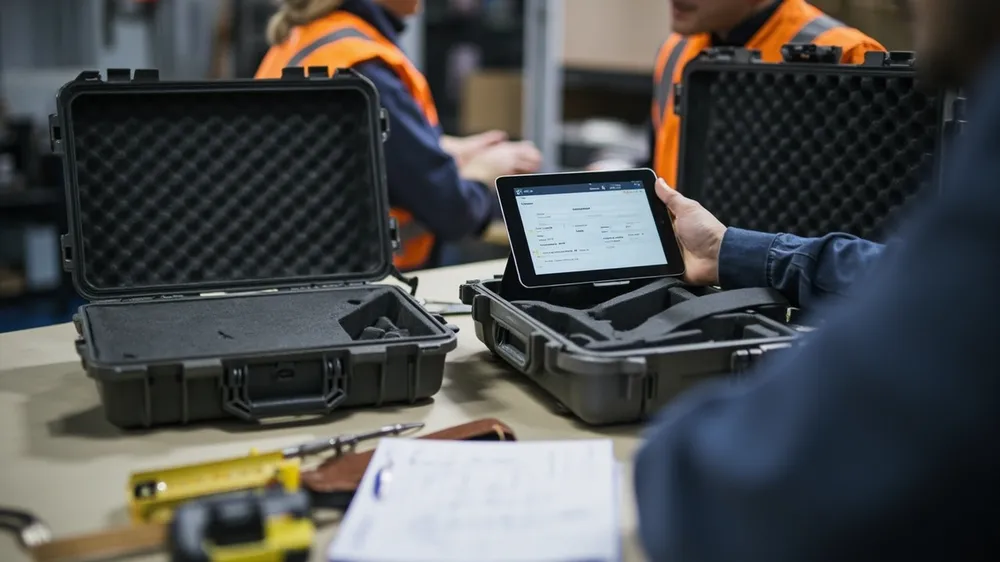
The most common drone case problem is not "overpaid" but "wrong, and you did not know". The root is almost always one vague line: “a sturdy case”. The factory builds a thick-walled box; your real need was “gimbal survives a one-metre loaded drop”. Two understandings lead to completely different products, discovered too late at acceptance. This checklist turns vague wants into ten verifiable clauses, so quotes are accurate and acceptance is clear.
First, the Payload List (Most Important Step)
Most sampling rounds happen because the buyer never listed "what goes in". Make a table: each part's name, dimensions, weight, fragile points. Aircraft, gimbal, battery, controller, props, accessories — none omitted.
This step pays hugely: with photos and the list, the factory understands the real need far better than from words, and sampling rounds drop. Why a real unit is mandatory: factory audit.
Set the Environment
State temperature range, humidity, salt or chemical exposure. "Outdoor" alone means nothing. Cold regions need low-temperature toughness (see cold brittleness); coast needs salt and rinse; long sun needs UV stabilizer.
Set the Protection Goal (Rating)
Use standard ingress ratings like IP67. "Waterproof" alone is read as "just does not leak"; the standard is "1m static, 30 min". See waterproofing. For washdown specify IP69K.
Set the Drop Requirement
The most skipped and most critical: drop height, orientation, loaded or not. Write "loaded, free drop from 1m on all six faces once, gimbal functional". Empty-pass tests do not prove loaded performance. See MIL-STD-810H.
Set Dimensional Constraints
State internal clearance and external max size. External only risks an interior that will not fit; internal only risks exceeding luggage limits. Airline size limits: airline travel.
Set Material and Wall
Not just "PP/ABS/PC" but grade, wall, flame/UV. Material logic: material selection; virgin vs recycled: virgin vs recycled. Write grade into contract against substitution.
Set Interior Requirements
State material, density, thickness, cavity count. Density is hidden; unwritten, it gets cut. Interior rules: foam design. Request a sealed sample for comparison.
Set Hardware and Accessories
Specify latches, hinges, handles, wheels, pressure valve models. Hardware downgrade is a common trap; name models and require replaceability. Valve role: pressure valve.
Set Quantity and Lead Time
State first order, estimated annual volume, desired lead. Understating volume locks a higher unit price. Cost and lead: factory capability and MOQ and lead time.
Set Acceptance (Most Skipped)
State sampling method, pass criterion, dispute handling. Without acceptance terms, problems become "is this qualified?" tug-of-war. Write directly: which sampling standard, how many inspected, which defects are critical, what happens on failure.
Put the Sealed Sample in the Contract
A signed approval sample is the production benchmark, stating "mass production matches the sample in material, structure and appearance". This alone resolves most sample-versus-production disputes. Pair with on-site verification.
Ten-Element Quick Table
| Element | State | Often omitted |
|---|---|---|
| Payload list | Name/size/weight/fragile | Only totals |
| Environment | Temp/humidity/salt/UV | Only "outdoor" |
| Rating | IP grade | Only "waterproof" |
| Drop | Height/orientation/loaded | Loaded unclear |
| Dimensions | In and out sizes | External only |
| Material/wall | Grade/wall/flame | No grade |
| Interior | Material/density/thick | No density |
| Hardware | Model specs | Unspecified |
| Qty/lead | First/annual/lead | Understated |
| Acceptance | Sampling/pass/dispute | None |
How to Send This at RFQ
Attach the table to RFQs for 2–3 factories, requiring same-basis quotes. Then comparison is meaningful — a low price on a different basis is a trap. Writing RFQs: how to write an RFQ; negotiation: how to negotiate.
How to Verify on Sample
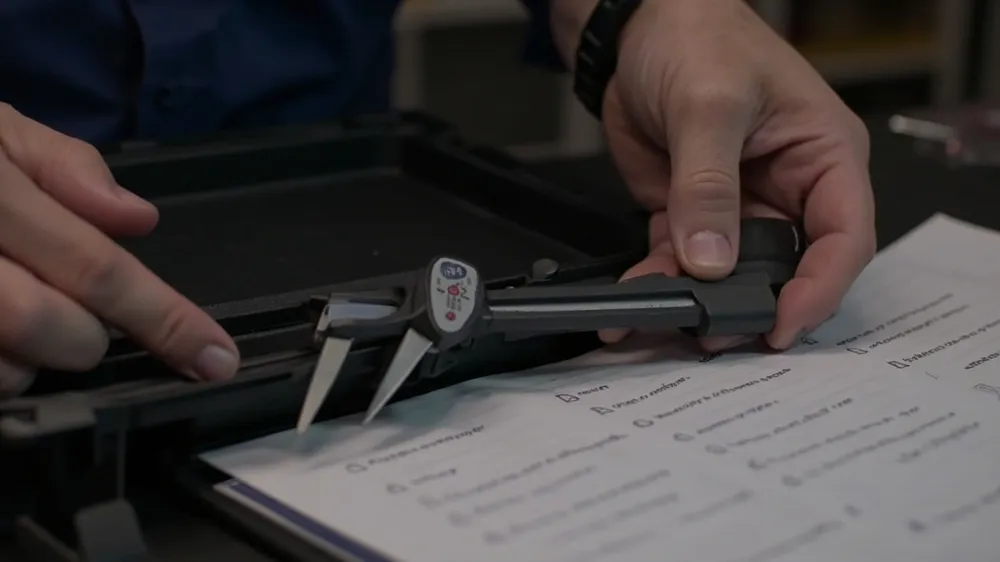
Check each clause with tools: wall by caliper, density by weight, cavities by fitting the real unit, drop by the agreed test. See incoming inspection and factory audit. Acceptance is not "looks fine" but "each clause passed".
Summary
Drone case procurement is won or lost at the requirement stage. Replace “a sturdy case” with ten verifiable clauses: the factory quotes with certainty, your acceptance has a basis, and disputes vanish at the source. The list need not be long, but every line must be measurable. When you use numbers instead of adjectives, you save more than money — you save every flight task delayed by a bad case.
Before RFQ, read drone protection guide and OEM/ODM, then attach this checklist.